


There are moments in history that burn themselves into our collective memory, moments when we remember exactly where we were. For one generation, it was the Kennedy assassination. For another, 9/11. And now, for many of us, January 6, 2021, is carved into that same mental ledger.
Want to Know Your Rights?
Download a free digital copy of the U.S. Constitution—the same document Trump is trying to bulldoze. Learn exactly what he’s breaking… and how to fight back.
📬 Stay Informed. Stay Loud.
Subscribe to The Coffman Chronicle for no-BS political analysis, action guides, and weekly truth bombs you won’t get from corporate media.
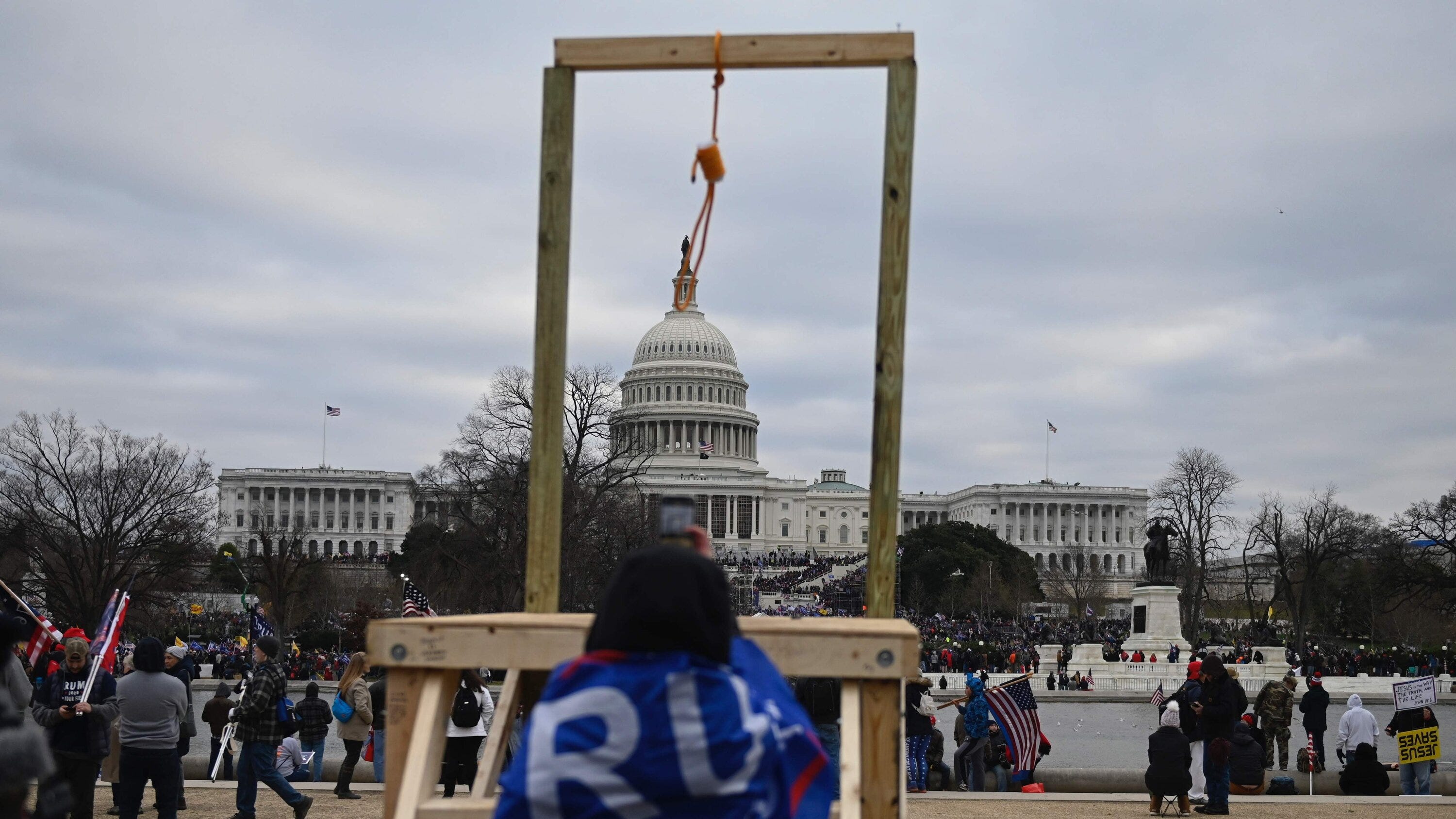
We watched it unfold in real time: the Capitol under siege. Members of Congress hiding behind furniture. Police beaten, overwhelmed. Gallows on the lawn. The American flag, weaponized. All of it, not from a foreign enemy, but from a domestic movement, waving Trump flags and livestreaming the breach.
And yet, five years later, a newly formed House subcommittee wants us to believe it was all a misunderstanding.
Imagine if, five years after 9/11, a congressional committee tried to convince the public that there were no planes. That the buildings never fell. That it was all a media distortion. The emotional outrage would have been swift and bipartisan.
But with January 6, we’re being asked to forget, or worse, to reinterpret. That’s not oversight. That’s historical sabotage.
Because democracy doesn’t defend itself, and neither does your sanity. Subscribe here to keep your eyes open and your sarcasm sharp.
How We Got Here
The Original Jan. 6 Committee: A Moment of Clarity
The first Congressional investigation into the Capitol attack — launched in 2021 — was imperfect, but critical. The bipartisan Jan. 6 Select Committee, led by Rep. Bennie Thompson (D-MS) and Vice Chair Liz Cheney (R-WY), presented a damning, structured account of how Donald Trump and his allies sought to overturn the 2020 election.
The committee’s televised hearings were watched by tens of millions. They detailed:
Trump’s efforts to pressure election officials, the DOJ, and his own Vice President
Coordination between far-right groups like the Oath Keepers and Proud Boys
The deliberate choice by Trump not to call off the mob
While some of its referrals didn’t result in prosecution, its findings laid the groundwork for DOJ investigations, criminal charges against Trump and allies, and a shift in public understanding of Jan. 6 as more than a protest, but as a failed coup attempt.
Then Came the Pardons
In early 2025, following Trump’s return to the presidency, he swiftly pardoned hundreds of individuals convicted for their roles in the insurrection, including those who assaulted police officers, coordinated the breach, or entered the Capitol unlawfully.
The message was clear: Accountability is for the other side.
However, the pardons didn’t erase the footage. They didn’t untraumatize the officers. They didn’t change what we saw that day.
The New Committee
Same Players, New Purpose
In September 2025, House Republicans, with little fanfare and even less transparency, embedded language into the chamber’s rules to create a new January 6 subcommittee under the Judiciary Committee. The language was vague, but its purpose wasn’t: to reopen the investigation, discredit the original findings, and reclaim the narrative.
They didn’t announce it with press conferences or floor speeches. It slipped through during procedural votes, framed as a routine oversight measure. But make no mistake, this is not a continuation of the previous committee’s work. It’s a rebuttal.
At the center of it is Rep. Barry Loudermilk, now chairing the subcommittee. Loudermilk, notably, was previously scrutinized for providing Capitol tours to individuals who later participated in the riot — a claim he denies. Now he’s leading the charge to reframe the event entirely.
Joining him are some of the most fervent Trump defenders in Congress: Reps. Clay Higgins, Troy Nehls, Morgan Griffith, and Harriet Hageman. The common thread? All are committed to painting the original investigation as partisan, the prosecutions as political, and the entire event as misunderstood.
The Democratic Counterweight
Democratic Leader Hakeem Jeffries responded by appointing a handful of fiery, media-savvy members to the minority side: Eric Swalwell, Jared Moskowitz, and Jasmine Crockett, each known for turning hearings into viral takedowns of GOP talking points. Strategically, Rep. Jamie Raskin, former impeachment manager and constitutional scholar, will serve in an advisory role.
The GOP may hold the gavel, but Democrats are poised to control the headlines.
A Committee with Teeth and an Agenda
This is not a toothless vanity project. The subcommittee has full subpoena power, investigatory authority, and a broad mandate to examine not only the original events of January 6 but also the actions of law enforcement and intelligence agencies, especially the FBI.
According to the resolution that created it, the committee is tasked with exploring “all facets” of the lead-up to the riot, the law enforcement response, and — crucially — the “weaponization of government” against political figures and citizens.”
Translation? They’re not here to clarify what happened. They’re here to rewrite it.
What They’re Investigating and Why It Matters
From Truth-Seeking to Doubt-Spreading
The stated mission of the new subcommittee is to examine the “security failures” and “intelligence breakdowns” surrounding January 6. On paper, that might sound responsible, even overdue. But in practice, this committee is something very different.
This isn’t about uncovering new facts. It’s about reshuffling old narratives, elevating fringe theories, and casting just enough doubt on the public memory to make accountability seem like partisanship. It’s the politics of plausible deniability, weaponized.
One of the main targets is the FBI, not because of what it missed, but because of what it may have known. Republicans are pointing to revelations that federal investigators had confidential informants in proximity to the rioters as evidence of entrapment or provocation. Some members have even floated the baseless idea that undercover agents incited the violence in order to justify later investigations.
There’s no credible evidence to support this. In fact, the FBI’s own inspector general found that while some informants were present, they were not directed to enter the Capitol or participate in the violence. Still, the idea plays well with right-wing media, and the committee seems eager to amplify it — not to prove anything definitively, but to blur the lines of culpability.
Surveillance as Scandal, But Only When It’s Convenient
The committee is also expected to focus on alleged surveillance of Republican lawmakers by federal agencies during the original investigations. Phone metadata, obtained via grand jury subpoena or other legal means, has become a rallying cry for those claiming government overreach.
But here’s the irony: while Republicans decry “deep state surveillance” in one breath, they cheer on Trump’s Justice Department as it investigates and potentially prosecutes former officials like James Comey and Andrew McCabe. The message is clear: surveillance is only tyranny when it targets us.
Setting the Stage for the Future
More than anything, this new investigation is about the next election. By reopening Jan. 6, Republicans are not just defending Trump. They’re inoculating him.
If they can convince the public that the original investigation was biased, that the prosecutions were excessive, and that the FBI acted improperly, they can frame Trump not as the instigator of the violence, but as the persecuted victim of a political witch hunt.
In doing so, they’re not just rewriting the story of the past. They’re preparing the narrative for the future.
Source: New York Times
The Legal Undercut: Fischer v. United States
How the Supreme Court Made Obstruction Harder to Prove
For years, the Department of Justice relied heavily on a single federal law to charge many of the January 6 rioters: 18 U.S.C. § 1512(c)(2), a provision originally created during the post-Enron era to stop corporate executives from destroying evidence.
This statute makes it a crime to “otherwise obstruct, influence, or impede any official proceeding.” It was never written with insurrections in mind, but in the absence of a more direct legal tool, it became the best available option for prosecutors trying to hold violent rioters and political operatives accountable for halting the certification of the 2020 election.
Then came Fischer v. United States.
In June 2024, the Supreme Court ruled that the obstruction statute must be interpreted narrowly, applying only when someone takes action to impair or interfere with documents, records, or other tangible evidence used in the proceeding. The decision didn’t strike down all Jan. 6 cases, but it undermined a key pillar of many prosecutions and made it harder to hold certain participants — and potentially Trump himself — criminally liable.
The Law Was Built for Enron. We Used It for an Insurrection.
That’s how unprecedented Jan. 6 was: to prosecute the attackers, we had to borrow a white-collar crime law built to stop executives from shredding audit records.
It worked — for a while. Over 300 people were charged under the statute, but the Fischer ruling pulled the rug out from under many of those cases.
This creates a dangerous opening.
If you take the court’s ruling to its logical extreme, you could violently shut down Congress, attack police, even physically harm elected officials, and still not be guilty of “obstruction” unless you also interfered with a physical object used in the proceeding.
It’s the legal equivalent of saying: “If you shoot the bank teller but don’t take the money, it’s not robbery.”
The law protected the paperwork, not the people, and this new committee is already seizing on that ambiguity to argue that the entire legal response to Jan. 6 was an overreach.
Or Maybe... It’s Just Another Distraction Sequel
When You Run Out of Conspiracies, You Rewrite Your Crimes
Let’s take a step back.
In Trump’s administrations, when political heat gets uncomfortable, the administration reaches for spectacle:
UFO disclosures
The JFK assassination files
MLK Jr. surveillance records
Even the Amelia Earhart case
Each one was dangled like a shiny object: Look here, not there.
They stirred headlines. They distracted cable news, but they didn’t stop the walls from closing in.
So now, with chaos mounting again — Epstein files circulating, DOJ revenge probes expanding, and civil liberties eroding — what’s left?
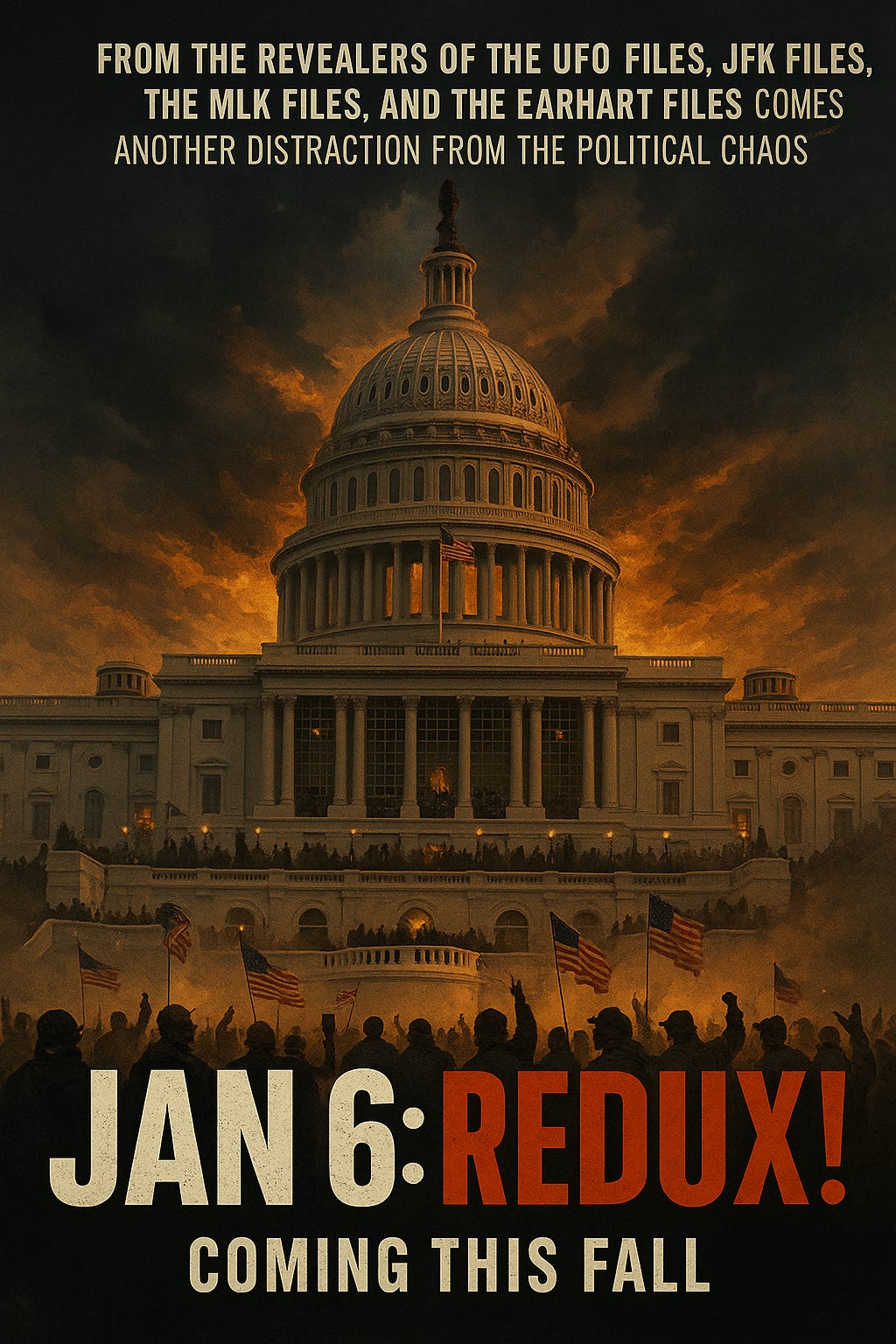
“From the revealers of the UFO files, the JFK files, the MLK files, and the Earhart files…
Another distraction from the political chaos emerges…
Coming this fall: Jan. 6: Redux.”
It’s not a real investigation. It’s a sequel.
And like most sequels, it doesn’t exist to deepen the story, but to milk the franchise.
What They Want You to Forget
While this committee chews up airtime, Trump’s DOJ is investigating former officials who displeased him, federal surveillance powers are quietly being expanded, and international trust in the U.S. is being undermined, again. Oh, and the Epstein files.
The public is being retrained to view Jan. 6 as just another chapter in political dysfunction, rather than what it actually was: a coordinated effort to undermine democracy from within.
The chaos is the point. The distraction is the strategy, and the longer we argue about “what really happened,” the easier it is for them to do it again.
The Narrative Descent
One Excuse at a Time
This is how disinformation works: not all at once, but in stages. The goal isn’t to convince you of a new reality. It’s to wear down your trust in the one you saw unfold.
You can hear the descent if you listen:
“Well, it was just a tourist group.”
“Okay, maybe it got a bit violent, but it was antifa.”
“Well, maybe not all antifa, but not Trump’s fault.”
“Okay, so he said some inflammatory things, but that’s just political speech.”
“Yes, some people were injured and traumatized, but that’s what happens at protests.”
“Alright, yes, it was violent, but there were undercover officers, so it must’ve been a setup.”
“Sure, they were his FBI officers, but maybe that’s just deep state genius turning against him.”
Each step is a softening, a rationalization, a way to reframe a violent assault on democracy as a series of misunderstandings, overreactions, and finally, partisan overreach.
This isn’t just a messaging strategy. It’s a cultural conditioning campaign.
The more we hear it, the more likely we are to tune out the reality of what happened— not because we forget — but because we’re taught to question the memory itself.
And that’s when memory becomes myth.
The Unity That Never Came
What We Could Have Said, But Didn’t
What still shocks me is this: 9/11 brought us together. Not forever. Not cleanly. And yes, that unity was twisted into fear, war, and surveillance. However, for a brief moment, we stood still. We looked at each other, across our differences, and said: This must never happen again.
January 6 could have — should have — been that too.
We watched it live. We felt the shock, the fear, the disbelief. And for a brief, flickering moment, it seemed possible that the country might speak with one voice, not in vengeance, but in defense of the rule of law, of peaceful transitions, of truth.
Instead, that moment was stolen, not by rioters, but by the narratives that followed, by the scramble to minimize, redirect, and confuse.
There was no shared moment of reckoning. No national vow. No never again. Just deflection, revision, and silence.
And now, a new committee tells us we saw it wrong.
The Real Danger: Normalization by Committee
Repetition Makes the Radical Seem Reasonable
This committee’s real mission isn’t to uncover new information. It’s to recontextualize old facts until they lose their impact.
If you repeat something long enough — that the violence was overstated, that the prosecution was political, that the whole thing was a misunderstanding — eventually, even those who once knew better may begin to doubt their own memories.
That’s the danger, not that Trump is cleared, but that the public stops seeing January 6 as extraordinary at all.
If this subcommittee succeeds, even partially, it will establish a precedent: Political violence can be debated. Election denial can be explained. Insurrection can be reframed as just another rally gone wrong.
This isn’t a legal strategy. It’s a cultural one. They are training the public to accept what should remain unacceptable.
And if that conditioning sticks, the next time it happens, it won’t feel like a coup.
It’ll feel like politics as usual.
Five Years Later & Still No Tools to Stop the Next One
Legal Confusion. Political Paralysis. And a Dangerous Deadline.
We’ve had five years since January 6. Five years to clarify the law. Five years to close loopholes. Five years to strengthen the guardrails of democracy.
And yet, we haven’t done it.
Congress passed some modest reforms to the Electoral Count Act, clarifying the process by which states and Congress certify presidential elections. But when it comes to criminal law — the kind needed to stop political violence, incitement, or coordinated disruptions of federal proceedings — nothing new has passed.
We’re still relying on:
An obstruction statute designed for Enron executives.
Loosely interpreted conspiracy laws.
A patchwork of riot and trespass charges never meant for coordinated sedition.
Meanwhile, the new Jan. 6 committee has until December 31, 2026, to release its final report, a date that lands well within the midterm cycle for maximum chaos. Perfect timing for a narrative reset and to set the stage for 2028.
So we find ourselves here:
No new statutes to hold future seditionists accountable.
No legal clarity for prosecutors if this happens again.
And now, a Congress-led campaign to convince the public that it wasn’t so bad the first time.
The conditions that allowed Jan. 6 to happen have not been fixed. They’ve been politicized, and the longer we pretend this is just another policy disagreement, the more inevitable the next breach becomes.
Call to Action
Don’t Let Them Rewrite This
We saw what happened. We remember what it felt like.
This isn’t about re-litigating the past. It is about refusing to let it be rewritten. The moment we start treating January 6 as a mere political disagreement instead of a national rupture, we make it easier for the next rupture to occur.
So what do we do now?
Watch the hearings. Even if they’re painful. Even if they’re farcical. Eyes on the process is part of the fight.
Speak up when the gaslighting starts. Don’t let “it wasn’t that bad” go unchallenged.
Support the truth-tellers. The members of Congress pushing back, the journalists keeping receipts, the neighbors trying to make sense of it all.
Share what you remember. Your voice is part of the record.
The final report is due by the end of 2026, but the real history is being written right now — in headlines, in hearings, in casual conversations, and in what we choose to believe.
Don’t forget.
Don’t soften it.
Don’t let them turn a coup into a shrug.
Don’t let the bastards sneak anything past you. Subscribe and get your daily dose of rage and receipts delivered fresh, before the spin doctors can scrub it.
Sources:
Republicans name members to new Jan. 6 committee (The Washington Post)
LEADER JEFFRIES ANNOUNCES APPOINTMENTS TO NEW JANUARY 6TH SUBCOMMITTEE (Press release) Hakeem Jeffries
Chairman Loudermilk Issues Statement After Speaker Johnson Appoints Republicans (Press release) Congresswoman Harriet Hageman
FBI did not send undercover operatives to join Jan. 6 attack, watchdog says (Reuters)
US intelligence investigating whether FBI involved in 2021 Capitol riot (Reuters)
FACT FOCUS: Inspector general’s Jan. 6 report misrepresented as proof of FBI setup (AP News)
Trump falsely suggests FBI agents to blame for igniting Jan … (Politico via Yahoo)
Republican US House committee releases thousands of Epstein files (Reuters)
Trump was told he is in Epstein files (Reuters)
US Justice Department scrambles to defend its about-face release of Epstein files (Reuters)
Exclusive: FBI finds scant evidence U.S. Capitol attack was coordinated (Reuters)
January 6th Committee (Wikipedia)
House Republicans form new January 6 panel in effort to undercut past inquiry (theguardian.com)
