


September 2 – October 1, 2025 — Caribbean
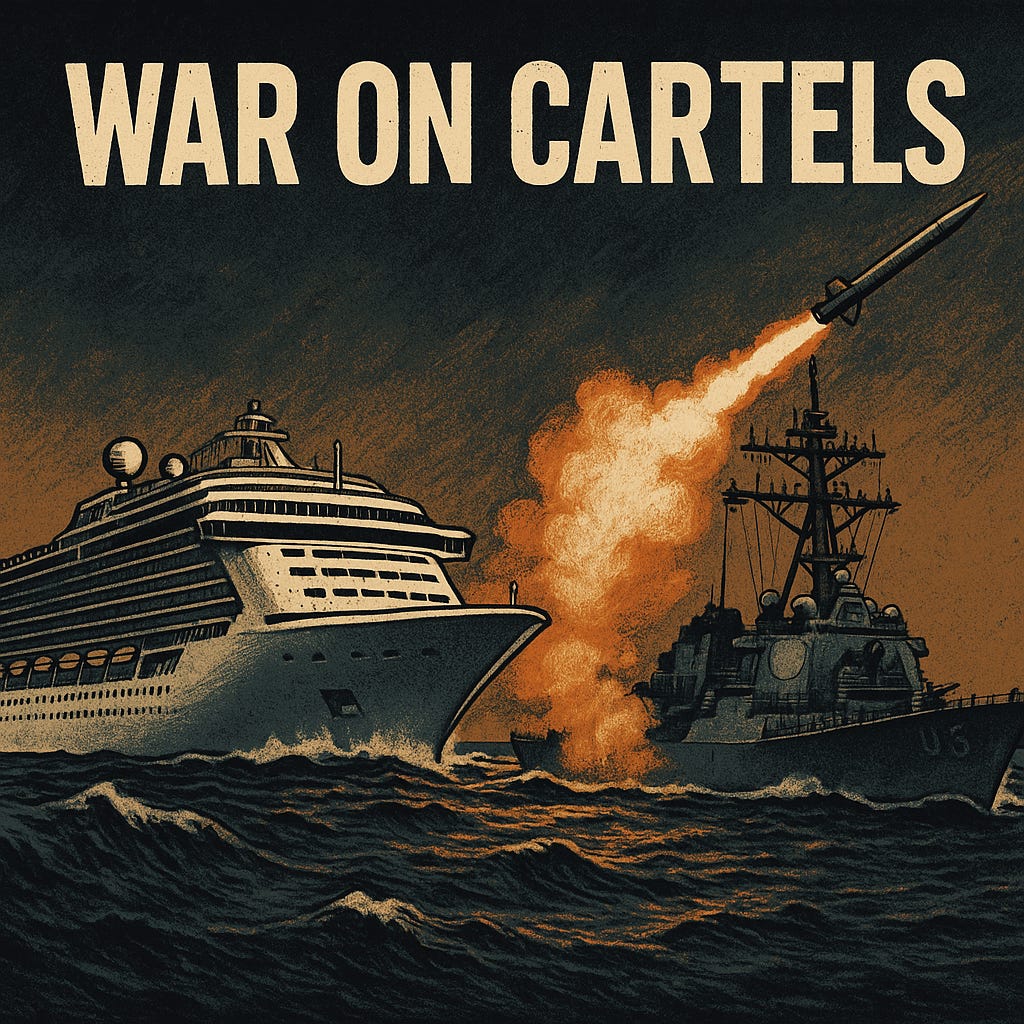
It began on September 2. A single boat was destroyed in the southern Caribbean, allegedly carrying narcotics from Venezuela. The Trump administration offered no hard proof, only a brief statement from the president claiming it was “loaded” with drugs and linked to a violent gang. No names were released. No arrests were made.
Over the next month, three more vessels were struck, with one incident occurring around September 15, another near September 19, and a final reported strike between September 28 and 29. None of the targets has been independently verified as being linked to a cartel. No forensic evidence, footage, or photos of seized contraband has been shown. No survivors were interrogated or detained.
Then, on October 1, Trump formally notified Congress that the U.S. was now engaged in a “non-international armed conflict” with drug cartels, a wartime posture that allows the use of military force without Congressional war authorization.
This was no longer law enforcement. It was a war, declared in legal terms, launched without debate, and aimed at an unnamed, undefined enemy.
Congratulations, America. You are at war.
We just hit 20,000 subscribers, 1,000 articles, and 1,000 podcast episodes. To celebrate, paid subscriptions are 20% off for two weeks only. That’s just $64/year—less than $1.25 a week.
From International Waters to American Cities
July - October — Los Angeles, Washington, D.C., Memphis, Portland, Chicago
As the Caribbean strikes escalated, so did something else — federal militarization inside the United States.
July – Los Angeles: National Guard units deployed under federal command. Trump called L.A. “a failed city,” blaming “radical leadership” for a crime wave.
August – D.C.: A “crime emergency” was declared via executive order. Local control of the police was suspended. Eight hundred Guard troops were deployed on city streets.
Mid-September – Memphis: Trump described the city as “run by thugs.” A federal “Safe Task Force” entered the city, followed by Guard reinforcements.
September 28 – Portland: 200 Guard troops under federal authority arrived. Trump labeled Portland “a war zone,” warning of “anarchist enclaves” and “urban terrorism.”
October 1 – Chicago: Trump cited “complete collapse,” telling supporters the city would be “taken back” by federal force if local officials “didn’t do their jobs.”
Each of these moves mimicked the logic of the Caribbean strikes — vague threats, no transparent oversight, and total federal control.
The Speech That Tied It All Together
September 30, 2025 — Quantico Marine Base
At the end of the month, before 800 generals and admirals, Trump made it plain. He told the military:
“We are under invasion — not from abroad, but from within. And it’s worse in many ways, because they don’t wear uniforms.”
He called major U.S. cities “training grounds for sedition” and declared that “federal power must be used to restore order where weak local leaders have failed.”
He praised the military’s role in taking out boats in the Caribbean. Then he pivoted.
“We are not just fighting them overseas. We are fighting them in Chicago. In Portland. In Los Angeles. In your cities. And we will win that war.”
It was the final link: international war powers and domestic force fused under a single banner.
The Silence Is Part of the Strategy
It’s hard to believe the timing is accidental. On the very day the White House declared a new war — not against a nation, but against an idea — the federal government shut down. Congressional offices were half-staffed, voicemail inboxes full, and public lines of communication choked off. Constituents trying to raise alarm over the destruction of boats in the Caribbean or the arrival of National Guard troops in their neighborhoods were left in the dark.
But silence is only part of the problem. Congress itself is paralyzed, not just functionally, but also psychologically. Lawmakers are being pulled in three directions at once: scrambling to negotiate a funding bill to reopen the government, responding to the federal militarization of U.S. cities, and now facing a legally murky declaration of war made without their approval.
It’s legislative triage. Every crisis demands to be the top priority, and in the chaos, none of them receives the scrutiny they deserve. That’s not a flaw in the system, but the feature Trump’s administration is counting on: a Congress too fragmented to resist, too overwhelmed to act, and too slow to notice the ground shifting under its feet.
The Pattern Is the Plan
First, foreign strikes without evidence.
Then, domestic troop deployments without consent.
Then, a speech reclassifying political opposition as warfare.
Then, a Congress unable to hear the alarm, even if it wanted to.
This wasn’t random. It was the sequence.
The Caribbean war was a test.
The National Guard deployments were the pilot.
The Quantico speech was the doctrine.
The shutdown was the smokescreen.
If Trump can declare war without naming an enemy, use force without oversight, and suspend local governance under the guise of crisis, then what is left of checks and balances?
Nine Months In
It took Bush 18 months to get to Baghdad.
Trump has been in office for nine months.
He has:
Declared a war on vague enemies
Sent troops into American cities
Recast protest and crime as military threats
And told the military leadership that the enemy is already inside the country.
The blueprint is no longer being drafted. It’s being followed.
Stay Informed. Stay Loud.
Subscribe to The Coffman Chronicle for no-BS political analysis, action guides, and daily truth bombs you won’t get from corporate media.
Sources:
“US military strikes vessel carrying drugs from Venezuela, Trump says” — Reuters, Sept 2, 2025
“US military kills 11 people in strike on alleged drug boat …” — Reuters, Sept 3, 2025
“Trump says US struck another alleged Venezuelan drug vessel, killing three” — Reuters, Sept 15, 2025
“Trump says US is in ‘armed conflict’ with drug cartels after ordering strikes in the Caribbean” — AP News, Oct 2, 2025
“Trump memo says US in ‘non‑international armed conflict’ with cartels” —
Al Jazeera, Oct 2, 2025“Trump tells a roomful of silent generals to join a ‘war from within’” — The Washington Post, Sept 30, 2025
“Trump calls for using US cities as a ‘training ground’ for military in unusual speech to generals” — AP News, Sept 30, 2025
“What we know so far about the National Guard deployment in Portland” — opb, Oct 1, 2025
“Declaring a Crime Emergency in the District of Columbia” — Wikipedia
“US government shuts down after Senate fails to advance both parties’ bills” — Reuters, Oct 1, 2025
“The US government has shut down. Here’s what to know” — ABC News, Oct 1

From the outside, it all seems unreal, like something out of a bad movie. We also watch in disbelief as one red line after another is crossed. Congress and the Senate are going along with it. The Republicans seem to be happy about it. And most likely, there is a large majority in the country that approves of it all. From the outside, it's a disaster.