


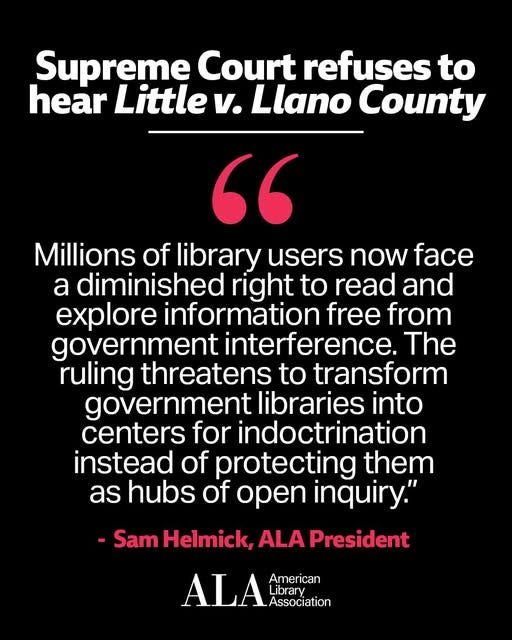
On December 8, 2025, the United States Supreme Court declined to hear Little v. Llano County, a case that could have clarified whether public libraries must adhere to basic First Amendment protections against viewpoint‑based censorship. By refusing to take up the appeal, the Court left intact a ruling by the U.S. Court of Appeals for the Fifth Circuit that explicitly allows local governments in Texas, Louisiana, and Mississippi to remove books from public libraries on political or ideological grounds.
In legal terms, the Fifth Circuit held that library collection decisions are a form of “government speech,” and thus not subject to the First Amendment limits that normally forbid viewpoint discrimination. This decision, and the Supreme Court’s failure to intervene, is more than a legal footnote. It is a terrible portent for the future of intellectual freedom in this country.
Want to Know Your Rights?
Download a free digital copy of the U.S. Constitution, the same document Trump is trying to bulldoze. Learn exactly what he’s breaking, and how to fight back.
100,000+ strong — and counting.
This holiday, become a paid subscriber for just $1 a week and help us keep the truth alive.
Join The Coffman Chronicle — $1/Week
The Llano County Story: From Shelves to Supreme Court Inaction
The saga began in 2022, when seven residents of Llano County, Texas, filed a federal lawsuit challenging the removal of at least 17 books from their local public libraries. These titles included works addressing issues of race and gender identity, as well as children’s books, all of which were removed at the behest of county officials. The plaintiffs argued that such content‑based removals violated their First Amendment right to receive information, a constitutional doctrine long recognized in case law.
Initially, a federal district court in Texas agreed. In March 2023, Judge Robert Pitman ordered several of the books restored and halted further removals. A divided appellate panel upheld that decision in June 2024, concluding that removing books based on their content violated the First Amendment. However, in May 2025, a full en banc Fifth Circuit reversed course, rejecting the idea that libraries are limited public forums and instead declaring that book selection and removal are expressions of “government speech” — meaning the county could decide what to exclude without triggering constitutional scrutiny. When the Supreme Court declined to review the case in December, it let that reasoning stand in the Fifth Circuit.
Understanding “Government Speech” and Its Consequences
Legal terms can obscure as much as they clarify, so it’s worth unpacking exactly what’s at stake. The government speech doctrine holds that when the government is the speaker, such as issuing its own proclamations, it can control content without offending the First Amendment. Equating that doctrine with public library collections is a radical departure from longstanding precedent.
For decades, courts have treated public libraries and public school libraries as limited public forums for the exchange and receipt of information. In this framework, the government can set neutral rules governing resource use, but it cannot remove or suppress materials simply because it disagrees with their viewpoint. Libraries do not speak for the government. They facilitate the voices of others. To claim otherwise is to misunderstand both the mission of libraries and the constitutional protection they are meant to safeguard.
The Fifth Circuit’s decision, now unchallenged in its circuit, effectively redefines libraries as instruments of state messaging rather than civic institutions that support inquiry and free thought. This not only undercuts professional ethics in librarianship but also invites governments to act as arbiters of truth, a role that should be antithetical to democratic institutions.
A Trend Nation‑Wide: This Isn’t Just a Southern or Red‑State Issue
While the Llano County case has drawn media attention because of its origin in Texas, the broader trend of book challenges, removals, and censorship extends far beyond the Lone Star State. Data collected by national organizations shows that book bans are widespread and ongoing.
PEN America’s 2024–2025 report documented 6,870 instances of book bans across 23 states and 87 public school districts, with books by or about historically marginalized groups disproportionately targeted. Since 2021, nearly 23,000 bans have been recorded nationwide, including in states not traditionally seen as battlegrounds for censorship efforts.
Meanwhile, the American Library Association documented hundreds of attempts to censor library materials and services in public, school, and academic libraries, with organized campaigns, often led by pressure groups or government entities, accounting for the majority of these efforts.
These figures dispel the myth that book bans are confined to a few states or fringe movements. The pattern has crept into communities across the nation, and Llano County’s legal affirmation is likely to embolden similar actions elsewhere.
A Parallel Legal Battle: Idaho and the Spread of the “Government Speech” Argument
In Idaho, a separate controversy highlights how quickly the Llano reasoning is being adopted. A 2024 state law sought to impose a distance requirement between adult and children’s materials, which, in many small libraries, forced the removal of entire children’s sections because they could not comply. In response, a coalition of major publishers, including Penguin Random House, Hachette, HarperCollins, Macmillan, and Simon & Schuster, along with library advocates and local library districts, filed a federal lawsuit challenging the law as a First Amendment violation.
Recently, the state’s attorney general has leaned on the same “government speech” rationale that emerged in the Llano circuit decision. That signals a disturbing trend. The very logic that erodes constitutional protections in Texas is being replicated elsewhere, threatening to turn local censorship into a nationwide doctrine.
Because federal appellate courts in different regions could reach opposite conclusions on similar questions, this development risks creating a circuit split, precisely the kind of conflicting standards that often force the Supreme Court to take up such cases again. Until then, however, constitutional protections for access to ideas may vary dramatically depending on geography.
Authoritarian Patterns: Why Control of Information Matters
Across history and across societies, authoritarian and authoritarian‑leaning governments have consistently targeted the same institutions early on: the press, the education system, and libraries. Control of information is not an incidental tactic. It is foundational to controlling public perception and silencing dissent.
In 2025, the Trump administration has pursued school curriculum restrictions, legislative directives about acceptable language on government websites, and public pressure campaigns to remove or restrict books. In this context, the Supreme Court’s decision not to take up Llano County amounts to tacit approval of a broader effort to redefine constitutional protections around information access.
When a government can dictate what its citizens may read — and where that power is not checked — it has laid the groundwork for the normalization of censorship.
The Logical Consequences: Empty Shelves and an Unequal Public Sphere
Allowing ideological control over library collections carries predictable and corrosive outcomes. First, it creates instability. Collections that shift with every change in political leadership are no longer public resources, but political artifacts.
Second, it sets a dangerous precedent where viewpoints opposed by those in power can be systematically excluded, effectively rewriting the boundaries of acceptable discourse.
This also creates a chilling effect in the publishing industry. If public libraries are increasingly unable to purchase materials on certain topics, by specific demographics, or with precise themes, there is little incentive to continue producing them. The result is self-censorship by an entire industry.
Further, removing topics, authors, or themes from public libraries creates a class divide. In practice, this means access to information becomes a matter of private means. If you can afford to buy it yourself, you can read it. If not, you’re left with what the government permits.
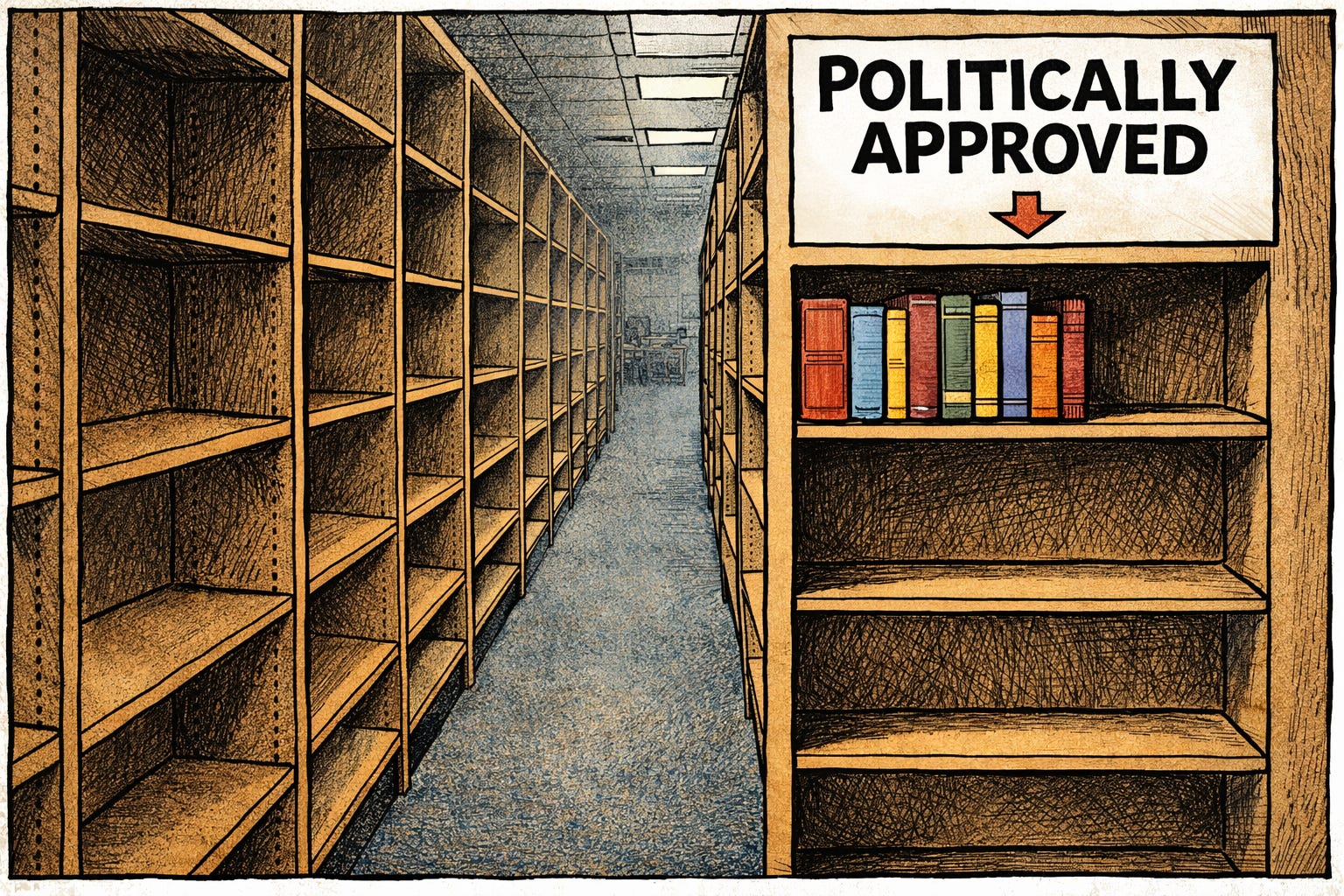
Finally, and perhaps most chillingly, it leads inexorably to empty shelves. If every group that dislikes a particular book can demand its removal, no institution will retain the diversity of ideas that makes a library a library.
Why This Matters: Libraries Are for All
Just as a librarian is expected to build a collection that serves everyone — not just the readers they agree with — so too must elected officials govern for all, not solely those who share their ideology. Public libraries, schools, and community resources should reflect the diversity of human experience and thought, offering spaces where people can learn, challenge themselves, and grow.
Censorship elevates ideological conformity over intellectual freedom. We must resist that framing and affirm that the right to read, think, and explore ideas is not a luxury but a democratic necessity.
What You Can Do
1. Support Independent Libraries
Encourage shifts to independent governance models.
Many rely on community donations. Contribute if you can.
2. Speak Up Locally
Attend board meetings.
Voice support for librarians and intellectual freedom.
Resist the narrative that book bans are about “safety.”
3. Advocate for Smart Legislative Guardrails
Carefully worded state protections can help, but require vigilance.
Work with groups like PEN America and NCAC to craft fundamental safeguards.
4. Back National Legal and Advocacy Efforts
Support PEN America, ALA, Authors Guild, and others.
Stay informed and share accurate updates.
If truth and rights matter to you, the time for vigilance and action is now.
Our work is fueled by you, at least until the regime decides we are a threat. Consider becoming a paid subscriber to fund our mission.
Sources:
PEN America Decries Supreme Court Decision on Book Ban Case (Dec 8, 2025) PEN America
American Library Association Responds to Supreme Court Refusal to Hear Little v. Llano County (Dec 9, 2025) American Library Association
Llano County Library Book Removals Allowed After Supreme Court Declines Challenge (Dec 8, 2025) The Texas Tribune
SCOTUS Denies Petition to Hear Little v. Llano County (Dec 9, 2025) PublishersWeekly.com
Book Bans Report: 2024–25 Index PEN America
Book Ban Data: Censorship Attempts in Libraries (2024) American Library Association
Wonder how much they were paid to make that decision. The supreme court is now the demeaned corpse. DCOUS
Assuming the country returns to sanity, how can this censorship be reversed?