


Early yesterday, news broke about a grave national security breach coming from within Trump’s regime. As details continue to emerge, the optics continue to get worse.
So what happened?
According to reports, National Security Advisor Mike Waltz set up the Signal chat that included Vice President JD Vance, Defense Secretary Pete Hegseth, Secretary of State Marco Rubio, CIA Director John Ratcliffe or his representative, White House Chief of Staff Susie Wiles, and Middle East Special Envoy Steve Witkoff. This group was discussing real-time military planning about airstrikes against Houthi militants in Yemen when they accidentally included Jeffrey Goldberg, editor-in-chief of The Atlantic, who had no clearance to see the messages. Interestingly, the journalist thought it was a joke until he watched in real-time as the military actions on his screen took place in Yemen.
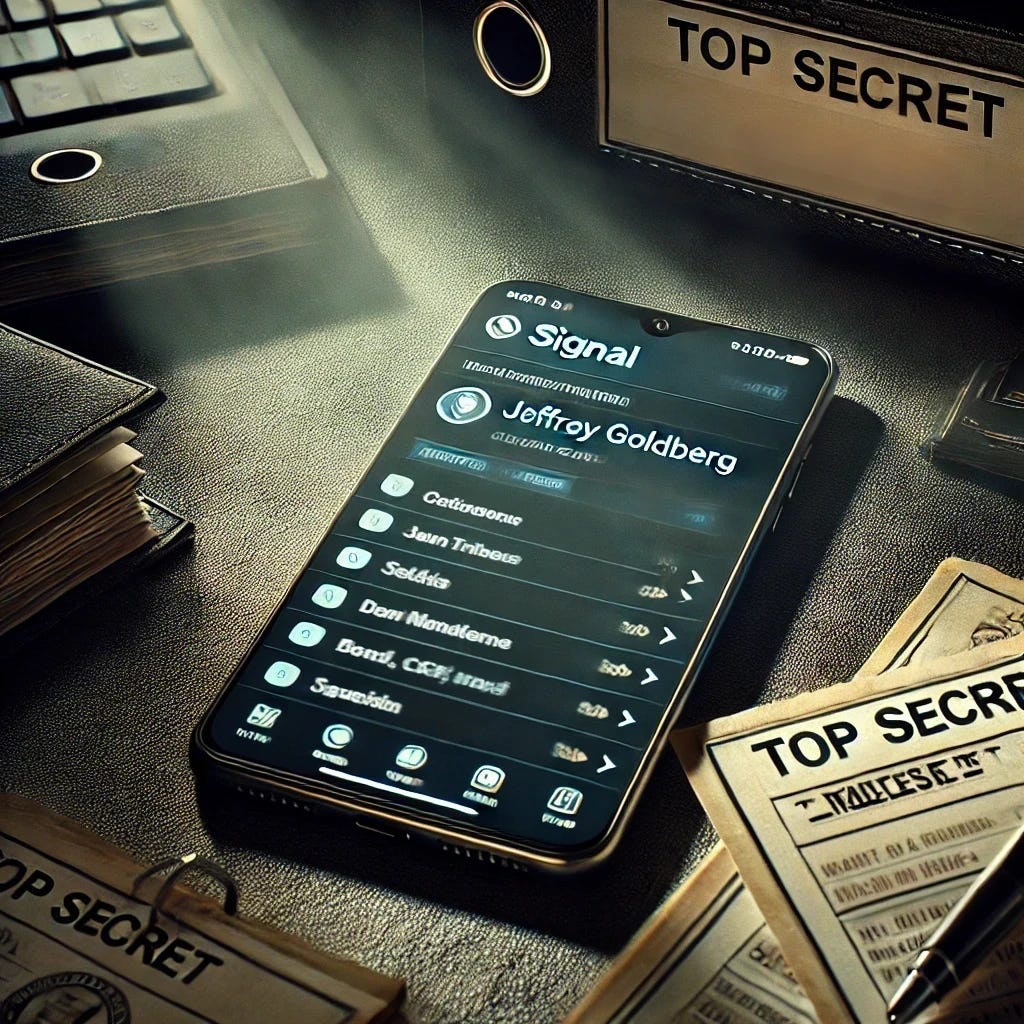
This isn’t just a careless mistake; it’s a blaring red alert about how casually high-ranking officials handle national security. Despite House Speaker Mike Johnson’s dismissive “honest mistake” remark, the reality is far more disturbing.
More telling—and upsetting—is 47's response. When asked at a press conference, Trump said, "I don't know anything about it. You're telling me about it for the first time." He further dismissed the significance of the breach by criticizing The Atlantic, saying, "I'm not a big fan of The Atlantic."
I’m sorry. What? You are the Commander in Chief. And judging by Mike Johnson’s thoroughly uncomfortable and entertainingly visceral response, you are either lying or entirely out of the loop. Both options are concerning (and likely).
They All Knew Better
It’s not enough to say this was reckless. Every major participant in the chat had the training, knowledge, and responsibility to know this was a severe breach of protocol. And the fact that none of them objected suggests that this dangerous approach to communication might be standard operating procedure.
Why Each of Them Knew Better:
Mike Waltz (National Security Advisor):
Background: Former Green Beret, U.S. Congressman, and current National Security Advisor with expertise in counterterrorism and operational security (OPSEC).
Why He’s Most Responsible: He set up the chat on Signal, knowing from his military training and position in the Administration that secure platforms were required. His failure to enforce protocol is inexcusable.
John Ratcliffe (CIA Director):
Background: Former Director of National Intelligence, now CIA Director, responsible for safeguarding classified information.
Why He Should Have Known Better: Using Signal blatantly violates intelligence community protocols.
Pete Hegseth (Defense Secretary):
Background: Former Army National Guard officer with deployments to Guantanamo Bay, Iraq, and Afghanistan.
Why He Should Have Known Better: His experience with Operational Security (OPSEC) should have made him immediately object to using Signal.
JD Vance (Vice President):
Background: Four years in the U.S. Marine Corps, including deployment to Iraq, where he would have OPSEC training.
Why He Should Have Known Better: His silence suggests negligence or normalization of improper practices.
Marco Rubio (Secretary of State):
Background: Former Senator with senior Senate Intelligence and Foreign Relations Committees positions.
Why He Should Have Known Better: His extensive experience handling classified information makes his failure to object inexplicable and dangerous.
See our reporting on Pete Hegseth and his unsuitability for the position here:


What They Should Have Used Instead:
Government officials — especially those with military and national security experience — are not just encouraged but required to use secure, government-approved communication platforms for discussing classified information. These platforms include:
Intelink: A secure intranet designed for sharing classified information within the U.S. Intelligence Community, supporting communications up to Top Secret/Sensitive Compartmented Information (TS/SCI).
Defense Red Switch Network (DRSN): A secure telephone network dedicated to military command and control, capable of handling Top Secret-level communications.
Fishbowl Phones: Secure mobile devices developed by the NSA to provide encrypted VoIP communications for sensitive operations.
Their existence is not only well-known — Waltz, Vance, Rubio, Hegseth, and Ratcliffe are trained to use them and expected to do so for all sensitive or classified communications. Using Signal, a consumer app lacking government oversight, wasn’t just a bad choice. It was a clear violation of protocol.
But what’s worse is the complete lack of objection. The fact that no one even attempted to move the conversation to an approved platform suggests this behavior has become standard operating procedure. And if that’s true, this breach may only be the tip of a very dangerous iceberg.
How Did Goldberg’s Contact Information End Up There?
Jeffrey Goldberg's accidental addition to the Signal chat raises another troubling question: Why did National Security Advisor Mike Waltz save Goldberg’s Signal handle in the first place?
If this was indeed an accident, Waltz must have either:
Intentionally saved Goldberg’s contact info at some point, OR
Recently communicated with Goldberg, causing his handle to appear as an autofill suggestion.
This revelation suggests either a reckless mixing of official and unofficial contacts or a habit of using Signal for various conversations, some of which may be highly inappropriate for the platform. This is exactly why this is not an approved federal communication channel.
And if Waltz meant to add someone else, who was it? Another official? Another journalist? Or someone outside the government entirely?
The Reckless New Normal:
The most damning part of this incident is how casually the conversation continued over Signal. This wasn’t a one-time mistake. This suggests that such reckless behavior may have become standard operating procedure.
And here’s where the hypocrisy becomes glaring. Republicans spent years demonizing Hillary Clinton’s use of a private email server, framing it as a reckless endangerment of national security. The infamous rallying cry, “Lock Her Up!”, became a political weapon wielded repeatedly against Clinton.
But now, Hegseth, Vance, Rubio, Waltz, and Ratcliffe — all who know better — are casually discussing real-time military operations on Signal, an app with zero government oversight and no guarantee of security.
Instead of acknowledging the severity of this breach, National Security Council spokesperson Brian Hughes attempted to dismiss it, stating:
“The thread is a demonstration of the deep and thoughtful policy coordination between senior officials. The ongoing success of the Houthi operation demonstrates that there were no threats to troops or national security.”
This is not damage control. It’s an absurd attempt to justify gross negligence. The success of an operation doesn’t retroactively justify violating protocols designed to keep classified information out of the wrong hands.
See our reporting on security risks:

Reactions and Calls for Accountability:
Those involved have largely remained silent, with Hegseth downplaying the incident and stating that no harm was done. But while those on the call have little say, others have… thoughts.
The breach has drawn bipartisan criticism, with both Democrats and Republicans expressing outrage over the reckless handling of sensitive information.
From Democrats:
Rep. Pat Ryan (D-N.Y.): A former Army officer and member of the House Armed Services Committee, described the breach as “FUBAR.” Ryan has called for an immediate hearing to investigate the matter.
Rep. Chris Deluzio (D-Pa.): “This is an outrageous national security breach and heads should roll.”
Rep. Sara Jacobs (D-Calif.): “We can’t chalk this up to a simple mistake — people should be fired for this.”
From Republicans:
Sen. Roger Wicker (R-Miss.): “We’re very concerned about it and we’ll be looking into it on a bipartisan basis.”
Sen. John Cornyn (R-Texas): “This is a huge screw-up. The interagency needs to look into how something like this could happen.”
Rep. Mike Lawler (R-N.Y.): “Classified information should not be transmitted on unsecured channels – and certainly not to those without security clearances. Period.”
Call to Action:
The American people deserve answers and accountability. This breach is not just a mistake. Furthermore, we cannot have a national security system that casually uses unofficial means of communication and — oops!— adds an unauthorized person to the discussion. It is a failure of leadership, competence, and basic adherence to established security protocols. No other administration would ever get away with such blatant disregard for norms and protocol.
Congress and relevant oversight bodies must:
Launch a Comprehensive Investigation:
Immediately conduct a bipartisan investigation into how this breach occurred, who was responsible, and how often unauthorized platforms have been used for classified discussions.
Implement Stricter Communication Protocols:
Review and reinforce guidelines governing the communication of classified information.
Ensure all officials are properly trained and held to the highest operational security standards.
Ensure Accountability:
Those found responsible for this breach must face appropriate legal and administrative consequences.
The nation’s security must not be compromised by political loyalty or incompetence.
Conclusion:
The Signal breach isn’t just another example of poor judgment. It’s a reckless violation of national security protocols, and the dismissive response from those involved only makes it worse. The American public should know if unauthorized platforms have become standard operating procedure.
This incident begs the question: how many times has this happened before? What sensitive information was leaked to individuals with less moral aptitude than Goldberg? And why are we casually group-chatting about missile strikes like frat boys making plans for Spring Break?
Those responsible must be held accountable to the full extent of the law. There is zero excuse.
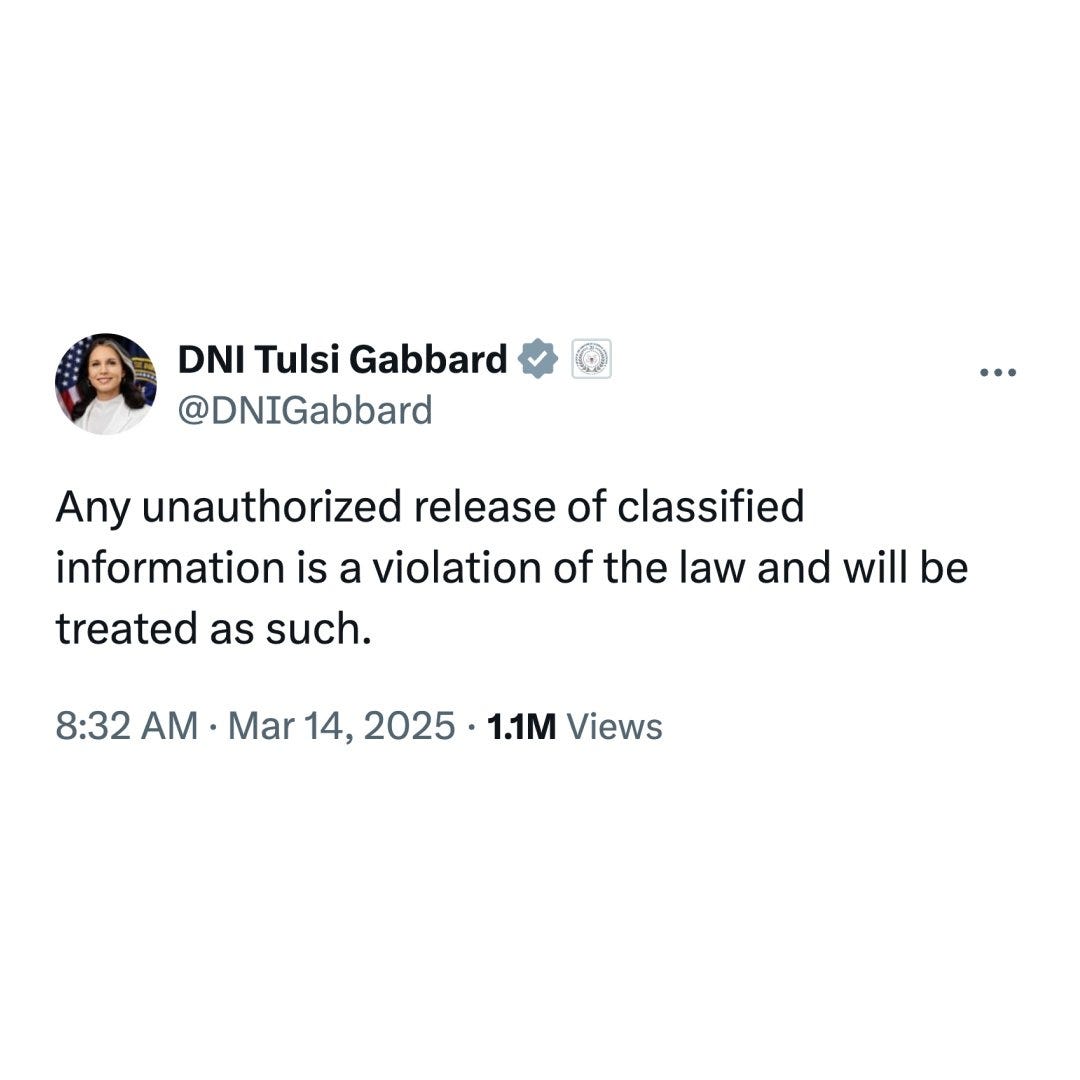
So Tulsi, you posted this recently. Show you meant it. Or admit you are complicit.
Independent News. Just $1/Week.
We just hit 10,000 subscribers—thank you! To celebrate, we’re offering full access to The Coffman Chronicle for just $1 a week ($52/year).
Get exclusive analysis, daily rundowns, and fearless reporting you won’t find in corporate media.
Support truth. Stay informed.
Bibliography:
Goldberg, Jeffrey. “The Trump Administration Accidentally Texted Me Its War Plans.” The Atlantic, March 24, 2025.
Hughes, Brian. “Top Trump Officials Debated War Plans on Unclassified Chat Shared With Journalist.” The Wall Street Journal, March 24, 2025.
Politico Staff. “Trump Advisers in War Plans Chat Criticized Dems for Fumbling Secrets.” Politico, March 24, 2025.
Politico Staff. “5 Revelations from the Trump Administration's War Plan Texts.” Politico, March 24, 2025.
Politico Staff. “Vance Broke with Trump over Houthi Airstrikes, Group Chat Report Says.” Politico, March 24, 2025.
NY1. “Senior Trump administration officials reportedly planned Yemen bombings in group chat shared with journalist by accident.” NY1, March 24, 2025.
The Guardian. “National security council investigating after Trump officials accidentally text journalist top-secret Yemen war plans – live.” The Guardian, March 24, 2025.
Wikipedia. “March 2025 United States Attacks in Yemen.” Wikipedia, March 24, 2025.