


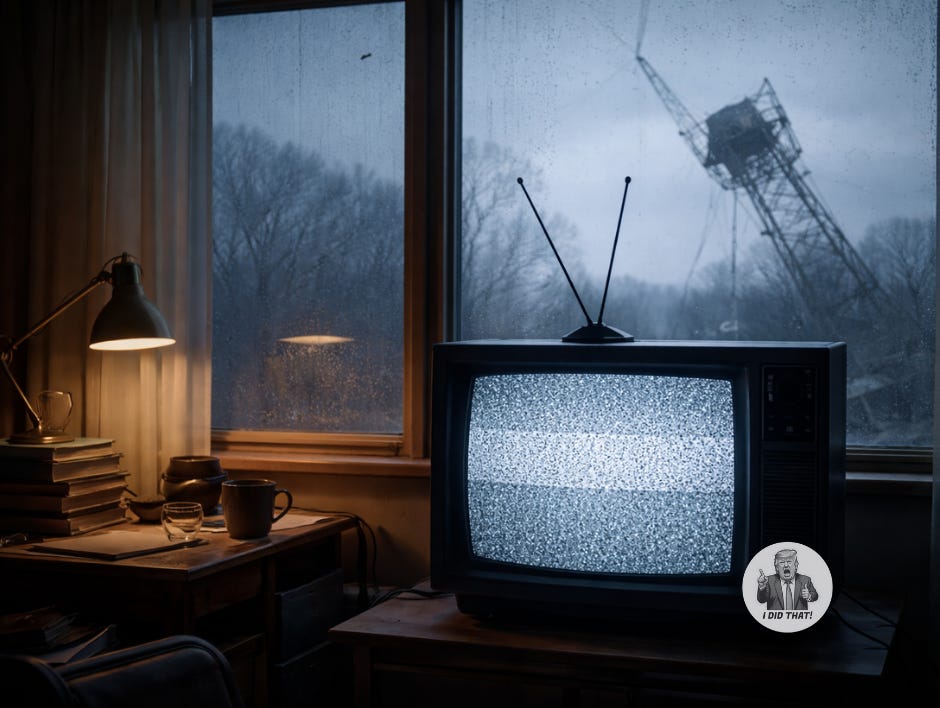
On January 5, 2026, the board of the Corporation for Public Broadcasting voted to dissolve the organization.
The vote was quiet, procedural, and barely covered by national media. There were no press conferences or public statements, no hearings or ceremony to mark the end of a public institution that had served the American people for nearly sixty years. Yet for those who understood what the CPB represented and what it made possible, the decision was neither benign nor bureaucratic. It was the formal conclusion of a long and deliberate effort to dismantle public broadcasting in the United States.
While the final blow came in the form of budget rescissions and legislative maneuvering over the past year, the campaign to defund and delegitimize public media has been ongoing for decades. It did not begin with a single budget line, but rather with a shift in philosophy, a rejection of the idea that access to education, information, and cultural programming should be a public good rather than a private commodity.
This is not just the story of an institution’s closure. It is a story about the erasure of public space, the consolidation of power over information, and the intentional narrowing of who gets to be informed, educated, and heard.
Want to Know Your Rights?
Download a free digital copy of the U.S. Constitution, the same document Trump is trying to bulldoze. Learn exactly what he’s breaking, and how to fight back.
100,000+ strong — and counting.
This winter, become a paid subscriber for just $1 a week and help us keep the truth alive.
Join The Coffman Chronicle — $1/Week
What Was the CPB, and Why Did It Matter?
The Corporation for Public Broadcasting was created in 1967 through the Public Broadcasting Act, signed into law by President Lyndon B. Johnson. It was designed to fund, but not control, public media. It was intentionally structured to act as a buffer between content creators and the government. Its mandate was clear: ensure that every American, regardless of income or geography, could access high-quality, noncommercial educational and cultural programming.
CPB did not own television stations or produce content itself. Instead, it distributed federal funding to a nationwide network of over 1,500 local public radio and television stations, supporting the development and dissemination of programming through PBS, NPR, and a wide range of independent public media organizations.
Over the course of its existence, CPB cost American taxpayers approximately $1.35 per person per year, a remarkably small investment that helped build and sustain some of the most trusted and influential programming in American media history. This includes Sesame Street, Mister Rogers’ Neighborhood, PBS NewsHour, Frontline, American Experience, StoryCorps, and countless others.
In addition to funding programming, CPB provided essential support for emergency alert systems, local journalism infrastructure, station upgrades, technical assistance, and internships and fellowships for early-career journalists, particularly those from underrepresented communities.
It was never a flashy institution. Its work happened quietly, in the background. However, for communities without access to broadband, reliable commercial media, or safe public schools, CPB-supported stations were often the last remaining civic institution standing.
This Was Always the Plan
The Public Broadcasting Act of 1967 was barely 15 years old when President Ronald Reagan began calling for its elimination. By 1983, the Reagan administration was actively proposing to dismantle the Corporation for Public Broadcasting, arguing that public media was unnecessary and overly ideological. His budget director at the time, David Stockman, famously included CPB on a list of “wasteful” federal programs targeted for elimination.
This wasn’t a critique of programming quality. It was a philosophical opposition to the very idea that government should support publicly accessible information and education. In Reagan’s political framework, “government is not the solution to our problem; government is the problem.” That perspective shaped the conservative movement’s posture toward public goods for the next forty years.
Under Reagan, public media funding was cut dramatically. Although CPB survived, it was forced into a defensive posture, constantly justifying its value and neutrality amid ongoing political pressure. The firewall built to protect content from government interference was still in place, but its funding was increasingly unstable.
See our earlier reporting here:
Note: Articles move into the archive over time. Consider becoming a paid subscriber for full access and exclusive perks.

The attacks didn’t stop when Reagan left office. Through the 1990s and 2000s, conservative think tanks and media figures continued to frame PBS and NPR as biased, elitist, or out of touch despite consistently ranking among the most trusted news sources in the country. Under President George W. Bush, federal oversight of CPB tightened, and in 2005, the CPB board chair, a Republican appointee, was found to have violated ethical standards by using his position to promote right-wing programming.
The Obama years brought stability, but not repair. Funding remained flat, and political support was cautious at best. Then came the first Trump administration, which made eliminating CPB a formal budget priority. Though Congress blocked those early efforts, the message was clear: public media was a target, not a treasure.
The second Trump administration, bolstered by a Congress aligned with its agenda, finished what Reagan began. In 2025, CPB’s funding was rescinded, its operations reduced to a skeletal staff, and its mission effectively ended. The January 2026 board vote was not a shock. It was the quiet conclusion of a war that had been waged in the open for decades.
This was not fiscal responsibility. It was ideological strategy. Now, the plan has succeeded.
What Died with CPB
The closure of the Corporation for Public Broadcasting is not just the end of a funding stream. It marks the loss of a national infrastructure that supported thousands of local stations, trained generations of journalists, delivered emergency alerts in remote regions, and enabled public media to reach Americans across economic, geographic, and political divides.
With CPB gone, some major-market stations may survive through philanthropy and local donors. However, the network that it once sustained, particularly in rural, tribal, and low-income communities, will begin to fracture. These were areas where commercial broadcasters had little financial incentive to operate, and where CPB-funded stations often provided the only local news, children’s programming, or educational media available.
That programming wasn’t merely informative. It was often formative. It taught letters and numbers, but also civic values such as listening, questioning, treating others with respect, and seeing oneself as worthy of care and dignity. Mister Rogers’ Neighborhood, Sesame Street, Arthur, Daniel Tiger, and countless others were not political programs, but they were grounded in pluralism, compassion, and inclusion.
For some, that was always the problem.
The loss of CPB isn’t just an attack on education and access to information. It is part of a broader effort to dismantle the idea that a shared public culture should reflect the diversity, complexity, and common humanity of the people it serves.
The death of CPB echoes a larger shift in how public education and civic life are treated in the United States, away from inclusion, curiosity, and service to the public good.
Now, without CPB, those values lose their most potent, accessible platform.
Who This Harms Most
The end of CPB does not impact all communities equally. As mentioned earlier, while public media may still exist in major urban markets with wealthy donor bases, in much of the country, it will simply disappear.
The communities most affected are those that depended on CPB funding not as a supplement, but as a lifeline. In rural regions, on tribal lands, and in low-income urban neighborhoods, local stations often received the majority of their operating budgets from CPB grants. Without that support, they cannot survive. There will be no backup stream of wealthy benefactors, large corporate underwriters, and endowments waiting in reserve. When these stations go dark, they are unlikely to return.
These communities will lose more than a TV or radio signal. They will lose local journalism, civic coverage, emergency alerts, and children’s programming tailored to the lives of the people who live there. They will lose access to the public square, one not shaped by advertising dollars or political agendas, but by the needs and stories of the community itself.
And it is important to say clearly. This is a loss that does not fall randomly. It falls hardest on the same communities where education, infrastructure, and access to basic services have long been undercut.
This is not just a story about public broadcasting. It is another chapter in the ongoing story of which Americans are allowed access to information, education, and representation, and which are not.
The Archives Left Behind
The Corporation for Public Broadcasting may be gone, but the materials it helped produce—decades of journalism, storytelling, children’s programming, and public discourse—still exist. The question is whether they will survive.
For years, CPB partnered with organizations like GBH in Boston and the Library of Congress to preserve and digitize these materials through the American Archive of Public Broadcasting. That work has produced an extraordinary historical record, including local coverage of civil rights marches, early environmental documentaries, Indigenous language programming, and thousands of hours of public media that reflected American life in all its complexity.
Now that CPB has dissolved and its funding has been eliminated, the future of that archive is uncertain. The Library of Congress, once a trusted institutional steward, has seen its own independence compromised. The firing of Librarian of Congress Carla Hayden, the first Black woman to hold the role, signaled a shift in how even apolitical federal institutions might be reshaped under political pressure. The Smithsonian, another potential partner, has already removed or altered exhibits in response to recent ideological demands.
See our reporting on the Library of Congress here:
Note: Over time, our articles move into the archive. Please consider becoming a paid subscriber for full access to our full 2000+ article archive, exclusive content, and occassional early access.

The most promising current steward may be the University of Maryland, which has long collaborated with CPB and GBH on archival preservation. As a public research university, it has both the infrastructure and the academic independence to continue the work—at least for now. However, public universities themselves are increasingly under threat, facing defunding, legislative interference, and pressure to comply with political mandates. Their stability, like that of the archives they protect, cannot be taken for granted.
These materials are not simply nostalgic artifacts. They are records of how the public once educated its children, documented its communities, challenged its leaders, and defined its values. Losing access to that archive, whether through neglect, decay, or deliberate erasure, means losing the evidence of who we have been, and the blueprint for who we might still become.
The Pattern Is the Point
The death of CPB is not an isolated event. It is part of a broader, deliberate pattern, one that is reshaping how information, education, and public memory function in the United States.
Public broadcasting has now joined a growing list of institutions that once served to bridge the gap between wealth and knowledge, and that are now being hollowed out, privatized, or politically compromised. Public schools are being defunded, censored, and surveilled. Libraries face book bans, budget threats, and ideological intimidation. Local newspapers have been bought out and gutted, or folded entirely. Local television news, once rooted in the community, is often outsourced from cities two or three counties away. Head Start programs, long a foundation of early childhood equity, are quietly disappearing from the very areas where they are most needed. Major media outlets increasingly lock high-quality reporting behind paywalls, while the flood of misinformation grows unchecked.
See our previous reporting on these topics here:
Note: Articles move into the archive over time. Consider becoming a paid subscriber for full access to our 2000+ article archive, exclusive content, and occassional early access.
Part 1 of a series on media


Each of these losses may appear disconnected—just another consequence of budget cuts, policy shifts, or changing media habits. However, taken together, they reveal a strategy, not a coincidence. The institutions under attack are the ones that have traditionally worked to equalize opportunity and understanding across class, race, and geography. They are the ones who helped working people access truth, history, and the tools to navigate civic life.
When those institutions fall, what’s left is a two-tiered society in which the well-resourced continue to access information, analysis, and education through private schools, legacy media subscriptions, elite universities, and curated digital ecosystems, while the public is left with filtered, manipulated, or absent information.
It is not just a wealth divide. It is a knowledge divide, a civic divide, and, increasingly, an epistemological divide, where even the concept of a shared reality fractures under the weight of inequality.
In this landscape, even institutions meant to represent American values abroad are being repurposed. The Voice of America, once a global model of nonpartisan journalism, has begun incorporating content from One America News Network, a far-right outlet known for promoting conspiracy theories and political propaganda. The same government that dismantled CPB now funds an international broadcaster airing overtly partisan messaging, an inversion of its original mission to provide truthful, independent reporting in places where the free press is threatened.
We Are the Enemy We Once Fought
The institutions we are watching collapse are not accidental. They were designed imperfectly, unevenly, but deliberately to make democracy possible. Public schools, public libraries, public media— together, they form a civic infrastructure that supports not only learning, but the idea that all people, regardless of income or background, deserve to understand the world they live in.
That belief is no longer universal. To some, it is firmly anti-American.
We are now living through a form of information redlining, a system in which access to truth, education, and cultural memory is increasingly determined by wealth, geography, and political allegiance. What was once public is now privatized. What was once trusted is now targeted. What was once free is now behind a paywall or gone entirely.
At the same time, we are witnessing the emergence of a cognitive caste system, in which only those with resources can afford to be well-informed, while others are kept in a state of confusion, division, or silence. This is not just a side effect of inequality. It is a tool of governance.
Perhaps most devastating of all, we know this story.
We once taught it in our public schools. We documented it on our public radio programs. We archived it in our public libraries. We recognized it in the propaganda of regimes we claimed to oppose.
We built institutions like the Corporation for Public Broadcasting to ensure we would never become that kind of country.
Now that it is gone, we must confront what remains.
What You Can Do
Use your public libraries and local public media. They need your presence as much as your support.
Donate if you can to your local station, library, or educational institutions. Even small contributions matter.
Talk about this. Share this. Let others know what’s happening and what we’re losing.
The more we use what remains, the harder it becomes to take it away quietly.
Stay Informed
If you value independent analysis on the state of public institutions, media, and democracy, subscribe to receive future pieces directly.
No noise. No spin. Just the facts and the patterns they reveal.
Sources:
“Corporation for Public Broadcasting Board Votes to Dissolve Organization” – January 5, 2026, CPB.org
“Carla Hayden Fired as Librarian of Congress” – May 9, 2025, ALA News
“Kari Lake Says OAN to Supply Voice of America Programming” – May 7, 2025, The Washington Post
“Corporation for Public Broadcasting Votes Itself Out of Existence” – January 5, 2026, AP News
“Corporation for Public Broadcasting, Gutted of Federal Funds, Votes to Dissolve” – January 6, 2026, The Washington Post
“Nonprofit That Funded NPR and PBS to Dissolve After 58 Years” – January 5, 2026, The Wall Street Journal
“The Scramble to Keep Public Media Afloat” – August 19, 2025, Politico
“Rescissions Act of 2025” – Wikipedia
“Corporation for Public Broadcasting” – Wikipedia
This is an all out attack on ‘the commons’, places where the general public meet, witness, discuss, learn about all sorts of topics, applaud or challenge every day life. Autocracies/dictatorships cannot abide these spaces, they cannot stand questioning nor evaluation, they cannot allow knowledge and methods of thinking to be spread, they cannot allow potentially oppositional like minds to gather. Soon, as digital media gets reined in, so, too, will the physical spaces. Groups larger than three will be suspect and rousted. Spaces closed to people. Opportunities to meet, gather, celebrate or protest will become scarce. We will be forced to the Dark Web, the underground, the back alleys to communicate with each other. Very dark times are ahead.
By all that was holy, this is utterly appalling. I knew things were bad in the States, I knew they were continually getting worse, but this is just too despicable to tolerate. Our focus has been on the attacks on science - didn't even imagine anything so innocent being targeted. I'm in Europe and all they're talking about is Greenland...upsetting enough way to start the day - but this is too bloody personal, too painful.
And I feel helpless to respond...