


Something is changing inside the U.S. military, and it isn’t happening with a press conference or a formal rewrite of the rules.
It’s happening quietly, in deleted posts, scrubbed bios, and service members deciding it’s safer to say nothing at all.
According to reporting by Business Insider, troops across branches are self-censoring their social media and online presence amid an intensified Pentagon effort to monitor and discipline political speech. What’s striking isn’t that the military has rules. It always has. What’s striking is how far beyond those well-understood boundaries this new climate appears to reach, and how quickly fear has filled the gaps.
When soldiers, sailors, airmen, and Marines start wondering whether a LinkedIn profile, a pronoun, or a carefully worded opinion might end a career, that’s not discipline. That’s deterrence. And in a force sworn to defend the Constitution — not a party, not a president — that should worry all of us.
Want to Know Your Rights?
Download a free digital copy of the U.S. Constitution, the same document Trump is trying to bulldoze. Learn exactly what he’s breaking, and how to fight back.
80,000+ strong — and counting.
This holiday, become a paid subscriber for just $1 a week and help us keep the truth alive.
Join The Coffman Chronicle — $1/Week
When the Rules Haven’t Changed, but the Fear Has
For decades, U.S. service members have lived with clear, if sometimes strict, limits on political activity. Don’t campaign in uniform. Don’t endorse candidates on duty. Don’t use rank to influence elections. Those lines are well known, taught early, and generally understood.
What’s different now is not the letter of the law but the atmosphere around it.
The Business Insider report describes service members quietly altering their behavior, including deleting old posts, removing identifying information, and pulling back from even mildly expressive speech that could be interpreted as political. One Marine sergeant reportedly stripped her online profiles down to bare essentials. Others described a growing sense that anything could be construed as crossing a line, depending on who is watching and how aggressively the rules are being enforced.
That uncertainty is the point.
A chilling effect doesn’t require mass punishments. It doesn’t need new statutes or sweeping bans. All it needs is enough investigations, enough warnings, and enough examples to make people think twice, and then stay silent.
This is where kitchen-table consequences come into focus. When troops self-censor, it doesn’t just affect public debate. It affects internal accountability, whether service members feel safe raising concerns, questioning orders, or discussing ethical boundaries with peers.
Those consequences don’t stay online. Silence seeps inward before it ever shows up on social media, and silence inside a military isn’t neutral. It tilts power upward.
When the fear of discipline becomes broader than the rule itself, enforcement stops being about maintaining good order and discipline and starts functioning as a loyalty filter— not officially, not on paper, but in practice.
That’s the danger zone, because once silence becomes routine, it reshapes how decisions are made when it matters most.
Silence Is How Unlawful Orders Survive
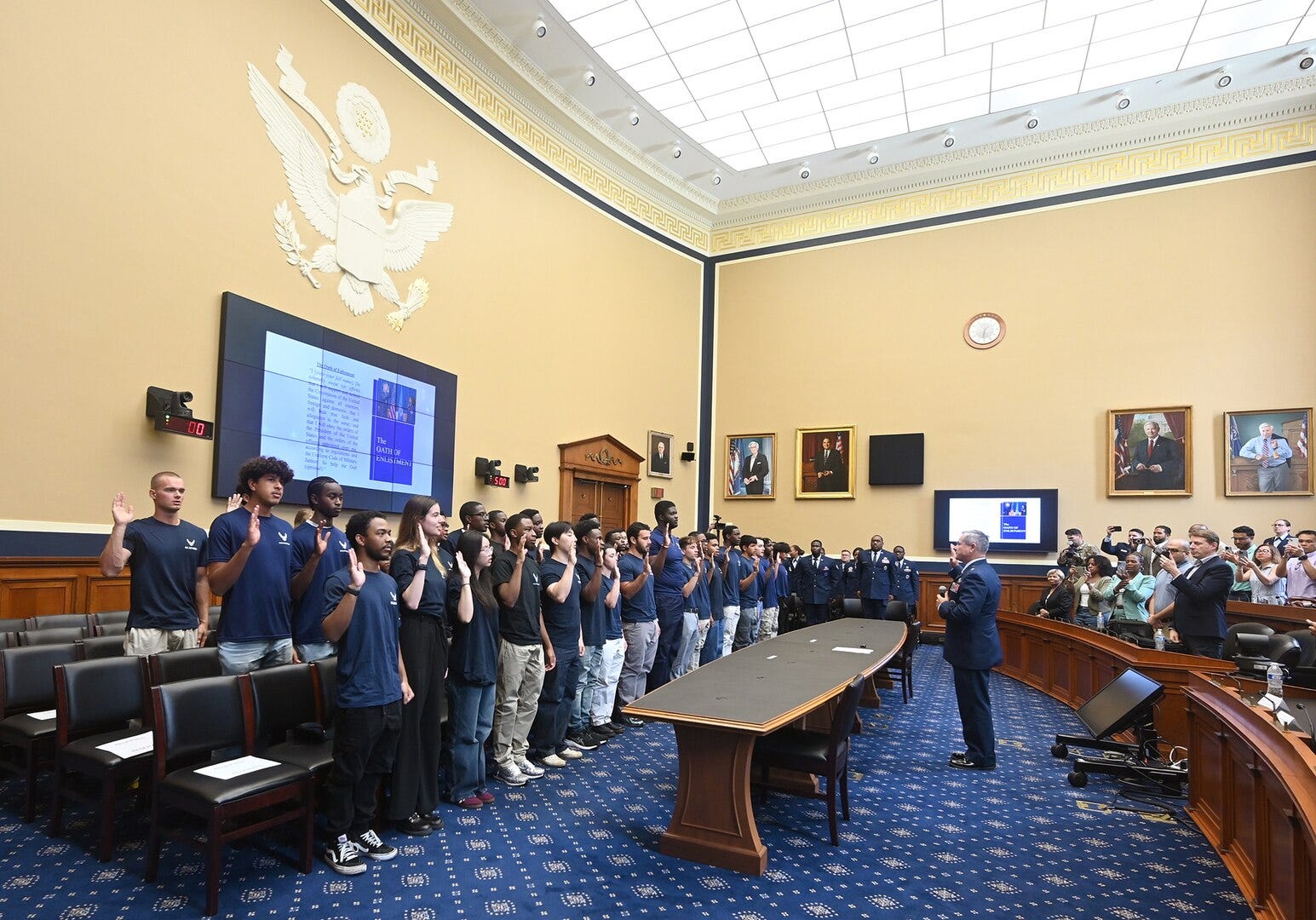
Every person who raises their right hand to serve in the U.S. military swears an oath — not to a president, not to a party, and not to the Pentagon itself — but to the Constitution.
That oath is tested not in moments of calm, but in moments of pressure when silence feels safer than speaking up.
The U.S. military is built on a crucial safeguard. Service members are not only allowed but also obligated to refuse unlawful orders. That principle isn’t theoretical. It exists precisely because history — American and otherwise — shows what happens when armed institutions are trained to obey first and question never.
However, that safeguard only works if people feel safe speaking up before an order crosses the line.
This is where the current chilling effect becomes dangerous.
See our reporting on the Democrat veterans video reminding the military of their code:


When troops are unsure whether expressing concern, asking questions, or even discussing ethical boundaries might trigger investigation or discipline, the instinct is not rebellion. It’s withdrawal, silence, and deference. “Keep your head down.”
And once that instinct takes hold, it doesn’t confine itself to public speech.
It follows people into briefings, into private conversations, and into moments when a questionable directive might otherwise be challenged.
No unlawful order announces itself as unlawful. It emerges through ambiguity, urgency, and pressure, often framed as necessity or patriotism. The only thing standing between a bad order and irreversible damage is a culture where questioning is not punished by default.
That culture erodes quietly.
A military that self-censors does not suddenly become lawless. It becomes less resilient, less capable of internal correction, and more dependent on the judgment of fewer people at the top, precisely the opposite of what civilian control and constitutional governance require.
This is why fear-based compliance is so corrosive. It doesn’t need mass crackdowns. It doesn’t need courts-martial. It only needs enough examples to convince people that staying silent is safer than being right.
At the kitchen-table level, this isn’t abstract. It affects military families, veterans who know the weight of moral injury, andthe next generation of service members who must decide if their oath is a shield or a trap.
A force trained to obey the law must also be free to speak about it. When that freedom contracts, institutions adapt around the silence.
From Discipline to Loyalty Filtering
There is a difference between enforcing discipline and testing loyalty. On paper, the Pentagon insists it is doing the former.
In practice, once silence becomes a survival strategy, the system reorganizes itself around who speaks and who doesn’t.
A loyalty filter doesn’t require explicit pledges or political litmus tests. It works through selective attention, uneven enforcement, and strategic ambiguity. People don’t need to be told what not to say if they learn, through observation, what gets noticed.
Investigations matter even when they don’t end in punishment. A probe that goes nowhere still sends a message: you were watched. In hierarchical institutions like the military, that message travels fast. Careers are built on trust, evaluations, and recommendations. Few people are willing to gamble all three on the hope that their speech will be judged generously.
So the calculation changes— not: Is this lawful? But: Is this worth the risk?
That shift is subtle and corrosive.
This is how enforcement becomes asymmetric without ever being announced as such. Speech that aligns with perceived leadership preferences is less likely to draw scrutiny. Speech that raises concerns, questions motives, or brushes up against politically sensitive topics becomes radioactive. The rules don’t have to say this. People learn it anyway.
What emerges is a culture where silence is mistaken for professionalism, and caution is rewarded over conscience.
This is not about troops wanting to campaign, posture, or grandstand. The reporting makes that clear. This is about service members retreating from even neutral self-expression because the boundaries feel unstable.
And instability inside a disciplined force doesn’t create order but compliance.
At the kitchen table, this looks like a son or daughter coming home quieter than before, a spouse noticing fewer conversations about work, and a veteran deciding it’s safer not to mentor younger troops too openly about ethical gray areas.
Those are not signs of good order. They’re signs of narrowing space.
Civilian control of the military depends on more than formal authority. It depends on internal honesty, on people inside the system's ability to surface problems before they metastasize. Loyalty filtering short-circuits that process. It concentrates judgment upward and removes friction where friction is most needed.
History shows that institutions don’t fail when everyone suddenly agrees. They fail when disagreement becomes too expensive.
When that happens inside an armed force, the consequences don’t stay internal for long.
This Is How Democracies Lose Their Last Line of Defense
Here is the part civilians are supposed to ignore until it’s too late.
A military that is afraid to speak is not a neutral institution. It is not “professional.” It is unfinished business for anyone seeking unchecked power.
Democracies rely on a final internal guardrail: an armed force that understands the law, talks openly about it, and feels secure enough to refuse when orders cross the line. That safeguard does not collapse all at once. It erodes through silence, through caution, and through people deciding it’s smarter to keep their heads down than to ask hard questions.
That erosion is happening now.
See our reporting on the Pentagon policy regarding the media here:


No one needs to issue an explicit loyalty oath. No one needs to rewrite the UCMJ. All it takes is a climate where troops learn that visibility is dangerous, that attention is punitive, and that ambiguity always cuts against the individual and in favor of power.
At that point, obedience becomes reflexive, not because orders are lawful, but because resistance feels risky.
This is not speculation. History is blunt about how this works. Armed institutions do not suddenly “turn.” They are conditioned, step by step, investigation by investigation, and silence by silence. By the time civilians notice, the culture has already shifted.
And when that happens, civilian oversight weakens, not strengthens. Congress hears less. Inspectors general hear less. The public hears nothing at all because the people closest to the problem have learned that survival requires quiet.
That is not stability. It is stored volatility.
At the kitchen table, this isn’t an abstract theory. It’s a democracy asking its sons and daughters to bear moral weight alone without the protection of open discourse or institutional courage. It’s veterans quietly carrying the moral injury they were never meant to shoulder. It’s families realizing too late that silence wasn’t safety but isolation.
A military sworn to the Constitution must never be trained, implicitly or otherwise, to fear it. Once silence becomes the safest option, the oath ceases to be a safeguard. It becomes a test.
Support Independent Media
If this story made you uncomfortable, it should have.
These are the kinds of institutional shifts that rarely get sustained coverage, not because they don’t matter, but because they’re quiet, complex, and inconvenient to power. The Coffman Chronicle exists to document those moments before silence becomes the norm.
If you value reporting that follows the consequences all the way down to the kitchen table, consider becoming a paid subscriber. Your support keeps this work independent, accountable, and free from the pressures that encourage silence.
Because democracy doesn’t fail loudly. It fails when people stop speaking.
Sources:
“Troops worry any speech with a political undertone could cost them their careers.” Business Insider, December 17, 2025.
“Sen. Mark Kelly Calls Pentagon Investigation into His Remarks a Move to Chill Military Dissent.” AP News, December 16, 2025.
Sam Fellman. “Inside the Pentagon’s Political Speech Crackdown That’s Driving Troops to Scrub Their Social Media.” LinkedIn (post linking Business Insider article), December 18, 2025.
U.S. Senate — Office of Senator Ron Wyden. “Wyden Slams New Pentagon Press Restrictions Forcing Reporters to Obtain Government Approval of Coverage.” Press release, October 17, 2025.
“SPJ Condemns Pentagon’s Unconstitutional Restrictions on Reporters.” Society of Professional Journalists, September 20, 2025.
White House Correspondents’ Association; State Department Correspondents’ Association. “Statement on Press Restrictions at the Pentagon.” WHCA Press, October 13, 2025.
“2025 Pentagon Press Pass Forfeiture.” Wikipedia
Very well done! Explained thoroughly and well said. Thank you. However frightening it may be, we need to know and face the truth. Unfortunate that there isn't a way to make sure every American gets this information. Get Mark Kelly to get out there with the message that 'silence through fear is a weapon of control by a dictator'. Scary times we are living in ...
I believe that we need the military to remove Trump. Nothing else will stop him. Jail him and some others, put the government like it was before Trump. Legislate laws increasing the amendments to the constitution and fix everything that is out of date with our constitution--we need a magna carta for modern times