


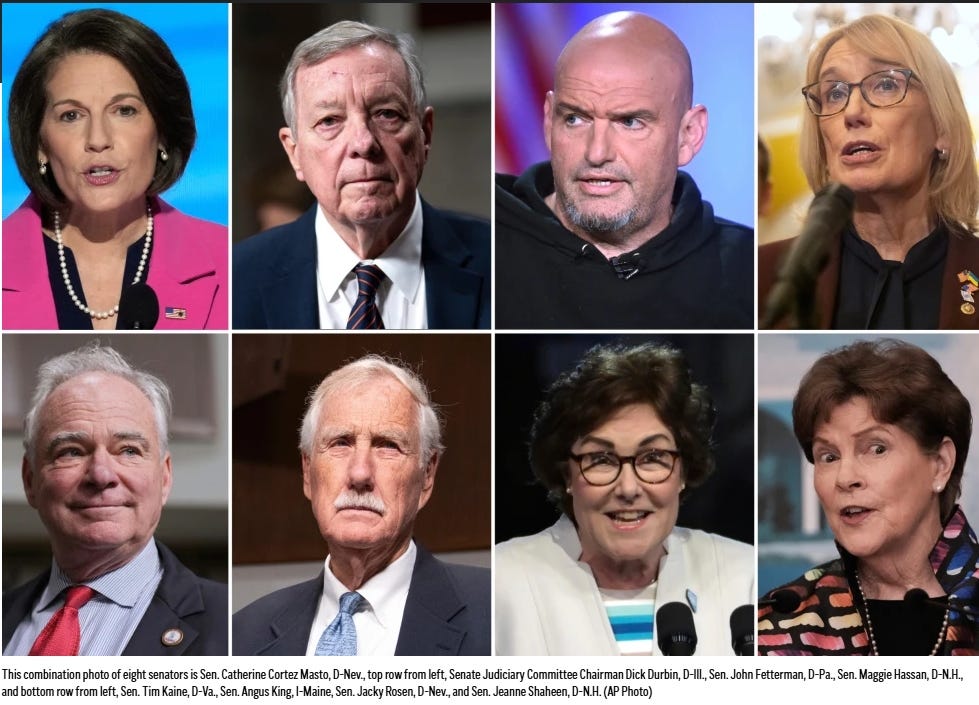
Late on Sunday night, eight Senate Democrats crossed the aisle and voted to help Republicans advance a shutdown-ending agreement. Their votes cleared the 60-vote threshold needed to break a Democratic filibuster. Just like that, the longest government shutdown in modern U.S. history inched closer to resolution—not through negotiation, but through surrender.
The agreement, led by Republicans who hold a narrow Senate majority and control of the House and White House, offers little beyond the reopening of the government under Republican terms. It includes no targeted aid for vulnerable families, no guarantees for programs hit hardest, no sign that the Trump administration’s decision to block food aid will be reversed, and no meaningful concessions from the party that created this crisis. Instead, there is a vague promise of a future vote to extend ACA subsidies. Possibly. Maybe.
What makes this worse is what could have happened instead.
Want to Know Your Rights?
Download a free digital copy of the U.S. Constitution—the same document Trump is trying to bulldoze. Learn exactly what he’s breaking… and how to fight back.
47,000 strong — and counting.
This Early Black Friday, become a paid subscriber for just $1 a week and help us keep the truth alive.
Join The Coffman Chronicle — $1/Week Early Access
The Missed Play That Might Have Worked
Even as the minority, Senate Democrats had strategic tools at their disposal. Chief among them was the power of the 60-vote threshold. Until Sunday night, they were using it to hold the line—not just for leverage, but also for priorities.
One such priority was extending ACA subsidies, a goal that remains unrealized.
Three Bills, One Shutdown
The Senate was considering three standalone appropriations bills to navigate the longest government shutdown in recent memory. One bill would fund the military and defense establishment. Another would fund the United States Department of Agriculture (USDA), which includes the Supplemental Nutrition Assistance Program (SNAP). A third would fund the legislative branch, ensuring Congress, its staff, and its operations remain functional.
These bills are being advanced by Senate Republicans to give the impression that they’re doing something to resolve the crisis. But Democrats voted them down, viewing them as deeply selective. Why fund the Pentagon, but not public housing? Why make sure Congress gets paid, but not ensure families have groceries? For weeks, Democrats resisted what they call a piecemeal approach to budgeting, saying they won’t legitimize a strategy that treats only certain parts of government as worthy of saving.
Why Democrats Have Said “No” to Piecemeal Funding
For weeks, Democrats held firm on a simple principle: the government should be funded in full, not in parts. Passing a military-only funding bill would send a message that weapons and bases are more important than food aid or education. Approving funding for Congress while Americans face missed paychecks, evictions, and food insecurity would scream hypocrisy. Democrats believe if they allow Republicans to fund only what’s politically convenient, the harder—but no less important—parts of government will be left behind.
This wasn’t just about optics. It was about leverage. Once the defense budget is off the table, there’s less pressure on Republicans to compromise elsewhere. Holding the line, Democrats argue, was necessary to force a comprehensive, negotiated solution.
But a shifting legal and humanitarian crisis could have necessitated a shift in strategy.
The Play They Missed
A focused, narrowly tailored bill funding the United States Department of Agriculture and SNAP could have provided food aid to more than 40 million Americans, just as court battles and administrative obstruction were throwing that assistance into question.
More importantly, that vote could have created real pressure. If passed, it would have forced House Republicans and Speaker Mike Johnson to reconvene the chamber to vote on funding food assistance. That act alone would have required them to swear in Representative-elect Adelita Grijalva, whose seating could break open a discharge petition on another explosive issue: the sealed Epstein files.

A clean Senate vote on SNAP wouldn’t have ended the shutdown, but it would have drawn a moral line in the sand. It would have dared Republicans to say no to hungry families and shone a spotlight on exactly who was refusing to govern. Immediately following the November election upset, it could have used fear and momentum to take a stand.
Instead, eight Senate Democrats gave Republicans the votes they needed and walked away empty-handed.
The SNAP Crisis That Made It Urgent
This wasn’t theoretical.
On November 6, U.S. District Judge John J. McConnell Jr. ruled that the Trump administration must release full November SNAP benefits, warning of “irreparable harm” if the White House continued withholding funds. The administration, citing lapses in appropriations related to the shutdown, appealed.
On November 7, Supreme Court Justice Ketanji Brown Jackson granted an administrative stay, pausing the lower court’s order and allowing the First Circuit time to rule on the broader constitutional issue: can courts compel executive spending without a congressional appropriation?
Jackson’s decision wasn’t an endorsement of withholding food. It was a procedural shield meant to protect the separation of powers. Courts shouldn’t become appropriators of last resort. However, while the judiciary waited, the administration acted—halting or cutting November benefits, and continuing to argue that unless Congress explicitly authorizes it, the food will not flow.
This was the moment for Senate Democrats to act— not to win the shutdown, but to fight for the people caught in its gears.
The Safe Senators Who Gave It Away
Among the eight Democrats who crossed the aisle were Catherine Cortez Masto and Jacky Rosen of Nevada, who cited the impact of the shutdown on their constituents and federal workers in their state. John Fetterman of Pennsylvania called it a difficult vote but said he was “holding his nose” to restore stability. Tim Kaine of Virginia emphasized the pain being felt by furloughed workers in his region, while New Hampshire Senators Maggie Hassan and Jeanne Shaheen described the deal as the only viable path forward. Dick Durbin of Illinois, the Senate’s Democratic whip, defended the vote as a regrettable necessity. Angus King of Maine, an independent who caucuses with Democrats, framed his support as a centrist response to dysfunction.
Every one of the eight Democrats who joined Republicans is insulated from the consequences of their vote. None faces reelection in 2026. They could have used that protection to spark a SNAP battle, forcing Speaker Johnson and the House into session, compelling the swearing-in of Representative-elect Grijalva, and a vote on the Epstein discharge petition. Instead, they chose not to use that safety to demand a single concession: no additional SNAP funding, no supplemental WIC guarantees, and no protections for families or the newly unemployed. Instead, they received a vague promise of a possible future vote on ACA subsidies.
Voters took notice. Frustration surged across progressive networks. Advocates who have spent weeks mobilizing for food aid and budget justice were left stunned. It wasn’t just that Democrats lost a fight. It’s that they didn’t throw a punch when they had the chance.
Not a Compromise. A Capitulation
It’s tempting to call this deal a compromise. However, a compromise means both sides give up something.
Democrats gave up their only real point of leverage—the 60-vote threshold. They gave Republicans everything they asked for without forcing a vote on any of their own top priorities. The GOP, meanwhile, received a “Get Out of Jail Free” card and the ability to argue that they sparked the resolution of the shutdown.
This wasn’t a negotiation. It was preemption, and it sets a chilling precedent for the months to come.
The Next Move Must Be Better
The government may soon reopen. However, the long-term damage is real—not just in policy, but in trust.
Senate Democrats won’t get many more chances to define themselves in this shutdown era. They’re the minority. Their power lies not in control of the chamber, but in the clarity of their moral stands, in the strategic timing of their votes, and in their willingness to force Republicans to make impossible choices in the light of day.
They missed that chance on Sunday.
Next time, they’ll need to choose better— not just because voters are watching, but because the people who rely on them for food, housing, and hope can’t afford for them to fold again.
Don’t let the bastards sneak anything past you. Subscribe and get your daily dose of rage and receipts delivered fresh, before the spin doctors can scrub it.
Sources:
“Senate Democrats who defected in shutdown vote: ‘This was the only deal’” — The Guardian, Nov 10, 2025.
“These 8 senators broke with Democrats on the government shutdown deal. Here’s how they explain it” — Associated Press, Nov 10, 2025.
“‘America Deserves Better’: Chuck Schumer Faces Broad Backlash Over Shutdown Deal He Opposed” — Time, Nov 10, 2025.
“US Senate takes steps toward vote to end historic federal shutdown” — The Guardian, Nov 9, 2025.
“US Senate shutdown vote: What happened, who voted to end it …” — Al Jazeera, Nov 10, 2025.
Supreme Court issues emergency order to block full SNAP food aid payments — Associated Press, Nov 7, 2025.
Supreme Court temporarily blocks order on releasing SNAP benefits — The Washington Post, Nov 8, 2025.
Trump admin will partially fund November SNAP benefits — Politico, Nov 3, 2025.
US Supreme Court lets Trump withhold $4 billion in food aid funding for now — Reuters, Nov 8, 2025.
Senate Republicans strike down Democratic proposal to fully fund SNAP — The Guardian, Nov 4, 2025.
S.3024 — Keep SNAP Funded Act of 2025 — Congress.gov.
Democrats and Republicans Clash Over SNAP Contingency Funds — FactCheck.org, Oct 31, 2025.
Hawley Introduces Legislation to Fund Food Stamps and Farm Programs During Government Shutdown — Office of Senator Josh Hawley press release, Oct 22, 2025.
Supreme Court temporarily pauses ruling on November SNAP payments — SCOTUSBlog, Nov 8, 2025.

Hey, you want them playing cards over kid's meals?? Go to Hell you bourgeois bastards. Your health insurance costs do NOT count more than my sister's food, you got that, punk?!?
They caved for a pinky swear 🤬
https://open.substack.com/pub/itskeifer/p/government-to-reopen-after-democrats?utm_source=share&utm_medium=android&r=53zpx3