


On Monday, January 19, 2026, while much of the country observed Martin Luther King, Jr. Day, the Trump administration filed a notice of appeal in the U.S. District Court for the District of Rhode Island. The filing was brief, procedural, and easily missed amid the holiday headlines.
Its implications are seismic.
The appeal challenges the court’s November 9, 2025, ruling that permanently enjoined the administration from dismantling the Institute of Museum and Library Services (IMLS), the only federal agency solely dedicated to supporting America’s 117,000 libraries and 35,000 museums. The original lawsuit, Rhode Island et al. v. Trump, brought by several states and joined by labor partners including the American Federation of State, County, and Municipal Employees (AFSCME), successfully argued that the administration’s actions to dismantle IMLS were unlawful, unconstitutional, and a direct violation of statutory mandates.
Now, the administration wants that ruling overturned. If they succeed, the consequences will stretch far beyond libraries.
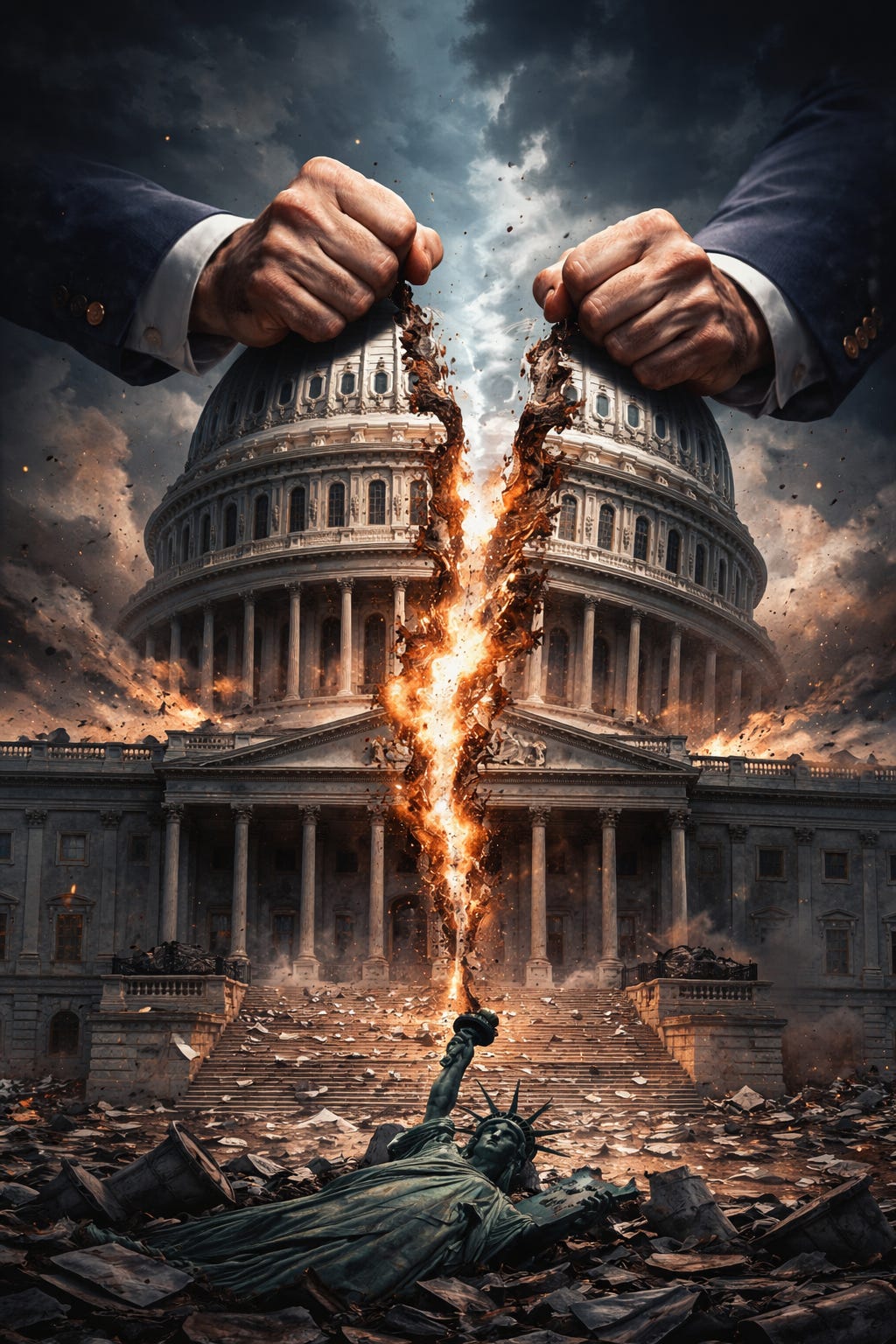
This case is not about museums. It is not about libraries. It is not about grants, buildings, or storytime. It isn’t even about censorship or book bans. It is about whether a president can unilaterally defund and dismantle a federal agency that Congress created, funds annually, and has explicitly chosen to keep alive.
It is a test case, a precedent-seeking move, and a constitutional stress test dressed in bureaucracy.
If the courts side with the president, we will have answered a terrifying question: Can the executive branch eliminate parts of government without congressional approval?
The answer, in that case, would be yes, and the Republic, as designed, would be over.
Want to Know Your Rights?
Download a free digital copy of the U.S. Constitution, the same document Trump is trying to bulldoze. Learn exactly what he’s breaking, and how to fight back.
100,000+ strong — and counting.
This winter of our discontent, become a paid subscriber for just $1 a week and help us keep the truth alive.
Join The Coffman Chronicle — $1/Week
A Trojan Horse Dressed as a Technicality
The administration’s legal arguments haven’t been fully laid out in public filings yet, but court watchers and constitutional scholars expect the White House to lean heavily on procedural shields, such as the Tucker Act, which limits certain claims against the federal government to financial disputes. Their likely aim will be to frame the original ruling as judicial overreach, essentially an interference with the president’s authority to allocate and execute funds.
However, the lower court already addressed that. In her decision, Judge Mary McElroy wrote plainly that “no constitutional or statutory framework grants the president unilateral authority to dismantle an agency created and funded by Congress.” She noted that Congress has passed, funded, and renewed IMLS’s authorization consistently since its establishment in 1996, and that the president’s March 14, 2025, executive order directing the agency’s “sunset” lacked both legal justification and procedural legitimacy.
Yet here we are, with an appeal designed not to argue policy, but to test precedent, and to see just how far the judiciary will allow the White House to go in treating governance like suggestion.
It’s not just about winning this case. It’s about building a path to win the next one faster and with less resistance.
And while many Americans may not utilize or understand the resources provided by their local library or museum, the next agency the administration dismantles will be far harder to ignore or excuse.
Why IMLS? Because It Was the Easiest Target
To the administration, this wasn’t a random fight. IMLS was the perfect test subject. It is an obscure agency, with limited public recognition and no powerful industry lobby behind it. Its annual budget, at just $265 million, makes up a rounding error in federal spending. Its staff is small. Its grantees are spread thin across rural towns, urban library branches, small historical societies, and community museums. It is the kind of institution that serves widely but quietly, without the fanfare or PR power that might make it a difficult kill.
In April of last year, in The Library Is Still Open, we described libraries as America’s second responders, the institutions that show up when every other system fails. They serve as emergency shelters, cooling centers, polling places, food distribution hubs, and social service guides. They provide internet to the disconnected, job search support, language learning, and after-school safety for children whose communities no longer have the resources to provide these elsewhere.
Yet their value — profound, tangible, measurable — is not often loud. In an age where political survival is determined by what goes viral, libraries often don’t make a splash.
Instead, they make a difference, often to the most vulnerable and powerless, and that, tragically, makes them vulnerable.
IMLS, as the federal engine behind many of these local efforts, became a low-risk, high-yield target, and therefore the ideal place to test the theory that the president can erase what he does not control.
The Real Fight: Separation of Powers, Not Library Cards
At its core, this case is about constitutional architecture. Congress has the power of the purse. It creates agencies through legislation and allocates their budgets. The president’s job, as laid out in Article II, is to “take Care that the Laws be faithfully executed.” He cannot simply decide that certain laws, or the agencies they authorize, are inconvenient.
And yet, that is precisely what Trump has done. Through Executive Order 14231, signed on March 14, 2025, the administration directed the Office of Management and Budget to “initiate the phased wind-down” of IMLS, including immediate staff furloughs and grant cancellations. By mid-April, the agency had ceased operations. Its leadership was placed on leave. Its website began redirecting users to the Department of Government Efficiency (DOGE). Grant recipients were told their funds were “no longer assured.” Staff were gagged from speaking publicly.
Congress had neither defunded nor repealed IMLS. No vote had occurred. However, the agency was, for all practical purposes, gone, erased by executive fiat.
This is the moment the lawsuit was filed. This is where the courts stepped in, and this is now what’s under threat.
If this appeal succeeds, the executive branch will have formal permission to dismantle congressionally created institutions, not by law, but by neglect.
The Authoritarian Dream: Set Precedent Quietly, Then Use It Loudly
What makes this case so dangerous is not the agency involved, but the precedent it seeks to establish.
Authoritarian regimes do not begin with sweeping declarations. They begin with small tests, quiet shifts, and legal maneuvers that seem technical — even boring — to the public.
That is why this case matters.
As we warned in “It Started with a Map” last August, authoritarianism isn’t always loud at first. It moves in stages. It rewrites historical plaques,t purges archives, and guts grant programs. It replaces shared truth with executive discretion, and when the courts allow it, that precedent becomes law.
IMLS is simply the prototype. If this appeal is upheld, there is no functional reason the same mechanism couldn’t be used to target the Environmental Protection Agency, the Department of Education, or the Civil Rights Division of the DOJ. All it would take is silence from Congress, and complicity or fatigue from the courts.
This isn’t the start of the monarchy. It is the solidifying of it.
What Happens If They Win
If the First Circuit reverses the lower court and upholds the administration’s dismantling of IMLS, the damage won’t be limited to one agency. It will be a legal green light for the executive to dismantle any federal structure it finds politically inconvenient. The separation of powers will remain in name only. Congress will write the checks, but the president will decide which ones get cashed. The courts will issue rulings, but the executive will act — or not — at its discretion.
That’s not oversight, but performance.
When that happens, we will have accepted, in the guise of technical governance, a governing structure where only one branch holds real power.
The Fight Isn’t About Books. It’s About the Republic.
Do not confuse this article with downplaying the value of IMLS or the institutions they help support. Public libraries and museums are essential because they are the keepers of memory, of knowledge, and of access. They are core pillars of democracy.
This fight, however, didn’t happen overnight. It has taken generations of underfunding, repeated culture wars over book bans, and post-capitalist consumerism to create the conditions for using this agency as a starting point for full executive control.
Libraries and museums are easy to ignore until you need one. So are the rules of government, the invisible scaffolding of checks and balances, legislative mandates, and judicial review. However, when those rules fall, the consequences are real.
We’re watching one of the most important constitutional fights of this era play out in a case most people haven’t heard of, about an agency most people couldn’t name.
That’s how power is taken: when the rest of us aren’t looking.
If you believe democracy doesn’t defend itself, neither should journalism.
Subscribe to The Coffman Chronicle for ongoing coverage of the battles most headlines miss, and the stakes too high to ignore.
We follow the threads. We name the patterns. We don’t look away.
Sources:
“Trump Administration Appeals Decision in IMLS Lawsuit Brought by State Attorneys General” (Jan. 19, 2026) — Book Riot
“A Victory for IMLS as Court Blocks Trump’s Attempt to Dismantle Agency” (Nov. 21, 2025) — School Library Journal
“Federal Judge in Rhode Island Orders Halt to IMLS Dismantling” (May 14, 2025) — Publishers Weekly
“Library Grants Reinstated Nationwide After ‘Massive’ Legal Victory” (Dec. 4, 2025) — Newsweek
“IMLS Restores Competitive Grant Funding” (Dec. 4, 2025) — Publishers Weekly
“Museums Cautiously Optimistic as Some Federal Grants Reinstated After Federal Court Ruling” (May 21, 2025) — Hyperallergic
“Continuing the Reduction of the Federal Bureaucracy” (Mar. 14, 2025) — White House
“The Trump Administration Is Threatening Libraries, Museums, and Other Nonprofits That Support the Arts, Humanities, and Learning” (Jul. 7, 2025) — Center on Budget and Policy Priorities
“Trump guts small federal agency funding museums and libraries” (Mar. 31, 2025) — Politico
“Trump Order Threatens University Libraries, Museums” (Mar. 20, 2025) — Inside Higher Ed
“Institute of Museum and Library Services” — Wikipedia
“IMLS Restores All Previously Canceled Federal Grants” (Dec. 3, 2025) — IMLS.gov
“Celebrating the Federal Court Ruling Protecting IMLS” (Nov. 21, 2025) — EveryLibrary.org
“IMLS Ceased Performing Agency Functions and Withheld Funds From Obligation” (Jun. 16, 2025) — U.S. Government Accountability Office
He is a dictator errands l wanna be! Must be stopped! We were all warned this would happen.
Throw the bounty out quickly!! He’s destroying us directly in line with the stupid 2025 playbook. Congress!!! Where are you!!!!!!??????