


The Atlantic hurricane season begins June 1, but the real storm has already arrived for millions of Americans, especially in the South and rural Midwest.
In the first months of 2025, a deadly tornado tore through Arkansas. West Virginia drowned under flash floods. North Carolina is still struggling to recover from Hurricane Helene. Federal disaster response was slow, muted, or nonexistent in each case. And in each case, the message was the same: you’re on your own.
This isn't an isolated failure. It’s the deliberate dismantling of the American disaster response system, cut by cut, agency by agency, dollar by dollar.
In our previous piece, The Rural Lie, we exposed how Trump 2.0 has turned rural America into a sacrifice zone, gutting health care, food access, and job opportunities under the guise of patriotism. Now, we turn to the next stage of that betrayal: what happens when the levee breaks, the flames rise, or the sky turns black, and no one comes.
This is the story of how the Trump administration, through its Department of Government Efficiency (DOGE), has set a slow-motion collapse of our disaster infrastructure in motion. From gutting AmeriCorps, which trained communities for emergencies, to crippling NOAA’s forecasting ability, to transforming FEMA into a top-down fiefdom with no local trust or accountability, this isn’t a broken system.
It’s a new one.
One that prepares no one, warns no one, and saves no one—unless there’s profit to be made.
Coffman Chronicles
We just hit 13,000 subscribers—thank you! We’re offering full access to The Coffman Chronicle at 50% off to celebrate.
Get exclusive analysis and fearless reporting you won’t find in corporate media.
Support truth. Stay informed.
Before the Storm: From Preparation to Silence
Long before the winds howl or the water rises, there are warning signs and people trained to respond to them—or at least there used to be.
For decades, programs like AmeriCorps quietly formed the backbone of rural and small-town emergency preparedness. These weren’t flashy, headline-making operations. They were young adults clearing storm drains, coordinating emergency shelters, and helping elderly residents craft evacuation plans. They were in church basements and community centers, doing the slow, essential resilience-building work.
However, in 2025, the Trump administration, through DOGE, slashed over $400 million from AmeriCorps. Over 32,000 volunteers were displaced, and over 1,000 community preparedness programs vanished.
This loss isn’t theoretical. We’ve documented how these cuts turn rural communities into sacrifice zones.
Read our full report:

Now, there’s no one left to run evacuation drills. No one to organize the storm shelter checklist. No one to help the food bank stock up in advance of the flood forecast.
And the forecast itself? That’s another silence, one created by the ongoing degradation of NOAA.
The Eye of the Storm: Undermining NOAA and Public Forecasting
Disaster response begins with a forecast. With time. With a warning. Without it, there’s no preparation—only panic.
For over 50 years, the National Oceanic and Atmospheric Administration (NOAA) has been that warning system. Through satellites, weather balloons, radar, and public alerts, NOAA provided the raw data behind everything from your local five-day forecast to hurricane evacuation orders. It was a public good, funded by taxpayers and accessible to all.
Until now.
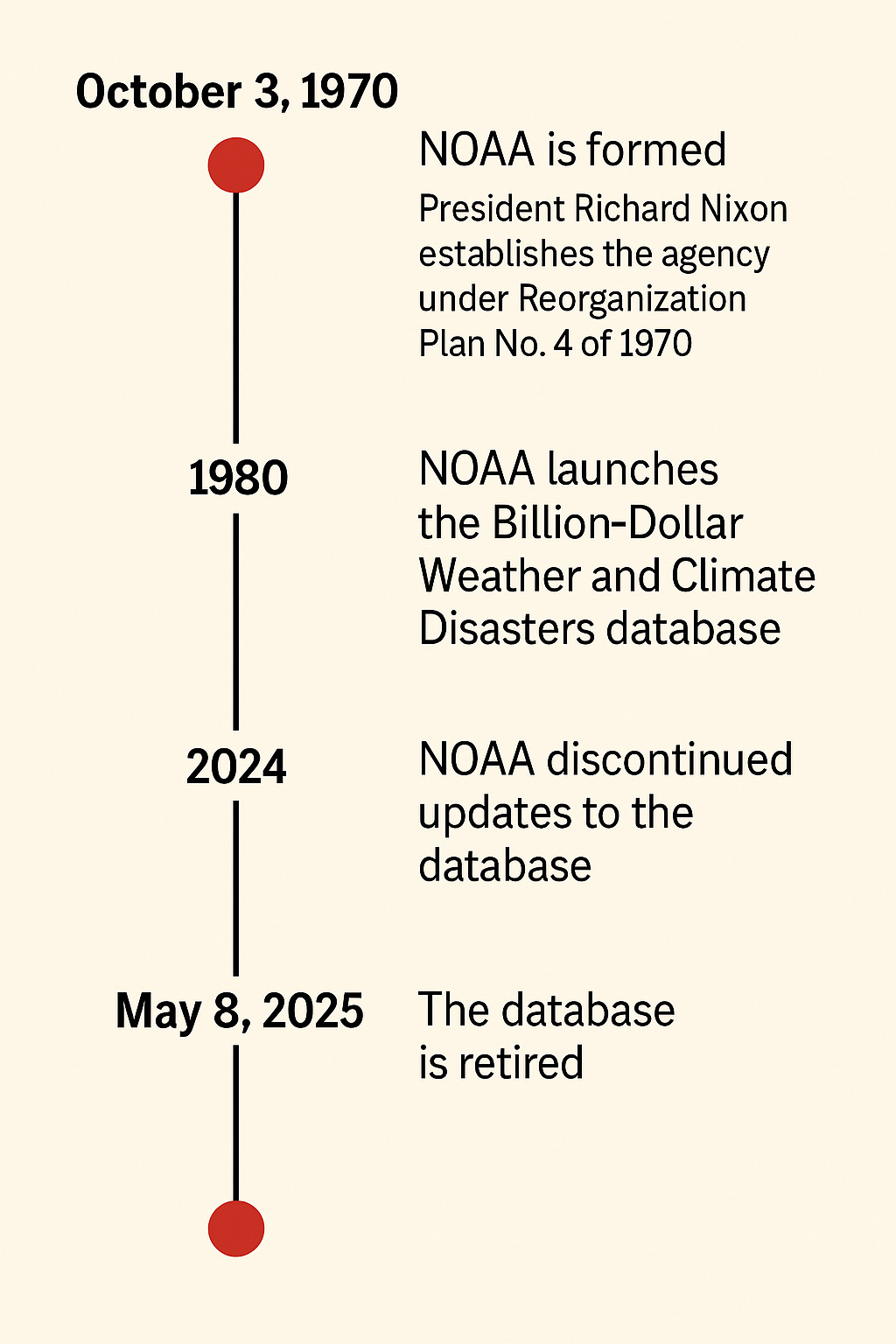
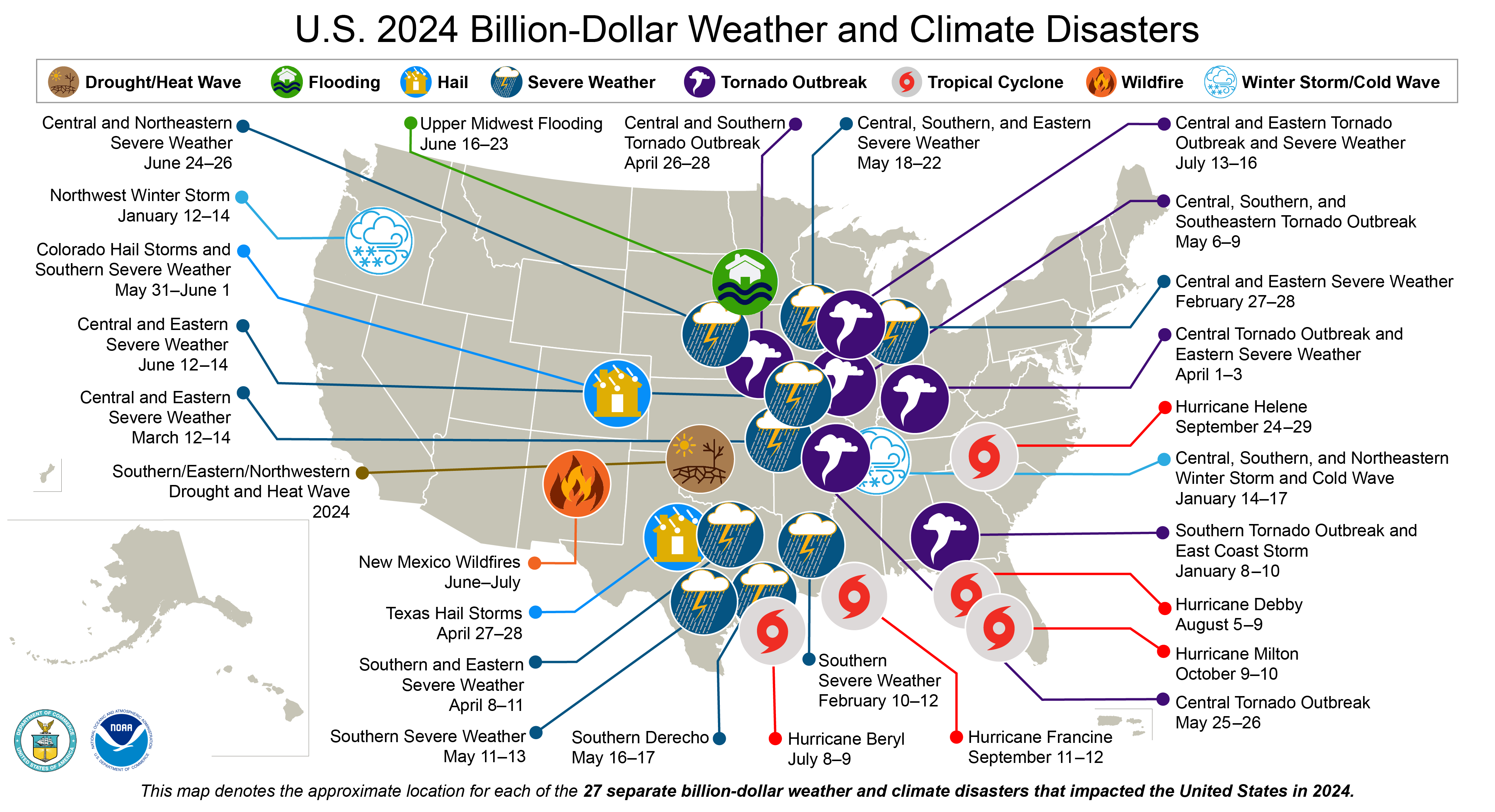
On May 8, 2025, NOAA announced it would retire its Billion-Dollar Weather and Climate Disasters database, ceasing updates beyond 2024. This database, which has tracked the cost of extreme weather events since 1980, has been instrumental in assessing the economic impacts of climate change-induced disasters like wildfires, hurricanes, and heatwaves.
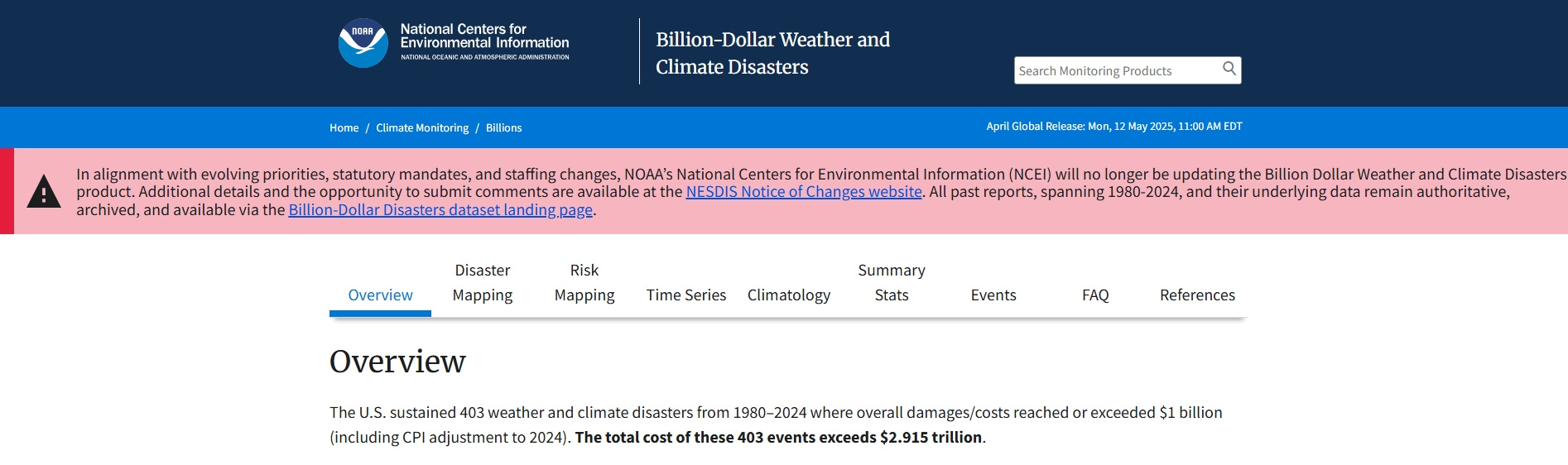
The database's retirement is more than a bureaucratic change; it's a strategic effort to erase the evidence of escalating climate costs.
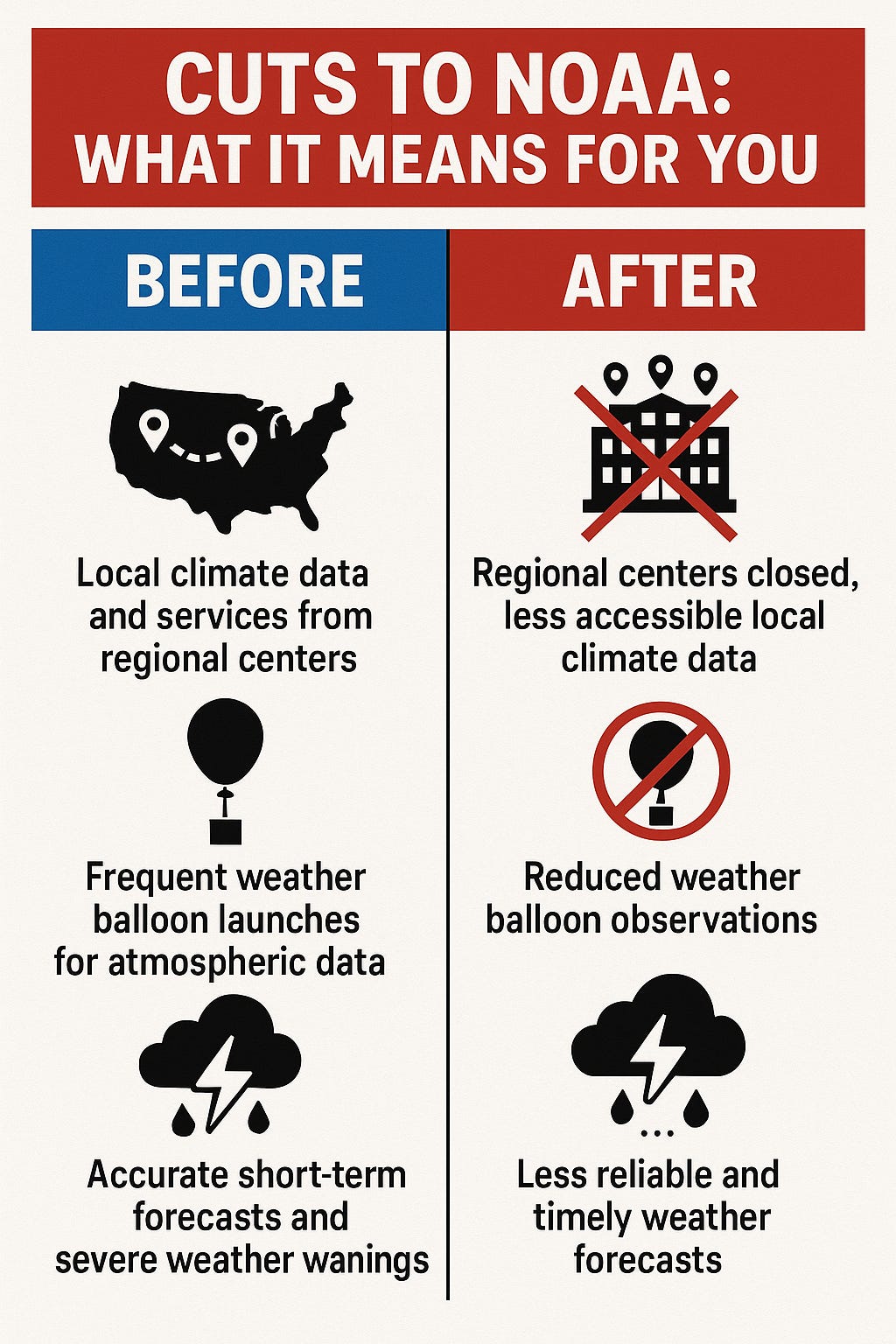
But the cuts didn’t stop there. Through DOGE and the proposed NOAA budget, the administration is slashing:
Funding for the Office of Oceanic and Atmospheric Research (by up to 74%)
Dozens of regional climate centers
Weather balloon launches, essential for real-time storm modeling
These cuts reduce warning time and increase forecast error, making it harder for meteorologists to tell you whether to evacuate or shelter in place.
Meanwhile, a cottage industry of private weather companies flourishes, built almost entirely on NOAA’s publicly funded backbone.
AccuWeather repackages NOAA data, while lobbying to limit the National Weather Service’s public alerts. IBM’s Weather Company sells premium forecasts built from NOAA’s models. Spire Global and Tomorrow.io, which run some of their own satellites and AI tools, still rely on NOAA data to validate their systems and keep their outputs largely behind paywalls.
These companies aren’t replacing NOAA. They’re riding its shoulders.
And now they’re cashing in while the foundation crumbles.
When disaster comes, the silence won’t be an accident.
It will be policy.
After the Storm: FEMA in Freefall
When the storm passes, we expect help to come. That expectation was called FEMA.
But in 2025, that system is in freefall.
Just weeks before hurricane season, President Trump abruptly fired Acting FEMA Administrator Cameron Hamilton, replacing him with David Richardson, a former Marine with no major emergency management background. Richardson’s appointment came one day after Hamilton warned Congress that dismantling FEMA would be a “catastrophic mistake.”
Richardson's message to staff? “Don’t get in my way. If you do, I will run right over you.”
FEMA’s workforce is shrinking, programs for underserved and rural communities are disappearing, coordination is breaking down, and disaster declarations—for Arkansas, North Carolina, and West Virginia—are being denied or delayed.
This isn’t a FEMA that failed. It’s a FEMA that’s been deliberately neutered.
If help comes, it may be from a contractor, not your government.
And it won’t be free.
Collapsing the System, One Link at a Time
This isn’t a broken chain. It’s a dismantled one.
Cut AmeriCorps: no preparation.
Cut NOAA: no warning.
Cut FEMA: no rescue.
The Trump administration hasn’t just failed at disaster response. It’s systematically removed every phase of it.
In its place? A privatized model. One where survival is pay-to-play. One where risk is someone else’s profit.
It’s not neglect.
It’s engineered collapse.
The Insurance Time Bomb
Without NOAA’s data, insurers cannot model risk, and they cannot or will not offer affordable coverage.
Companies are already pulling out of high-risk areas like the Gulf Coast and wildfire zones. Premiums are doubling and tripling, and some homeowners are uninsurable.
The result? No forecast. No preparation. No rebuilding.
Even if you’ve done everything right—paid every premium—you may be left with nothing.
And it’s not an accident. It’s a predictable outcome of tearing down the very infrastructure that lets people stay afloat after disaster.
The Political Irony: Red States, Real Losses
The greatest irony? Trump’s strongest supporters are his biggest victims.
Arkansas. West Virginia. North Carolina. Red states, abandoned in the flood, tornado, and hurricane aftermath.
Why? Because this isn’t about saving people; it’s about proving that government can’t save them. So that when the system fails, the private sector steps in.
And loyalty? Loyalty is useful when it’s blind.
The administration isn’t serving its voters.
It’s using them to justify dismantling everything that once kept them safe.
This Is Not Incompetence. It’s Strategy.
This is not a government too slow to act.
It’s a government that’s chosen not to.
It’s chosen to cut preparedness, silence science, and leave recovery to the marketplace.
It’s chosen to turn disaster into opportunity for private firms, political donors, and authoritarian control.
The collapse isn’t hypothetical.
It’s here.
And it’s being managed like a business.
And for most of us? There is no help coming.
We just hit 13,000 subscribers—thank you! We’re offering full access to The Coffman Chronicle at 50% off to celebrate.
Get exclusive analysis and fearless reporting you won’t find in corporate media.
Bibliography:
Dance, Scott. “NOAA Will Stop Updating Database Tracking Costliest Weather Disasters.” The Washington Post, May 8, 2025.
“Billion-Dollar Weather and Climate Disasters.” NOAA National Centers for Environmental Information. Accessed May 10, 2025.
“Trump Administration Cuts to AmeriCorps Causing ‘Damage and Disruption.’” CBS News, May 7, 2025.
Ludden, Jennifer. “Trump’s Gutting of AmeriCorps Hits Hard, for Both Volunteers and Communities.” NPR, May 9, 2025.
“AmeriCorps Cuts Prompt Two Dozen States, Including Minnesota, to Sue Trump Administration.” MPR News, April 30, 2025.
Sganga, Nicole. “New FEMA Head Tells Staff: ‘Don’t Get in My Way… I Will Run Right Over You.’” CBS News, May 9, 2025.
“FEMA Chief Fired After Breaking with Trump on Disaster Agency’s Future.” Reuters, May 8, 2025.
“David Richardson.” FEMA.gov. Accessed May 10, 2025.
Kahn, Chris. “'I Alone Will Speak on Behalf of FEMA,' New Agency Chief Tells Staff.” MSN News, May 9, 2025.
Miller, Zachary. “New FEMA Head Says He Will 'Run Right Over' Staff Who Resist His Changes.” MSN News, May 9, 2025.
“Spire Global Awarded $3.8 Million NOAA Contract for Satellite Weather Data.” Spire Global, September 9, 2024.
“Tomorrow.io Awarded NOAA Contract to Support Commercial Weather Data Program.” Tomorrow.io, October 8, 2024.
“Validation & Potential Impact of Tomorrow.io Precipitation/Radar Satellite Data with NOAA Scientists.” NOAA Technology Partnerships Office. Accessed May 10, 2025.
“Tomorrow.io Demonstrates High-Quality Data from Newly Launched Microwave Sounders, Setting the Stage for Significant Weather Forecasting Advancements.” Tomorrow.io, October 2024.
“Spire Global Awarded $9.4 Million Contract by NOAA for Satellite Weather Data.” Spire Global, January 8, 2024.
Yes, the defunding/dismantling is real so we must use every resource to prepare to the best of our abilities. https://www.fema.gov/emergency-managers/individuals-communities/preparedness-activities-webinars/community-emergency-response-team
CERT info is a great start. Grab it while the information is still available online.
Wildfire season is almost here in the Pacific Northwest. We see devastation on a yearly basis and dependent upon federal aid to support impacted citizens and in infrastructure restoration.
It is also a matter of when, not if, for a large earthquake. We have been hearing those warnings for quite some time and I expect to see one in my lifetime.