


The dog first appeared on a Tuesday, sitting in the narrow strip of shade beside a row of mailboxes, panting softly in the afternoon heat.
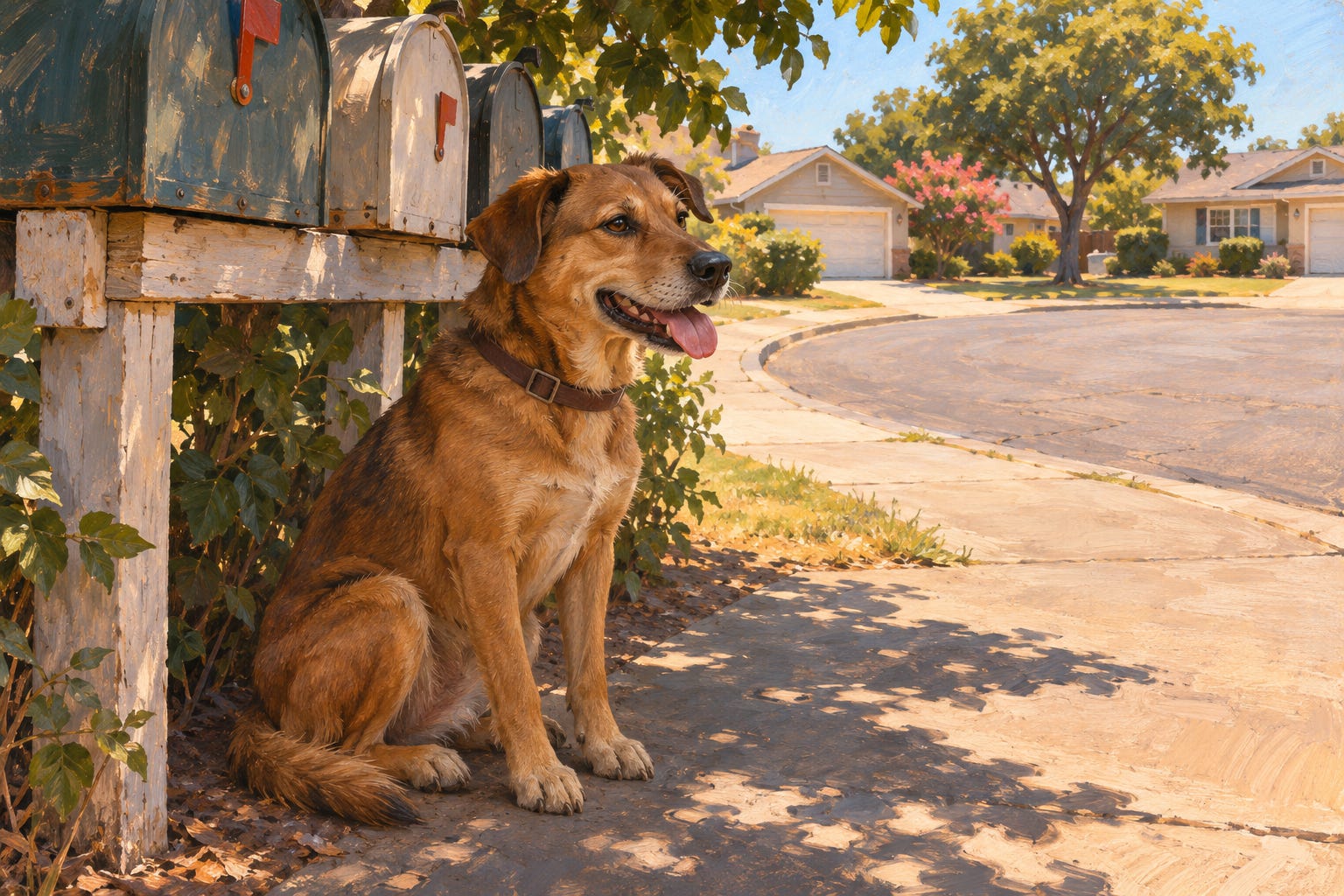
He was medium-sized and brown, with a collar but no tag. When Mrs. Dwyer came out to get her mail, he looked up at her with the patient expression of someone who had already heard every excuse.
“Well,” she said. “Hello, Buddy.”
Buddy wagged his tail once.
Mrs. Dwyer went inside and returned with cold water and a biscuit. The bowl clinked against the pavement as she set it down, but by then the dog had moved on.
This Community Is Powered by You
What started as a small circle has grown into something much bigger, and it’s all because of readers like you.
Every time you forward this email, post it on socials, or bring someone new into the fold, you’re helping build one of the most passionate, independent communities out there.
Want to keep the momentum going?
Share this newsletter with someone who should be part of this conversation.
Thank you for being here. It means everything.
Every Porch Had a Name for Him
On Wednesday, he was on the porch two doors down. Mr. Kim was watering his tomatoes, whose damp leaves gave off their sharp, green smell. “I’m calling him Pickles,” he said.
“Why Pickles?” his wife asked.
“He looks like a Pickles.”
She considered this. “He looks like a dog.”
The dog accepted a small piece of cheese from Mr. Kim and wandered toward the end of the cul-de-sac.
By Thursday, he had a third name. “Who’s a good Scout?” Tyler called from his driveway.
The dog trotted over. Tyler’s mother came outside, took one look at the untagged collar, and folded her arms. “We are not naming him. We are finding out where he belongs.”
“Sure,” Tyler said, scratching Scout behind the ears. “That’s why I named him.”
No one could agree on when the dog had first arrived. Mrs. Dwyer was certain it was Tuesday. Mr. Kim thought he had seen him the previous weekend. Tyler said Scout had been “around for a while,” which could mean anything from a day to the entire summer.
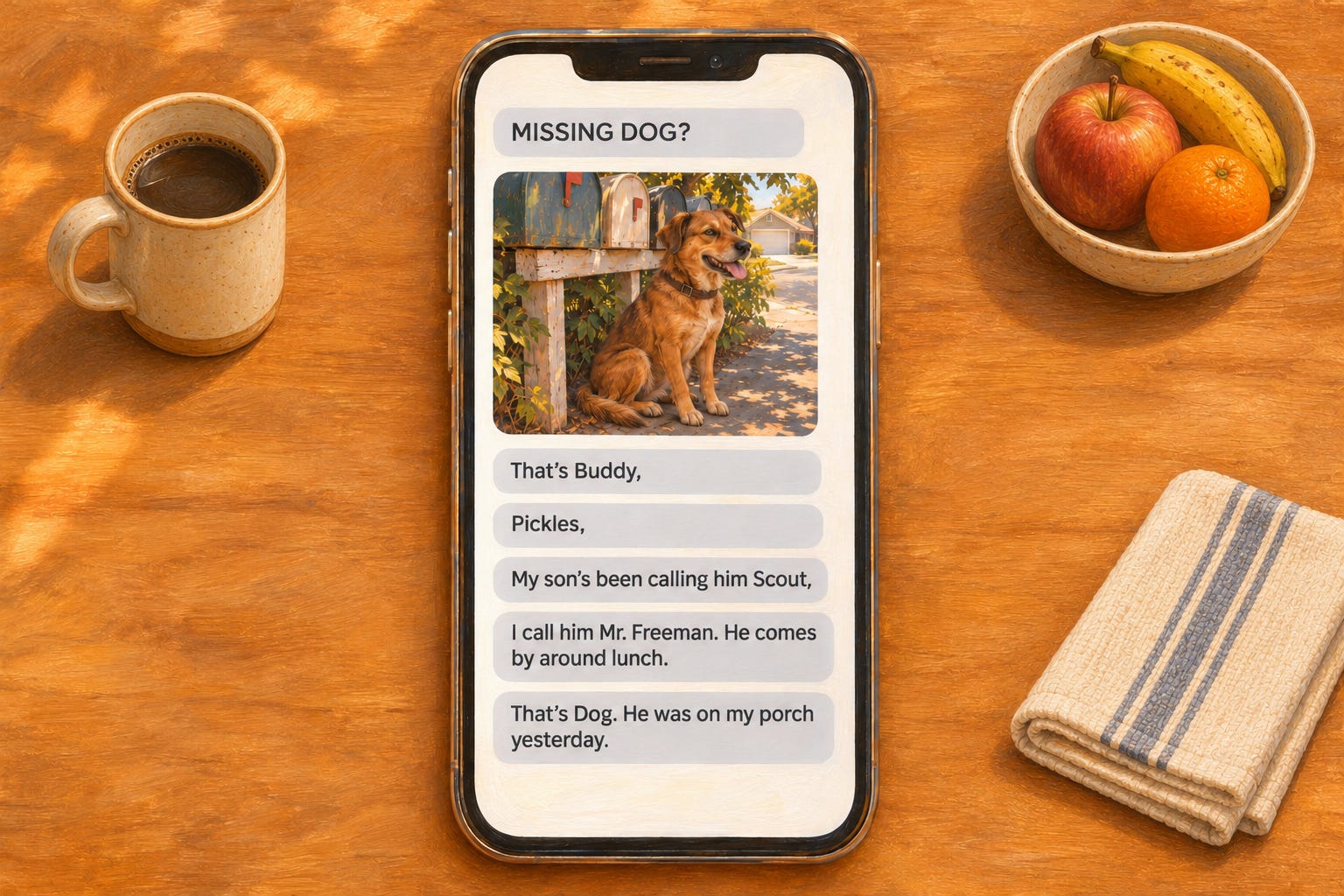
The neighborhood group chat became the official record. MISSING DOG? someone posted, along with a photograph of the dog beside the mailboxes.
“That’s Buddy,” Mrs. Dwyer replied.
“Pickles,” wrote Mr. Kim.
“My son’s been calling him Scout,” Tyler’s mom added.
A neighbor named Denise sent back a photo of the same dog by her garage. “I call him Mr. Freeman. He comes by around lunch.”
The last person to weigh in was Mr. Bell, who lived at the end of the street. “That’s Dog. He was on my porch yesterday.”
The discussion paused. “You named him Dog?” Tyler’s mother asked.
“I didn’t name him,” Mr. Bell replied. “I identified him.”
For several days, the arrangement seemed to work. Mrs. Dwyer put out water, Mr. Kim shared cheese, and Tyler carried treats in his pocket so often that the dog began recognizing the sound of his bicycle. Denise had an old porch blanket that Mr. Freeman seemed to consider his office. Mr. Bell left a cardboard box near his garage, though he insisted that did not count as participation.
Nobody organized any of this. Nobody needed to. A thirsty dog appeared, and people helped. It was the sort of community generosity that happened before anyone had time to create a committee.
Everyone Thought Someone Else Had Checked
Then Saturday morning came, and the dog showed up at Denise’s house limping. Each time he put weight on his front paw, gravel shifted beneath it.
Denise crouched several feet away. “Hey, Mr. Freeman.”
The dog wagged his tail but did not move closer. Within fifteen minutes, the neighbors had gathered in the driveway, leaving him room.
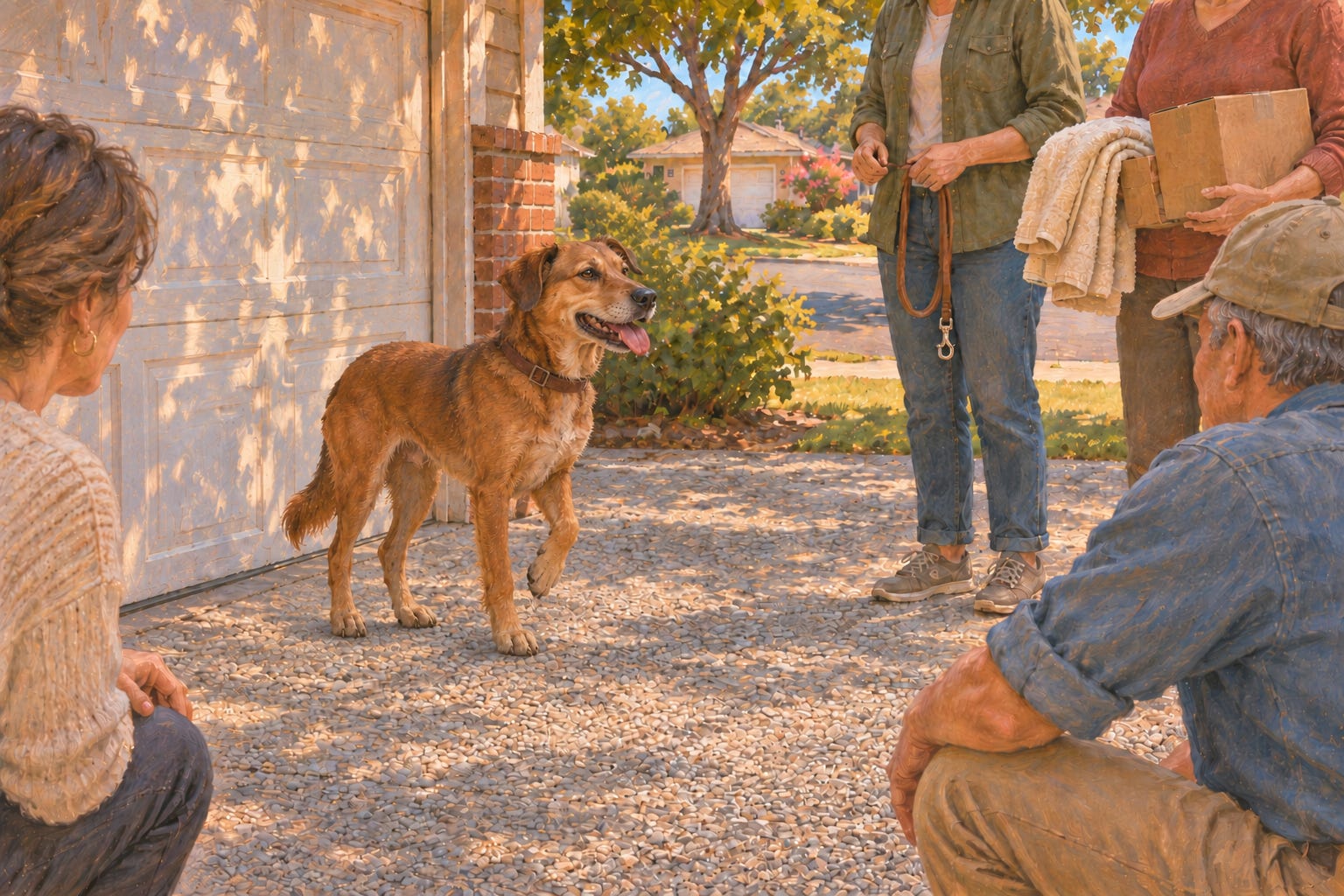
“I can call the shelter,” Denise said.
“I can drive him if they tell us where to go,” Mr. Kim said.
“I have a leash,” Mrs. Dwyer offered.
“I have treats,” Tyler said.
“Those are not the same thing,” his mother reminded him.
Mr. Bell arrived carrying a cardboard box.
Denise stared at it. “What is that for?”
“In case he needs a box.”
The dog looked at the box, then at Mr. Bell.
“He doesn’t need a box,” Tyler said.
“I’m prepared,” Mr. Bell replied.
Denise called the county animal shelter. A woman named Maria answered. She asked whether the dog was bleeding, whether he could walk, whether anyone had been bitten, and whether he had a tag.
“No tag,” Denise said. “Just a collar.”
“Has anyone checked whether somebody reported him missing?”
The neighbors looked at one another. “I assumed someone had,” Mrs. Dwyer said.
“So did I,” Mr. Kim added.
Denise covered the phone. “I thought the shelter would already know.”
Everyone looked at Mr. Bell. “What?” he said. “I thought one of you knew who he belonged to.”
There it was. For nearly a week, five households had been feeding the same dog. Everyone had cared, and everyone had helped, but nobody had taken responsibility for the question that mattered most: Where did he belong?
Maria explained that the shelter could scan him for a microchip, check lost-animal reports, and examine his paw. She also walked the neighbors through moving him safely.
Half an hour later, Scout-Buddy-Pickles-Mr.-Freeman-Dog was riding in the back seat of Mr. Kim’s car. Tyler sat beside him. Mrs. Dwyer supplied the leash, Denise carried a towel, and Mr. Bell put his box in the trunk. “For supplies,” he clarified.
Nobody argued.
A Plan Takes More Than Good Intentions
At the shelter, Maria scanned the dog. No chip. She checked the county database and nearby municipalities. No matching report. A veterinary technician examined his paw and found a small cut between the pads. It needed cleaning and rest, but there was no serious injury.
“That’s good news,” Denise said.
“It is,” Maria replied. “But he still needs somewhere to go.”
The neighbors had assumed that bringing him to the shelter would transfer the whole problem to someone else. Maria gently corrected them. The shelter could scan animals, keep lost-animal reports, provide temporary care in emergencies, connect people with rescue groups, and help determine whether an animal had an owner. What it could not do was create unlimited kennels, staff, foster homes, or money.
“We’ll help,” Maria said. “But if one of you can foster him while we keep looking, that gives us room for the next animal with nowhere else to go.”
Denise looked at the dog. The dog looked at Denise. “I suppose Mr. Freeman already knows my kitchen.”
“Scout,” Tyler corrected her.
“Not helping.”
The neighborhood went home with a plan. Denise would foster him temporarily while the shelter continued checking lost-animal reports. A local rescue group would post his photograph and help find a permanent home if no owner appeared. Mr. Kim offered to cover the first veterinary appointment. Mrs. Dwyer found a sturdier leash, and Tyler’s mother agreed to help with walks. Tyler was told not to design adoption flyers until they knew whether the dog already belonged to someone.
Mr. Bell contributed the cardboard box. Nobody was entirely certain why.
That night, the dog settled into Denise’s kitchen. His nails clicked across the floor as he inspected the cabinets and suspicious corners. He drank some water, circled twice, and curled up beside the back door.
Later, Denise got out of bed for a glass of water. The dog lifted his head and watched her for several seconds.
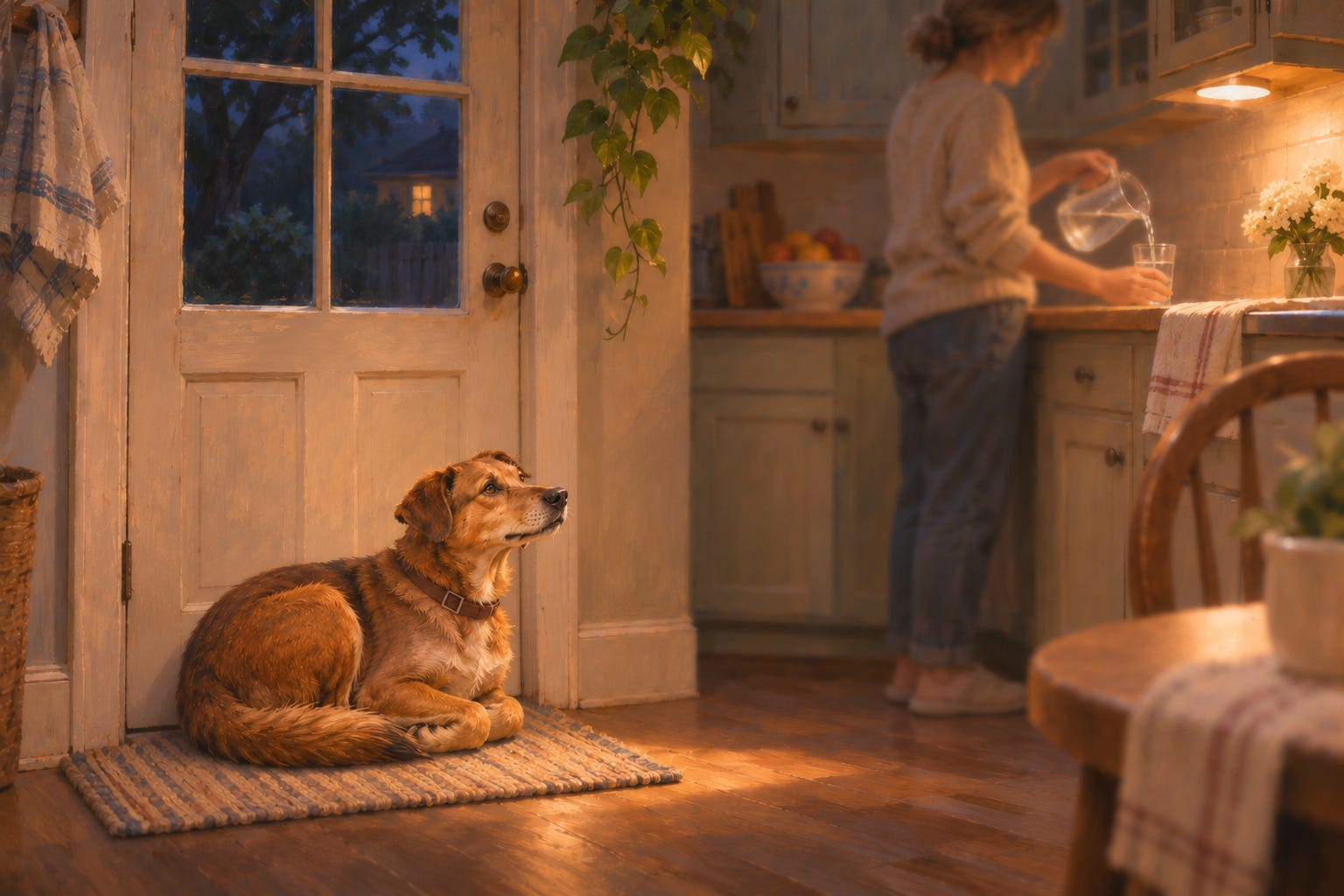
Apparently satisfied that she was still there, he rested his head again. Denise stood quietly in the kitchen. Feeding him had been easy. This was different. This was responsibility.
Over the next several weeks, the neighbors learned more about him. He was gentle and house-trained. He disliked thunderstorms and had no interest in Mr. Kim’s tomatoes, though Mr. Kim continued regarding him with suspicion. He liked warm patches of sunlight and sitting directly in the center of any conversation that lasted longer than five minutes.
The shelter never found his previous owner. The rescue group eventually located a family a few miles away who were looking for an adult dog. They had a fenced yard, two teenagers, and another dog named Walter.
Before the family arrived, Tyler announced that the neighborhood needed to settle the name question. “We cannot send him into a new life with five names.”
“Four names and one identification,” Mr. Bell said.
Tyler ignored him. His mother put the name question to a vote in the neighborhood group chat. Buddy received two votes, Pickles one, Scout three, and Mr. Freeman a write-in from Denise. Dog received no votes.
Mr. Bell objected. “I was not informed nominations had closed.”
“Scout wins,” Tyler’s mother announced.
“By one vote,” Mr. Kim said. “That is not a strong mandate.”
“It’s stronger than the vote that named Mr. Bell’s porch ‘the dog’s office,’” Denise replied.
Mr. Bell looked up from his coffee. “That name is still under review.”
When the family came to meet him, Scout walked directly to their youngest daughter, sat on her shoe, and refused to move. Nobody bothered conducting a second ballot.
Scout went home with them on a Sunday afternoon. The neighbors stood along the curb as the car pulled away. For the next few days, everyone noticed the empty places where Scout had appeared: the shade near the mailboxes, the sunny spot beside Mr. Kim’s tomatoes, Denise’s back step, Mr. Bell’s porch.
“Dog’s office is vacant,” Denise told him.
“Prime real estate,” Mr. Bell replied.
A week later, Mrs. Dwyer placed a small sign beside the mailboxes: FOUND A STRAY? GIVE WATER IF IT IS SAFE. CHECK FOR IDENTIFICATION. CALL THE SHELTER. PLEASE DON’T ASSUME SOMEONE ELSE ALREADY HAS.
Mr. Bell stood in front of it for several moments. “Good sign.”
Mrs. Dwyer smiled. “Thank you.”
“Could use a picture of a box.”
Nobody gave him a marker.
What Shared Responsibility Looks Like
The neighborhood had learned something from Scout. Being a good neighbor did not mean taking every problem entirely onto your own shoulders. The shelter had tools the neighbors did not have; the rescue organization had connections the shelter did not; the veterinarian had knowledge none of them possessed. Denise had room for a temporary guest, Mr. Kim had a car, Mrs. Dwyer had a leash, and Tyler had enough enthusiasm for the entire county.
Even Mr. Bell had a box.
None of them could have done the whole job. Together, they could. They had confused many small acts of kindness with a system of responsibility. Kindness mattered—the water and biscuits mattered—but stewardship began when someone asked whether the problem had actually been solved.
Communities work the same way. Citizens have responsibilities because government cannot see every need or understand every neighbor’s situation. Public institutions have responsibilities because citizens cannot maintain public infrastructure, keep essential records, enforce laws, or provide professional services simply by being generous. Local organizations have responsibilities because they often know the people and circumstances better than distant institutions do.
Each has something the others lack. The answer is not to choose one and eliminate the rest; it is to make them work together. A republic is not only something people participate in on Election Day. It is also the habit of recognizing that shared problems sometimes create shared duties.
Scout had arrived with no tag, no known owner, and eventually five names. What helped him was not discovering which neighbor cared the most. They all cared. What helped was figuring out who could do what, connecting those people, and making sure somebody followed through.
A few days later, Tyler received a photograph from Scout’s new family. Scout was asleep on a couch beside Walter.
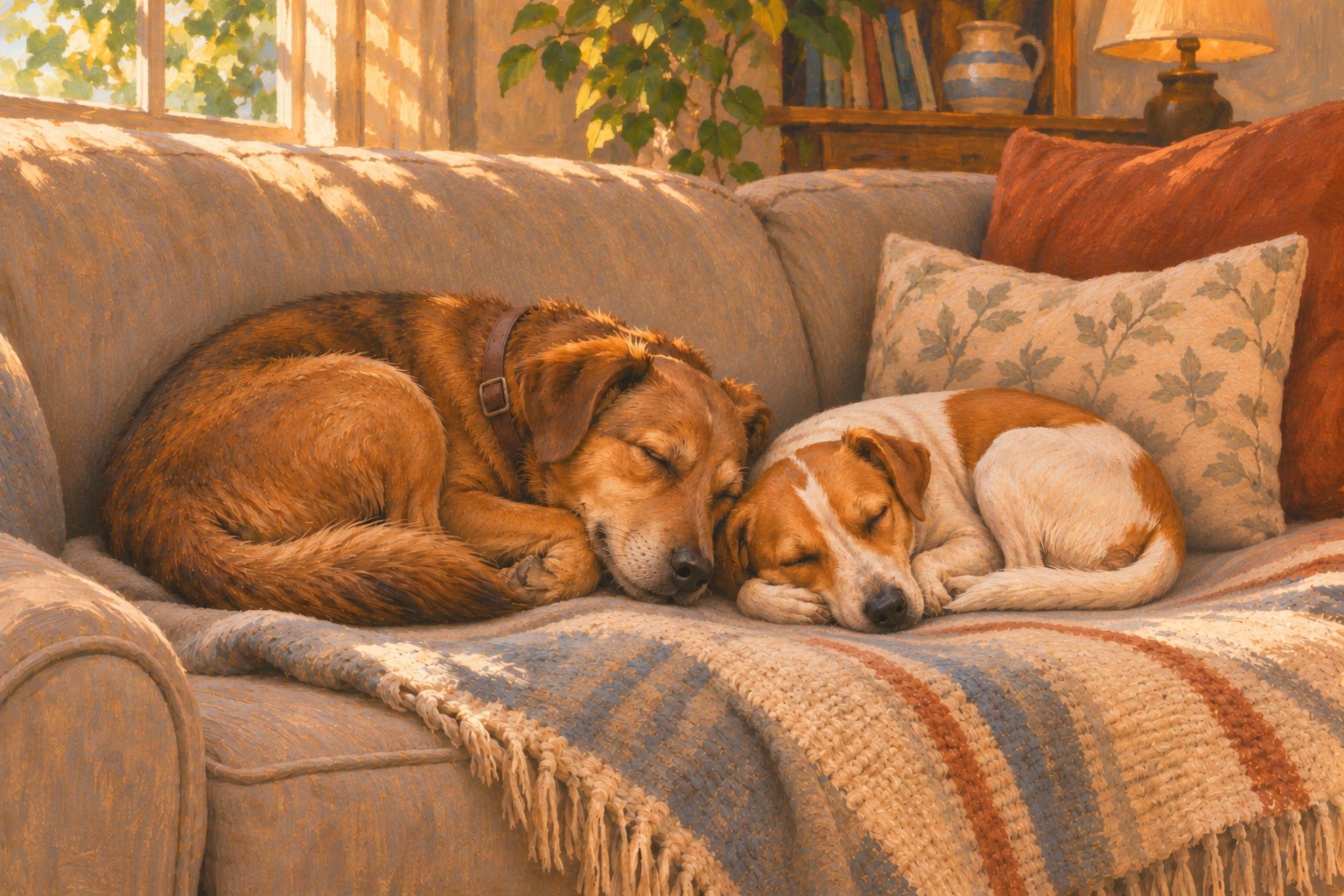
He showed the picture to his mother, who shared it in the neighborhood chat. “Scout looks happy.”
Mrs. Dwyer replied first: “Buddy does.”
Mr. Kim followed with “Pickles always liked couches.”
Denise added, “Mr. Freeman has entered private life.”
A minute later, Mr. Bell responded. “Dog found home.”
For once, nobody corrected him.
A charming, funny, and dicey story. The shelter could have taken the dog in, and euthanized it when no one claimed it.
Maria made a terrific statement: "But he still needs somewhere to go." He was already somewhere. He had become part of the neighborhood and of the shared functioning of the neighbors.
Buddy, Pickles, Scout. Three kind neighbours, three names, and for days nobody made the one call that would find his family. "Stewardship began when someone asked whether the problem had actually been solved" is the line I'd pin in every building's WhatsApp group.