

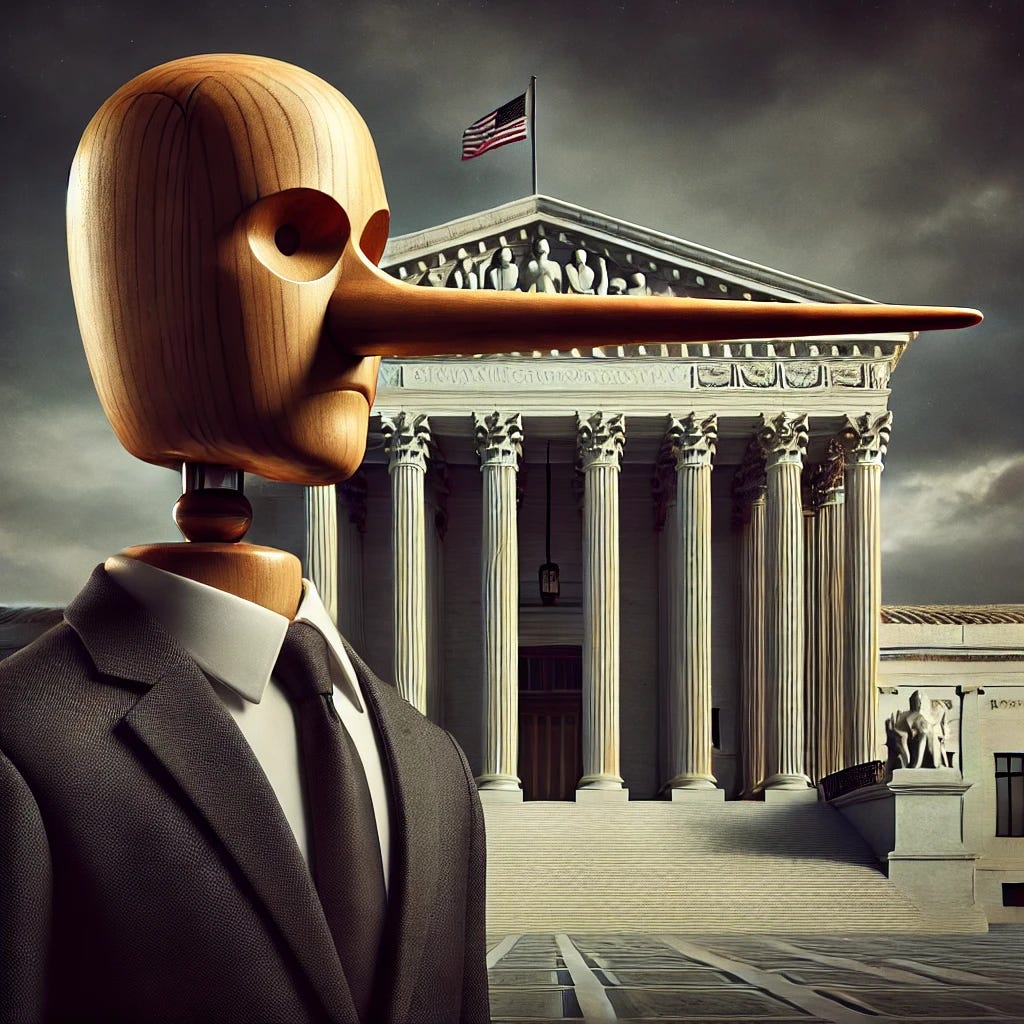
When is a lie not a lie? When Tulsi Gabbard and John Ratcliffe told Congressional investigators last week that they “did not recall” certain aspects of the Signal chat, did that constitute misleading statements or outright lies? The latest decision from the Supreme Court may have a surprising answer.
In 2019, former National Security Adviser Michael Flynn misled the FBI about conversations with Russian officials. His statements were technically accurate but intentionally deceptive; he claimed he didn't “discuss sanctions,” when the conversation had focused on lifting diplomatic expulsions. That nuance allowed him to avoid directly lying while still obscuring the truth.
At the time, Flynn was charged under 18 U.S.C. § 1001, a federal law that makes it a crime to knowingly and willfully provide false statements to federal investigators. But under the Supreme Court’s latest ruling, someone in Flynn’s shoes might walk away without consequences.
The Court has now declared that misleading—but technically true—statements are no longer prosecutable under this statute. That ruling, while subtle in language, carries massive consequences: It removes a key tool for enforcing truth in federal investigations and creates new legal cover for strategic deception by those in power.
Independent News. Just $1/Week.
We just hit 10,000 subscribers—thank you! To celebrate, we’re offering full access to The Coffman Chronicle for just $1 a week ($52/year).
Get exclusive analysis, daily rundowns, and fearless reporting you won’t find in corporate media.
Support truth. Stay informed.
The Ruling in Context: A Higher Bar for Accountability
This decision follows a long trajectory of narrowing what the law considers a lie. It builds upon:
Bronston v. United States (1973): The Court held that literally factual but misleading statements do not amount to perjury. In that case, a businessman gave accurate answers but designed to mislead investigators during a bankruptcy hearing. The Court ruled that the burden to clarify lay with the questioner, not the person giving evasive answers.
United States v. Safavian (2008): A federal official made factually accurate but misleading statements to the FBI. The appeals court overturned his conviction, stating that Section 1001 doesn’t apply if statements aren't outright false, even if they intentionally create a false impression.
The new ruling extends that logic further: deceptive statements are not criminal unless they are both explicitly false and “materially relevant”, meaning they must directly influence the outcome of the investigation. That is a high bar to clear, and it allows skilled operatives to sidestep accountability by staying within technical legal lines while obscuring the truth.
A Larger Pattern: Shielding Power and Weakening Oversight
To understand the deeper implications of this decision, it must be viewed in a broader context. The power to deceive without consequence is expanding, while regulatory oversight and accountability are systematically being rolled back.
Deregulation and Reduced Oversight
Over the past decade, especially during the Trump administration, regulatory agencies like the Environmental Protection Agency (EPA) and the Securities and Exchange Commission (SEC) have seen their enforcement powers curtailed. As oversight weakens, corporations face fewer penalties for misleading disclosures.
Take the 2008 financial crisis, for example: Banks made technically compliant disclosures about risky mortgage-backed securities, but buried the truth in fine print and legalese. Investors and regulators were misled—legally. With the new standard from the Court, that behavior is now even more shielded from legal consequence.
By raising the burden of proof for deception, this decision effectively makes it easier for corporations and influential individuals to mislead federal investigators, as long as their statements don’t tip into direct falsehood.
Protecting Political Elites Through Ambiguity
This ruling also plays directly into the hands of political operatives and government officials skilled in the art of evasion. During the Trump impeachment hearings, numerous witnesses gave carefully worded responses like “I don’t recall” or “I was not directly involved.” These statements were not provably false, but they were designed to avoid accountability.
Under the Court’s new standard, legalistic dodging becomes even more protected. Investigations into corruption, obstruction, and abuse of power increasingly hinge on testimony. Those under investigation can now play word games without fear of legal fallout.
The result? Congressional hearings, federal probes, and ethics inquiries lose their teeth.
Expansion of Executive Privilege and Immunity
In recent years, there’s been a notable expansion in how the executive branch uses executive privilege. This doctrine allows presidents and high-level officials to refuse to disclose certain information. While it's meant to protect national security and sensitive deliberations, it has increasingly become a tool to avoid scrutiny.
The case of Steve Bannon, who cited executive privilege to defy a subpoena during the January 6 investigation, is a vivid example. He was eventually held in contempt, but the process was slow and politically fraught.
With this Supreme Court ruling, even if officials testify, they can mislead without crossing the legal line. It's another brick in the wall insulating elites from democratic oversight.
A Blow to Anti-Corruption Efforts and Whistleblowers
Federal anti-corruption laws have already been weakened in recent years. The Supreme Court’s ruling in McDonnell v. United States (2016) narrowed the definition of “official acts” in bribery cases, making it harder to prosecute corruption unless there's a clear exchange of money for specific actions.
This new ruling chips away further: If officials can mislead investigators with impunity, whistleblowers and internal investigators are left powerless. The risk they take to expose wrongdoing becomes even more significant when the law no longer defends the truth.
Counterarguments: Balancing Free Speech and Prosecutorial Overreach
Supporters of the Court’s decision argue that criminalizing misleading speech risks chilling free expression. They cite United States v. Alvarez (2012), where the Court struck down the Stolen Valor Act and held that false speech is not automatically unprotected under the First Amendment.
They also raise concerns about overzealous prosecutors using vague or ambiguous statements to charge individuals unfairly under § 1001. People have sometimes been prosecuted for errors or inconsistencies in interviews, not deliberate lies.
These are legitimate concerns, but they must be weighed against the power imbalance. Influential figures with access to legal teams can exploit ambiguity deliberately, weaponizing vagueness as a shield. The ruling may protect the careless, but it also protects the calculating.
Who Wins and Who Loses?
Winners:
Political and Corporate Elites: Those skilled in legalese and selective disclosure now enjoy a stronger shield from accountability.
High-Level Officials: Government insiders can now mislead during investigations with less fear of criminal liability.
Corporations and Lobbyists: Vague disclosures and “truth-adjacent” statements are now less likely to lead to prosecution.
Losers:
Federal Investigators and Regulators: Agencies like the DOJ, SEC, and EPA will face even more significant challenges in prosecuting deceptive conduct.
Whistleblowers and Internal Auditors: With legal tools weakened, exposing wrongdoing becomes riskier and less effective.
The Public: When deception goes unpunished, trust in government and democracy erodes, and cynicism replaces civic engagement.
Real-World Consequences: Why This Matters Now
This ruling isn't just about lawyers splitting hairs. It has real implications across:
Financial markets, where corporate fraud hides behind legal complexity.
Environmental policy, where polluters downplay risk while avoiding outright lies.
Democratic institutions, where misleading testimony undermines accountability.
In short: The law just gave cover to a more sophisticated kind of dishonesty, and the damage won't be hypothetical.
Restoring Accountability: A Call to Action
The Supreme Court’s ruling may be legally defensible, but that doesn’t mean it’s morally sound or democratically safe. Congress and civil society must respond:
Reform False Statements Law: Amend § 1001 to include materially misleading statements, not just outright lies.
Strengthen Oversight Powers: Give congressional investigators more authority to compel and verify truthful testimony.
Protect Whistleblowers: Expand legal and institutional protections for those who expose hidden misconduct.
Conclusion: Truth Is a Public Good, Not a Privilege
The Court’s decision doesn’t just change a law. It changes the terms of truth in America. In doing so, it chips away at the idea that justice is blind, fair, and accessible to all. If we allow truth to become optional for the powerful, democracy is on borrowed time.
See our previous reporting on the Supreme Court here:


We just hit 10,000 subscribers—thank you! We’re offering full access to The Coffman Chronicle for just $1 a week ($52/year) to celebrate.
Enjoy unlimited access to our entire archive, exclusive content, and occasionally early access.
Bibliography:
"Bronston v. United States, 409 U.S. 352 (1973)" U.S. Supreme Court, Decided Jan 10, 1973
"United States v. Safavian, 528 F.3d 957 (D.C. Cir. 2008)" Casetext, U.S. Court of Appeals for the D.C. Circuit, Decided June 17, 2008
"United States v. Alvarez, 567 U.S. 709 (2012)" U.S. Supreme Court, Decided June 28, 2012
"United States v. Yermian, 468 U.S. 63 (1984)" U.S. Supreme Court, Decided Nov 27, 1984
"McDonnell v. United States, 579 U.S. 550 (2016)" U.S. Supreme Court, Decided June 27, 2016. Justia.
"18 U.S. Code § 1001 – Statements or Entries Generally" Legal Information Institute, Cornell Law School
"Congressional Oversight and Executive Privilege" Congressional Research Service (CRS) Report R45636, Updated May 15, 2023
By the time I read the whole thing, I had to get up before I🤮 all over myself. What has our country done to ourselves? The law is not the law anymore. It’s whatever will help the thugs do anything and everything they want wherever they want. Is that what the WH is doing to make oligarchs even richer? Soon they will be throwing each other under the bus. I am old but I think I will see this happen.
I don’t expect this note will make the cut, but I am happy to vent today, we may not be able to do that much longer.
Impeach Thomas