


On October 24, 2025, Senator Elizabeth Warren took to the Senate floor with a warning and a bill.
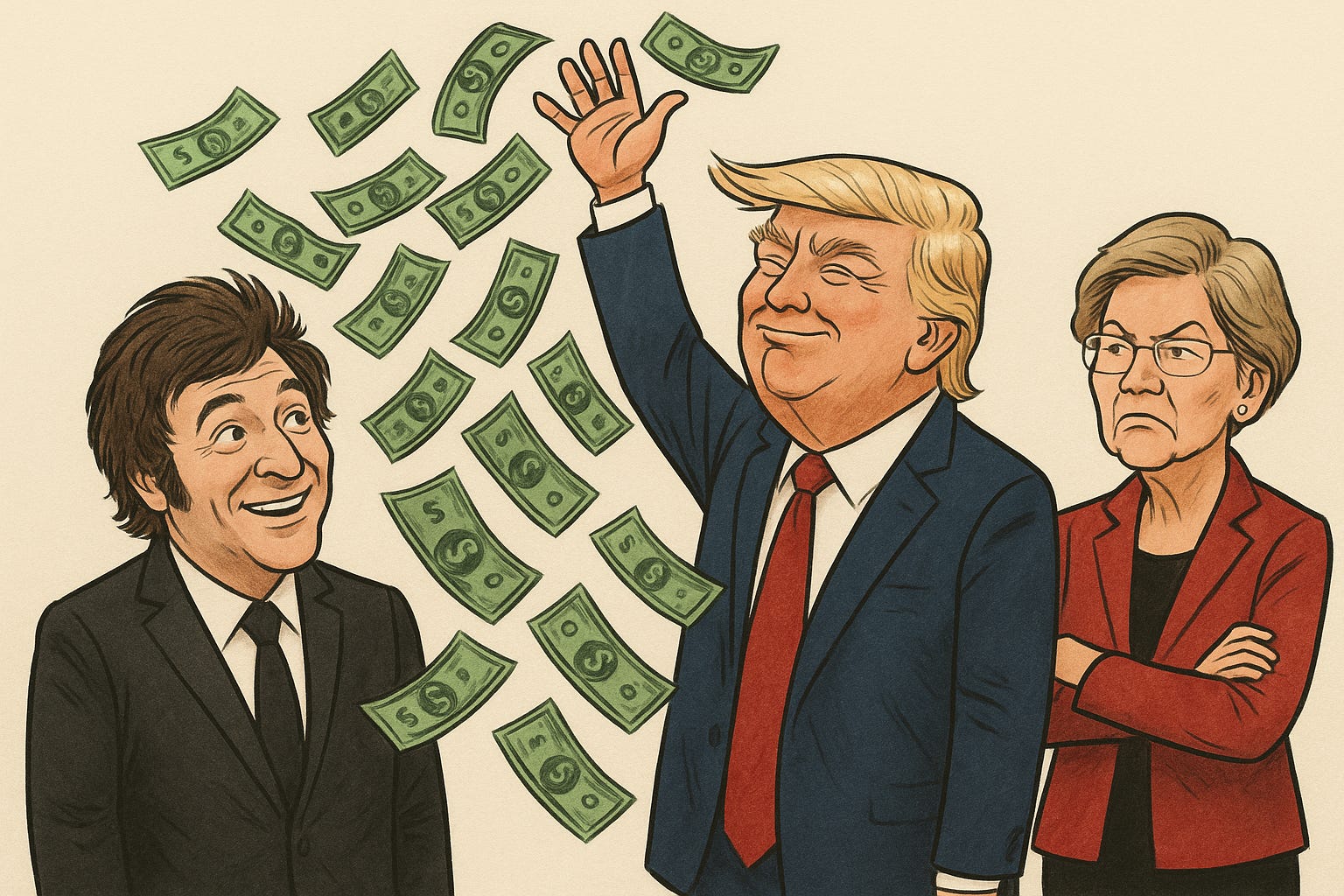
She had just introduced the No Argentina Bailout Act, a legislative attempt to block the Trump administration from sending billions of U.S. taxpayer-backed dollars to prop up the far-right government of Argentine President Javier Milei. She announced the bill on October 9th, the same day the deal was finalized, in partnership with Tim Kaine (D-VA), Chris Van Hollen (D-MD), Cory Booker (D-NJ), Tina Smith (D-MN), Ruben Gallego (D-AZ), Bernie Sanders (I-VT), and Peter Welch (D-VT).
Their timing was urgent. Treasury Secretary Scott Bessent had already finalized the framework of a $20 billion currency swap agreement with Argentina’s central bank. By the 24th, there was no indication that the money had yet changed hands.
Warren moved to advance the bill by unanimous consent, a procedure that, if no senator objected, could have allowed the legislation to move swiftly to a vote. It didn’t make it past the first hurdle. Senator Tim Scott, a Republican of South Carolina, stood up and blocked the bill without hesitation.
That means there was no debate, no amendment, and no vote— just a single objection, and the last chance to stop the deal evaporated.
Want to Know Your Rights?
Download a free digital copy of the U.S. Constitution—the same document Trump is trying to bulldoze. Learn exactly what he’s breaking… and how to fight back.
50,000 strong — and counting.
This Early Black Friday, become a paid subscriber for just $1 a week and help us keep the truth alive.
Join The Coffman Chronicle — $1/Week Early Access
What the Argentina Deal Really Is
The swap deal between the U.S. Treasury and Argentina is not a traditional loan. It’s a currency exchange. The United States sends dollars to Argentina’s central bank in exchange for Argentine pesos, which are theoretically to be swapped back at a future date. These kinds of deals are usually intended to help stabilize weak currencies during economic crises by backing them with a stronger, more liquid global currency, such as the U.S. dollar.
See our previous reporting here:

But there was nothing normal about this one.
The Death Spiral
At the time the swap was finalized, the Argentine peso was in a death spiral. Inflation was over 150 percent. Foreign currency reserves were nearly depleted. The peso had collapsed to over 1,000 per dollar in unofficial exchange markets, up from roughly 350 per dollar just two years prior.
At the same time, the U.S. dollar wasn’t exactly strong either. In 2025, the dollar declined 11 percent against global currencies, one of its steepest half-year declines in modern history. That means the U.S. Treasury was effectively trading a weakening dollar for a currency in near freefall.
So why do it?
Argentina isn’t a fiscally safe bet, nor is it a major partner to the United States. Unlike Ukraine, which has been actively at war with an invader for years, there was no immediate outcry over spending from the GOP.
That leaves one reason: Because ideology — not economics — was driving the deal.
Friends With Benefits
President Javier Milei isn’t just any foreign leader. He’s a self-described “anarcho-capitalist” and proud Trump admirer who slashed public spending, promised to eliminate Argentina’s central bank, and has embraced libertarian shock doctrine with religious zeal. He is, in short, the embodiment of the far-right, anti-government fantasy Trump and his allies would love to bring back to the United States.
And the Trump Treasury decided he was worth backing with your money.
Terms? What Terms?
Even the terms of the deal remain suspiciously vague. There is no public schedule for when Argentina must repay the swap, no known interest rate, and no enforceable deadline for returning the dollars. As Martín Kalos, an Argentine economist, noted at the time, “It is not even clear whether those conditions have been established, or will be decided when one of the parties needs to use the swap money.” That means the United States may have handed over billions with no concrete path to ever recovering them.
And the only stipulation the U.S. Treasury has acknowledged? That Milei continue pushing the very austerity measures and privatization policies that have gutted Argentina’s public sector. “The U.S. would not put additional conditions on Argentina beyond President Javier Milei’s government continuing to pursue its fiscal austerity and economic reform programmes,” Bessent told Al Jazeera, “to foster more private-sector growth.”
In other words: no oversight, no transparency, no economic protections — just a green light to double down on a libertarian model that has already plunged millions of Argentines into deeper poverty.
The Illusion of Profit
In early November, Scott Bessent, Secretary of the Treasury, confirmed that Argentina had begun activating the swap line. A portion of the U.S. funds had already been accessed. He even claimed, publicly, that the United States had already made a “small profit” from the transaction.
“We used our financial balance sheet to stabilize the government, one of our great allies in Latin America, during an election,” Bessent said in an interview on MSNBC. “The president there won in a landslide, the government is going to make money.”
The Real Motive
That comment makes the nature of the deal crystal clear: it wasn’t financial. It was political. It was a strategic injection of dollars to help Milei survive an election, and a public declaration that the U.S. backed his victory. The “profit” wasn’t fiscal. It was ideological.
Trump himself made the political motive unmistakable. Speaking just days before Argentina’s legislative elections, he told reporters: “If [Milei] loses, we are not going to be generous with Argentina,” and added, “we’re not going to waste our time” if Milei’s party, La Libertad Avanza, wasn’t victorious.
That’s not a stabilization policy. That’s electoral blackmail using U.S. taxpayer dollars as leverage to help a foreign far-right party win an election.
But Economically?
Economically, however, the math doesn’t add up. Currency swaps are designed to be neutral, not profit-generating. And in this case, the U.S. gave Argentina hard dollars in exchange for pesos that are losing value by the day. Unless there was some form of interest payment or skewed exchange rate — both of which would be extraordinary — the notion of profit is hard to swallow. And if there was interest involved, how is a country drowning in hyperinflation and foreign debt supposed to pay it?
More importantly, even if a short-term profit did materialize on paper, it’s largely meaningless. If the peso continues to collapse and Argentina fails to return the dollars when the swap matures — and if there are no terms, it never will— the U.S. will be left holding virtually worthless currency. A profit today could become a massive loss tomorrow.
In that light, Bessent’s statement begins to look less like financial truth and more like political cover.
Fiscal Responsibility for Some
The timing of this deal couldn’t be more revealing.
At the very moment the Trump administration was executing a $20 billion bailout for a foreign government, the U.S. federal government was ensnared in a shutdown due to a failure to pass a budget. Republicans in Congress were blocking Continuing Resolutions left and right, claiming that the U.S. could no longer afford to spend money on what they called “unsustainable entitlements.” Democrat-led efforts to address expiring ACA subsidies were shut down. SNAP funding remained in limbo, embroiled in court cases.
And yet, there was no pushback when Trump’s Treasury handed billions to a libertarian foreign leader. One GOP senator objected to a bill trying to stop it, and that was enough. Now the bill has gone to die in committee, and the money is flowing.
The hypocrisy is staggering. Americans are told to tighten their belts, accept rising health care costs, and live with fewer benefits, all in the name of fiscal discipline. But when it comes to bailing out a foreign regime aligned with Trumpism? Suddenly, the deficit doesn’t matter.
“For Trump, the leader of Argentina is more important than American families struggling with rising costs.” -Elizabeth Warren
Congress Surrenders Its Power
Under the U.S. Constitution, the power of the purse belongs to Congress, not the executive. Yet in this case, that power was bypassed.
Warren’s bill wasn’t trying to regulate foreign policy. It was trying to stop the Treasury from using the Exchange Stabilization Fund, a taxpayer-backed pool of money intended for short-term currency operations, as a shadow foreign-aid mechanism.
But Congress never got to vote. The bill never made it to the floor.
And that was the point.
Bessent’s Cloak of Secrecy
Behind all of this lies the deeper scandal: the deal was deliberately shrouded in secrecy.
Multiple FOIA requests for information about the swap were denied. No public timeline for the fund transfer was released. The Treasury offered no transparency to lawmakers about when Argentina would activate the swap line, or how much of it had been used. Even when Warren introduced the bill, there was no way to know if the money had already changed hands.
By the time Bessent confirmed that Argentina had accessed the funds, it was too late.
That’s not an accident. That’s a strategy.
By keeping Congress and the public in the dark, the administration gave itself just enough time to execute the deal — to make it irreversible — before opposition could build. Even Warren, acting quickly, was outmaneuvered.
They tried to stop the bailout. The Trump Treasury had already moved the money behind closed doors.
Austerity for You, Bailouts for Them
If there was ever any doubt about who benefits under this economic model, let this deal settle it.
Americans get austerity — wage stagnation, cuts to healthcare, food insecurity, and government shutdowns. Foreign regimes that flatter Trump get billions in emergency support.
And let’s be clear: this money won’t help the Argentine people. There are no restrictions on how it’s used. The dollars could be spent shoring up Argentina’s central bank reserves, but they could just as easily be used by insiders to convert their own pesos, stash wealth offshore, and disappear into jurisdictions where U.S. authorities can’t reach them.
“On October 9, 2025, the Treasury Department–under your leadership–agreed to a $20 billion currency swap with the central bank of Argentina, designed to prop up the country’s failing financial markets. The transaction, which promised to benefit ‘major fund managers’ and ‘wealthy investors’ at the expense of American farmers and taxpayers, was widely understood as a move intended to bolster Argentinian President Javier Milei–a personal friend of President Trump’s–amidst the country’s midterm elections.” - Elizabeth Warren, in a letter to Scott Bessent
This isn’t foreign aid. It’s a gift to oligarchs, wrapped in a U.S. Treasury seal.
The Global Grift and Its Domestic Mirror
In a grim twist, the logic of this deal mirrors what’s happening here at home. The American oligarchy extracts value from the public, hoards it, and shields it from accountability, all while claiming to defend economic freedom. The continuing resolution passed by the Senate notably includes a rider that permits GOP senators to sue the DOJ for damages stemming from investigations into Jan 6.
See our reporting here:

Now, that same model is being exported. Milei slashes Argentina’s social programs, opens the floodgates for capital flight, and gets rewarded with U.S. dollars. It’s not an accident. It’s an ideological investment.
We’re not just bailing out a country. We’re bailing out a system, one that rewards wealth, punishes the poor, hides behind deregulation, and launders its failure through the language of “freedom.”
A Warning, Not Just a Scandal
This isn’t just a bad deal. It’s a warning.
The unchecked power of the executive to spend public money abroad, the collapse of congressional authority, the weaponization of secrecy, the export of economic cruelty, the lie of fiscal responsibility— it is the authoritarian playbook in action.
And at the center of it all, the unmistakable message: There’s always money — just not for you.
Don’t let the bastards sneak anything past you. Subscribe and get your daily dose of rage and receipts delivered fresh, before the spin doctors can scrub it.
Sources:
“US profited from Argentina currency swap deal, Treasury chief Bessent says” — Reuters (Nov 11, 2025)
“Argentina: Grabbing A US Lifeline” — Global Finance Magazine (Nov 8, 2025)
“Argentina formalizes $20 bn currency swap deal with US” — The Guardian (Oct 20, 2025)
“Argentina’s central bank says it signed $20 bn currency swap deal with US” — Al Jazeera (Oct 20, 2025)
“Why Is the U.S. Bailing Out Argentina?” — Encyclopaedia Britannica (Oct 27, 2025)
“S.2965 – No Argentina Bailout Act” — Congress.gov (119th Congress)
“Warren, Colleagues Introduce Bill to Stop Trump’s Argentina Bailout” — U.S. Senate Banking, Housing & Urban Affairs Committee (Oct 9, 2025)
“GOP Blocks Warren Bill to Stop Trump’s ‘Brazen’ $20B Argentina Bailout” — Truthout (Oct 15, 2025)
“Warren Presses Treasury Secretary Bessent on Plans to Provide An Additional $20 Billion to Argentina Amid A Government Shutdown” — U.S. Senate Banking (Oct 16, 2025)
“The U.S. just bailed out Argentina, Treasury Secretary confirms” — The Washington Post (Oct 9, 2025)
“Us Treasury intervenes in Argentina’s currency market” — Financial Times (Oct 9, 2025)
