


In the years after September 11, Americans were told that air travel would never feel the same again. Shoes would come off, bags would be scanned, and names would be checked against government watchlists. These were the tradeoffs for safety, and most people accepted them as the cost of preventing another catastrophic attack.
More than two decades later, one of those systems has surfaced in a very different role.
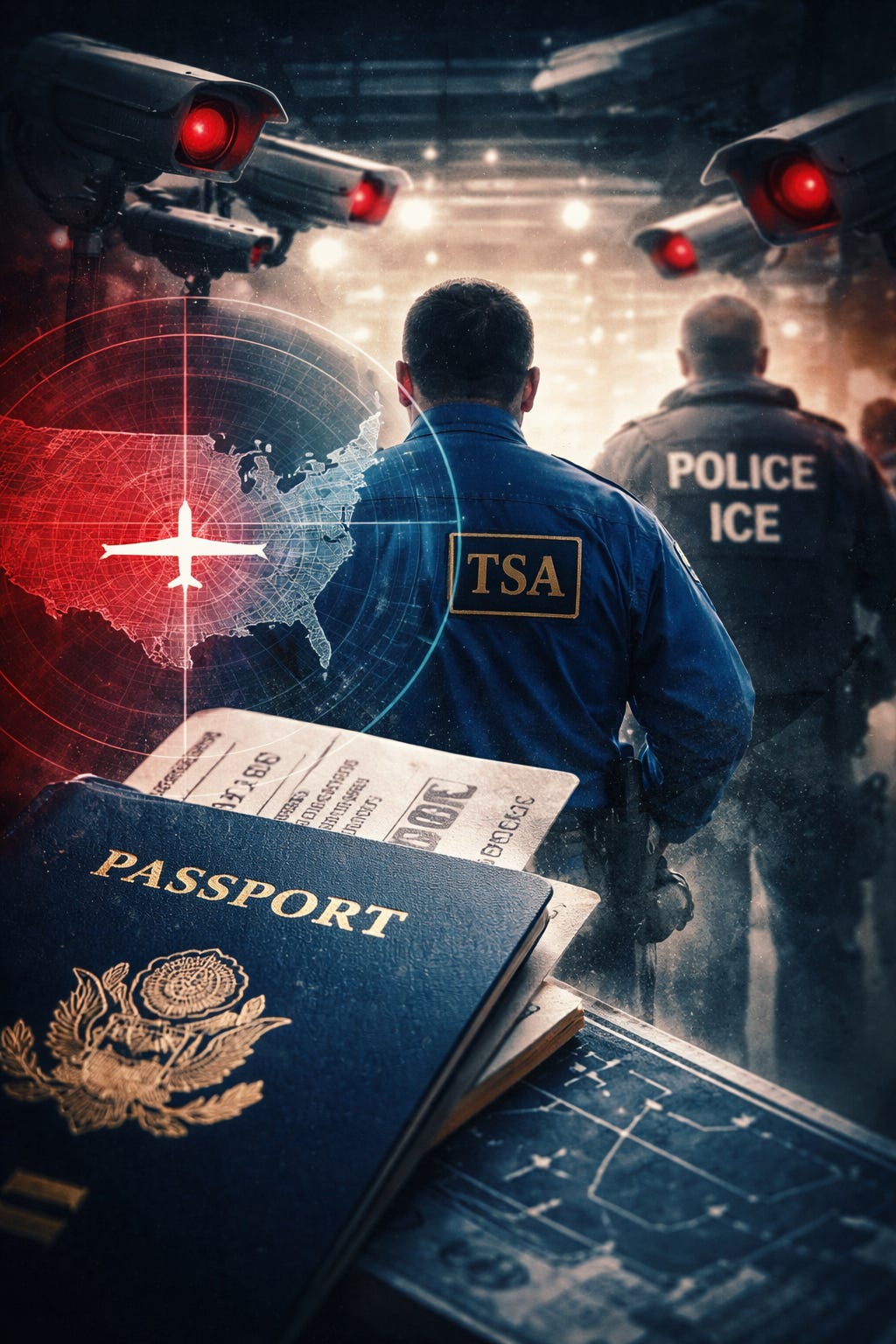
A recent Reuters investigation found that the Transportation Security Administration, or TSA, shared information on more than 31,000 travelers with Immigration and Customs Enforcement, or ICE, between early 2025 and February 2026. That data, drawn from the government’s Secure Flight program, helped ICE track individuals’ movements and contributed to more than 800 arrests. The reporting also made clear that key details remain unknown, including how travelers were selected for scrutiny and how directly TSA’s information led to specific detentions.
At first glance, this might look like routine cooperation between two agencies housed within the Department of Homeland Security. However, it is something more consequential. It is the latest example of a post-9/11 security system drifting beyond its original purpose, in a country that still has not built meaningful guardrails around how personal data can be used.
This Community Is Powered by You
What started as a small circle has grown into something much bigger, and it’s all because of readers like you.
Every time you forward this email, post it on socials, or bring someone new into the fold, you’re helping build one of the most passionate, independent political communities out there.
Want to keep the momentum going?
Share this newsletter with someone who should be part of this conversation.
Thank you for being here. It means everything.
What Reuters Found
The core facts are straightforward, even if the full picture is not.
According to Reuters, TSA shared data tied to more than 31,000 travelers with ICE over roughly a one-year period. That information came through Secure Flight, a system that collects passenger data from airlines and checks it against government watchlists. ICE used that information to monitor when individuals were flying, allowing agents to time arrests. More than 800 people were ultimately detained using those leads.
Yet the reporting leaves several important questions unanswered. It is not clear how many of those 31,000 records represent unique individuals versus repeated checks on the same travelers. Officials have not publicly explained the criteria used to flag those travelers in the first place. It also remains unclear how often arrests occurred inside airports, as opposed to later, after someone had landed.
This information gap is notable and suggests that the public is seeing the outputs of a system without understanding the rules that govern it.
What Secure Flight Was Supposed to Be
To understand why this story has unsettled civil liberties advocates, it helps to remember what Secure Flight was designed to do.
Secure Flight emerged from the post-9/11 push to harden aviation security. Its core function is to compare passenger information against federal watchlists, including lists of individuals suspected of terrorism or posing threats to aviation. The idea was to identify risks before they boarded a plane.
That mission shaped how the program was presented to the public. It was part of a broader national effort to prevent another attack, and it was justified in that context. Travelers might have bristled at the inconvenience, yet the underlying purpose was clear and narrowly defined. This was about stopping terrorism.
That clarity is what makes the current use feel different. Using the same system to help locate and arrest people for immigration violations is not simply a technical adjustment. It is a shift in purpose.
The Life Cycle of Emergency Powers
There is a familiar pattern in American governance that tends to reveal itself only with time.
A crisis creates urgency. Urgency produces new powers. Those powers are framed as exceptional, tied to a specific threat, and often accepted with limited debate. Once the crisis recedes, the powers remain. They become routine, embedded in institutions and workflows. Eventually, they are applied in ways that would have been difficult to imagine when they were first introduced.
The Secure Flight story fits neatly into that pattern.
The system was built in response to a singular fear: another terrorist attack using commercial aviation. The public consented to it on those terms. Today, it appears to be assisting in a very different form of enforcement. No formal redefinition of the program may have been announced, yet the function has expanded.
That is what civil liberties advocates mean when they talk about mission creep. It does not require bad intent or a dramatic policy shift. It often happens through small, defensible steps that accumulate over time, until a system designed for one purpose is quietly serving another.
This invites speculation on what future expansions of surveillance or monitoring programs could be justified next.
Did the Public Ever Really Know?
There is also a process question that sits just beneath the surface of this story.
When Americans accepted post-9/11 screening, they understood that their data would be used to assess security risks associated with flying. It is far less clear that they understood it could be used to facilitate immigration arrests. That distinction matters, not only as a matter of principle but as a matter of democratic accountability.
Two U.S. senators, Alex Padilla and Adam Schiff, have already launched an inquiry into the TSA-ICE data sharing. Among other things, they are asking which authority authorized the information to be used this way and what data the TSA collects about travelers’ immigration or citizenship status. The fact that those questions are still being asked suggests that the program's scope has not been clearly communicated to the public.
Government systems do not need to operate in secrecy to become opaque. Complexity, bureaucratic language, and incremental change can achieve the same effect. By the time the public understands how a system is being used, the system is already entrenched.
Download a FREE Pocket Constitution NOW →

When Movement Becomes a Signal
The TSA-ICE story is not occurring in isolation. It is part of a broader shift in how immigration enforcement operates.
Increasingly, movement itself has become a point of interest. Where someone is going, when they are traveling, and how they move through the country can all become opportunities for enforcement. The Reuters report illustrates this directly. ICE used travel data not just to identify individuals, but to time their arrests.
This same logic is visible beyond air travel. In recent years, immigration authorities have faced scrutiny for their use of cellphone location data, often obtained through commercial data brokers. That data can reveal where a person lives, where they work, and where they spend time, creating a detailed map of their daily life. The Supreme Court has recognized just how sensitive that kind of tracking is. In Carpenter v. United States, the Court held that historical cellphone location data generally requires a warrant. Yet in practice, agencies can sometimes access similar information by purchasing it from private companies, sidestepping the very protections the Court sought to establish.
The common thread is not the specific technology. It is the growing reliance on movement itself as a form of intelligence. Travel records, phone signals, and location pings all turn ordinary behavior into something that can be tracked, analyzed, and acted upon.
Other reporting has pointed to similar trends. A program informally referred to as “Operation Irish Goodbye” has been described as targeting migrants who are voluntarily leaving the United States, with enforcement actions occurring as they attempt to depart. Critics argue that such practices can convert voluntary compliance into a formal removal, which carries more severe legal consequences.
See our previous reporting on Operation: Irish Goodbye here:
Note: Articles roll into the archive over time. Become a paid subscriber for full access to our extensive catalog.

Taken together, these developments suggest an enforcement approach that is becoming more data-driven and more attuned to mobility. The question is no longer only who someone is. It is also where they are and when they can be intercepted.
The Bigger Privacy Problem
This is where the story widens beyond immigration policy.
The TSA data at issue here is government-collected, yet it exists within a broader American landscape where personal information is routinely gathered, analyzed, and shared. There is no comprehensive federal privacy law that sets clear limits on how such data can be used across contexts. Instead, the United States relies on a patchwork of rules that often allow data collected for one purpose to be repurposed for another.
That legal environment creates a kind of cultural assumption within institutions. If data exists and can be accessed, it is often treated as fair game, so long as there is some plausible justification. Over time, that assumption can blur the line between distinct missions.
The result is a system where boundaries are not clearly drawn at the outset. They are negotiated after the fact, usually in response to reporting, public pressure, or litigation.
Why This Should Concern More Than One Group
For some readers, the TSA-ICE data sharing may not feel especially troubling. They may see it as a reasonable use of existing tools to enforce immigration law. That perspective is not uncommon, and it is part of why such expansions can take hold.
Yet the broader concern is not limited to any one group or policy area.
When a government builds a system capable of tracking people’s movements and normalizes its use in one context, the barrier to using it in another context becomes lower. The categories of who is targeted can change with political priorities. The underlying capability does not.
The question, then, is not simply whether one agrees with the current use. The question is whether one is comfortable with the tool's existence and normalization, knowing that future administrations may apply it differently.
That is the lesson embedded in decades of civil liberties debates. Powers are rarely confined to their original targets. Once established, they tend to expand.
The Conversation We Keep Avoiding
The Reuters investigation is not just a story about TSA and ICE. It is a reminder of an unfinished national conversation.
After 9/11, Americans accepted a new security architecture in the name of safety. That architecture did not disappear as the immediate threat receded. It became part of everyday governance. Now, it is being adapted for new purposes, often without clear public debate or updated legal guardrails.
At the same time, the country has allowed a vast data economy to develop with relatively few constraints. Personal information flows through private and public systems alike, creating opportunities for both innovation and misuse.
These two realities are converging. A government with access to extensive data, operating within a weak privacy framework, will continue to find new ways to use it.
The question is whether the public is willing to accept that trajectory, or whether it is finally time to set clearer limits.
The TSA-ICE story offers a moment to ask that question. Whether the country chooses to answer it is another matter entirely.
If you believe these are conversations worth having before the next expansion, not after, subscribe. We focus on the structures behind the headlines and the questions that tend to arrive too late.
Sources:
April 7, 2026, “ICE arrested more than 800 people after tips from US airport security agency,” Reuters
April 2, 2026, “Padilla, Schiff Launch Inquiry into TSA, ICE Data Sharing Following Alarming Arrest at San Francisco International Airport,” Office of Senator Alex Padilla
March 31, 2026, “NEWS: Sens. Schiff, Padilla Launch Inquiry into TSA and ICE Data Sharing Following Alarming Arrest at San Francisco International Airport,” Office of Senator Adam Schiff
October 28, 2008, “Secure Flight Program,” Federal Register
December 16, 2025, “‘Operation Irish Goodbye’: ICE to detain migrants voluntarily leaving the US as part of Trump’s deportation campaign,” Texas Public Radio
June 22, 2018, “Carpenter v. United States,” Supreme Court of the United States
Giorgio Agamben's State of Exception (2005) traces the American manifestation of this problem right back to Lincoln: if you give a government, any government, extraordinary powers, those powers become permanent and permanently directed against the liberties of the people. The point of the US Constitution was to enumerate the precise powers of government and to limit government to those specifically enumerated powers. But 'progressive' ideas and the notion of 'a living Constitution' have expanded governance for a century and a half, and here we are . . .
Well, that's the problem. Under the guise of promising greater security, privacy is being destroyed and people are being spied on. Unfortunately, it's too late now to turn back the clock.