


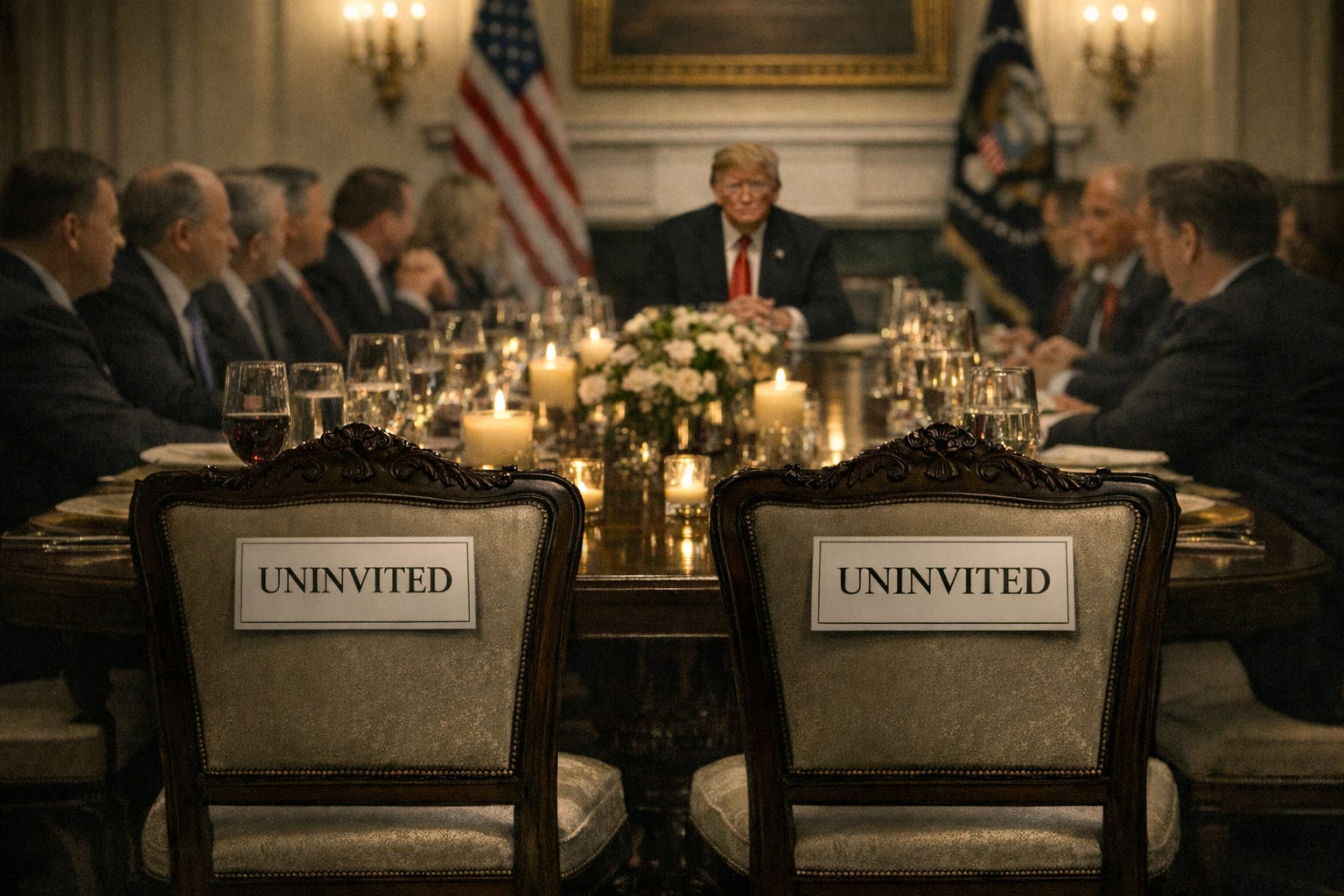
Once a symbol of unity and federal-state cooperation, this year’s National Governors Association (NGA) Winter Meeting is ending not with a reaffirmation of bipartisanship, but with a closed-door Republican strategy session and a selective dinner guest list.
Democratic governors Wes Moore of Maryland and Jared Polis of Colorado were both explicitly uninvited from the annual White House dinner, and also excluded from the working sessions that traditionally bring all 50 governors into the same room as the President. According to the White House, this was a matter of “presidential discretion.” Some Democratic governors, including notably Gavin Newsom, J.B. Pritzker, and Tim Walz, were invited, but no explanation has been given for the distinction.
Perhaps more disturbingly, we still don’t know how many governors were simply never invited in the first place.
What was once a moment of unity has now become a loyalty test.
This Community Is Powered by You
What started as a small circle has grown into something much bigger, and it’s all because of readers like you.
Every time you forward this email, post it on socials, or bring someone new into the fold, you’re helping build one of the most passionate, independent political communities out there.
Want to keep the momentum going?
Share this newsletter with someone who should be part of this conversation.
Thank you for being here. It means everything.
What the NGA Is And Why This Moment Matters
The National Governors Association is not some feel-good networking club. It is the bipartisan body through which all U.S. governors convene, strategize, and coordinate with the federal government. While its origin dates back to 1908, when President Theodore Roosevelt invited all the nation’s governors to the White House to discuss natural resource conservation, the NGA as we know it was formally established in 1977 after decades of less concrete organization. Since then, it has existed as a deliberately bipartisan institution, with leadership that rotates between parties and a commitment to nonpartisan collaboration on policies that affect every state regardless of ideology.
The NGA hosts two primary convenings each year: a Summer Meeting and the Winter Meeting in Washington, D.C. The Winter Meeting traditionally includes a working session at the White House, where the President meets with governors to discuss national priorities and coordination, followed by a formal bipartisan dinner. These events have been held under every president, Republican and Democrat, since the NGA’s formalization. For nearly fifty years, the integrity of this shared space, where state and federal leaders come together regardless of political affiliation, has been respected.
Even during Donald Trump’s first term, as tensions mounted between his administration and Democratic governors over immigration, pandemic response, and public safety, the tradition held. All governors were still invited. The rhetoric was sharp, but the door remained open.
Until now.
Wes Moore: The Man They Disinvited
Governor Wes Moore is not just another Democratic governor. He is the co-chair of the NGA, elected by his fellow governors across party lines to help lead the organization. He is also, as of today, the only Black governor serving in the United States. In fact, he is only the third Black governor ever elected in American history, following Virginia’s Douglas Wilder in 1989 and Massachusetts’ Deval Patrick in 2006.
His exclusion is more than unprecedented. It’s institutionally offensive. The White House did not merely insult Moore. It invalidated the governors who elected him to represent them. When a sitting co-chair of the NGA is denied entry to the very forum he helps lead, it is no longer a matter of disagreement. It is a dismantling of structure.
This doesn’t need to be about race for it to feel racial. When the only Black governor in America is excluded during Black History Month, days after the Trump campaign shared a video depicting the Obamas as monkeys, the optics are not just bad. They are radioactive. Moore himself didn’t accuse the White House of racism, but he did point out the weight of being “the only Black governor” while being uninvited to a traditionally bipartisan event held in the so-called People’s House.
What Did Jared Polis Do to Deserve This?
Colorado Governor Jared Polis was also uninvited from the dinner and the working session. Like Moore, Polis wasn’t given a reason. However, the context is hard to ignore. Polis has been a consistent, outspoken critic of Trump’s policies, especially on climate, LGBTQ+ rights, election integrity, and drug reform. Most recently, he pushed back against the federal classification of an election denial case in Colorado and has refused to align state policy with Trump’s preferred stances on multiple fronts.
In this White House, disagreement is disqualifying.
Unlike Moore, Polis doesn’t represent symbolic firsts, but his exclusion reinforces the larger message: governors who fall out of political favor will not be allowed in the room, no matter what their voters or their NGA peers think.
The NGA Speaks Up… Softly
To its credit, the NGA did issue a statement. Acting CEO Brandon Tatum said the association was “disappointed” in the White House’s decision to turn the meeting into a partisan affair and confirmed that the event was removed from the official NGA schedule. The organization reiterated its commitment to representing all governors and maintaining a bipartisan approach.
It was a step, but it wasn’t a stand.
When your co-chair is excluded from a core event of the organization, “disappointment” feels more like brand management than moral clarity. The NGA acknowledged that the exclusion undermined federal-state cooperation, but it stopped short of naming names, calling for reinstatement, or taking public action beyond calendar semantics.
It was, in effect, a strongly worded letter.
Where Are the States’ Rights Defenders Now?
If a Democratic president had told Republican governors they weren’t welcome at a national coordination meeting or federal dinner, Fox News would be broadcasting 24/7 “Don’t Tread on Me” banners. Yet here we are, with red states watching quietly while the federal executive branch tells entire state governments they don’t belong at this table.
This isn’t just a snub of Moore or Polis. It’s a rejection of the citizens they represent. Maryland and Colorado are not accessories to federal power. They are sovereign participants in the American project. When their governors are barred from national forums, those states are effectively erased from the conversation.
And make no mistake: by excluding Moore, the White House is also dismissing every governor—Democrat or Republican—who voted to elevate him to NGA leadership. Worse, he is using the People’s House as his personal throne room, daring his opponents to confront him and demanding his loyalists pay homage.
What Should Happen (And Won’t)
In an ideal world, the NGA would respond forcefully. Governors from both parties would say if all our members aren’t welcome, then we’ll use our time elsewhere. They would schedule an official NGA session during the White House event. They would walk out. They would stand up.
That won’t happen.
In a better version of this world, every governor would stand in solidarity and refuse to attend. However, politics is proximity, and most governors are unwilling to surrender face time with the president, even when the event has been corrupted. It only takes one defector to break a boycott, and everyone knows someone will blink.
So if a walkout and a counterprogramming event are off the table, what’s left?
The Path Forward: Strategic, Malicious Compliance
Here’s what can—and should—happen.
First, governors from neighboring states should speak the names of their absent colleagues. If you’re Virginia’s Glenn Youngkin, acknowledge the joint infrastructure work with Moore. If you’re Utah’s Spencer Cox, recognize Polis’s leadership on water sharing and western wildfire coordination. Name them in every conversation. Bring their work into every session. If they’re not in the room, make sure the room still hears them.
Second, let the Big Three—Newsom, Pritzker, and Walz—take the fire. Trump can’t punish them any more than he already has. They represent politically safe states and have a turbulent history with federal overreach, ICE activities, and National Guard federalization. They’re already locked in ideological combat with the White House. Let them speak freely and forcefully. Let them say what others can’t afford to. Let them be the heat shield.
Walz, in particular, has every reason to be loud. Minnesota is currently grappling very publicly with a massive federal immigration enforcement surge and civilian deaths linked to ICE and Border Patrol actions. He has clashed publicly with the Trump administration over the operation. He doesn’t need an invitation to controversy. He’s living it. Give him the mic. He owes it to his citizens to show up and voice their grief and rage.
Let Newsom, Pritzker, and Walz make the room uncomfortable. Let them use their access not as reward, but as resistance. Let them protect more vulnerable governors who must be present for their states but can’t risk turning the spotlight on themselves.
The Table May Be Smaller, But the Message Can Be Bigger
If this year’s NGA summit has revealed anything, it’s that the White House is not even pretending that bipartisan cooperation is necessary. Access is transactional. Presence is politicized. However, that doesn’t mean governors have to play by those rules.
This is still the People’s House. The states still matter. While not every governor will refuse to sit at a corrupted table, the best of them will make damn sure the table doesn’t go quiet.
And the voters will be watching to see who is willing to stand on principle, and who will bend the knee.
Like this kind of clarity in the chaos? Stay with us.
We dig beneath the headlines to track the fault lines, where political theater meets institutional consequence. If you’re tired of passive reporting and want sharp, principled storytelling that actually names what’s broken, subscribe to get our next piece in your inbox.
No both-sides fog. No beltway euphemisms. Just the real story, told straight.
Subscribe now. Let’s keep the receipts together.
Sources:
Trump plans to keep Democratic governors out of traditionally bipartisan meeting — Washington Post, February 8, 2026.
Trump, 79, Upends Decades of Tradition to Take Petty Swipe — The Daily Beast, February 7, 2026.
The Only Black Governor Was Uninvited From a Partisan White House Dinner — BET, February 9, 2026.
Md. Governor Wes Moore disinvited to White House’s annual Governors’ dinner — TheGrio, February 9, 2026.
Maryland Gov. Moore excluded from governors’ events at the White House — WTOP, February 9, 2026.
Moore among Democratic governors excluded from White House bipartisan event — The Daily Record, February 9, 2026.
Statement from Governor Moore on National Governors Association Bipartisan Dinner — governor.maryland.gov, February 8, 2026.
‘Blatant disrespect’: Gov. Moore responds to being uninvited to NGA dinner — The Baltimore Sun, February 8, 2026.
There is power in numbers. There are 50 states and ONE president. So states, hold a governors meeting with all 50 states, no exclusions. Invite Mr. Trump, if he chooses to attend. He will be invited by the states, not the reverse. Hold the meeting with or without the POTUS. A bipartisan meeting of the states would be productive.
No Governor with any integrity should attend. That leaves some but not enough. Take a stand! Stand for something! The organization too. Any organization that does nothing in the face of racial discrimination and sexual persuasion distribution against not only its members but its second in command and incoming chair, is not much of an organization and is discredited, diminished and en route to dissolving!