


When Donald Trump re-entered the White House in 2025, he promised to get “tough on China” and put “America First” again. But just months into his second term, it’s becoming clear that the costs of this brand of economic nationalism are steep, and not just for China.
From the heart of America’s manufacturing hubs to global trade routes and strategic alliances, Trump’s erratic use of tariffs is creating economic shockwaves with no coherent policy in sight. What’s worse: the pattern isn’t new. We’ve seen it before, just with different targets.
Now, the warning signs are flashing red again.
Independent News. Just $1/Week.
We just hit 10,000 subscribers—thank you! We’re offering full access to The Coffman Chronicle for just $1 a week ($52/year) to celebrate.
Get exclusive analysis and fearless reporting you won’t find in corporate media.
Support truth. Stay informed.
The Boeing Bombshell: China Strikes Back
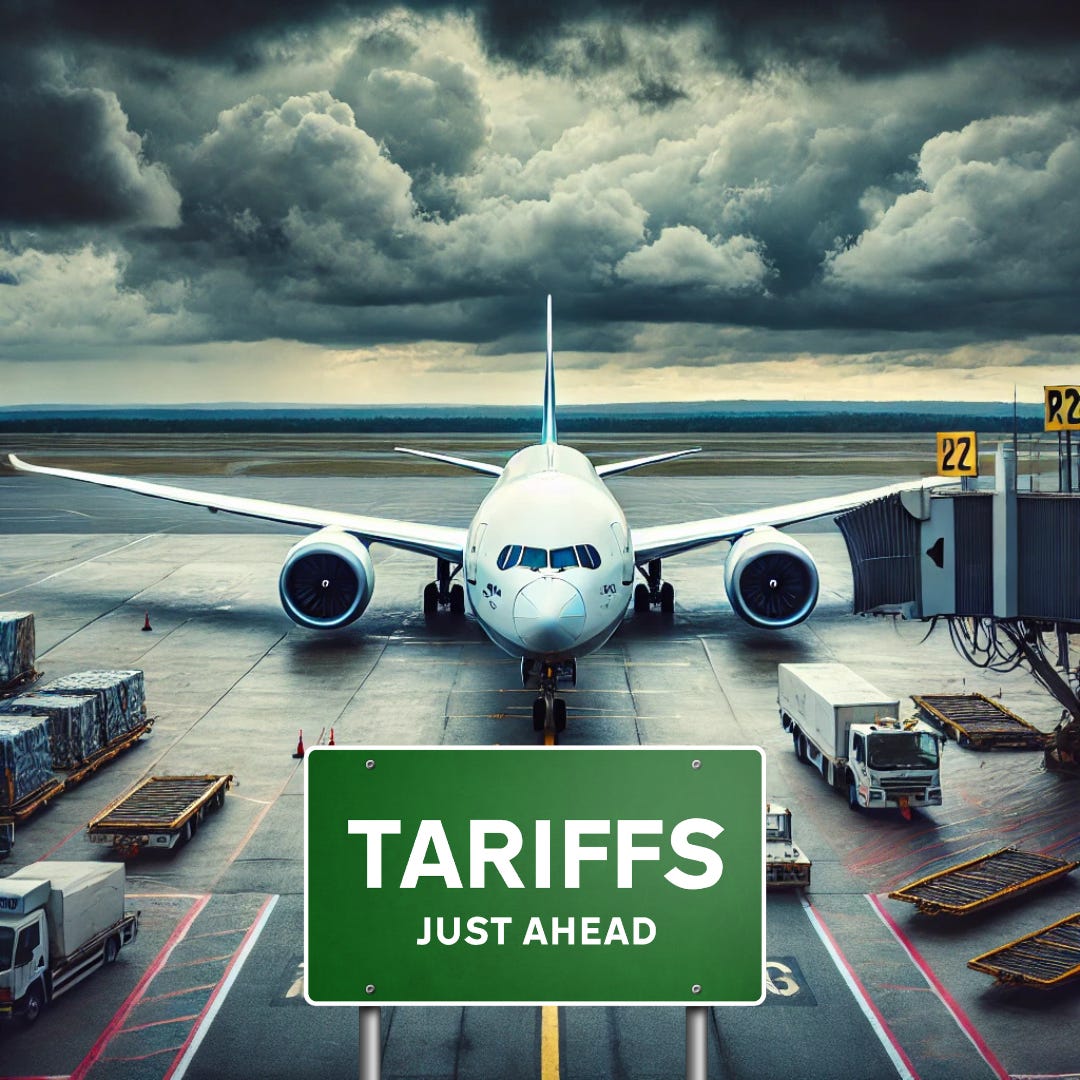
Earlier this month, China ordered its state-owned airlines to suspend Boeing aircraft purchases and deliveries in response to the Trump administration’s latest round of tariffs. These new duties—some as high as 145%—targeted a broad range of Chinese exports.
China’s retaliation hit where it hurts: Boeing, America’s largest exporter by value.
The estimated loss? Boeing will lose at least $1.2 billion in immediate cash flow and potentially tens of billions more over the next decade if China continues shifting toward Airbus and its domestic rival COMAC.
Boeing’s 2024 market outlook projected that China would need 8,830 new aircraft by 2043, worth over $1.4 trillion. That demand hasn’t vanished, but now those contracts may no longer land in the U.S.
The Pattern: Tariffs for Power, Not Policy
This isn’t the first time Trump’s tariff-first trade strategy has backfired. During his first term:
China responded to U.S. soybean tariffs by pivoting to Brazil, devastating U.S. farmers.
U.S. automakers struggled with rising costs from steel and aluminum tariffs.
Trump’s abrupt tariff threats against Mexico and the EU disrupted supply chains and diplomatic relations.
In 2025, the same pattern is repeating on a grander scale.
Pattern: Tariffs as punishment, not policy. Isolation, not leadership.
Short-Term Optics, Long-Term Damage
Tariffs may sound tough at rallies, but rarely deliver the long-term economic benefits promised. Trump claims they force countries to “pay up,” but what they often do is:
Raise prices on American consumers
Trigger retaliatory tariffs on U.S. exports
Destabilize supply chains
Weaken international alliances
Economists estimate that the 2018–2020 trade war with China cost the U.S. economy around $300 billion. Tariffs created more economic uncertainty than they solved, and job losses in export-heavy sectors outpaced any gains in protected industries.
Who Really Pays for Tariffs?
Despite Trump's repeated claims that “China pays the tariffs,” the reality is clear: American businesses and consumers foot the bill.
When a tariff is imposed on Chinese goods, U.S. importers pay the tax and pass it on to customers. Meanwhile, exporters like Boeing lose contracts and global credibility.
The hardest-hit sectors? The very ones Trump claims to champion:
Farmers, crushed by retaliatory bans
Manufacturers, paying more for imported inputs
Exporters, losing market share to rivals like Airbus
We’ve covered the impact of tariffs in much of our reporting. Below are a few examples, some serious and some more… snarky.
Note: Articles over 45 days live in our archives. Consider becoming a paid subscriber for the full 400+ article archive, exclusive content, and occasional early access.


Corporate America Sounds the Alarm
The damage isn’t abstract; it’s happening now. Major U.S. firms across multiple sectors are raising red flags about rising costs, shrinking demand, and a climate of extreme uncertainty:
Boeing faces a $1.2 billion blow as China halts aircraft deliveries.
Ford, General Motors, and Stellantis warn that 25% tariffs on vehicle parts will increase consumer prices and disrupt supply chains.
Best Buy and Target expect rising prices on consumer electronics and essentials.
Learning Resources, an educational toy maker, says its tariff burden will skyrocket from $2.3 million to over $100 million in 2025.
Nintendo delayed U.S. preorders for its new console due to trade volatility.
Top financial executives are speaking out:
JPMorgan CEO Jamie Dimon said companies may suspend guidance entirely due to uncertainty.
BlackRock CEO Larry Fink called the situation unprecedented in his five-decade career.
Wells Fargo CEO Charlie Scharf warned of a slowing economy and added volatility.
These aren’t political pundits; they’re market leaders. And they’re worried.
But America’s boardrooms are not the only ones feeling the heat—around the world, allies and adversaries alike are recalibrating in response to this economic upheaval.
Global Fallout: America Isolates Itself
Trump’s tariffs aren’t isolating China; they’re isolating America.
By turning trade into a zero-sum game, the Trump administration is creating opportunities for competitors. China, facing U.S. hostility, is:
Investing in its own aviation industry (COMAC)
Building infrastructure and trade ties through the Belt and Road Initiative
Deepening alliances in Asia, Africa, and Latin America
Meanwhile, Airbus is gaining contracts that Boeing used to dominate. And the BRICS+ bloc (Brazil, Russia, India, China, South Africa) is actively exploring non-dollar trade alternatives.
Trump’s unilateral trade wars are accelerating a multipolar global economy, one in which U.S. dominance is no longer a given.
Collateral Damage in U.S. Communities
From factory floors to farm fields, the pain is real:
Boeing’s lost orders in Washington State threaten union jobs and small suppliers.
In South Carolina, Boeing facilities face long-term uncertainty if Chinese contracts vanish.
In the Midwest, farmers are watching export markets slip away again.
Across the U.S., consumers will feel it in the checkout aisle, as tariffs drive up costs.
Yet there’s no relief plan, only threats of more tariffs.
A Global Economic System Under Strain
Trump isn’t just slapping tariffs. He’s undermining the international economic system.
He’s weakened the World Trade Organization
Withdrawn from trade agreements like TPP
Threatened allies with economic penalties
Encouraged ad hoc deals over multilateral frameworks
What’s left is a chaotic, unstable global market. One where authoritarian regimes like China and Russia fill the gaps left by American retreat.
Would China Have Cut Off Boeing Without Tariffs?
Not likely.
Boeing was too strategic; its aircraft were vital to China’s growing aviation sector. Even after tensions, China resumed Boeing deliveries in late 2024.
But Trump’s sweeping tariffs—up to 145% on Chinese imports—forced a response. Blocking Boeing orders sent a message:
“We will not be bullied. And we can hurt you too.”
It was retaliation, not an organic policy shift. It also shows how quickly American industries can become pawns in Trump’s political chessboard.
What Comes Next? A World Divided
As global supply chains fray and economic alliances realign, the long-term consequences are beginning to crystallize.
If these trends continue unchecked, here’s what the future may hold—not just for U.S. businesses, but for the global order itself:
A permanent fracture in global supply chains
Expansion of non-dollar trade alliances
More countries aligning with China and BRICS for economic stability
Long-term erosion of U.S. industrial influence
In trying to weaponize trade, Trump may be laying the groundwork for America’s economic decline on the global stage.
Conclusion: Tariffs Aren’t a Strategy; They’re a Warning Sign
Trump promised strength through tariffs. What we’re seeing instead is a blueprint for economic retreat.
Are we using tariffs to build the future or to burn bridges to the past?
It’s time for voters, workers, and lawmakers to demand accountability before the damage becomes irreversible.
We just hit 10,000 subscribers—thank you! We’re offering full access to The Coffman Chronicle for just $1 a week ($52/year) to celebrate.
Get exclusive analysis and fearless reporting you won’t find in corporate media.
Bibliography:
Boeing. Commercial Market Outlook 2024. July 22, 2024.
Bloomberg News. "China Tells Airlines to Stop Taking Boeing Jets." Bloomberg.com, April 15, 2025.
Reuters. "China Orders Airlines to Suspend Boeing Jet Deliveries Amid Trade Tensions." Reuters, April 15, 2025.
Brookings Institution. "More Pain Than Gain: How the US-China Trade War Hurt America." Brookings.edu, August 7, 2020.
Reuters. "Businesses Sound Alarm as Trump Tariff Chaos Hits the Economy." Reuters, March 11, 2025.
Yahoo Finance. "Automakers Warn That Trump Tariffs Will Hike Vehicle Prices as Much as 25%." Yahoo Finance, March 4, 2025.
Reuters. "Trump's Tariffs Roil Company Plans, Threatening Exports and Investment." Reuters, April 2, 2025.
Tax Foundation. "Trump Tariffs: The Economic Impact of the Trump Trade War." TaxFoundation.org, February 2025.
Axios. "Trade Earthquake." Axios, April 16, 2025.
Reuters. "US-China Decoupling Is Crossing a Rubicon." Reuters, April 16, 2025.
China is outsmarting t is hilarious. And the thermal meltdown ketchup spewing all caps rants on social media make me smile.
China will not back down, whatever the cost. Anyone with a basic understanding of China would know this, it’s sheer lunacy!!!