


On the refrigerator, beneath a magnet shaped like a pear, June had taped a card that read: THANKSGIVING RULE: NO POLITICS AT THE TABLE.
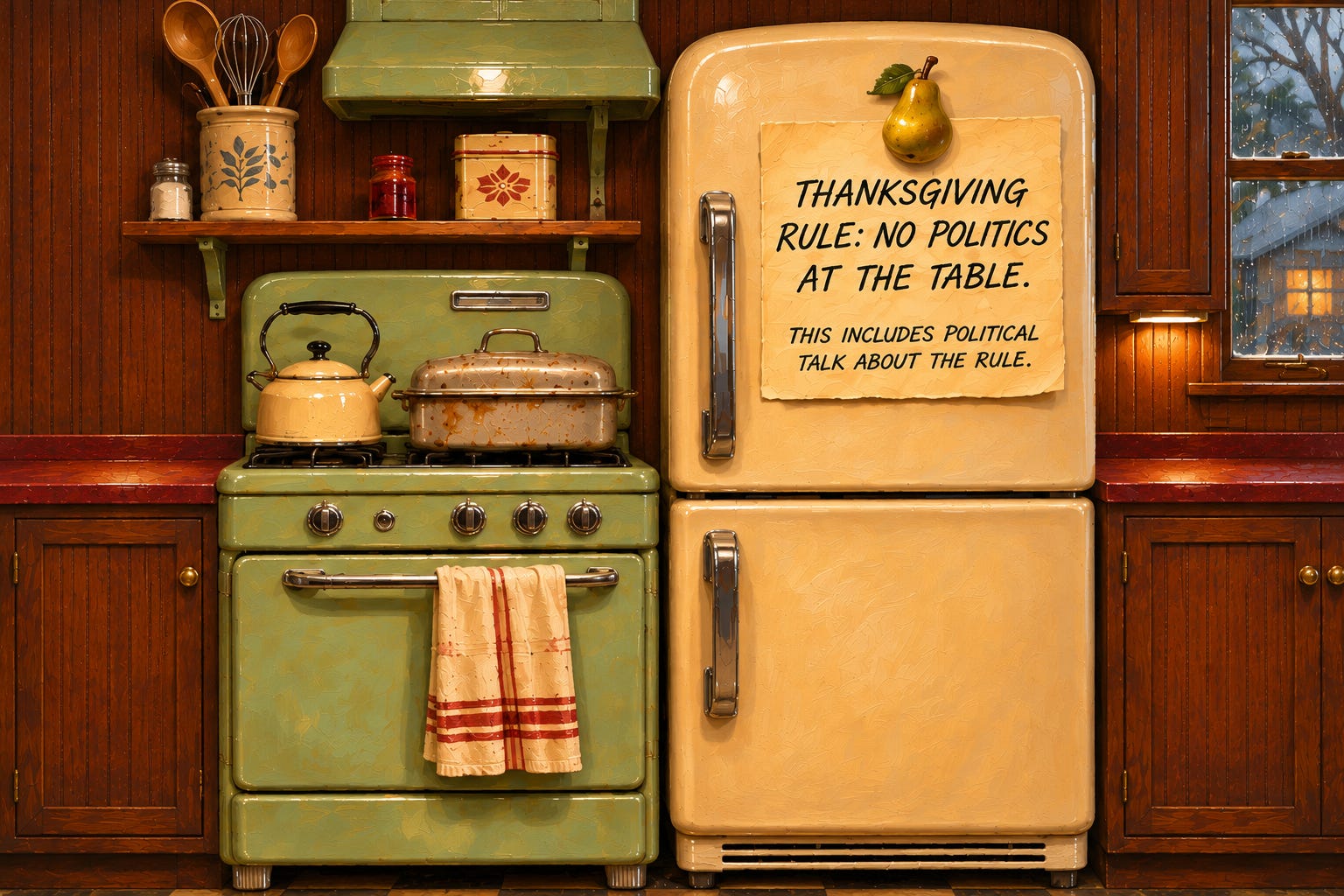
Her granddaughter Nell had added, in smaller writing: THIS INCLUDES POLITICAL TALK ABOUT THE RULE.
By four o’clock, the kitchen smelled of browned butter, sage, and the turkey June had spent the morning telling everyone not to touch. Outside, a cold rain tapped the windows. Inside, the oven ticked as it cooled, and the old storm window over the sink rattled whenever the wind pressed against it.
June’s daughter Mara arrived with a pie and a stack of campaign mail she said she’d meant to recycle. Her brother Ben came in carrying a toolbox.
“Is that for the pie?” June asked.
“It’s for the porch rail.”
“You brought a toolbox to Thanksgiving.”
“I said I’d look at it.”
“You said that last Thanksgiving.”
“I was looking at it last Thanksgiving.”
“You were standing near it holding a screwdriver.”
“That is one of the ways a person looks at a porch rail.”
Mara set the pie on the counter. “Should we appoint someone to supervise the looking?”
Nell, sixteen and already wearing a paper name tag that said MODERATOR, held up a wooden spoon. “I’m in charge of keeping things civil.”
“Then I’m putting you in charge of the gravy,” June said. “It’s been hostile since noon.”
This Community Is Powered by You
What started as a small circle has grown into something much bigger, and it’s all because of readers like you.
Every time you forward this email, post it on socials, or bring someone new into the fold, you’re helping build one of the most passionate, independent communities out there.
Want to keep the momentum going?
Share this newsletter with someone who should be part of this conversation.
Thank you for being here. It means everything.
The Rule Lasted Through the First Helping
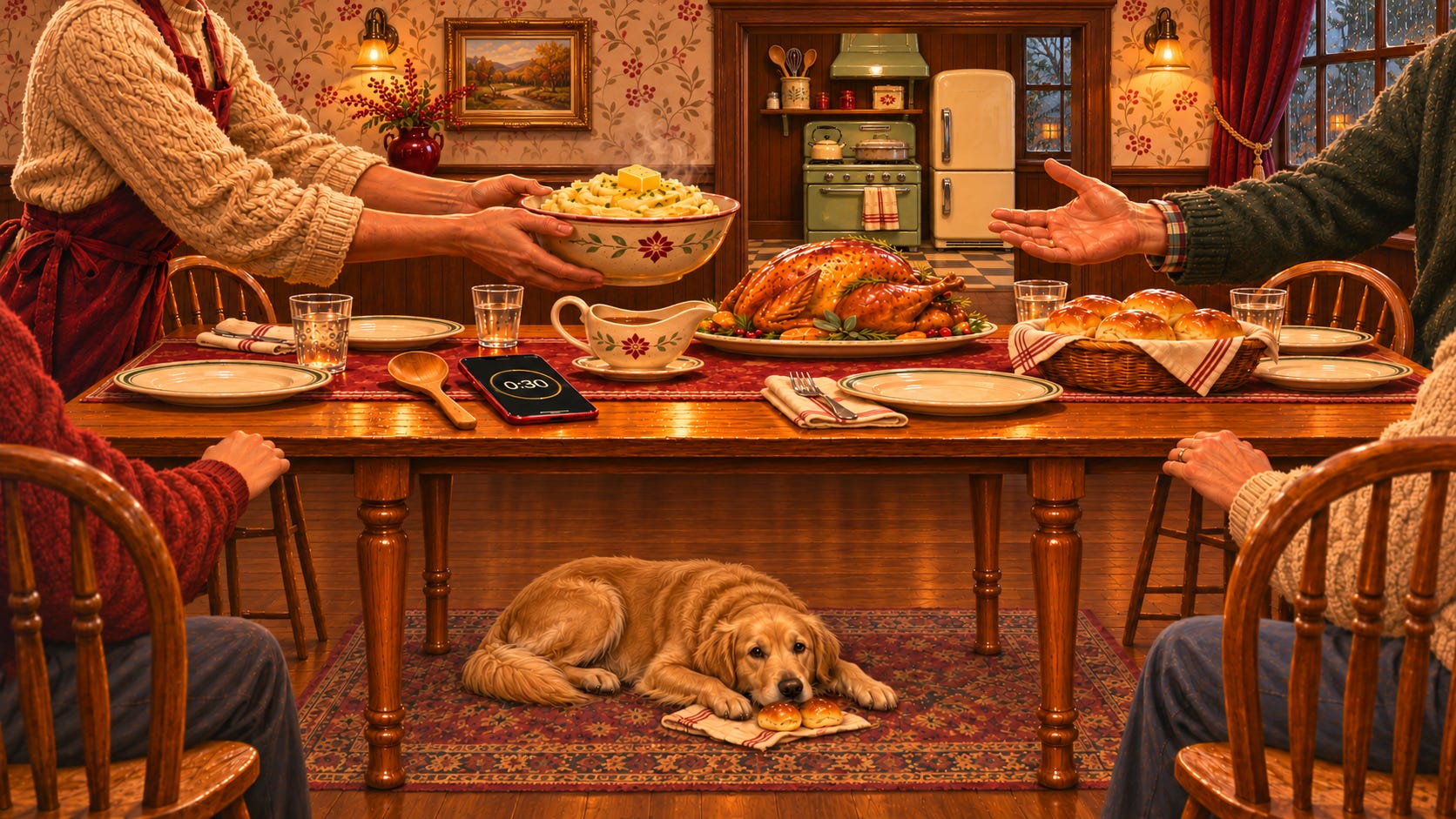
The family managed to keep politics off the table through the first helping. They discussed the weather, the price of butter, and whether the dog had eaten one of the dinner rolls or merely hidden it for later. Ben claimed the dog had “a strong record of preserving resources.” The dog watched from under the table, where he had preserved two rolls and a napkin.
Then Mara mentioned the election. She did not mean to start an argument. She was telling June that the library had stayed open late on Election Day so people could use the computers to check information and find their polling places. Ben asked if the library had been paid extra for that.
“It was part of our public service,” Mara said.
“Sure,” Ben said. “I just wonder how many public services people can ask for before somebody has to figure out the bill.”
Nell raised the spoon. “Point of order. We are not supposed to talk about politics.”
“That was a question about the bill,” Ben said.
“Bills are political,” Mara replied.
“Some bills are just bills.”
“That’s what people say until it’s their library that has to cut hours.”
Ben leaned back. His chair creaked. “And some people talk as if every problem can be fixed by adding another program.”
The kitchen fell quiet, save for the rain and the faint hiss of the radiator. Mara folded her napkin. “I didn’t say that.”
“You didn’t have to.”
Nell tapped the spoon against her water glass. The note rang out with the solemnity of a small church bell. “Thirty-second speaking limit,” she announced. “I made a timer.”
She set a phone on the table. It began counting down from thirty. Everyone stared at it.
“This is already more organized than Congress,” Ben said.
“That’s because Congress doesn’t have Grandma’s gravy,” June said.
The laughter came, but it did not last. Mara said she was tired of hearing that help for people was wasteful when she saw families come into the library needing a place to fill out forms, print job applications, or sit somewhere warm. Ben said he was tired of being told that if he questioned a program, he must not care about the people it was meant to help. He had watched the town spend money on plans and signs while the same potholes opened every spring.
“I care about people,” he said. “I just don’t trust every person who promises to help them.”
“And I don’t trust the idea that people can manage alone if we just leave them alone,” Mara said.
Nell’s timer beeped. She started, swatted at the phone, and knocked her spoon onto the floor.
“Moderator has lost control of the chamber,” Ben said.
“The chamber needs to stop interrupting the moderator,” Nell replied, retrieving the spoon.
June passed the potatoes. No one took any. She looked from Mara to Ben. “You both sound like you’re arguing about whether the other one has a heart.”
Neither answered.
“I didn’t say he didn’t care,” Mara said after a moment.
“You said I didn’t have to say it,” Ben replied.
Mara stared down at her plate. The turkey skin had gone crisp and golden, and the smell of pepper and rosemary rose between them. “I was angry. I made it about you.”
Ben ran his thumb along the rim of his glass. “I made your work sound like a waste of money. I know it isn’t.”
“I want the money spent well, too,” Mara said. “I just wish you could see some of the people who come through those doors.”
“Maybe I should,” Ben said. “And maybe somebody ought to ask whether the programs are doing what they’re supposed to.”
“That’s a fair question.”
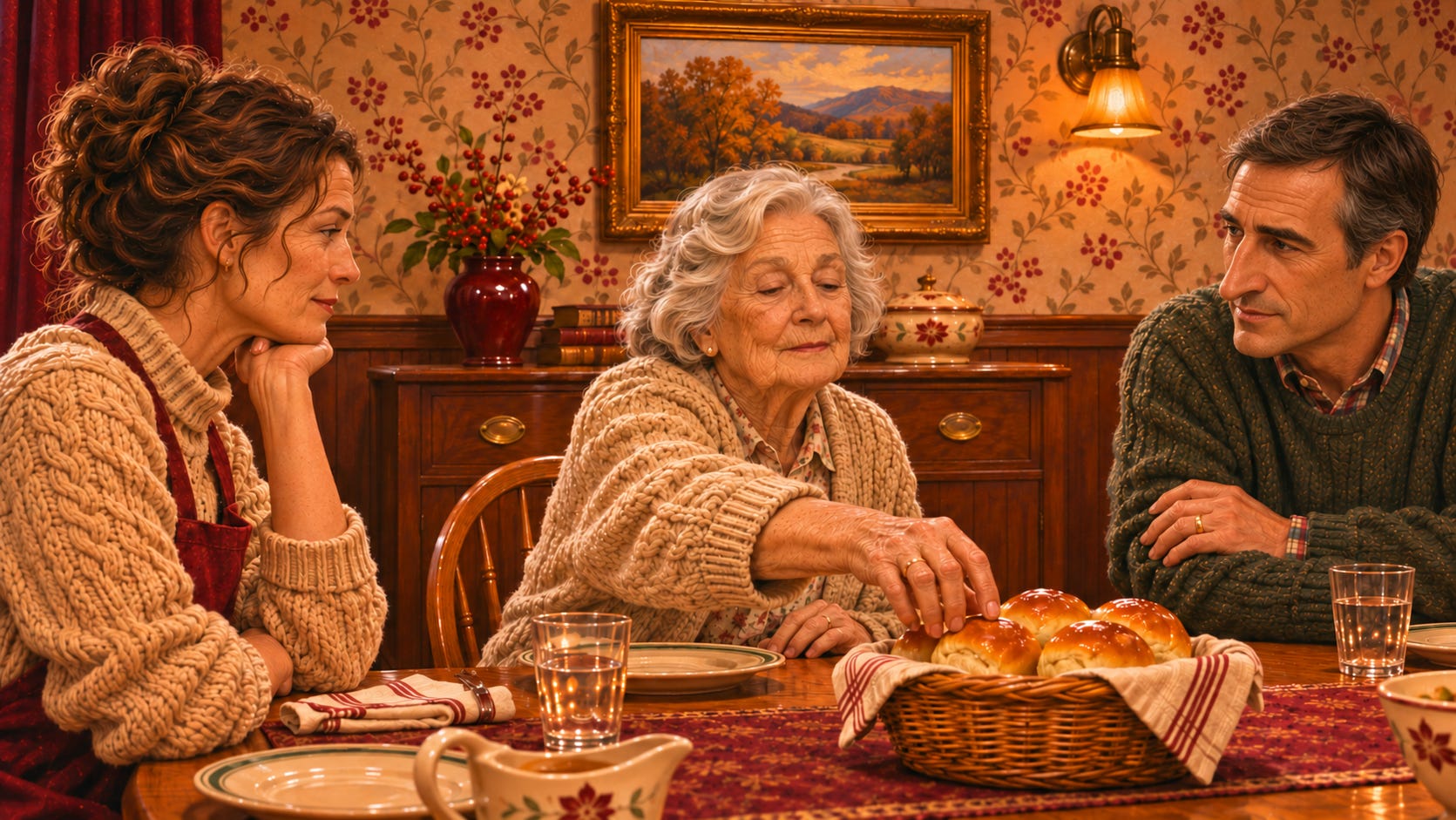
Neither looked entirely comfortable having agreed about something. The words did not fix everything. They did, however, make enough room for June to reach the rolls.
Making Room to Listen
She passed the basket to Nell, who had begun writing something on the back of her moderator badge.
“What are you doing?” Ben asked.
“Taking minutes.”
“Of the family meeting?”
“Of the part where everyone decided what everyone else thinks.”
Ben nodded. “That could be a long document.”
“Then I’ll use the library printer.”
Mara laughed despite herself, and the tightness at the table loosened a little.
The House Has Its Own Agenda
After dinner, the family carried plates to the kitchen. The sink filled with warm, cloudy water. Someone turned on the tap too hard and splashed Mara’s sleeves. Ben wiped the counter. Nell discovered the dog’s stolen rolls under the table and declared them no longer fit for public consumption.
As June reached for a stack of serving dishes, the storm window rattled sharply. A thin line of water had gathered along the sill.
“Is that new?” Mara asked.
“No,” June said. “It’s been doing that.”
“For how long?”
“Since the first rain.”
“You could’ve told us.”
“I did tell Ben about the porch rail.”
“That’s not the window.”
“It’s in the same general family of house problems.”
Ben went to the hall closet and came back with his toolbox. Mara found an old towel. Nell held the flashlight while June showed them where the sash stuck.
The window was cold under Mara’s fingers. A bead of water slid over the painted wood and darkened the towel. Ben loosened the latch, then stopped to inspect the frame.
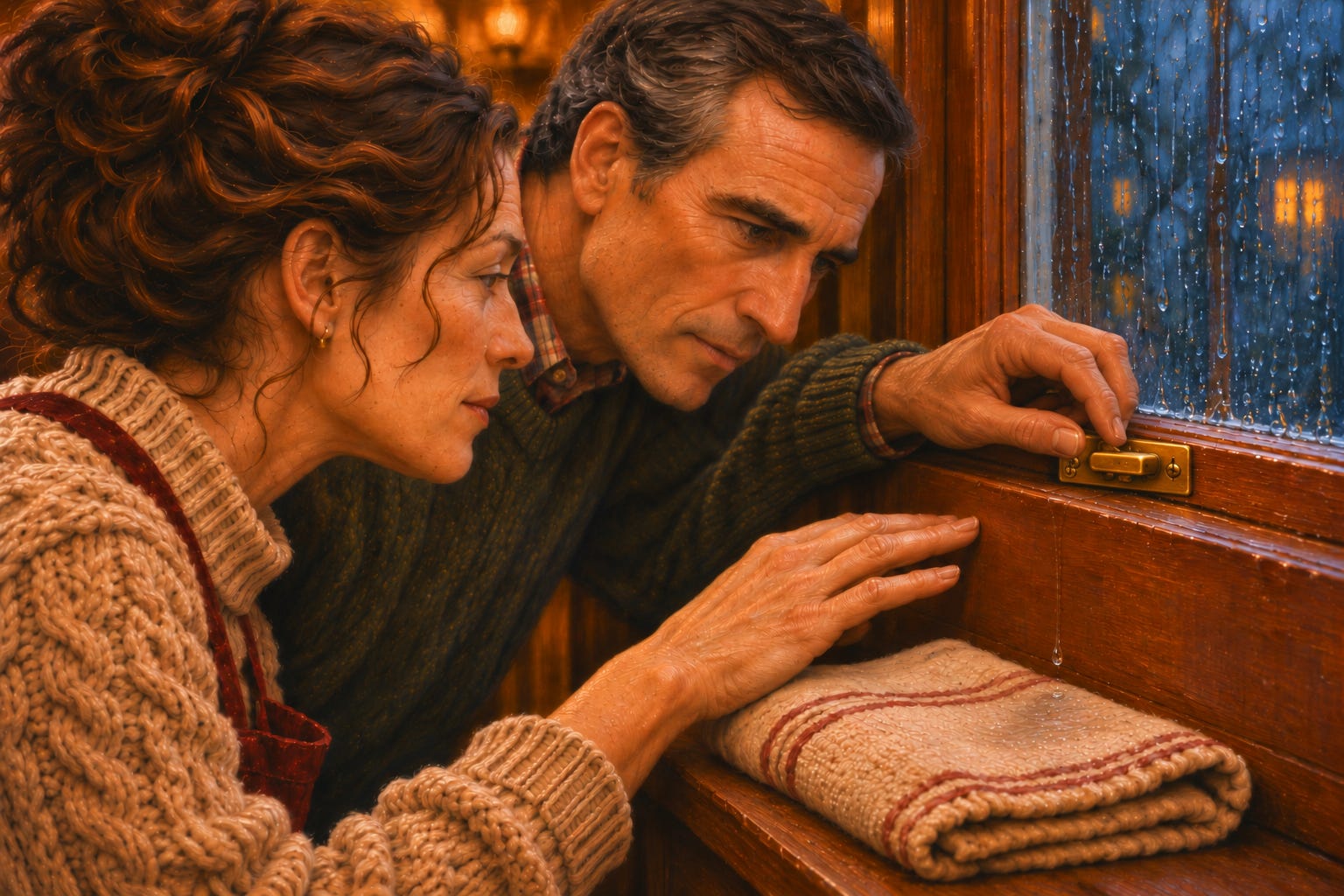
“This needs new weather stripping,” he said. “The rail needs a bracket, too.”
“Can you do both tomorrow?” June asked.
“I can do the rail tomorrow. The window needs a part.”
“I can pick it up,” Mara said. “I’m off in the morning.”
Ben looked at her. “I’ll send you the measurements.”
“Please do. I don’t want to buy another part that’s almost right.”
“Almost right is how most of this house stays standing.”
“That explains a lot,” June said.
While Ben packed away the tools, Mara asked June why she hadn’t called either of them earlier.
June shrugged. “I don’t want to become the next item on everyone’s list. I like living here. I like deciding what needs doing and when.”
Mara nodded. “We can help without taking over.”
“And I can ask before the window starts making speeches,” June said.
The next morning, Ben returned with a bracket for the porch rail. Mara came back from the hardware store with the weather stripping he’d measured. They repaired the porch rail first. The wet boards smelled like rain and old cedar. Ben steadied the post while Mara tightened the screws. Nell held the flashlight even though the daylight was bright enough.
June watched from the doorway, offering occasional instructions that Ben insisted were unnecessary until one of them turned out to be correct.
When the rail stopped wobbling, June leaned on it gently. “Good,” she said. “Now I can safely tell you both you’re wrong about something.”
“We’re ready,” Mara said.
“Give us a minute,” Ben replied. “We’re still installing the bracket.”
They laughed, and the sound carried across the porch.
Still Family, Still Disagreeing
Over coffee, Mara and Ben talked again about the election and the problems that had made them angry. They did not reach the same conclusions. Mara still thought public institutions needed more support. Ben still wanted clearer answers about where money went and who was responsible when plans failed.
Ben asked how the library knew which services people actually used. Mara said they kept records, although she wasn’t sure anyone on the town council paid much attention to them. Mara asked when Ben had last visited the library. He admitted he couldn’t remember. Neither answer settled their argument, but both gave them something to think about.
Importantly, each asked what the other had actually seen, instead of what they assumed the other believed.
By noon, the window no longer rattled. The porch rail held firm. Nell had crossed out MODERATOR on her badge and written TIMEKEEPER, MAYBE.
June put the unused campaign mail in the recycling bin and handed Ben a fresh cup of coffee. “Next year,” she said, “I’m making everyone sign a speaking agreement before dessert.”
“Can it be one page?” Ben asked.
“I’m the one who decides.”
“Then I support the agreement.”
Mara reached for the sugar. “That sounds suspiciously like a political position.”
The family laughed. They still disagreed about plenty, but the rain stayed outside, the rail held, and no one left June to manage the loose ends alone.