


Most Americans can’t name the three branches of government. Fewer can explain what they actually do. That’s not a dig; it’s by design. Civics has been stripped from classrooms, drowned in cable news brawls, and buried under decades of distraction.
But while we were looking away, the system started to warp. Congress stopped checking presidents. Presidents started ruling by executive order. Courts began redrawing the meaning of rights.
And worst of all? The public barely blinked, not out of apathy, but because too many of us don’t know what “normal” governance is supposed to look like.
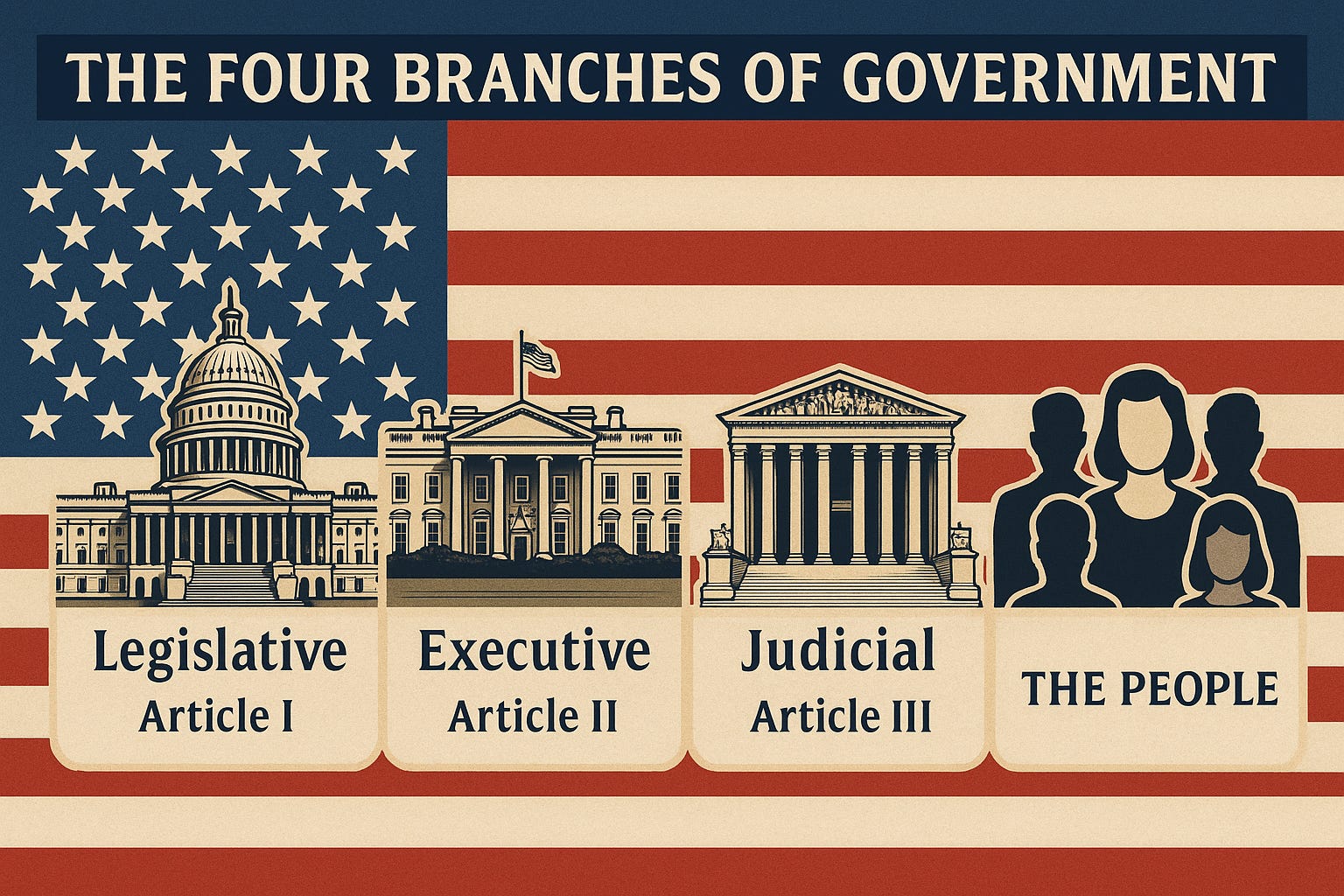
So let’s fix that. This isn’t a history class; it’s a survival guide. What are the three branches supposed to do? How have they been undermined? And why you, the people, are the forgotten Fourth Branch, the only one with the power to reset the system.
We just hit 13,000 subscribers—thank you! We’re offering full access to The Coffman Chronicle at 50% off to celebrate.
Get exclusive analysis and fearless reporting you won’t find in corporate media.
Article I – Congress: The Power We Gave Away
Congress was meant to be the heartbeat of American democracy. It’s Article I, and the longest of the articles, for a reason. The framers put it first because it was supposed to be the most powerful branch—the people’s voice. It’s charged with:
Making laws
Controlling the budget (the “power of the purse”)
Declaring war
Confirming or rejecting presidential appointments
Investigating and checking the executive
But in recent decades, Congress has become more performative than powerful, ceding ground to the White House and the courts while lobbing soundbites for donors and clicks.
Case in Point: The Emoluments Clause
The Constitution explicitly prohibits federal officials from accepting gifts or payments from foreign governments without congressional approval. It’s not a technicality; it’s a firewall against foreign influence and presidential profiteering.
Recently, headlines erupted over President Trump’s reported plan to accept a $400 million private jet from the Qatari government. The aircraft, allegedly intended for future use in his presidential library, has triggered alarm even among some of his own supporters.
But this isn’t a new problem. It’s just the loudest symptom of a disease that’s been ignored. During his first term, the Trump Organization openly continued to operate hotels and golf clubs that received payments from foreign governments. Lawsuits followed, but Congress did little. No hearings. No votes. No accountability.
This is how constitutional erosion works: not with a bang, but with a shrug.
See our reporting here for more context:

Did You Know? Congress hasn’t formally declared war since 1942. Every conflict since—from Korea to Iraq—has happened through executive action rubber-stamped by silence.
When Congress Worked: During Watergate, congressional investigations exposed presidential crimes and led to resignations. Today? Many members fear party backlash more than violating their oath.
Congress still holds enormous power. But if the public doesn't demand they use it, the Constitution’s first branch will keep becoming the weakest one.
Article II – The Executive: Power, Consolidated
The presidency was never meant to be a throne. Article II created the executive branch to enforce the laws passed by Congress, not to make them, rewrite them, or ignore them.
But today’s presidency looks very different from what the framers envisioned. Over time, power has concentrated in the White House through war powers, emergency declarations, regulatory control, and, most notably, executive orders.
Presidents now make major policy decisions—on immigration, trade, surveillance, climate, and more—with a stroke of a pen. And with each unchallenged move, the office gets stronger… while public influence gets weaker.
Case in Point: CEOs at the Table
When President Trump traveled to Saudi Arabia earlier this year, he didn’t go alone. He brought a delegation of American CEOs—Elon Musk, Sam Altman, and others—who weren’t just observers. They inked deals. They talked policy. They operated as quasi-diplomats.
This wasn’t just a business trip. It was a redefinition of foreign policy, where the line between national interest and corporate gain blurred beyond recognition.
This isn’t unique to Trump. Presidents of both parties have used executive clout to bypass Congress and align policy with elite or corporate interests. But when corporate leaders sit in the front row of international negotiations, without public input or congressional oversight, the power of the presidency has clearly jumped its constitutional tracks.
The article below digs deeper into this issue:

Did You Know? The Constitution doesn’t mention “executive orders” at all. They’ve evolved through custom and crisis, and today, they shape the country more than most laws passed by Congress.
When the Presidency Was Checked: After Nixon’s abuses, Congress passed laws to curb executive overreach. But those laws only work if enforced and only when the public demands it.
Presidents are not monarchs. But if we treat them like they are and shrug off abuses because they’re “on our side,” we surrender the balance of power the framers fought to build.
Article III – The Judiciary: The Quiet Expansion of Power
The judiciary, as outlined in Article III, was designed to interpret laws, not to make them, not to enforce them, and certainly not to dominate them. But today’s federal courts—especially the Supreme Court—are doing precisely that, not as neutral referees, but as ideological enforcers.
This isn’t just about one ruling. It’s about a long-term project. The Court has been intentionally reshaped to carry out a narrow political vision that the electorate, left to its own devices, might not support.
Case in Point: Nationwide Injunctions Under Fire
The Supreme Court is currently hearing Trump v. CASA, a case about whether lower federal courts can issue nationwide injunctions, broad rulings that block executive actions nationwide.
The case stems from district court rulings halting President Trump’s executive order attempting to deny birthright citizenship to the children of undocumented immigrants. But the Court isn’t evaluating the policy; it’s considering whether the judiciary should retain the power to intervene this broadly.
If they restrict that power, the executive branch gains yet another unchecked tool. And if that happens under a court already shaped by one party’s agenda? It’s not justice; it’s consolidation.
We dug into this story in the following article:

Did You Know? The Constitution doesn’t mention judicial review at all. The Supreme Court gave itself that power in 1803 with Marbury v. Madison. What it chooses to do with that self-granted authority shapes the law for generations.
Then vs. Now: The Court once stood as a bulwark against injustice, from Brown v. Board to Loving v. Virginia. Today, it often serves as the last stop for ideological policies that couldn’t pass Congress or survive public scrutiny.
The courts were supposed to be the least dangerous branch. But when they act as an extension of executive and legislative extremism, they become a democratic threat in a black robe.
The Fourth Branch – The People: The Power They’re Trying to Take
The Constitution doesn’t name you as a branch of government, but it begins with you: “We the People.” You elect Congress. You elect the President. You shape the judiciary through those choices. You are the only branch that isn’t limited by terms, votes, or confirmation hearings. You are the root of legitimacy.
And that’s exactly why so much energy is spent trying to weaken you.
Voter suppression, gerrymandering, disinformation campaigns, and political purges of election officials— these aren’t glitches. They’re strategies. If your voice didn’t matter, they wouldn’t be working this hard to silence it.
Case in Point: Every time a state redraws a map to dilute Black and brown voters. Every time early voting hours are slashed. Every time disinformation floods your feed. It’s not apathy that threatens democracy; it’s engineered disempowerment. The only response is radical re-engagement.
Did You Know? Roughly 1 in 6 eligible voters didn’t cast a ballot in 2024, and most weren’t apathetic. They were blocked, misled, or made to feel that their voice didn’t matter.
You are the Fourth Branch. You don’t need permission to reclaim your power. You just need the truth and the tools.
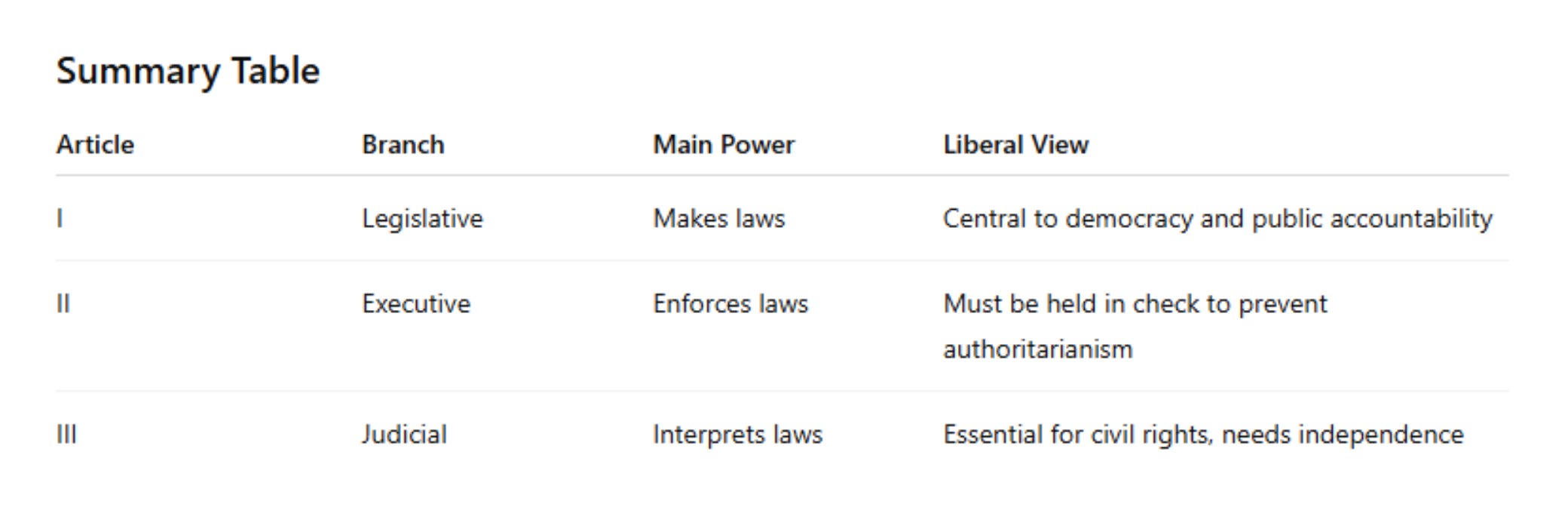
TL;DR
Conclusion: Time to Wake the Hell Up
This isn’t just about civics. It’s about survival. Congress won’t save us. The President won’t save us. The Courts won’t save us. The only branch with a reason to save democracy is us.
📚 Understand how power is supposed to work.
🔍 Spot where it’s being abused.
📢 Speak up, show up, vote, organize, donate, protest, educate.
Your ignorance is someone else’s strategy. Your silence is someone else’s weapon. Your power? It’s still there.
But it only works if you use it.
We just hit 13,000 subscribers—thank you! We’re offering full access to The Coffman Chronicle at 50% off to celebrate.
Get exclusive analysis and fearless reporting you won’t find in corporate media.
Bibliography:
Note: Our previous reporting linked within this article each has a bibliography for further information on those specific topics.
United States Constitution. Articles I–III. National Archives.
Brennan Center for Justice. “Gerrymandering and the 2024 Election.” Brennan Center, November 2024.
SCOTUSblog. “Trump v. CASA, Inc.” SCOTUSblog, May 2025.

It's time for the war on greed to start!!!
Excellent exposé on how our government was supposed to work.