


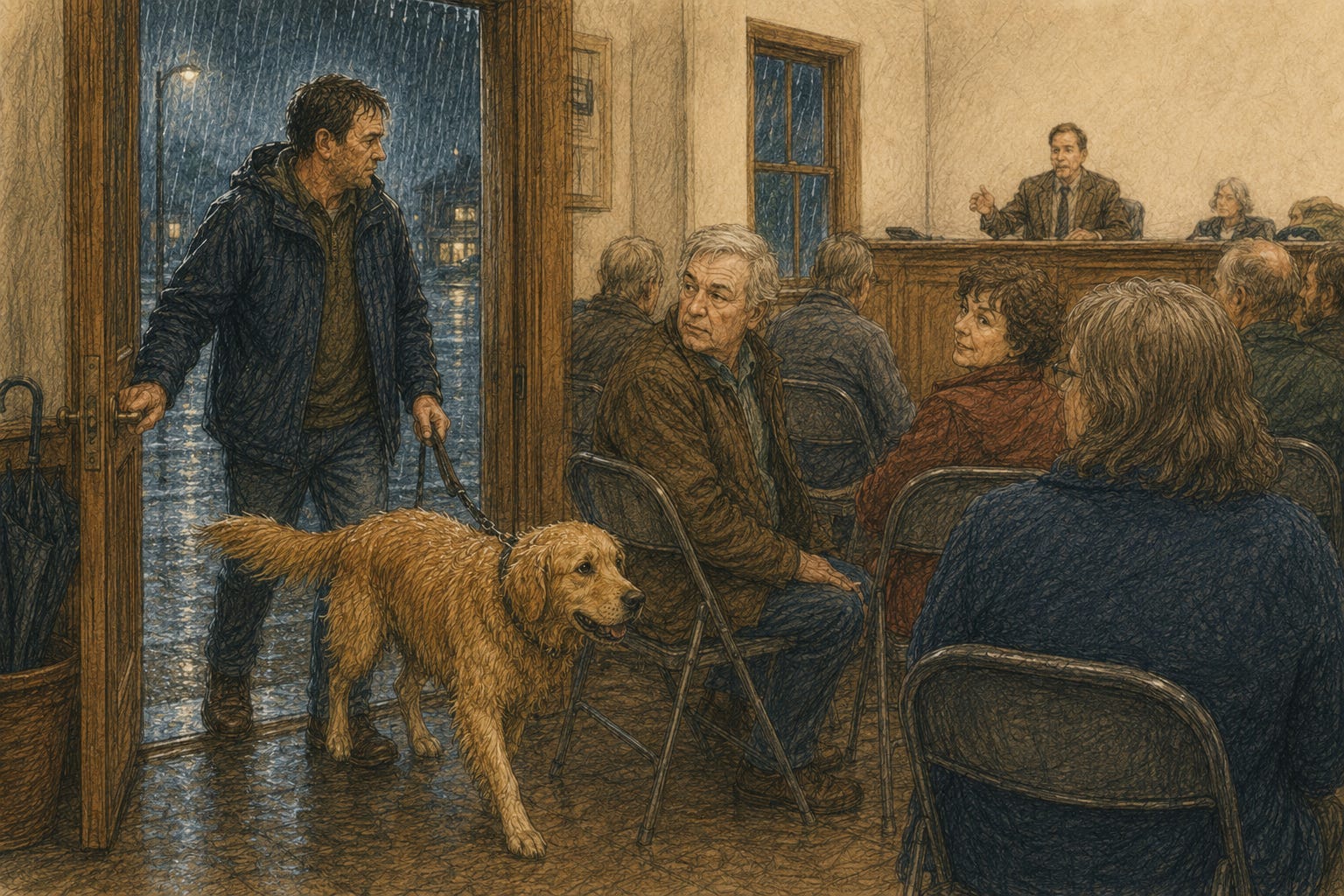
Murphy did not run for mayor. This was his first qualification.
His second was that he had never made a promise he could not keep, unless someone counted the words “Bring back the tennis ball,” which Murphy regarded more as a suggestion than a binding agreement.
The actual mayor, Russell Pike, had held the office for twelve years and owned seven pairs of ceremonial scissors. He had cut ribbons for a renovated courthouse step, a repainted fire hydrant, and the reopening of a bakery that had closed for only nine days.
Mayor Pike was especially talented at announcing that something would soon be studied. The leaking library roof was being studied. So had the broken drinking fountain at Maple Street Park.
The pedestrian signal at Third and Walnut had been displaying WAIT for eleven months, which the mayor said was part of a comprehensive traffic-safety review. “Before we make any changes,” he told the town council, “we need to gather the relevant information and consult with the appropriate departments.”
Most residents assumed Mayor Pike would be reelected because no one had agreed to run against him. Then came the public forum.
This Community Is Powered by You
What started as a small circle has grown into something much bigger, and it’s all because of readers like you.
Every time you forward this email, post it on socials, or bring someone new into the fold, you’re helping build one of the most passionate, independent communities out there.
Want to keep the momentum going?
Share this newsletter with someone who should be part of this conversation.
Thank you for being here. It means everything.
At Least the Dog Listened
Joe Palmer brought Murphy because the dog disliked being left alone during thunderstorms. Rain tapped against the windows of the municipal building, and Murphy’s damp coat filled the room with the smell of wet towels.
One by one, residents stepped to the microphone.
Mrs. Haney asked when the library roof would be repaired. Mayor Pike explained that the town was developing a moisture-management strategy.
Mr. Lewis asked about the loose railing outside the post office. The mayor thanked him for participating in the town’s infrastructure conversation.
A mother asked whether the playground slide would be replaced before her children were old enough to drive. Mayor Pike said the town had to balance recreational priorities with long-term fiscal realities.
During each answer, Murphy sat beside Joe and watched the person who had asked the question. When Mrs. Haney returned to her chair, he rested his chin on her knee. “At least the dog listened,” she said.
Someone laughed.
By the following morning, a handwritten sign had appeared in the window of the hardware store. **MURPHY FOR MAYOR**
Another appeared at the laundromat. **SIT. STAY. SERVE.**
Joe removed three signs from his own yard before giving up.
“It’s a joke,” Mayor Pike assured everyone.
It remained a joke right up until election night.
The Write-In Candidate
Town clerk Clara Bell counted 417 write-in votes for Murphy and 400 for Mayor Pike. She also found six votes for “That Nice Yellow Dog,” four for “Murfy,” and one for “Air Bud,” which she ruled too ambiguous to assign.
The town attorney reviewed the results and announced that Murphy could not legally serve because he was not a person, a registered voter, or capable of signing his own name. Joe pointed out that the last qualification had not stopped several previous council members.
Legally, Mayor Pike kept his office. The law was still the law, even when most of the town would have preferred the dog. Politically, though, Russell Pike had lost to an animal who had spent most of Election Day asleep behind Joe’s recliner.
The council attempted a compromise. Murphy would be named honorary mayor for one year. He would attend parades, visit schoolchildren, and pose for photographs. Mayor Pike would continue doing the actual work. This arrangement satisfied everyone except Mayor Pike.
Murphy’s first official appearance was at the council meeting the following Tuesday. His nails clicked across the tile floor as Clara led him to a cushion beside the mayor’s chair. He circled it three times, rejected it, and went to sleep under Clara’s desk. Residents described this as a refreshing display of independence.
The Mayoral Walk
Murphy’s schedule soon included a weekly “mayoral walk” with Joe. The council intended it as a public-relations event. It became something else.
At Third and Walnut, Joe noticed that the pedestrian signal was still broken because he and Murphy stood there long enough to watch it cycle from WAIT to WAIT.
At the library, Murphy stopped to drink from a puddle beneath the gutter. Joe looked up and saw a plastic sheet flapping over the roof where shingles should have been.
At Maple Street Park, Murphy pushed his nose into a patch of wet grass and began digging. Joe pulled him away, but cold water continued bubbling up through the soil. A buried pipe had been leaking long enough to turn the ground soft beneath the nearest bench.
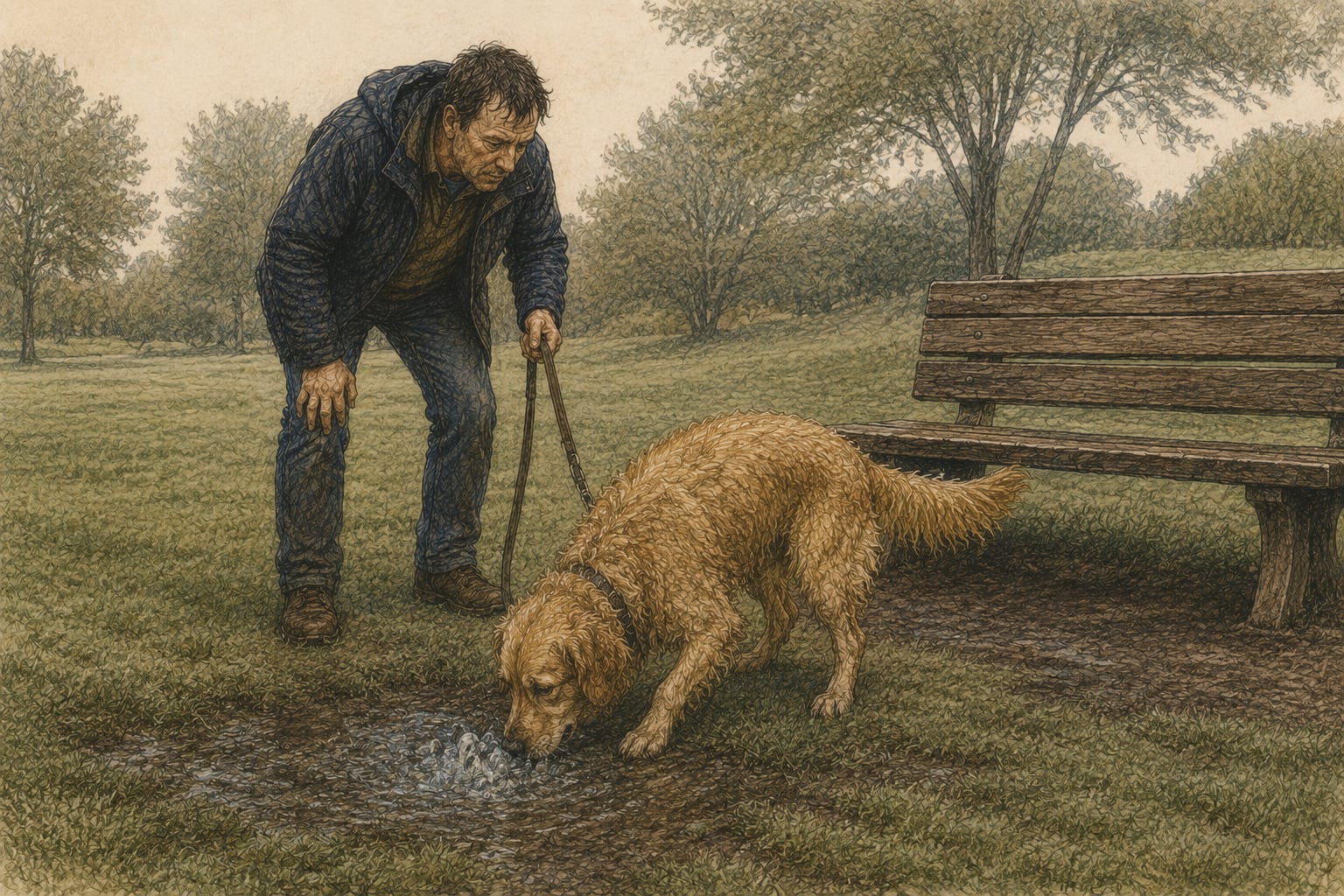
Murphy did not understand municipal neglect. He just liked puddles, but Joe began carrying a small notebook on their walks.
Residents started joining them. They pointed out buckled sidewalks, burned-out streetlights, and storm drains packed with leaves. Murphy greeted every complaint with the same patient expression, particularly when the complainant had recently handled food.
At council meetings, he sat near whoever was speaking. Sometimes he rested his chin on a knee. Sometimes he fell asleep against a pair of shoes. People felt heard.
Mayor Pike attempted to explain that Murphy was not actually listening. “He’s hoping somebody has ham,” Pike said.
Mrs. Haney folded her arms. “You could try that.”
The Park for Sale
The trouble began when the town’s budget came up short. Mayor Pike and the council had found what they called a fiscally responsible solution. A development company wanted to purchase Maple Street Park and build a climate-controlled storage facility. The sale would close the budget gap without raising taxes or immediately cutting services. The proposal was titled **Municipal Recreational Asset Optimization Initiative**.
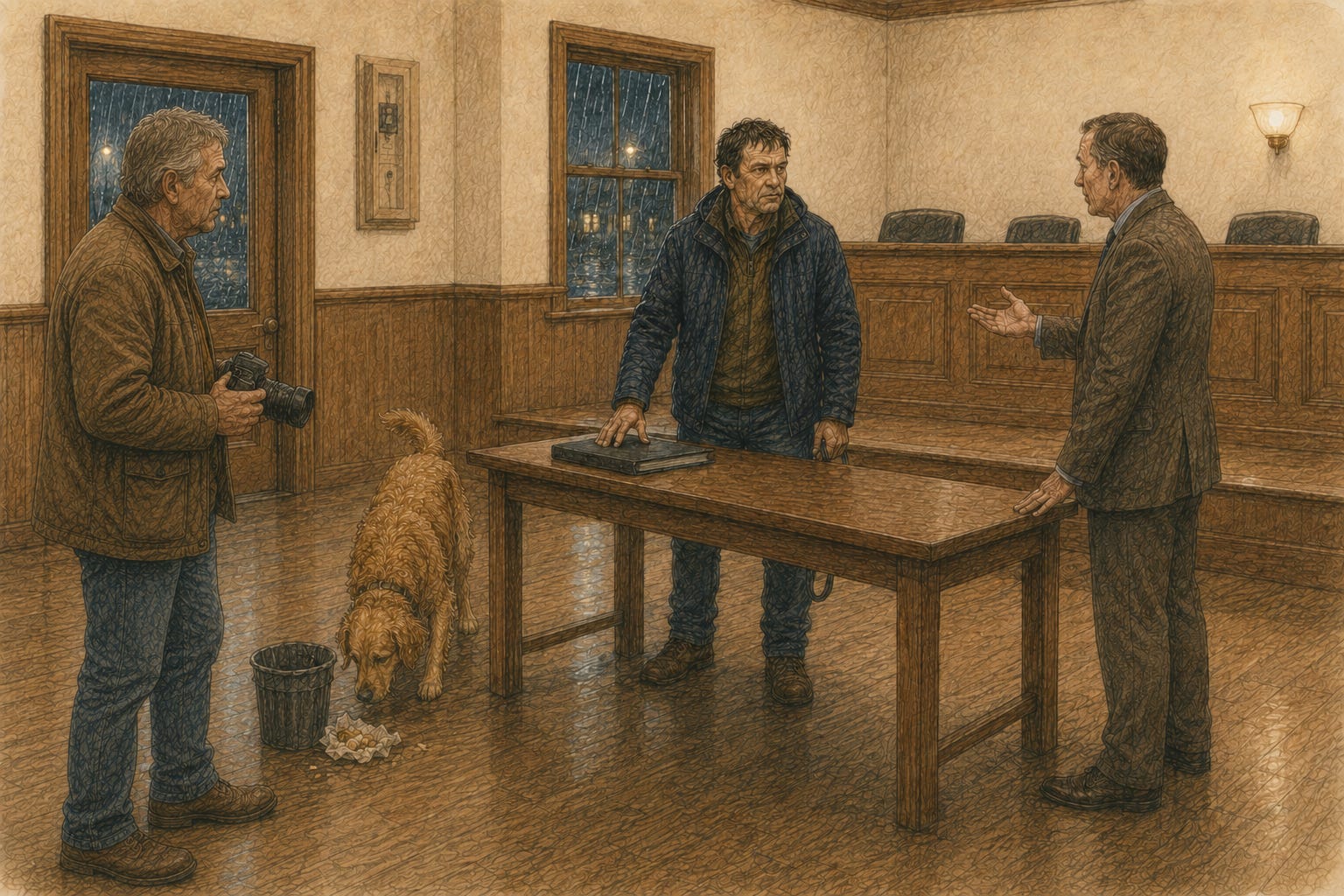
The council planned to announce it with a photograph of Murphy placing his paw on the proposal.
Joe read the first page. “What does this do?” he asked.
Mayor Pike glanced toward the photographer. “It converts an underperforming public asset into a revenue-producing property.”
“You’re selling the park.”
“That is an unnecessarily reductive description.”
“Murphy is a dog, Russell. Reduce it.”
The photographer lowered his camera.
Joe closed the folder. Murphy sniffed it once and turned toward a trash can where someone had discarded a sandwich wrapper. “You’re not using him to sell something people haven’t been told about,” Joe said.
The photograph never happened.
The sentence traveled through town before lunch. At the next council meeting, every chair was filled.
Mayor Pike explained that Maple Street Park had become too expensive to maintain.
Mrs. Haney reminded him that the drinking fountain had been broken for three summers. A father held up a piece of the playground swing he had found lying in the grass. A teenager presented photographs of trash caught along the creek bank.
Darlene Fitch, who had served on the council for nine years, looked down at the maintenance reports. Most requests had been delayed, reassigned, or marked for future review.
She turned another page, then another. “We’ve been calling the park a burden,” she said slowly, “after spending years refusing to take care of it.”
The room went quiet.
Maintenance, she realized, had been treated as though it were an optional favor the town might someday provide rather than one of the obligations that came with owning the park in the first place.
From the hallway came the crinkle of a snack bag. Murphy stood, walked out of the meeting, and sat beside a boy eating cheese crackers. Half the room followed him.
Mayor Pike stared at the empty chairs.
The public hearing moved to the park the following Saturday. It was the first time some council members had visited it in years. They found peeling paint on the shelter, splintered benches, a crooked basketball hoop, and the slow silver trickle of water seeping through the grass. The creek smelled of mud and wet leaves.
They also found families using it. Children raced across the field. Two older men played chess on a picnic table. A woman walked laps around the cracked path while pushing a stroller.
Murphy charged into a pile of leaves and emerged carrying a crushed plastic bottle as though he had retrieved something of tremendous value.
The park was not underperforming. The town was. The council rejected the sale.
Then Came the Work
Then came the harder question: what to do instead.
Money reserved for a new illuminated welcome sign was redirected to repair the water line and playground. The public works department replaced the damaged railing, cleared the storm drains, and put the pedestrian signal on the immediate repair list.
Residents organized a cleanup day for the creek, repainted the shelter, and planted trees along the walking path.
Neighbors could rake leaves, pick up bottles, and put paint on a wall. They could not repair a municipal water line, replace a traffic signal, or decide how public money would be spent.
The town still had a job to do, but so did the people.
Mayor Pike arrived carrying one of his ceremonial shovels. Darlene handed him a real one. He developed a blister before lunch but stayed until the work was finished.
Something else changed after that. The council began publishing its maintenance list with each meeting agenda. Residents could see which repairs had been requested, which had been funded, and which were waiting.
When the town delayed something, somebody had to explain why. When money was moved, everybody could see where it went. The meetings did not become exciting.
Nobody asked for miracles.
Mrs. Haney still complained about the coffee, but fewer things disappeared into “future review.” By spring, the drinking fountain worked. The library had a new roof. The railing outside the post office no longer moved when Mr. Lewis leaned against it, and the signal at Third and Walnut finally changed from WAIT to WALK, although Murphy still refused to cross until he had thoroughly inspected the base of the pole.
At the end of Murphy’s honorary term, Mayor Pike asked Joe how the dog had become so popular. They were sitting beneath the repaired park shelter. Nearby, Murphy lay in the grass with a bright green tennis ball between his front paws.
“What was his secret?” Pike asked.
Joe watched Murphy roll onto his back and wait for someone to scratch his stomach.
“He showed up,” Joe said. “He paid attention, and he never confused having his picture taken with getting something done.”
Pike looked across the park. Children were using the new swings. The fountain squeaked whenever someone pressed the button. Two public works employees were checking the repaired water line near the path.
For once, nothing was being announced. It was simply working.
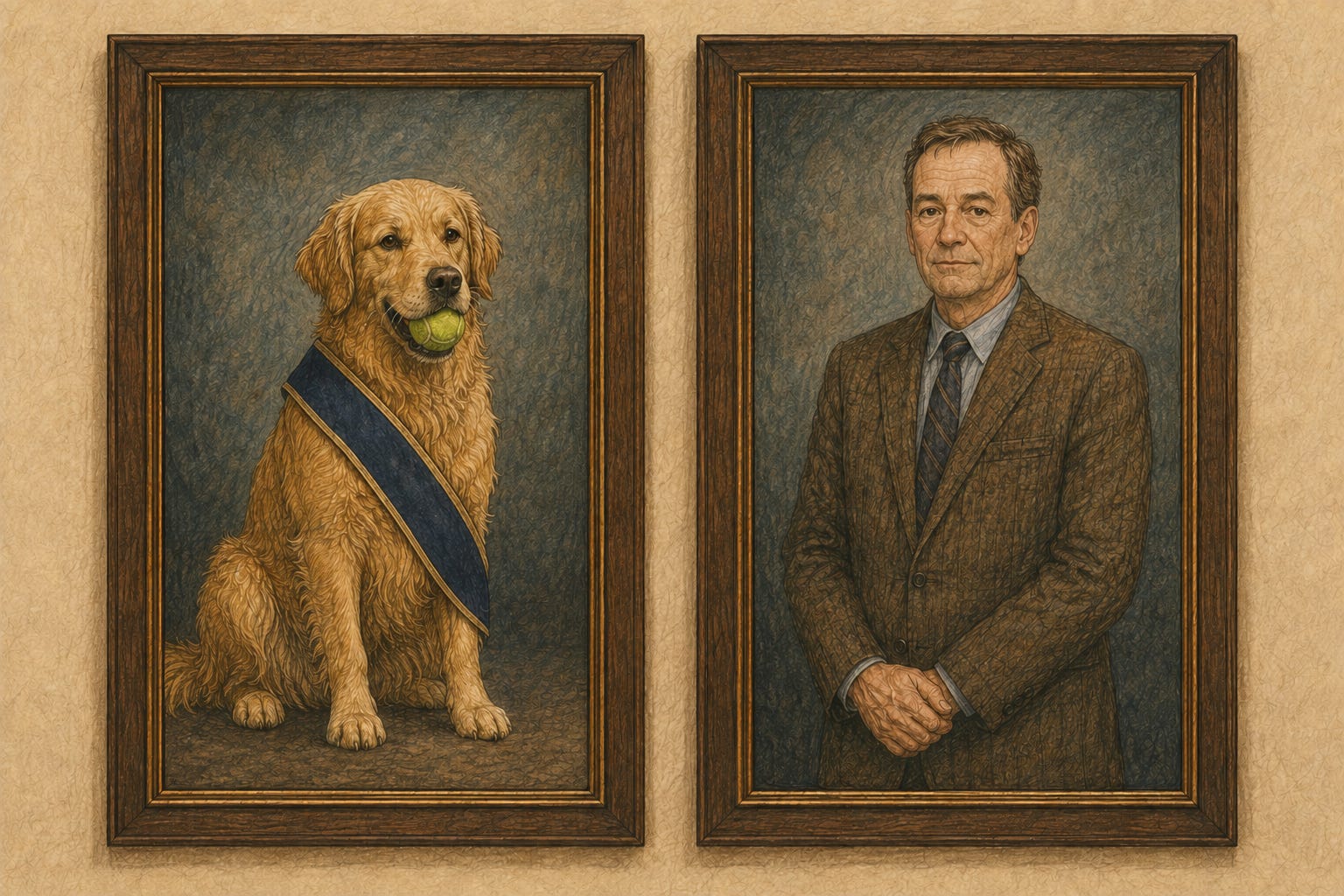
Murphy’s official portrait now hangs in City Hall. He wears the mayoral sash and looks remarkably dignified, despite the tennis ball clenched between his teeth.
Mayor Pike’s portrait hangs beside it. His ceremonial scissors are nowhere to be found.
Pike sounds like our mayor. Since she was elected I think 5-6 years ago we are 3 million in the hole. “Somebody made a mistake and missed it.” Look in the mirror blondie. We’re a small town so a 3million deficit should be hard to miss. I’m a 73 yr old woman, been voting Democrat since voting at 18 became legal (I was 19.). She leans maga. I call her “The Bimbo.” Now I’m not the only one who does.
In Guffey Colorado a black cat named Monster was elected mayor in 1998. We met the cat and took a picture of him several years ago. Guffey is an unincorporated community, no official leadership.
https://americacomesalive.com/dog-story-stolen-by-a-cat/