


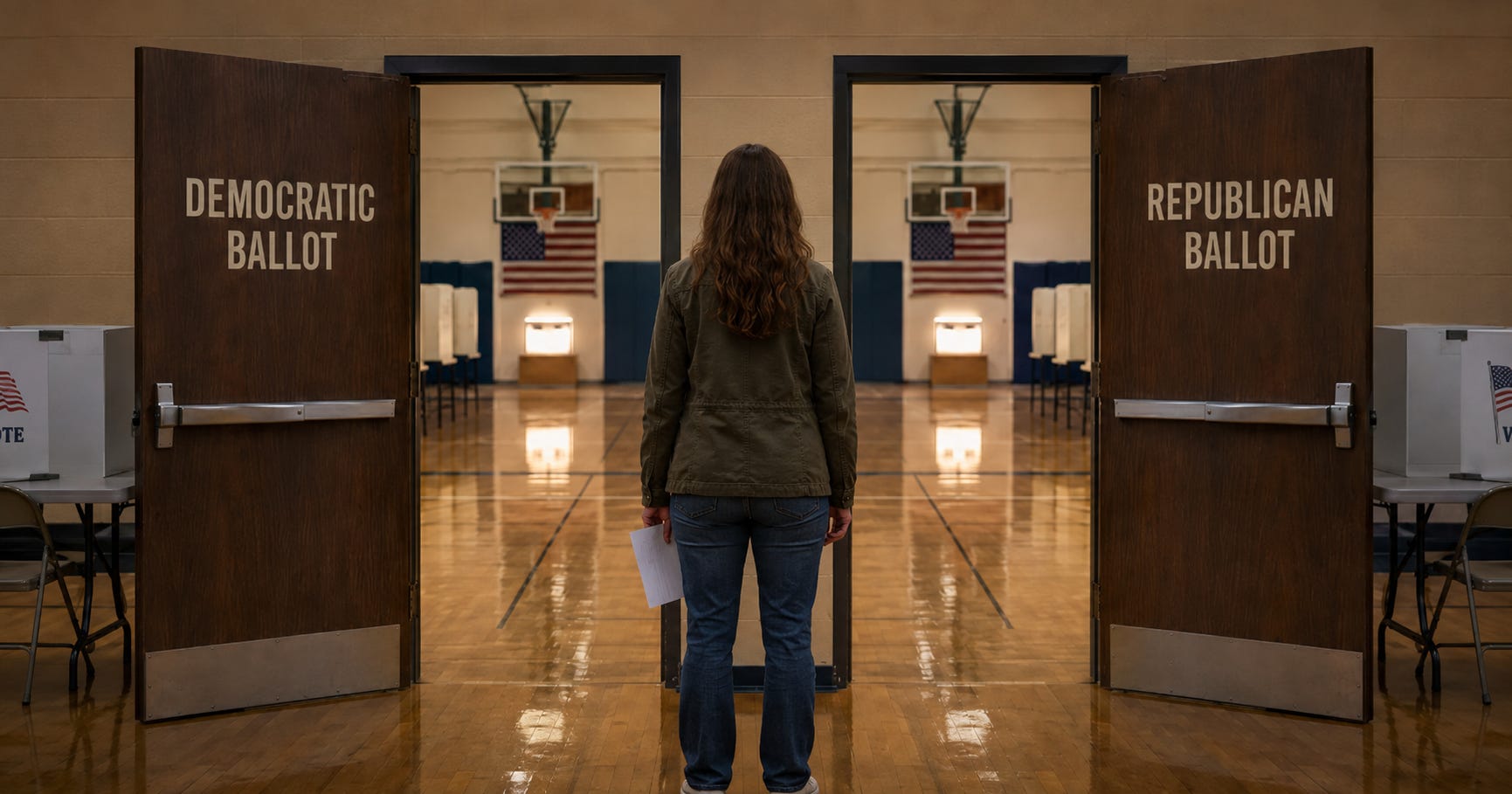
Two Doors at a Public Polling Place
A voter walks into a Massachusetts school gym to participate in an election paid for by the public and administered by public officials.
Before she can choose a candidate, she is asked to choose a party.
Democratic ballot or Republican ballot?
She belongs to neither.
That does not mean she is undecided, moderate, or disengaged. She may vote in every election. She may hold strong convictions. She may know exactly what she wants from the people seeking power in her name.
But the system still asks her to step through one of two party doors before her political voice is allowed into the room.
Massachusetts calls her unenrolled. Political reporters would probably call her independent. Neither term gets it right.
She is not independent from democracy. She is non-aligned with the parties controlling its primary gates.
Now Massachusetts may ask voters whether those gates should remain.
The voter did not leave democracy. The parties built two doors around it and called everyone outside them independent.
Something new is coming to The Coffman Chronicle.
For the past several years, we have used this publication to explain America—its politics, its history, its Constitution, and the people trying to hold it all together.
Now, those ideas are beginning to take a new form.
Tomorrow afternoon, our publisher, Tony Michaels, will share a story about a pocket watch, the generations that carried it, and the journey we are beginning together.
We don’t want to give too much away just yet. But this is bigger than one story. It is the beginning of the next chapter of The Coffman Chronicle.
Watch your inbox.
What Massachusetts Is Actually Debating
Massachusetts does not completely shut non-aligned voters out of its primaries.
A voter registered as unenrolled may request either a Democratic or Republican ballot without becoming a member of that party. But the voter must still choose one party’s lane. Once that ballot is selected, the choice is confined to the candidates inside that party’s contest.
The primary is open to the voter only on the parties’ terms.
That is what the proposed ballot question would change.
Instead of separate Democratic and Republican primaries, candidates for the same office would appear together on a single preliminary ballot. Every voter would receive the same choices, regardless of party registration. The two candidates with the most votes would advance to November, even if both come from the same party.
That would not abolish political parties. Parties could still organize, endorse, campaign, raise money, build coalitions, and tell voters which candidates carry their values. Voters could still support a party’s entire slate.
What would change is the parties’ guaranteed control over separate publicly administered nominating contests. That distinction explains why the fight matters.
The Massachusetts Democratic State Committee voted to oppose the proposal. The chair of the Massachusetts Republican Party has warned against it too.
Their concerns are not identical. Democrats risk losing exclusive control over who carries their party’s support into November. Republicans fear that, in a heavily Democratic state, two Democrats could advance to the general election and leave the Republican Party without a candidate on the final ballot.
Some of those concerns are real. A top-two system can create problems of its own, and those problems deserve scrutiny.
But beneath the competing objections is a shared institutional interest. Each party currently receives something the proposed system would no longer guarantee: its own ballot, its own contest, and its own reserved route into November.
The parties disagree about what should happen after voters pass through the gate.
They agree that the gate should belong to them.
The Same Door in Connecticut
Massachusetts is not alone.
In Connecticut, the doorway is easier to see. The state’s Democratic and Republican primaries are closed. Only registered party members may vote in them. An unaffiliated voter who wants to participate must first register with a party.
That is the system saying the quiet part plainly.
You may vote in the primary, but only after you align.
The voter does not have to change her beliefs. She does not have to become loyal to the party. She may only want to choose between candidates seeking public office in an election administered by the state. But before she can do that, she must accept a party label.
In Massachusetts, the non-aligned voter may enter a primary, but only through one party’s ballot. In Connecticut, the unaffiliated voter must formally step into a party before entering at all.
Different rules, same assumption: political power is treated as something voters reach through parties instead of something parties must seek from voters.
That is why the language matters.
The question is not whether parties have the right to exist, organize, endorse candidates, or fight for their nominees. They do.
The question is whether publicly administered elections should keep treating party alignment as the doorway to meaningful participation.
Independent Is the System’s Word
Independent voter sounds neutral.
It is not.
The term accepts the two-party system as the natural center of American political life. Democrats belong to one recognized camp. Republicans belong to the other. Everyone else is placed into a broad third category defined mostly by what they are not.
That category includes voters with almost nothing else in common. Some consistently vote for Democrats but refuse formal membership. Some usually support Republicans. Some split their tickets. Some support minor parties. Some are deeply ideological. Some are disgusted with both parties. Some simply believe no organization should receive permanent custody of their political identity.
Calling all of them independent creates the impression that they form one political bloc floating somewhere between Democrats and Republicans. They do not.
Many are not in the middle at all.
A voter may strongly support unions, universal healthcare, gun rights, abortion restrictions, lower taxes, climate action, or limits on presidential power without fitting comfortably inside either party. Refusing a party label does not dilute those convictions. It only means the voter has not converted those convictions into permanent organizational loyalty.
That is why non-aligned is more accurate.
A non-aligned voter is a citizen whose political voice and vote are not permanently pledged to a political party. The term describes a relationship to party machinery, not a location on an ideological spectrum.
Non-aligned does not mean undecided. It does not mean moderate. It does not mean uninformed, disengaged, or politically homeless. A non-aligned voter may know exactly what she believes and exactly why neither party has earned the right to speak for her.
The difference in language changes who is treated as normal. Independent makes Democrats and Republicans the established political identities and everyone else the exception. Non-aligned begins with the citizen and treats party membership as a voluntary choice that may be made, withheld, or reconsidered.
That is the democratic relationship the system has reversed. Political parties should have to organize, persuade, and earn support. Instead, voters are routinely described as though party affiliation were the default condition and refusing it required a special explanation.
Independent is the system’s word because it defines the voter from the parties’ point of view. Non-aligned defines the parties from the voter’s point of view.
Independent makes the voter sound detached from the political system. Non-aligned makes clear that the voter is detached only from the parties claiming ownership of it.
The Two-Party Illusion
The illusion is not that Democrats and Republicans are fictional.
They are real organizations with real voters, real candidates, real donors, real coalitions, and real power. Their policy differences can be enormous. Their governing choices can change lives. Their judicial appointments can reshape rights for generations. Their control of Congress, statehouses, courts, and executive offices can alter wages, healthcare, schools, taxes, labor rules, immigration enforcement, war powers, environmental protections, and civil liberties.
Elections between them matter. That is not the illusion.
The illusion is that these two organizations represent the natural and complete boundaries of American democratic choice. They do not.
The Constitution did not create a Democratic gate and a Republican gate. It did not divide the people into two permanent political populations. It did not guarantee either party a nominee, a ballot lane, a debate stage, a donor network, a media category, or a reserved place in November.
The Constitution created offices, elections, states, branches of government, and citizens.
Political parties came later as organizations seeking power inside that constitutional structure. That was not inherently illegitimate. Citizens have the right to organize. Candidates have the right to associate. Voters have the right to build movements, form parties, endorse platforms, and campaign together.
The problem begins when organizations built to compete inside the democratic system become treated as though they are the democratic system.
That is the reversal.
The party becomes the doorway. The citizen becomes the applicant. The vote becomes something routed through an organization before it can become power.
The two-party illusion teaches Americans to mistake a political arrangement for a constitutional requirement. It asks voters to accept that serious political choice naturally comes in two approved forms.
But political parties were created to compete for the support of voters. Voters were not created to supply political parties with permanent members.
That reversal does not live only in theory. It appears at the polling table, in filing rules, on debate stages, in campaign money, in media language, and in every election where voters are told the only responsible way to reject one party is to empower the other.
The Gatekeepers Compete, Trade Power, and Protect the Gate
Democrats want Democrats to win. Republicans want Republicans to win. That part is not theater, and it is not fake conflict.
The fights between them can be bitter, consequential, and morally urgent. They battle over courts, taxes, labor, healthcare, abortion, immigration, war, climate, civil rights, executive power, and the basic meaning of public responsibility.
Those fights matter because government matters.
But political competition does not erase shared institutional interest. Two businesses can compete for customers while both opposing a new road that lets people bypass them. Two gatekeepers can hate each other while agreeing that everyone should still have to pass through a gate.
That is the part Americans are trained not to see.
Democrats and Republicans do not have to coordinate victories or secretly agree to take turns. They can fight with everything they have while still benefiting from a structure that keeps viable political power circulating between them.
When voters reject Democrats, most of that anger is routed toward Republicans. When voters reject Republicans, the backlash is routed toward Democrats. One party loses control, but the two-party structure survives. The defeated party remains the officially recognized alternative, waiting for public frustration to return power to its side of the gate.
The system allows voters to punish one gatekeeper mainly by empowering the other.
That is not the same as saying elections are meaningless. They are not. The difference between gatekeepers can matter deeply to people whose rights, wages, health, families, and freedoms are on the line.
But a system can produce meaningful consequences inside its boundaries while still protecting the boundaries themselves.
That is how concentrated political power reproduces itself without requiring a conspiracy. Each party sincerely tries to win. Each party sincerely wants the other to lose. Yet both benefit when voters are repeatedly told that only the other major party is a realistic alternative.
Candidates who run outside the two-party structure are treated as spoilers, vanity projects, protest votes, or threats. Movements, donors, consultants, media outlets, debate rules, ballot access, and campaign infrastructure all learn to organize political possibility around two approved lanes.
The parties may trade control of government back and forth. What they rarely surrender is their shared control over who is allowed to compete for it.
That is why the gate matters more than any single election cycle. One party governs. The other waits. The public gets angry. Power changes hands. Then the cycle begins again.
Americans are offered regular changes in management while the two-party control structure remains largely untouched.
When the Primary Becomes the Election
The party gate matters most when the primary becomes the real election.
In a competitive district, the general election may still offer voters a meaningful choice between candidates with a real chance to win. The primary narrows the field. November decides the office.
But in many districts, that is not how power works.
If one party dominates the district, the decisive contest often happens months earlier. The winner of the dominant party’s primary may face only token opposition in November, or no opponent at all. By the time the general election arrives, the public ceremony of voting may remain, but the meaningful hiring decision has already been made.
Massachusetts shows the problem clearly.
This cycle, roughly three out of every five state legislative races are expected to be completely uncontested. In those races, voters will not choose between competing candidates in November. They will receive a name and an office. In most cases, that candidate will be an incumbent walking into another term without having to defeat anyone in the general election.
That is not merely an inconvenience for voters who like competitive politics. It changes accountability.
A lawmaker who faces no real opponent does not have to persuade the whole district in the same way. The campaign does not have to answer as many public questions. The incumbent does not have to defend the record as aggressively. The voters outside the dominant party’s primary electorate may still live under the laws, pay the taxes, send children to the schools, drive the roads, wait for the services, and carry the consequences.
But they may never receive a real choice about who represents them.
The system can technically say every voter had a ballot. That does not mean every voter had power.
This is where party control stops being an abstract complaint and becomes a kitchen-table problem. The person elected will vote on housing, wages, schools, utilities, healthcare, transportation, policing, taxes, and public spending. The office belongs to the whole district. The consequences land on the whole district.
Yet the real selection may happen inside one party’s lane.
The lawmaker will represent the entire district, but the system may allow one party’s primary electorate to do nearly all the hiring.
That is why the fight over primaries is not just a fight over party procedure. It is a fight over whether publicly administered elections should deliver meaningful participation to the citizens governed by the result.
A primary can look like an internal party contest on paper. In practice, it can become the election that decides who holds public power.
This Is Not a Claim That the Parties Are the Same
None of this means the parties are the same.
They are not.
Their coalitions are different. Their policies are different. Their governing records are different. Their relationships to labor, courts, regulation, voting rights, social policy, corporate power, immigration, and executive authority can be very different. In a given election, one party may present a far greater threat to constitutional government, civil rights, working people, or democratic institutions than the other.
That reality should not be flattened.
But recognizing real differences between the parties does not require pretending they lack shared institutional interests. Both things can be true at once.
One gatekeeper may be worse in a particular moment. One gatekeeper may be more dangerous on a particular issue. One gatekeeper may deserve defeat because the consequences of its power would be severe.
But the existence of a worse gatekeeper does not prove that the gate belongs there.
That is the distinction this argument depends on.
A voter may decide that one party must be stopped in an election and still understand that the larger system remains too narrow. A citizen may cast a strategic vote and still reject the idea that strategic voting should become permanent political captivity. A movement may enter one party’s coalition for a specific fight and still refuse to surrender its independent power, pressure, and identity forever.
The danger is not only that voters will choose badly. The danger is that voters will be taught to believe they have only two meaningful places to go.
That belief serves both parties. It turns every crisis into another demand for alignment. It tells citizens that the only responsible answer to one party’s failure is dependence on the other. It makes fear of the worse gatekeeper the permanent argument for accepting the gate.
Refusing the two-party illusion does not require moral blindness. It requires structural vision.
It requires the ability to see immediate danger without surrendering the larger question of who controls political access in the first place.
The parties are not the same.
But the voter still does not belong to either of them.
Massachusetts May Have the Right Problem and an Imperfect Answer
Massachusetts has identified a real democratic problem. That does not mean its proposed answer should escape scrutiny.
A top-two preliminary election can create problems of its own. It can send two Democrats or two Republicans to the general election, leaving voters who prefer another party without a candidate in November. It can push minor-party and nonparty candidates off the final ballot before many voters are paying attention. It can reward candidates with money, name recognition, donor networks, and institutional support.
A crowded field can also produce strange outcomes. Several candidates appealing to similar voters may split support, while two others advance with narrower but more concentrated bases. The November ballot may look more open because every voter participated in the preliminary election, but the final choice can still feel restricted.
Those concerns should not be dismissed merely because party leaders also have power to protect. The question is not whether every objection to the Massachusetts proposal is bad faith. Some objections are serious. The question is whether those objections answer the deeper democratic problem the proposal has exposed.
Separate party primaries do not become voter-centered merely because top-two primaries have flaws. Closed or semi-open party systems do not become democratic ideals merely because one reform may create new barriers. The existence of an imperfect remedy does not prove the disease is imaginary.
That distinction matters.
This article is not an endorsement letter for the Massachusetts ballot question. Voters in that state have the right to examine the design carefully, weigh the risks, and decide whether the proposed structure would improve or weaken their elections.
But the fight has already done something valuable.
It has forced the public to ask who the election is supposed to belong to.
Do publicly administered elections exist primarily to help parties manage their internal nominations? Or do parties participate in elections because citizens created a public system through which power is supposed to be assigned?
That question will remain whether Massachusetts voters approve or reject the proposal, because the question is larger than one ballot initiative.
Top-two primaries will not fix campaign money. They will not end gerrymandering. They will not guarantee debate access, media attention, fair ballot rules, ranked choices, competitive districts, or working-class candidates with enough time and money to run. They will not, by themselves, break the two-party control structure.
But Massachusetts has put pressure on the correct nerve.
The nerve is not whether parties should exist. The nerve is whether voters should have to pass through them before reaching meaningful power.
Non-Aligned Does Not Mean Powerless
The two-party system teaches voters to mistake non-alignment for weakness.
It treats the citizen outside the parties as unfinished. Not yet converted. Not yet captured. Not yet assigned to the proper lane. Campaigns study these voters, poll them, target them, blame them, flatter them, and panic over them. But too often, the system still describes them as people who must eventually choose where they belong.
That framing serves the parties.
Non-aligned voters are not a reservoir of people waiting to become Democrats or Republicans. They are citizens whose support must be earned election by election, candidate by candidate, office by office.
They do not need one ideology, one candidate, or one new party to matter.
Their shared position is simpler than that: neither major party has permanent ownership of their political voice. That is not political emptiness. It is political custody remaining where it belongs, with the citizen.
A non-aligned voter may support a Democrat in one race, a Republican in another, a minor-party candidate, a nonparty candidate, a reform candidate, or no candidate at all. She may vote strategically in one election because the danger is immediate, then organize outside both parties the next day because the larger system remains too narrow.
None of that makes her confused. It makes her free.
The old frame asks the voter: Which party do you belong to? The non-aligned frame asks the parties: What have you done to earn this vote?
That is a different relationship to power.
A citizen who refuses permanent alignment is not rejecting responsibility. She is accepting it. She is saying that no party may inherit her vote by default, no party may claim her silence as consent, and no party may convert fear of the other gatekeeper into ownership of her political identity.
That is what citizen stewardship requires.
Not passivity. Not purity. Not pretending every election presents equal choices.
Stewardship means knowing when an immediate danger must be stopped and still refusing to let emergency politics become permanent captivity. It means defending the Constitution above party. It means remembering that parties are tools, not masters. It means refusing to confuse tactical voting with political surrender.
Non-alignment is not the absence of political identity. It is the refusal to transfer permanent custody of that identity to a party.
The Voter Comes Before the Party
Return to the polling place.
The voter stands before the same two doors. The system treats the choice of party as the necessary first decision and the choice of candidate as the second.
Democracy should reverse that order.
The citizen comes first. The vote comes first. The party is one possible vehicle for organizing that power. It is not the owner, source, or constitutional destination of that power.
Massachusetts voters may approve the proposed change. They may reject it because they believe a top-two system would create new problems. Connecticut may keep its closed primaries. Other states may continue building their own versions of the same structure.
But the question will remain.
Who does the election belong to?
The ballot question in Massachusetts has already exposed something larger than one reform proposal. Democrats and Republicans can fight ferociously over government while standing together when their privileged position inside the electoral system is challenged.
They do not have to like each other. They do not have to agree on what lies beyond the gate. They need only agree that political power must continue passing through them.
One governs while the other waits. The public becomes angry. They exchange places. The structure remains.
That is the two-party illusion.
The voters called independent are not politically homeless. They are not ideologically empty. They are not waiting to be claimed by one organization or the other. They are non-aligned citizens.
Their votes, identities, and constitutional power belong to them.
The voter did not enter that school gym as a guest of the Democratic Party or the Republican Party. She entered as a citizen. The office being filled will govern her life whether she wears a party label or refuses one. The taxes will still be collected. The laws will still be enforced. The roads, schools, courts, utilities, wages, services, rights, and obligations will still reach her kitchen table.
That is why the gate cannot be treated as a private convenience.
The voter does not belong to a party. The parties must come before the voter and earn the vote.
If this argument matters to you, share it with someone who has been told they are “independent,” “unaffiliated,” or politically homeless.
They may not be outside democracy at all. They may simply be non-aligned with the gatekeepers claiming ownership of it.
And if you can afford to support this work, please consider becoming a paid subscriber to Coffman Chronicle.
Bibliography
“How to Vote in a Primary,” Secretary of the Commonwealth of Massachusetts, accessed July 17, 2026.
“Mass. Primary Election Overhaul Eligible for November Ballot, SJC Rules,” CommonWealth Beacon, June 22, 2026.
“Democratic State Committee Opposes Open State Primaries,” Dorchester Reporter, April 29, 2026.
“Yet Again, Legislative Competition in Massachusetts Will Be Woeful,” CommonWealth Beacon, May 28, 2026.
“What to Know About Getting an Absentee Ballot Ahead of Connecticut’s Primary,” CT Insider, July 15, 2026.
Can I argue with you about this? Primaries are about parties and their array of candidates. If you were, let's say, a Democrat, why should you have a voice about whom the Republicans advance? In the general election, there will be a Democrat, a Republican, maybe an Independent, a Green Party candidate, maybe a Communist, or maybe some others. And you can vote for any of them you want. Because you're registered, which was your choice, as a Democrat doesn't mean you can't vote in the general election.
Some states allow you to choose any party you want in the primaries. You can tell them when you arrive to vote. And it doesn't have to be the same party you chose last time. Some states allow you to choose any party you want, even if you declared yourself Independent (which everyone is). Other states don't let you choose D or R if you registered as I. Which, again, was your choice.
I'm not persuaded that this is as unfair, or unfairly limiting, as you describe it to be.