


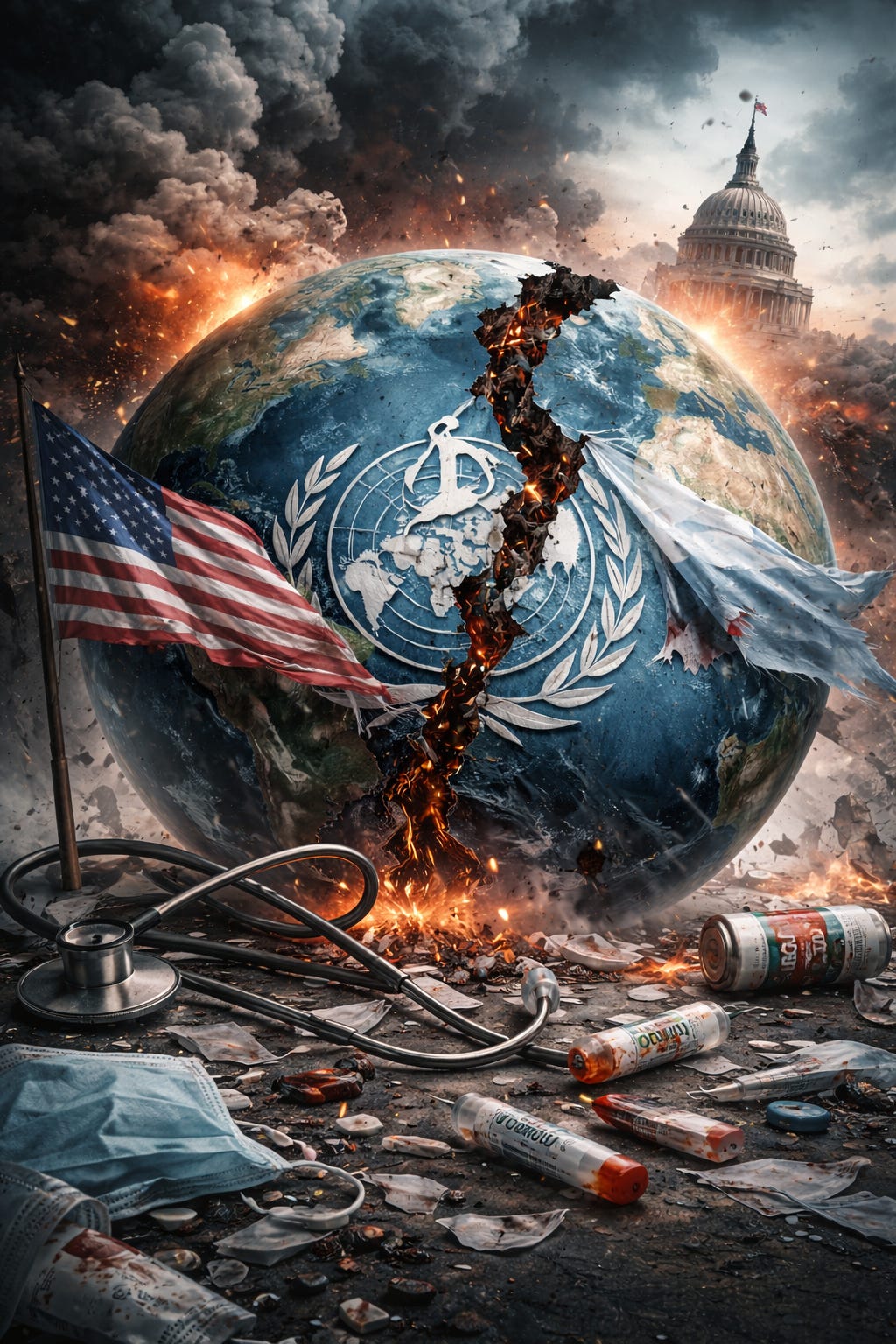
On January 22, 2026, the United States formally completed its withdrawal from the World Health Organization, ending nearly eight decades of membership in the global health body it helped found after World War II. This decision, ordered by President Donald Trump via Executive Order 14155 on his first day back in the Oval Office in 2025, finalized a process that had begun with fierce criticism of the WHO’s handling of the COVID‑19 pandemic.
The announcement rippled through global health communities, but it did not stop there. Within 24 hours of the official departure, California Governor Gavin Newsom declared that his state would independently join the WHO’s Global Outbreak Alert and Response Network (GOARN), making California the first U.S. state to tie itself directly into the world’s disease detection and response infrastructure.
Just days after Trump’s 2025 Executive Order, Argentina’s libertarian government signaled that it, too, plans to leave the WHO in March. While Argentina’s departure is not yet complete, the announcement reflects a broader challenge to multilateral health cooperation.
This Community Is Powered by You
What started as a small circle has grown into something much bigger, and it’s all because of readers like you.
Every time you forward this email, post it on socials, or bring someone new into the fold, you’re helping build one of the most passionate, independent political communities out there.
Want to keep the momentum going?
Share this newsletter with someone who should be part of this conversation.
Thank you for being here. It means everything.
What Is the World Health Organization?
To understand the significance of this moment, we have to step back and picture the organization at its center.
The World Health Organization is the specialized agency of the United Nations for health. Its mission is straightforward but immense: coordinate global responses to infectious disease outbreaks, monitor global health trends, set international health standards, and help countries build stronger health systems. Nearly every country on Earth participates in this effort.
For decades, the United States was not just a participant, but a leader. Washington helped establish the WHO in 1948, provided roughly one‑fifth of its operational budget, and was a central voice in shaping its policies and priorities. American scientists and public health professionals worked within WHO programs to combat smallpox, polio, Ebola, influenza, HIV, tuberculosis, and countless other threats.
This makes the roster of non‑members a striking one. Outside the United States, only a handful of entities are not members of the WHO, and, with one exception, they are not full sovereign states exercising independent public health policies.
The Vatican (the Holy See) participates as an observer, not a member, because it is a unique religious sovereign. Taiwan does not sit at the WHO table because of political pressure from China, despite having a world‑class public health infrastructure. Liechtenstein, a tiny European microstate whose foreign affairs are largely coordinated with neighboring Switzerland, has never joined. Finally, the State of Palestine, recognized by many nations, participates in international forums but is not a full WHO member due to its limited international recognition and lack of UN membership.
Put bluntly, the United States now stands in the company of two largely occupied or politically constrained entities, a center of global Catholic authority, and a microstate under its neighbor’s protection. This isn’t a collection of ideologically opposed nations, but international anomalies.
“We’re Leaving Because of Their COVID Response”
The official rationale for this dramatic move, given by the Trump administration, is rooted in the COVID‑19 pandemic. According to the Department of Health and Human Services and the State Department, the WHO “mishandled” its early pandemic response, delayed critical warnings, failed to act independently from political influence, and did not adopt necessary reforms after 2020.
This narrative mirrors a recurring thread in Trump’s criticism of international institutions: that they are slow, bureaucratic, and beholden to foreign interests at the expense of American citizens.
However, here is the uncomfortable historical paradox. During the pandemic itself, the same administration frequently ignored, undermined, or outright contradicted the very guidance it later used to justify its departure.
In early 2020, the WHO declared a global health emergency as the coronavirus spread. Experts point out that while the organization did not get every call right — for example, around mask guidance and the timing of declaring a pandemic — it did establish a platform for coordinated surveillance, data sharing, and research that became central to vaccine development and global mitigation efforts.
Meanwhile, in the United States, federal messaging was inconsistent at best. Mask guidance was politicized. Testing delays were acute. Federal leadership vacillated between downplaying the virus and resisting comprehensive, science‑driven public health strategies. The pandemic response became mired in partisanship even as death tolls mounted.
Critics have argued that this dissonance — attacking an international institution while dismissing domestic public health expertise — reveals not a principled stance but a political one.
What Happens Now? The Cost of Walking Away
Formally leaving the WHO doesn’t just remove the U.S. flag from Geneva. It severs the nation from systems that once helped keep Americans safe.
The United States will lose formal participation in WHO committees, technical working groups, and policy discussions that shape everything from vaccine strain selection to outbreak intelligence sharing. Public health experts warn that this loss will make it harder for scientists in the U.S., including at the Centers for Disease Control and Prevention and the National Institutes of Health, to access real‑time data from around the world.
There are also financial implications. The WHO says the United States still owes approximately $260 to $280 million in unpaid dues from previous years, and the organization maintains that withdrawal is not fully complete until these obligations are settled. The U.S. government has disputed this, arguing that after extensive prior contributions, further payments are unnecessary.
Beyond budget figures, the practical consequences are broad. Disease surveillance systems that once flowed through WHO networks could become fragmented. Vaccine coordination — essential for responding to seasonal flu, emergent viruses, and pandemic threats — may slow. Nations now have to decide whether to share data directly with Washington or default to collaborative platforms that share with nearly the rest of the world.
The WHO itself expressed deep regret at the U.S. departure, emphasizing its longstanding partnership and warning that the move “makes both the United States and the world less safe.”
Domestic Policy Undercutting Public Health
This international disengagement hasn’t happened in a vacuum. Domestically, the infrastructure that once prepared the United States for outbreaks has been weakened in recent years, most notably by Trump2.0.
Federal health agencies that monitor disease, track infections, and guide public health policy have faced significant restructuring, budget cuts, and political interference. The CDC’s role has been challenged, key advisory panels have been dissolved, and public trust has been eroded even as new threats emerge. At the same time that international collaboration was being abandoned, critical domestic mechanisms for anticipating and responding to health crises were diminished.
We’ve extensively reported on the anti-intellectualism and anti-science efforts of this administration. See some of that here:
Note: Articles roll into the archive after 45 days. Consider becoming a paid subscriber for full access.


The cumulative effect is a double blow. The U.S. is not only outside the global cooperative body designed to sound alarms and coordinate responses, but it’s also undercutting the domestic institutions best equipped to act when those alarms sound.
Who bears the brunt of this? It isn’t the political elite. Wealthy Americans with private healthcare options can access top specialists and, if necessary, seek treatment abroad. It is the uninsured, the underinsured, the elderly, people of color, and rural communities whose safety nets have been frayed, whose access to care is precarious, and whose lives depend on robust public health infrastructure.
California’s Response and What Comes Next
Amid this unraveling, a surprising countercurrent has emerged. On the heels of the U.S. withdrawal from the WHO, California stepped into the breach.
Governor Gavin Newsom announced that his state would join the WHO’s Global Outbreak Alert and Response Network, or GOARN, an international collaborative of governments, labs, and public health institutions that tracks and responds to emerging health threats.
Unlike full WHO membership, which is reserved for sovereign nations, GOARN participation allows California’s public health officials and scientists access to shared data and early warning systems without involving the federal government or paying membership dues.
For nearly 40 million Californians, this is more than symbolic. It means state health officials can tap into global disease intelligence and coordinate responses in ways that Washington no longer does.
California’s move signals one possible future: sub‑national entities seeking their own pathways to international cooperation when national leadership retreats. Other states, particularly those with robust public health systems and Democratic leadership, may follow suit or create their own interstate alliances to preserve scientific exchange and readiness.
However, this is no substitute for national engagement with global partners. The patchwork of state action cannot replicate the scale and reach of a unified national strategy grounded in global cooperation.
A Moment of Reckoning
The United States’ departure from the World Health Organization is not merely a bureaucratic reshuffling. It is a decisive turn away from decades of collective action against shared threats. It is a step that many public health experts describe as ill‑timed and potentially dangerous, given the reality that the next pandemic could emerge anywhere and spread at the speed of global travel.
In walking away from WHO, lawmakers and officials have not solved the problems they cite. Instead, they have weakened the very networks and institutions designed to protect every citizen. Whether through negligence, ideology, or political calculation, this choice isolates the nation at a moment when cooperation should be paramount.
California’s embrace of a WHO network offers a glimmer of resistance, but it also highlights the stark contrast between local responsibility and federal abdication.
What comes next will depend on whether leaders at all levels — state, local, and national — choose collaboration over isolation, science over rhetoric, and preparation over panic. The world is watching. The stakes could not be higher.
Stay informed. Stay sharp.
If this kind of deeply reported, unapologetically honest analysis matters to you, subscribe for more. We cover the intersection of politics, public health, and power, because understanding what’s happening is the first step to changing it.
Subscribe now to get future articles straight to your inbox.
Sources:
“US officially exits World Health Organization, accusing agency of straying ‘from its core mission’” — ABC News, January 22, 2026
“US formally withdraws from World Health Organization, leaving debt” — CIDRAP, January 22, 2026
“US set to quit World Health Organization” — Reuters, January 22, 2026
“U.S. makes exit from the WHO complete” — STAT, January 22, 2026
“Formal U.S. withdrawal from WHO is decried as ‘scientifically reckless’” — Washington Post, January 22, 2026
“US completes withdrawal from World Health Organization” — AP News, January 22, 2026
“World Health Organization says it regrets US decision to withdraw” — Reuters, January 24, 2026
“Fact Sheet: U.S. Withdrawal from the World Health Organization” — HHS.gov
“Executive Order 14155” — Wikipedia
“Argentina says it, too, plans to pull out of World Health Organization” — CIDRAP, February 5, 2025
“California joins UN health network following US departure from WHO” — Reuters, January 23, 2026
“California joins WHO-coordinated international network…” — ABC10, January 2026
Beyond DEPRESSING. Continues the death of our Democracy.
Make this stop 🛑
If we don't care about other people's lives, then we really don't care about our own.