


The Tower That Can Park Outside
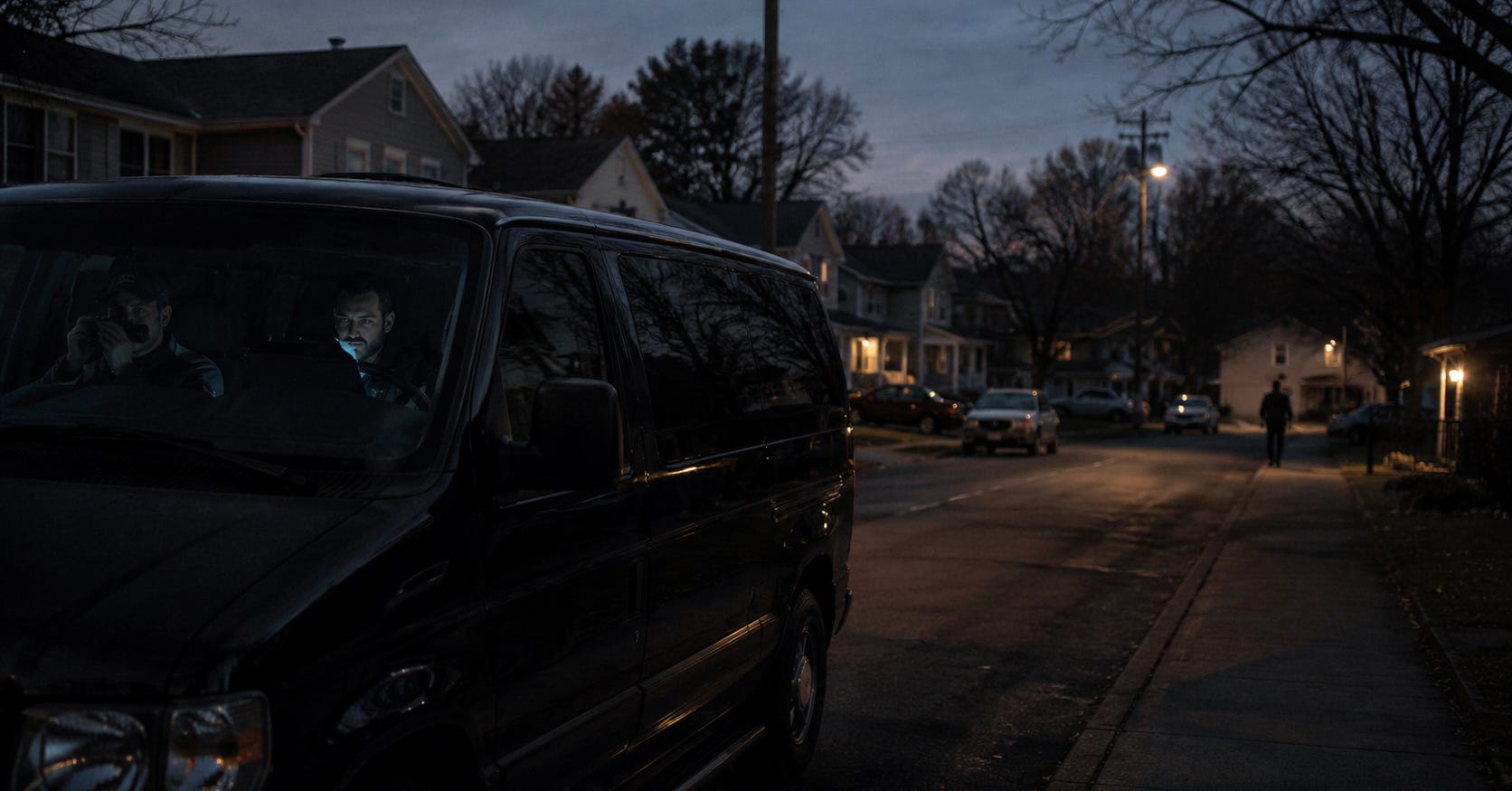
The worker walking toward the courthouse carries a phone in one pocket. So does the parent outside the school, the worshipper crossing a church parking lot, and the protester standing on a public sidewalk. None of them knows whether the van parked nearby is more than some soccer mom’s van.
No tower rises from its roof. No warning light announces that a federal surveillance device has been activated. No message appears on the screen asking whether the phone should identify itself to the government. The phone does not know the difference either.
A cell-site simulator can impersonate part of the cellular network and cause nearby compatible phones to respond. Federal agents may be searching for one device, but the machine may encounter others first. That does not make every use unlawful. It does make secrecy dangerous.
U.S. Immigration and Customs Enforcement has purchased vehicles built to carry this technology. The public knows little about where they operate, how often they are used, or what happens to information gathered from people who were never the target.
That is the question parked inside the van. The government may be looking for one phone. The Constitution still protects the others.
This Community Is Powered by You
What started as a small circle has grown into something much bigger, and it’s all because of readers like you.
Every time you forward this email, post it on socials, or bring someone new into the fold, you’re helping build one of the most passionate, independent political communities out there.
Want to keep the momentum going?
Share this newsletter with someone who should be part of this conversation.
Thank you for being here. It means everything.
ICE Put the Tower on Wheels
The federal contracting record does not refer to them as spy vans. It calls them “Cell Site Simulator Vehicles.”
In May 2025, Immigration and Customs Enforcement awarded approximately $825,000 to TechOps Specialty Vehicles for vehicles supporting the agency’s Homeland Security Technical Operations program. Eight months earlier, ICE had issued the same company a similar contract worth approximately $818,000. Together, the awards total more than $1.6 million.
A cell-site simulator turns a vehicle into something closer to a mobile cellular tower. It allows federal agents to bring phone-location technology into a neighborhood, parking lot, or public street without constructing permanent infrastructure or announcing that the equipment has arrived. The vehicle can move, and the surveillance moves with it.
This technology did not begin with Donald Trump. The first of these two recent contracts was awarded while Joe Biden was still president. That history makes the institutional failure larger, not smaller. Surveillance powers outlive the administrations that acquire them. They become ordinary inside government long before the public understands how they operate or what restraints follow them from one presidency to the next.
The May 2025 purchase expanded ICE’s mobile capability during a period of intensified immigration enforcement. Yet the contract does not explain where the vehicles were assigned, how many were delivered, or how frequently they have been deployed.
It does not say whether they are limited to criminal investigations by Homeland Security Investigations or whether they may also support civil immigration arrests. Nor does it tell the public how often agents obtain warrants, invoke emergency authority or encounter unrelated phones.
ICE knows where the vehicles went, who operates them and when they are activated. The people whose phones may respond know none of those things.
Congress funded the agency. ICE signed the contracts. The surveillance became more mobile. The accountability did not.
To Find One Phone, the Machine Encounters Others
A cell-site simulator does not begin by asking which phone belongs to the suspect. It begins by pretending to be something nearby phones have been designed to trust.
The device broadcasts a signal resembling a legitimate cellular tower. Compatible phones within range may respond with identifying information. Agents can compare those responses, isolate the device they seek, and use signal strength or direction to narrow its location. That is what makes the technology useful. It is also what makes the technology dangerous.
The government may have probable cause to locate one person. The machine may still interact with devices carried by everyone from the delivery driver outside the building to the attorney walking through the lobby.
Not every phone will necessarily respond. Range, network compatibility, terrain and configuration all matter. Nor does the public record establish that the systems inside these particular vehicles routinely read text messages, listen to calls or copy stored files.
We should not pretend otherwise. The verified capability is troubling enough: a search intended for one device can begin by sorting through signals from nearby devices.
ICE policy says information associated with non-target devices must be deleted after the target has been identified or located. But that protection depends almost entirely on what happens after collection.
The innocent person must trust that the government recognized the device as unrelated, did not copy or share the information, and actually verified its deletion. A warrant to search one house would not ordinarily allow officers to unlock every door on the block, look briefly inside and promise to forget what they saw. That principle should not disappear because a machine can perform the expansion silently.
A particularized warrant is supposed to restrain government power before a search begins. It should not become particular only after the government has encountered everyone else.
The machine may be efficient. The Constitution is supposed to decide what efficiency is allowed to cost.
The Rules Exist Because the Risk Is Real
The federal government already knows this technology is constitutionally sensitive. That is why it wrote rules for using it.
Department of Homeland Security policy generally requires judicial authorization before agents deploy a cell-site simulator. Emergency exceptions exist, but they are supposed to remain narrow. ICE policy also directs agents to delete information collected from devices that are not the target.
Those safeguards acknowledge the danger. Innocent phones may be encountered. Emergency power may expand. Identifiers collected from unrelated people should not remain in government hands.
However, an internal policy is not the same as a right protected by law. The executive branch wrote these limits for itself. The institution using the surveillance tool therefore decides how the rule is interpreted, when an exception applies, and what happens when an agent gets it wrong. An administration may revise the policy. A supervisor may approve an exception. The public may never know.
Even the deletion rule depends on trust. There is no notice sent to the owner of an unrelated phone, no receipt confirming that an identifier was erased, and no public log showing whether the information entered another government system before deletion.
Secrecy may protect an active investigation, but it should not protect the rules themselves from public judgment. The government can conceal a target’s identity while still reporting aggregate deployments, emergency uses and compliance failures. It can protect operational details without shielding the entire system from meaningful oversight.
A constitutional safeguard should not depend entirely on an agency promising that it restrained itself after no one else was watching.
The rules exist because the risk is real. The next question is whether ICE followed them.
ICE Has Already Failed the Trust Test
ICE does not have to imagine what happens when agents are trusted to police themselves. Its own inspector general already documented it.
In 2023, the Department of Homeland Security’s Office of Inspector General reviewed how ICE Homeland Security Investigations and the Secret Service used cell-site simulators. In the ordinary cases examined, agents obtained the required search warrants. The failures appeared when officials claimed urgent circumstances.
Even when an emergency permits agents to begin operating without first obtaining a conventional warrant, federal law and agency policy can still require a separate court order governing the collection of phone-identifying information. Agents may act first during a genuine emergency, but they generally must return to court within 48 hours.
ICE and the Secret Service did not always do that. The inspector general found that the agencies had misinterpreted legal requirements governing emergency deployments. Their policies also failed to provide sufficiently detailed guidance for operations conducted with outside law-enforcement agencies.
ICE had another problem. Cell-site simulators are classified as privacy-sensitive technology. Before using them, ICE was supposed to complete a privacy impact assessment explaining what the equipment could collect, how the information would be used, and what protections would reduce the danger to the public.
ICE deployed the technology before that assessment had been approved. The agency blamed limited resources, personnel changes and a lengthy review. Those circumstances may explain the delay, but they do not erase what happened.
ICE used surveillance equipment capable of encountering innocent phones before completing the privacy review intended to protect them. The missing court orders and delayed assessment were not side issues. They were part of the safeguard. ICE treated them as problems that could be corrected later.
The agency has now purchased more vehicles capable of carrying the same technology into more places. ICE may say that it revised its policies and improved its training. Those steps deserve examination, but they do not restore the presumption that an internal rule is enough.
The public has already seen the sequence: ICE possessed the technology, ICE had rules governing its use, and ICE did not always understand or obey them. Now the same institution asks the public to trust that unrelated information will be minimized and properly deleted within vehicles whose movements remain hidden.
That is the center of the story. ICE does not get to point to rules its agents have failed to follow and call that accountability.
The Fourth Amendment Does Not End at the Target’s Pocket
The Supreme Court has now made one principle unmistakable. A phone’s location is not constitutionally meaningless merely because the government obtains it through modern technology.
In June 2026, the Court ruled in Chatrie v. United States that police conducted a Fourth Amendment search when they compelled Google to produce cellphone location records through a geofence warrant. The case did not involve ICE vehicles or cell-site simulators. Google searched stored records, while a simulator imitates cellular infrastructure, but the constitutional principle matters.
The government in Chatrie did not begin with a known suspect’s phone and follow it into the area. It began with phones in the area and searched among them for a suspect. The Court held that obtaining the location information was a search and sent the case back for further consideration of probable cause and particularity.
That structure should sound familiar. A search may serve a legitimate investigative purpose and still be subject to constitutional limits. A judge’s signature does not end the inquiry. The warrant must describe with sufficient precision what the government may search, and probable cause must support the authority being exercised.
The Court also rejected the idea that brief access to location information is too limited to matter. A few moments can show that a device was present at a political gathering, religious institution, or attorney’s office. The government does not need a month of movements to learn that someone attended one protest or appeared near one courthouse. Location can speak before the person carrying the phone ever does.
Deletion may reduce the harm after collection, but it is not a substitute for deciding whether the government should have obtained the information in the first place. Nor can carrying a phone be treated as consent to secret surveillance. Modern Americans use phones to work, navigate, bank, reach doctors and participate in public life. Constitutional protection cannot evaporate because a person stepped onto a sidewalk with one in a pocket.
The target has rights. So does the crowd around the target. The Fourth Amendment does not end at the target’s pocket.
Surveillance Changes a Place
A surveillance device does not have to arrest anyone to change the meaning of a public space. The possibility of being identified can be enough.
A person entering a courthouse may be a witness, lawyer, or family member. A worshipper may consider attendance private. A protester may be challenging the very government operating the device. Their phones travel with them. That makes location more than a set of coordinates. It can reveal association.
We have not proved that these particular ICE vehicles were parked outside every courthouse, church, clinic, school or demonstration. The danger is that Congress has not established rules strong enough to tell the public where they may be parked, what justification is required near sensitive locations or what happens to unrelated devices when the equipment is activated.
The importance of the place should increase the government’s burden, not erase it. Agents should have to explain why deployment there is necessary, how the collection area will be limited, and how unrelated devices will be protected.
Instead, the public receives almost none of those answers. That silence gives the agency flexibility and leaves citizens carrying the uncertainty. A chilling effect does not require proof that the government intends to intimidate anyone. It can arise from the rational fear that a powerful agency possesses a hidden capability, controls the rules governing it, and refuses to disclose where that power has been used.
The machine does not have to order people away. The possibility of the machine may do it.
A republic should not force people to wonder whether entering public life means silently identifying themselves to the state.
Congress Funded the Power and Surrendered the Questions
Congress did not drive the vans onto the street. ICE did that. However, Congress funded the agency, wrote the surveillance laws, defined the emergency exceptions, and supplied the money needed to expand this capability. That makes Congress responsible for the rules that should have come with it.
Instead, Congress provides the money. The executive branch writes its own policy. The agency decides how the policy is interpreted. The inspector general arrives after something goes wrong. The courts see only the cases that reach them. Everyone else is asked to trust the process.
That is not oversight. It is surrender with paperwork. Congress can protect active investigations while demanding aggregate deployment numbers, emergency-use reports, compliance records and independent audits.
A federal statute should require a probable-cause warrant identifying the target person or device, with only a narrow emergency exception and a prompt return to court afterward. Judges should be told that the technology may interact with non-target phones.
Information associated with non-target devices should be deleted automatically, with logs and audits demonstrating that it did not first enter another system. Deployments near sensitive locations should require a heightened showing of necessity.
ICE should publish annual aggregate reports on deployments, emergency uses, partner-agency requests, and compliance failures. The inspector general should receive full access to the records, and violations should carry consequences strong enough to matter.
None of these requirements would prevent agents from pursuing a dangerous suspect. They would make the constitutional rules travel with the vehicle.
That is the part Congress abandoned. It funded a power capable of moving silently through public life, then left the executive branch to decide how much restraint was enough.
When Congress gives up power, the people lose power. In this case, they may lose it phone by phone without ever knowing the government passed nearby.
Everyone Nearby Is Not the Target
Return to the courthouse. The worker passes through the doors. A family member waits outside with a phone in one pocket and no reason to believe the government has any interest in it. Neither may ever know whether a vehicle nearby asked that phone to identify itself.
The government may have been searching for someone dangerous. A republic must be able to pursue a kidnapper, trafficker, or violent fugitive when probable cause supports the search. Modern law enforcement cannot be forced to use nineteenth-century tools against twenty-first-century threats.
However, constitutional government is measured by what it refuses to do even when a useful shortcut is available. It refuses to treat proximity as guilt. It refuses to convert a crowd into a suspect list. It refuses to make everyone in range temporarily searchable merely because one person among them may be wanted.
ICE’s cell-site-simulator vehicles test that promise. The technology can move without notice. Its operations are difficult to observe. Its collection may include device information belonging to people outside the investigation. Its protections depend heavily on internal policy. And the agency responsible for following those protections has already been found not to follow them every time.
That does not prove that every deployment is unlawful. It proves that blind trust is no longer a serious answer.
Congress must decide whether the government’s ability to locate one phone carries an enforceable duty to protect every unrelated device nearby. The answer cannot be another internal memorandum. The rules must be written before the van arrives. They must be enforceable while the system is operating, and they must carry consequences when the government crosses the line.
Everyone nearby is not the target. The government may be looking for one phone. The Constitution still protects the others.
Congress must make the machine obey that difference before another invisible tower switches on and another crowd is asked to trust that the government forgot what it saw.
Independent Media Cannot Look Away
Government surveillance expands most easily when the public cannot see it.
Independent media exists to keep asking the questions powerful institutions would rather leave unanswered: Who authorized this? Where was it used? What information was collected? Who verified that innocent people’s data was deleted?
The Coffman Chronicle does not answer to a political party, corporate sponsor or government agency. It answers to readers who believe public power should remain visible, limited and accountable.
Share this article so more people understand what may be happening around the phones in their pockets.
And if you can afford it, become a paid subscriber. Your support helps keep this work independent—and keeps us watching the people who have the power to watch everyone else.
Sources:
Franceschi-Bicchierai, Lorenzo. “ICE Bought Vehicles Equipped with Fake Cell Towers to Spy on Phones.” TechCrunch, October 7, 2025.
Supreme Court of the United States. “Chatrie v. United States, No. 25-112.” Supreme Court of the United States, June 29, 2026.
U.S. Department of Homeland Security, Office of Inspector General. “Secret Service and ICE Did Not Always Adhere to Statute and Policies Governing Use of Cell-Site Simulators—Law Enforcement Sensitive (Redacted).” Department of Homeland Security, Office of Inspector General, February 23, 2023.
U.S. Department of Justice. “Department of Justice Policy Guidance: Use of Cell-Site Simulator Technology.” U.S. Department of Justice, September 3, 2015.
U.S. Immigration and Customs Enforcement, Homeland Security Investigations. “Use of Cell Site Simulator Technology.” U.S. Immigration and Customs Enforcement, September 1, 2023.
Almost every technology that comes out can be used for good, but it can also be used to do evil or immoral things.
What rules, the trump NATZY'S don't follow any rules. If they need a subpoena they just write one up. This is our country under the republickin dictators.