


The Story That Was Too Perfect
A Facebook post began circulating with a claim that seems engineered to stop a person mid-scroll. Donald Trump, it said, had bulldozed more than sixty of Washington’s oldest Japanese cherry trees—116-year-old survivors of a historic gift from Japan—to make way for a golf course.
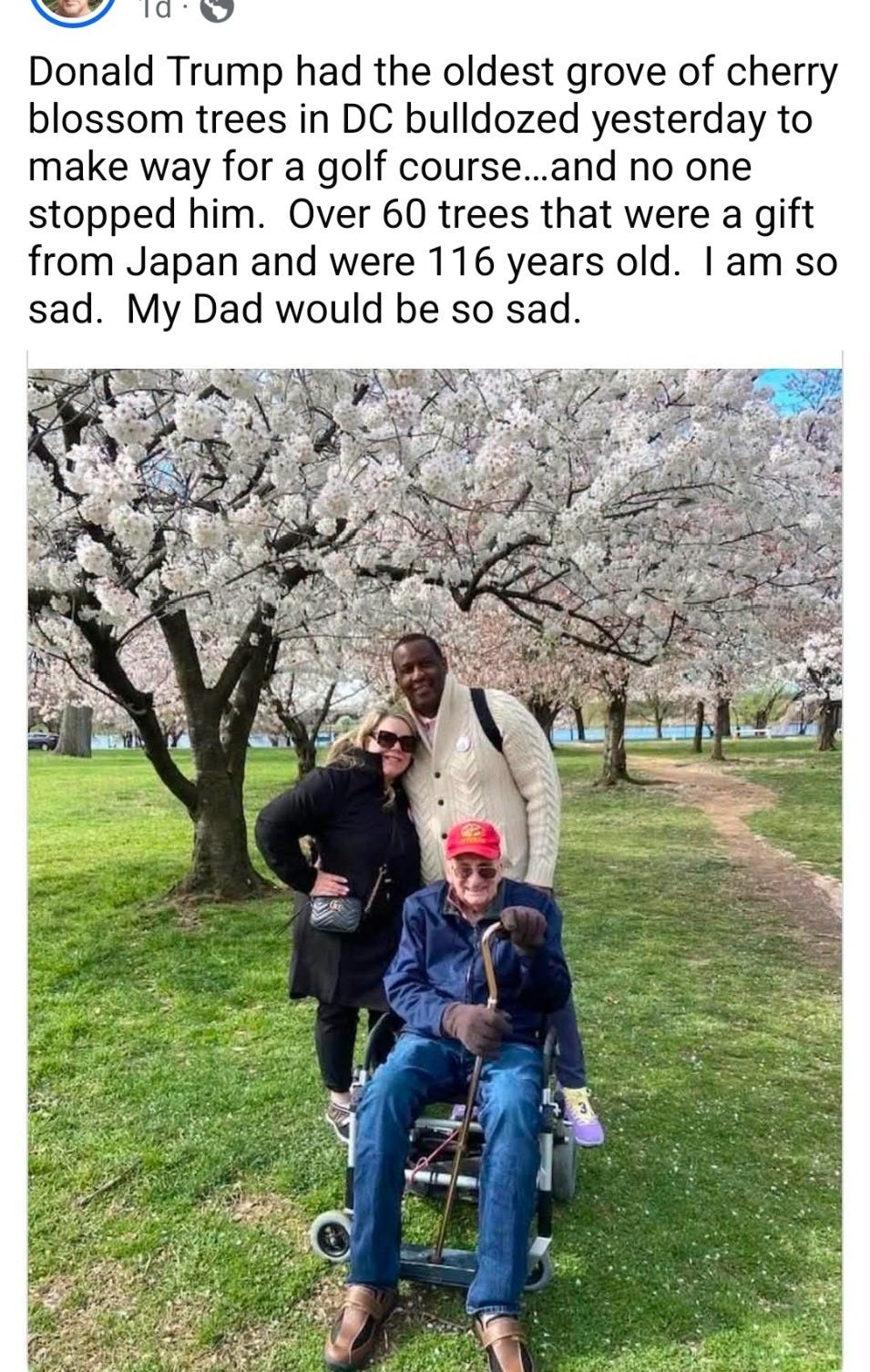
There was history, destruction, and a president whose name guarantees that half the country will believe the worst before breakfast and the other half will dismiss it before reading the second paragraph.
It was almost too perfect, so we checked. The evidence does not support the claim that Trump bulldozed more than sixty historic cherry trees, but correcting the viral story does not make East Potomac disappear. It does not put the trees back in the ground, and it does not answer the questions raised by what actually happened there.
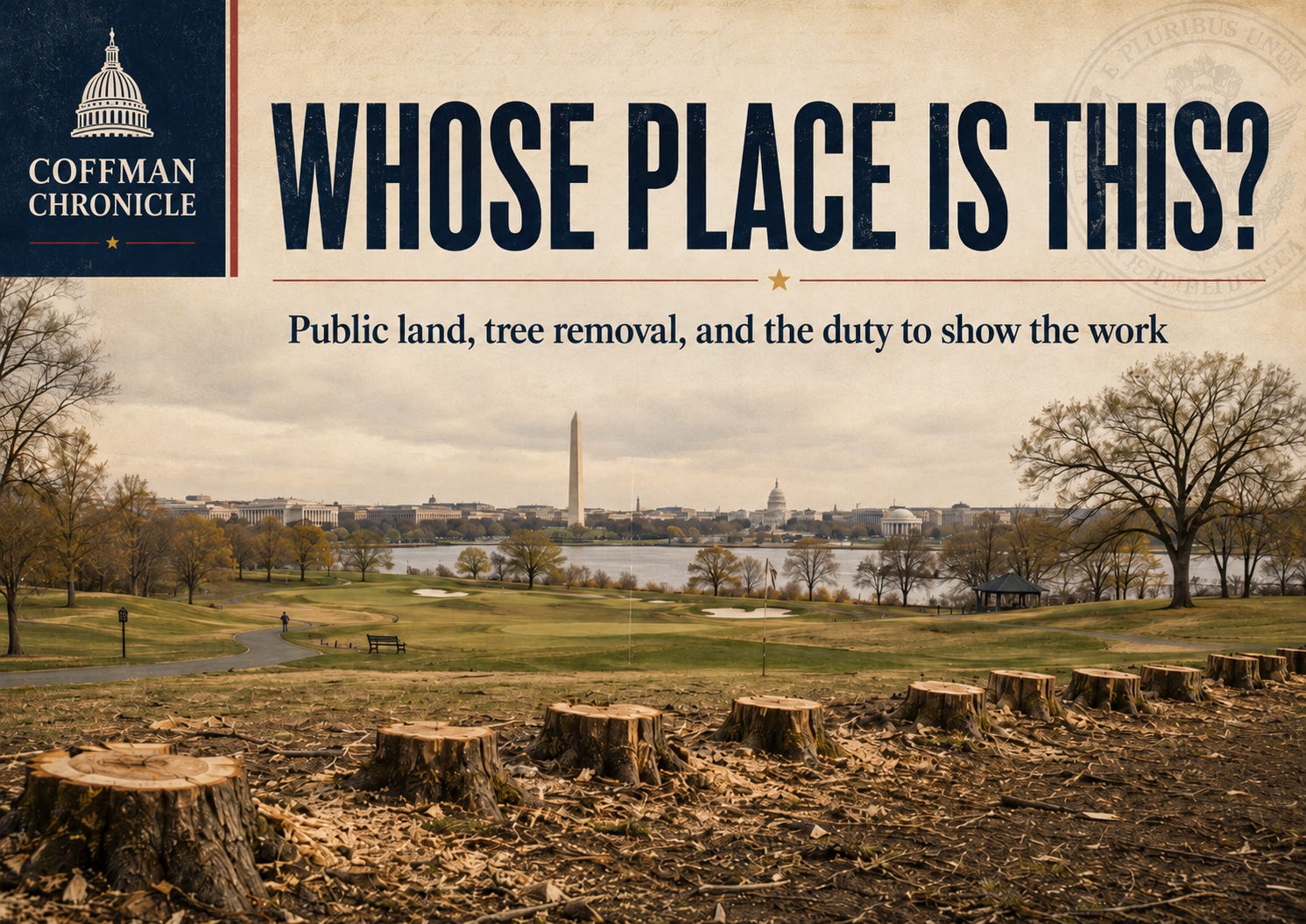
The Facebook post got the story wrong. The real story begins with the stumps.
This Community Is Powered by You
What started as a small circle has grown into something much bigger, and it’s all because of readers like you.
Every time you forward this email, post it on socials, or bring someone new into the fold, you’re helping build one of the most passionate, independent communities out there.
Want to keep the momentum going?
Share this newsletter with someone who should be part of this conversation.
Thank you for being here. It means everything.
The People Who Find the Stumps
The easiest way to misunderstand East Potomac is to hear golf course and picture a country club. East Potomac is public golf on public land. The National Park Service says its Washington courses are meant to provide affordable golf opportunities. Around the course, people bike Hains Point, run the loop, walk beside the Potomac, fish, bird-watch, and sit by the river.
On Saturday, while tree crews were still working, some of those people gathered at Hains Point. Bob Hartt, who is legally blind, told NOTUS he rides a tandem bicycle there because it is one of the safest places in the region to practice away from heavy traffic. Alex Rosen, who cycles, runs and golfs at East Potomac, described sitting at the tip of the park, calling his mother and watching planes take off.
Those are the people who disappear once a story moves into agency filings and redevelopment plans and becomes a collective noun: the public. Donald Trump has golf courses of his own. East Potomac is ours.
This Is What Public Means
A public golf course is a small expression of democracy. The surgeon can play behind the plumber. A retiree can tee off ahead of a lobbyist. A kid learning the game does not need a family membership, a sponsor, or somebody important to invite him.
The same principle reaches beyond golf. The runner, the cyclist, the angler, and the family beside the river do not need their names on a deed to belong there. The government holds the property, but not for itself.
The people using East Potomac do not own it individually. They own it together.
More Than 60 Trees Really Are Gone
Whatever the Facebook post got wrong, the empty spaces are real. On Aug. 27th, The Washington Post counted more than sixty places where trees appeared to have been removed in recent weeks, from parking areas and the perimeter to playing corridors on all three courses. Crews were still removing trees two days later.
The Department of the Interior says this was routine maintenance unrelated to the proposed redesign, including, they say, arborists removing hazardous, invasive, dying or declining trees. Some of the evidence supports that explanation. Reporters saw hollow stumps and watched a crew take down a visibly decayed tree.
The Post also identified a removed tree near the Blue Course’s 14th green as a cherry tree. The contractor, RTEC Treecare, says it removed no cherry trees.
Which trees were condemned? Who evaluated them? When? Why did so many need to come down immediately before a planned redevelopment of the same property? We do not have to assume the worst to ask. The government does not get to call sixty tree removals “maintenance” and expect that word alone to settle the matter either.
Congress Said Who This Place Was For
The word public can become so familiar that we stop hearing what it means. In 1897, after the federal government spent millions reclaiming the Potomac Flats, Congress declared the new ground a public park, to be “forever held and used as a park for the recreation and pleasure of the people.” During the House debate, Rep. Joseph Babcock explained that the purpose was to keep the reclaimed land from being diverted to other uses.
That did not freeze East Potomac in 1897. Golf and roads came later. Recreation changed, and the park changed with it.
It can change again. In 2020, the National Park Service signed a 50-year lease with the nonprofit National Links Trust to operate East Potomac, Langston and Rock Creek, with plans to address deferred maintenance, restore historic features, expand access, and make major capital improvements. East Potomac itself was slated for substantial work.
The problem is not that Donald Trump wants to change a public golf course. He could even be right that East Potomac can be made better. The harder question is what government owes the people before it makes those changes irreversible.
Stewardship is not preservation for preservation’s sake. It is accountability for change.
The Process Is the Public’s Protection
The government has represented in court that before construction of a proposed redesign begins, the Park Service must complete environmental and historic-preservation reviews, make findings concerning harm to park resources, and obtain approval from the National Capital Planning Commission. As of late August, some of that work remained unfinished.
Those requirements can sound like Washington paperwork until you ask who is supposed to do the checking instead. A golfer cannot commission an environmental study, nor can a cyclist personally inspect historic resources. A family using the park cannot sit in every agency meeting where someone decides which parts of the landscape stay and which disappear.
The process is the public’s eyes when the public cannot be standing there. However, review works only while there is still something meaningful to decide. If government can make the physical change first and complete the review afterward, the process becomes an autopsy. The process protects the public only if it comes before the irreversible part.
The Judge Had Already Asked About the Trees
A federal judge had already raised precisely that concern. In May, U.S. District Judge Ana Reyes declined to halt necessary maintenance at East Potomac but told government lawyers she wanted advance notice before more than ten trees were removed or equipment larger than a sedan was brought onto the property. Her direction was oral and was not incorporated into a formal written order, so the evidence does not support saying the administration violated a court order.
By July, Reyes was warning against being presented with a fait accompli before challengers had a meaningful opportunity to seek relief. Then, in August, more than sixty trees were removed. The Washington Post reported that a person familiar with the litigation said neither the plaintiffs nor the court had been notified about the recent tree work.
That does not prove misconduct, but it sharpens the question: Why did the kind of irreversible activity the judge had already expressed concern about occur without the notice she had requested?
The Cherry Trees We Should Actually Be Talking About
There really are extraordinary cherry trees at East Potomac. They just are not the sixty-plus trees described in the Facebook post.
The Library of Congress maintains a Historic American Landscapes Survey for a grove on the golf course identified as “1910 Japanese Flowering Cherry Trees.” It says the available evidence strongly indicates they are the sole surviving specimens from Japan’s first donation of cherry trees to Washington and therefore the city’s oldest Japanese cherry trees. The National Park Service says historical evidence suggests two dozen trees from the shipment believed destroyed in 1910 may have survived and later been planted near Hains Point.
There is no evidence that this grove has been bulldozed. Tom Fazio, the architect selected for Trump’s redesign, has said he intends to preserve the historic trees and that Trump has emphasized protecting them.
The grove also explains why the process exists. A golf architect can see a better fairway where a historian sees a surviving artifact of more than a century of U.S.-Japanese history. A golfer sees Saturday morning. A cyclist sees a safe route. A family sees an afternoon by the river. Public land has more than one beneficiary.
The Square New Deal Test: Show Your Work
The Square New Deal does not require government to preserve every tree or freeze every public space in time. Public property can change, and sometimes it should.
When government makes an irreversible change to something it holds in trust for the public, it should be able to show that the decision was lawful, necessary, transparent, and consistent with the property's public purpose.
That means showing the work: the tree assessments, the final plan, the historic and environmental reviews, what happens to public access, who pays, and how the oldest cherry trees will be protected. That is not hostility to development. It is accountability.
The rule should be the same whether the president is Donald Trump, Joe Biden, or somebody we have not elected yet. Public stewardship cannot depend on whether we trust the person holding the office.
A good steward does not have to preserve everything exactly as he found it. He does have to account for what he changes.

Public Means Public
The Facebook post that started this story made a claim the evidence could not support. We corrected it because facts do not become optional when an inaccurate version makes someone we oppose look worse.
Government deserves the same standard. If these removals were routine maintenance, show the basis for that conclusion. If the redevelopment has not begun, make the timeline clear. If the historic cherry trees are protected, show us where they remain in the final plan. Accountability is not an accusation. It is what public ownership requires.
More than a century ago, Congress said this land was to be held for the recreation and pleasure of the people. Presidents may improve it, agencies may manage it, architects may redesign it, and courts may determine what the law allows, but none of them own it. The people do.
Public means public. Stewardship begins by remembering whose property you are changing.
Support Independent Media
If you believe public power should come with public accountability, and that facts should matter even when the truth is less convenient than the viral version—subscribe to the Coffman Chronicle and share this article with someone who believes government should have to show its work.
If you can afford to support this work with a paid subscription, it helps us keep digging past the outrage, checking the claims and asking the harder question underneath them: Who is government supposed to be serving?
Sources:
Associated Press. “Judge Tells Trump Officials Not to Cut Trees at Historic Washington Golf Course.” May 2026.
Bastable, Alan. “Trump Wants a New-Look Golf Course in D.C. Preservationists Have Another Idea.” GOLF.com, June 12, 2026.
Binday, Ben, Salvador Rizzo, and Rick Maese. “Trump’s Timeline for Golf Course Revamp Is Getting Pushback from This Judge.” The Washington Post, July 2, 2026.
Historic American Landscapes Survey. “1910 Japanese Flowering Cherry Trees, East Potomac Golf Course, East Potomac Park, Hains Point Vicinity, Washington, District of Columbia, DC.” Library of Congress. HALS DC-8.
Maese, Rick. “Trees Are Coming Down by the Dozen as Trump’s D.C. Golf Makeover Nears.” The Washington Post, August 28, 2026.
Muhammad, Shamira. “At East Potomac Park, Trees Are Falling and Tensions Are Rising.” NOTUS, August 31, 2026.
National Park Service. “Golf Courses.” Region 1: National Capital Region. Last updated April 30, 2024.
National Park Service. “National Park Service Signs 50-Year Lease with National Links Trust for Historic Golf Courses.” National Mall and Memorial Parks. October 2, 2020.
National Park Service. “The Witness Tree.” Last updated April 4, 2024.
U.S. Congress. House. “Congressional Record—House, February 24, 1897.” 54th Cong., 2nd sess., Congressional Record 29, pt. 3 (February 24, 1897): 2202.
I’ve been waiting for someone to address this. This is public property and belongs to the people. wtf how can that orange turd do this
This is good work, letting facts be far more important than knee-jerk reactions. Kudos. But as a golfer with a hobbyist-level interest in golf architecture, let me provide some context. Battles over chopping down vs. preserving trees are epidemic now at both private and public courses. Many beloved courses in the Northeast were built in the first quarter of the 20th century. That provides a lot of years for trees to grow wider or grow up in places where the original architect never imagined they be. A lot of course "restorations" involve chopping down trees to enable the course to be played "the way the architect intended," which often upsets some of the more tender-hearted members. Happened at the club I belong to last year; even though I got why some trees came down, every felled trunk felt life a gut punch. So, you're right not to assume that was just the usual tasteless barbarism from our Orange Lord. But the evasion of the judge's order to inform the court first is so on brand for our lawless POTUS that it leaves a fair suspicion that something beyond justified course maintenance is going on.