


Every Tuesday at 8:15 in the morning, the waiting room of Mercy County Family Clinic looked less like a doctor’s office and more like an accidental town hall...
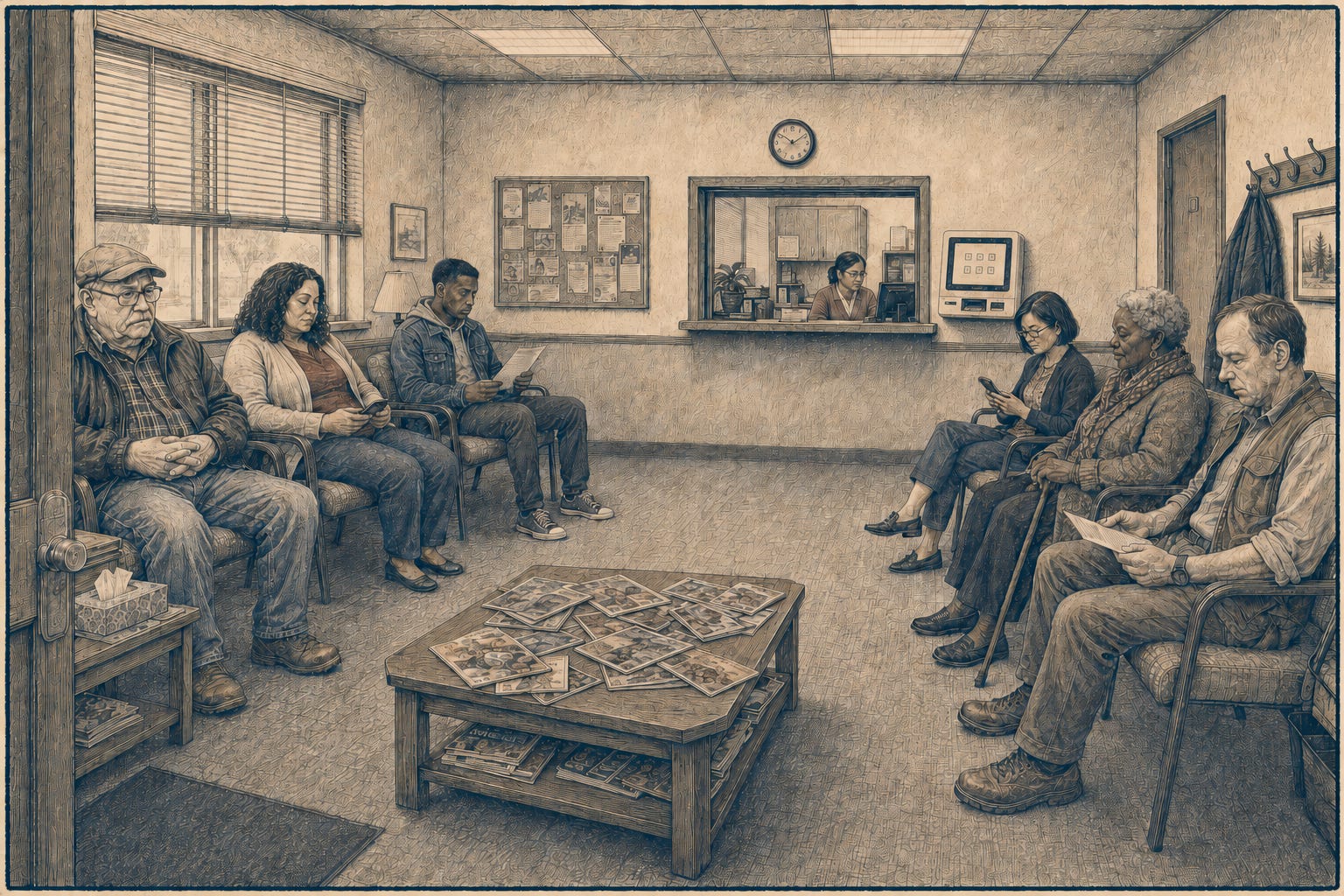
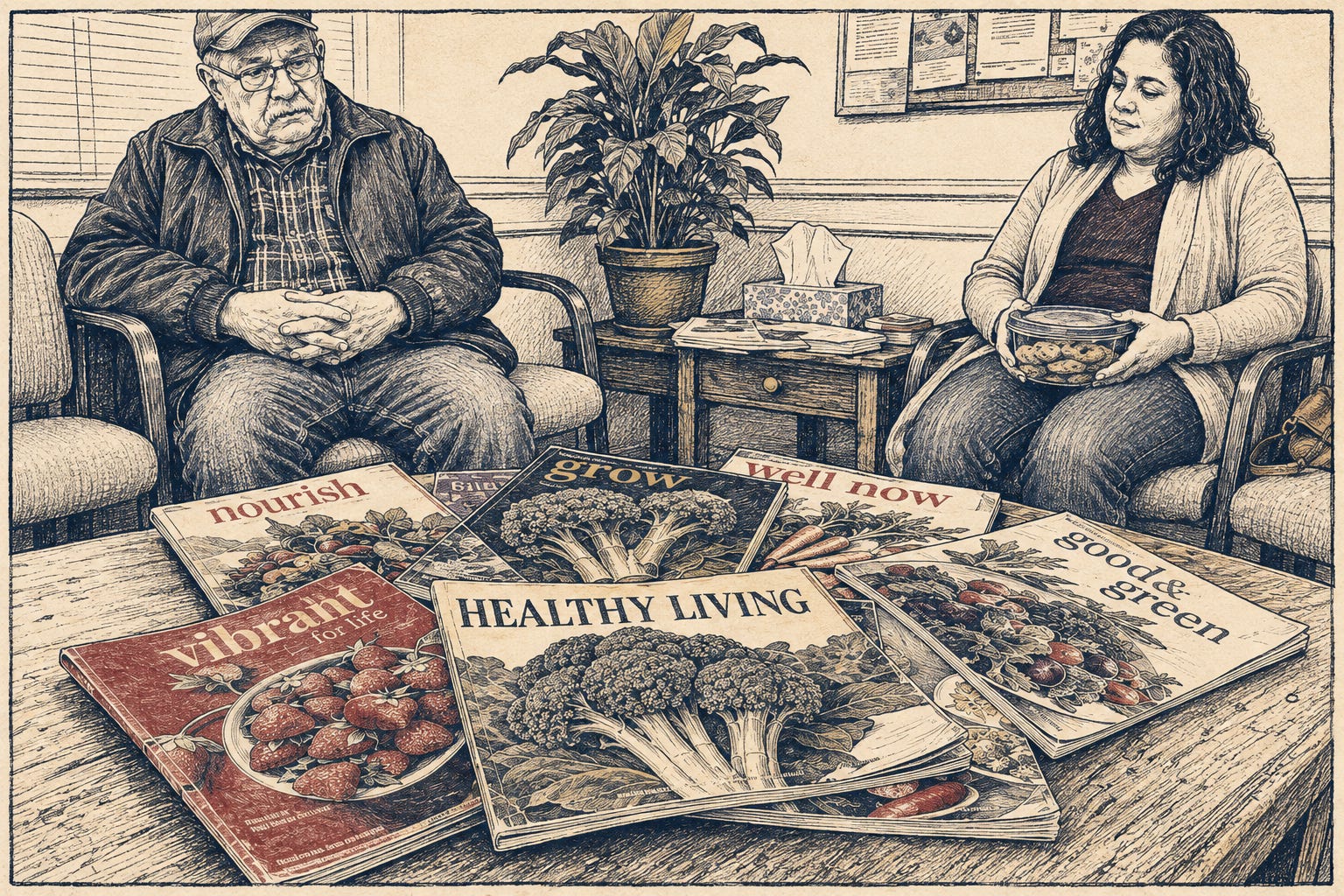
There was Earl Thompson, a retired machinist who distrusted every magazine in the room because they all seemed to feature vegetables on the cover. “Big Broccoli has taken over the media,” he announced one morning, holding up a copy of Healthy Living as evidence.
Denise Alvarez brought homemade cookies every week, despite rarely having an appointment. “I am here for community health,” she explained.
They waited for appointments. They waited for test results. They waited for insurance approvals, prescription refills, specialist referrals and letters confirming that the treatment their doctor had ordered was medically necessary.
Most of them believed that when a physician said something was medically necessary, the medical part of the discussion had already been settled.
The insurance companies regarded that as an opening argument.
“You are here because your husband told you to stop feeding the mail carrier,” the receptionist replied to Denise. “Community health takes many forms.”
Then there was Marvin Bell, who had become so familiar with the self-check-in kiosk that he greeted it by name. “Morning, Cheryl,” he said, tapping the screen.
“It is a touchscreen,” the receptionist reminded him. Marvin leaned closer to the machine. “She knows what she did.”
Everyone laughed, including the receptionist, who had learned that a little nonsense could make a waiting room full of worry feel briefly human.
The clinic served nearly every kind of person Mercy County could produce. Retired factory workers sat beside young parents. Farm families shared armrests with home health aides coming off overnight shifts. There were teachers, cashiers, mechanics, county employees, and people whose jobs changed so often that no insurance company seemed able to keep track of them. They disagreed about politics, religion, football, and whether Denise’s oatmeal cookies technically counted as cookies, but they all understood waiting.
This Community Is Powered by You
What started as a small circle has grown into something much bigger, and it’s all because of readers like you.
Every time you forward this email, post it on socials, or bring someone new into the fold, you’re helping build one of the most passionate, independent political communities out there.
Want to keep the momentum going?
Share this newsletter with someone who should be part of this conversation.
Thank you for being here. It means everything.
One rainy Tuesday, a resident physician named Dr. Anika Patel stepped into the waiting room and noticed something that had been bothering the clinic staff for years. Half the patients were not there because their health had changed, but because the paperwork had.
A man named Raymond had taken the same diabetes medication for twelve years. His insurer now required another office visit before authorizing another refill.
Dr. Patel opened his chart. “So,” she said, “has your diabetes resolved unexpectedly?” Raymond considered the question. “I was hoping you would tell me.”
Across the hall, a woman with severe arthritis needed a new referral to the same specialist she had seen every three months for six years. A father had taken an unpaid morning off from work so a physician could sign a form confirming that his son still had asthma. An elderly woman had arrived by county bus because her insurer would not cover a home blood-pressure monitor without another evaluation.
The clinic billed for the visits. The insurance companies processed the claims. The patients lost hours, wages, and patience. Every institution could say it had followed the rules. No one could explain whom the rules were helping.
At lunch, Dr. Patel carried a folder into the break room and dropped it on the table. “This is not healthcare,” she said. “This is ceremonial paperwork performed in the presence of a stethoscope.”
Nurse Greene looked at the stack. “Be careful. Ceremonial paperwork is one of the county’s largest industries.”
The clinic administrator, Mr. Feldman, did not laugh. He had spent the morning calculating whether the clinic could afford to keep its addiction counselor for another year. “We get reimbursed more reliably for a five-minute medication visit than for an hour of recovery counseling,” he said.
“That makes no sense,” Dr. Patel replied.
“It makes financial sense.”
“That is not the same thing.”
“No,” Feldman said. “It rarely is.”
The Pieces That Never Met
Across the waiting room sat Lisa Morgan. Five years earlier, she had undergone back surgery after being injured while stocking shelves at a warehouse. Her surgeon wanted her pain controlled. The pharmacy filled the prescription. Her insurance plan covered pills more readily than physical therapy. The physical therapy office required a forty-dollar copayment per visit, three times a week that Lisa could not afford. The prescription cost eight dollars.
No one intended for her life to unravel. The surgeon made what seemed like a reasonable decision. The pharmacy followed the prescription. The insurer applied its coverage rules. Lisa took the medication because she was in pain and needed to return to work.
Follow-up visits grew shorter. Renewals became easier than difficult conversations. Physical therapy remained expensive. Time off remained impossible. By the time anyone realized Lisa was no longer simply managing pain but had become dependent on the medication, every part of the system had done what it had been designed to do.
Unfortunately, those pieces had never been designed together. Lisa lost her warehouse job. She nearly lost her apartment. Her sister stopped allowing her to watch her nephew alone. For several months, Lisa’s life became a rotating schedule of emergency rooms, temporary treatment programs, and promises that she desperately meant when she made them.
Eventually, a counselor at Mercy County Family Clinic stayed after closing to help her complete an application for a recovery program. A nurse called three facilities before finding an available bed. Denise drove her there because the county transportation service required two days’ notice.
Three years later, Lisa worked part-time at the library and spoke at recovery meetings. Whenever someone described addiction as merely a failure of willpower, she smiled politely. “You ever try leaving IKEA with only the thing you came for?” she asked. No one ever had a good answer.
Lisa did not deny her own choices. Recovery had required her to confront them with painful honesty, but she also knew that personal responsibility could not become an excuse for institutional innocence. A person could be responsible for taking the next step without pretending that every previous step had been hers alone. That is the difference between accountability and abandonment.
The Meeting
That summer, the Mercy County Council announced a public meeting on healthcare spending, addiction treatment, and the growing cost of emergency services. The meeting was supposed to take place at city hall, but then the building’s air-conditioning system failed for the third time. The county moved the meeting to the clinic cafeteria.
By six o’clock, folding chairs filled the room. Nurses stood along the walls. Patients occupied the tables. Two insurance representatives sat near the rear exit with expressions suggesting they had already identified the quickest route to their cars.
Councilman Harold Briggs opened the meeting. “Government should stay out of healthcare,” he declared.
Nurse Greene raised her hand. “Who pays for Medicare?”
Briggs paused. “Well, naturally, there are exceptions.”
“Medicaid?”
“Another exception.”
“The county ambulance service?”
“That is emergency infrastructure.”
“The tax deduction for employer health plans?”
Briggs shifted in his seat. “This meeting is not about terminology.”
From the back of the room, Earl whispered loudly, “It was until the terminology started losing.”
The council chairman called for order. Another council member, Susan Webb, announced that the solution was to eliminate unnecessary paperwork. The clinic receptionist laughed so hard she nearly inhaled a mint. “You have clearly never met insurance,” she said. Even the council members chuckled.
Then Mr. Feldman presented the numbers. Mercy County was spending millions of dollars responding to medical crises that often began as manageable problems. Emergency-room visits were rising, and ambulance calls involving overdoses had increased. People discharged from treatment programs often waited weeks for follow-up counseling. The county paid for police responses, emergency transportation, temporary housing, court proceedings, and crisis care. It struggled to fund prevention.
“We are paying at the most expensive point in the process,” Feldman explained. “We save money on the front end and receive the bill after the roof collapses.”
Councilman Briggs objected. “The county cannot become responsible for every decision every person makes.”
“No,” Feldman answered. “But the county is already paying for the consequences. The question is whether we want to pay earlier, when help is cheaper and more effective, or later, when the damage is greater.”
The room quieted. It was not a question about whether the county would pay, but about what the people would receive in return.
What Stewardship Requires
When public comment began, several speakers demanded lower taxes. Others demanded more treatment beds. A pharmacist described spending hours arguing with insurers over medications that physicians had already prescribed.
Then Lisa approached the microphone. She did not ask for pity. She did not blame a single doctor, politician or company. “My addiction was not caused by one bad decision,” she said. “It was built from hundreds of reasonable decisions made by people who only saw one piece of the puzzle.”
The room became still. “My doctors cared. The pharmacists cared. The therapists cared. Even the people writing the regulations probably believed they were protecting someone.”
She looked toward the council. “But caring is not stewardship.”
Councilwoman Webb leaned forward. “What do you mean?”
“Stewardship means being responsible for what your decisions create, not only what you intended.” Lisa placed both hands on the lectern.
“When insurance made physical therapy harder to obtain than pain pills, that decision created something. When the clinic was paid more reliably for a quick prescription visit than for a long conversation about dependence, that created something. When the county funded emergency responses but left recovery programs searching for donations, that created something too.”
One of the insurance representatives began writing notes.
“You do not merely vote on budgets,” Lisa continued. “You vote on incentives. You decide what becomes easy and what becomes difficult. You decide whether the system waits for a person to collapse before it considers that person worth helping.”
She paused. “I had to take responsibility for my recovery. But responsibility cannot travel in only one direction. Patients have duties. Doctors have duties. Companies have duties. Government has duties. When only the person at the bottom carries responsibility, that is not accountability. It is a system protecting itself.”
No one applauded immediately. The words were too serious for that. Then Marvin began clapping. One by one, the others joined him. Even Cheryl’s screen flashed, although Marvin later claimed that was a sign of support.
The Mercy Compact
The council could not rewrite federal healthcare law. It could not command insurance companies across the country, or repair every weakness in the American medical system, but it could govern the authority and money entrusted to it. That was the first principle of the plan the county eventually adopted: public officials were not excused from acting merely because their power was incomplete. They called it the Mercy Compact.
The county guaranteed that any resident seeking addiction treatment would receive an assessment within twenty-four hours and a recovery appointment within three days. It funded transportation so that a treatment bed fifty miles away was not functionally unavailable to someone without a car.
County contracts began rewarding clinics for keeping patients stable rather than merely processing more visits. Insurers participating in county employee plans had to report how often they denied or delayed treatments ordered by physicians.
The clinic hired two patient navigators whose job was not to provide medical care but to guide people through the maze surrounding it. One was Denise. Her official title was Community Care Coordinator. She preferred Secretary of Cookies.
The compact also created a stewardship review board made up of patients, medical professionals, local employers, and county officials. Its purpose was not to run the clinic or replace doctors. It examined whether the county’s rules were producing the results the county claimed to want.
The board’s first report discovered that dozens of patients were missing follow-up appointments because the county bus schedule ended before evening clinic hours. The transportation department adjusted the route. It was not revolutionary legislation. No speeches were delivered on the courthouse steps. A bus simply ran forty-five minutes later. For several families, that was the difference between having healthcare and possessing a theoretical right to schedule it.
The compact required private contractors receiving county money to carry part of the cost when their practices created predictable burdens for the public. Companies could still earn profits. Doctors still made medical decisions. Patients still carried responsibility for following their treatment plans, but no institution could collect the benefit of a decision while automatically transferring its foreseeable costs to everyone else.
Private institutions could deliver healthcare. The people of Mercy County would own the rules governing what public money was expected to accomplish.
The Republic in the Room
The changes did not cure every illness. Insurance forms continued to reproduce in dark office drawers. The clinic still fought over authorizations. The county budget remained tight. Some patients relapsed. Others missed appointments. One insurance company responded to the new reporting requirement by creating a denial category called “administratively pending,” which everyone recognized as a denial wearing a necktie.
However, the direction of responsibility had changed. Before the compact, patients were expected to navigate every disconnected institution alone. Afterward, the institutions were required to see themselves as parts of the same public system.
That did not eliminate personal responsibility. It made personal responsibility possible.
Lisa began working full-time at the library and continued attending counseling. Raymond received a year-long authorization for his diabetes medication, sparing him eleven unnecessary appointments. The arthritis patient received a standing referral to her specialist. Dr. Patel completed her residency and chose to remain in Mercy County.
Councilman Briggs continued saying government should stay out of healthcare, although he began adding so many exceptions that his position eventually required a binder.
Every Tuesday morning, the waiting room still filled. Earl continued his campaign against vegetable propaganda. Denise distributed cookies under what she described as a “nutritional freedom framework.”
Marvin continued speaking to the kiosk. “Morning, Cheryl.”
The receptionist looked up from her desk. “You understand that machine cannot hear you.”
Marvin nodded solemnly. “Neither could the county council at first.”
Dr. Patel laughed. “So what changed?”
Marvin pressed the check-in button. “We kept talking until somebody became responsible for listening.”
The waiting room settled into its familiar rhythm. A child played beneath a chair. A nurse called the next name. Rain tapped against the windows.
Nothing about the room looked powerful. There were no marble columns, campaign banners, or television cameras. There were only people waiting for care and workers trying to provide it inside rules written by institutions most of them would never see, but a republic was never only the building where laws were passed. It also existed wherever the consequences arrived. It existed in the price of a prescription, the length of a bus route, the availability of a counselor, and the difference between a treatment authorized today and a crisis paid for tomorrow.
The people in the waiting room had not demanded that the government control every life. They had demanded that power accept responsibility for what it built.
They had not abolished markets. They had insisted that private profit could not depend on transferring every difficult cost to families, clinics and taxpayers.
They had not denied individual responsibility. They had placed it inside a larger chain of shared duties.
The government had to write rules worthy of the public trust. Companies had to carry the foreseeable costs of their decisions. Citizens had to care for one another and defend the dignity of people whose struggles were easy to judge from a distance.
That was stewardship, not charity from above, not control from the center, not another promise that the right person could repair everything alone. It was a public agreement that freedom required responsibility, that responsibility had to travel upward as well as downward, and that the institutions shaping human life must answer to the people living with the results.
Marvin finished checking in and patted the side of the kiosk. “Good meeting, Cheryl.”
The screen displayed a message. YOUR INFORMATION HAS BEEN RECEIVED.
Marvin pointed triumphantly. “See? That is all the people were asking for.”

Moral
The Square New Deal begins with a simple principle: every form of power carries a duty of stewardship.
Patients must participate honestly in their care. Medical professionals must protect the people who trust them. Companies must not profit by pushing predictable costs onto families and taxpayers. Government must do more than spend money after a system fails. It must write durable rules that make health, recovery, and human dignity easier to reach before crisis becomes the most expensive option.
Healthcare may be delivered through public institutions, private companies, nonprofit clinics, and local professionals, but the guarantee cannot belong to any of them alone.
The American people already carry the cost. They must also own the promise.
Stewardship is a polite way of saying accountability. Attached to accountability must be a system of rewards and punishments which ensure accountability. The rewards and punishments sequester responsibility. Big business does not like this because they have learned that responsibility eats into profits. We can use all the buzz words we want but not much will change until big business is taken out of medicine.
What a concept! Responsibility shared at many levels. Nobody has to bear it alone.