


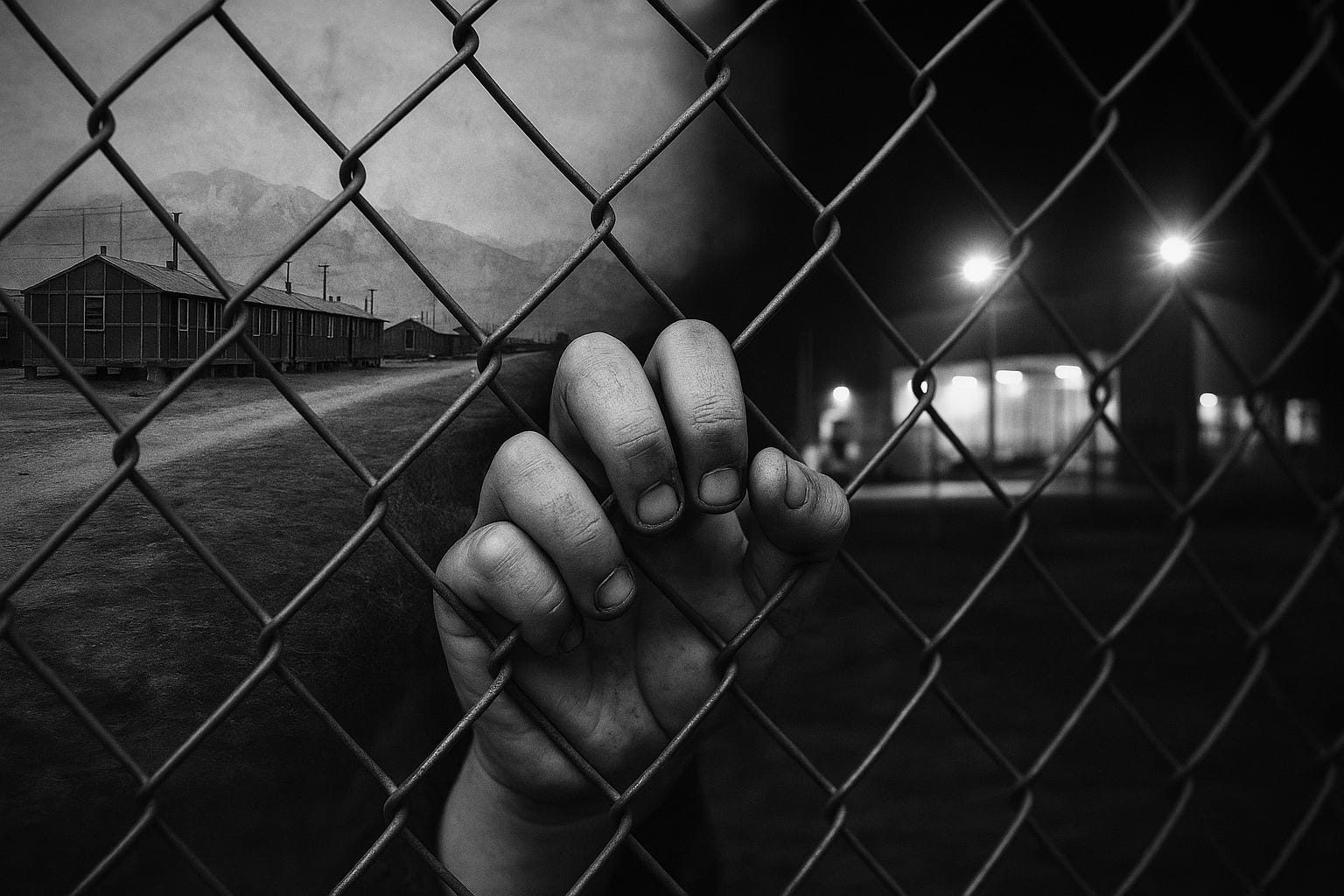
The War on Children
America has done shameful things before, but nothing justifies this. We are watching our government plot to lock brown and Black children in cages for as long as they want, in conditions so bad that a dog shelter would be shut down.
No sunlight. No clean clothes. No way home. Just kids — some still in diapers — trapped behind chain-link and razor wire while politicians grin for the cameras.
This year, the Trump administration asked a federal judge to destroy the Flores Settlement Agreement, the last thin shield between immigrant children and the full weight of state-sanctioned abuse. Without it, there will be no enforceable limit on how long kids can be held. No requirement for clean water or medical care. No guarantee they’ll be kept safe from predatory adults in custody.
And don’t pretend this is about “the border.” The reality is obvious: if these kids were white and came from Europe, this policy wouldn’t exist. This is cruelty with a color chart.
We’ve seen this story before, in Japanese internment camps, in Native American boarding schools, in Jim Crow’s back rooms, and every time, history condemned the perpetrators. If we don’t stop it now, we’ll be the ones future generations spit on.
Stay Informed. Stay Loud.
Subscribe to The Coffman Chronicle for no-BS political analysis, action guides, and daily truth bombs you won’t get from corporate media.
What Is the Flores Settlement & Why It Matters
Before the Trump administration decided to make immigrant children collateral damage, there was Jenny Lisette Flores, a 15-year-old girl from El Salvador who, in 1985, came to the United States fleeing violence. Instead of refuge, she found herself in U.S. government custody, strip-searched, locked in with unrelated adult men, and denied a simple phone call to her family. Her case dragged on for more than a decade, but it exposed a brutal truth: without hard rules, America’s immigration system treats kids like disposable contraband.
That fight produced the Flores Settlement Agreement in 1997 — a court-ordered baseline of decency that every administration, no matter how hardline, was forced to obey. It is not a luxury perk. It’s the legal equivalent of locking the liquor cabinet in a house full of arsonists. Among its key protections:
Safe and sanitary conditions, including food, clean water, medical care, and basic hygiene;
Separation from unrelated adults to prevent abuse;
Prompt transfer and release, generally within 72 hours out of CBP holding cells and into appropriate care; and
Placement in the least restrictive setting appropriate for children.
For nearly three decades, Flores has been the thin barrier between children and unchecked cruelty. This month, the Trump administration moved to tear that barrier down on purpose.
The Trump Administration’s 2025 Move
On May 22, 2025, the administration filed a formal motion to terminate the Flores Settlement in its entirety, a direct request to scrap the court-enforced standards that limit detention and mandate humane care. The motion was set on a fast track: opposition due June 20, reply July 3, and a hearing date initially noticed for July 18. The case sits before U.S. District Judge Dolly M. Gee in Los Angeles, who has overseen Flores for years.
On August 8, 2025, Judge Gee held a public hearing. She pressed government lawyers on why, amid reported drops in border apprehensions, children were still being held beyond legal limits and in degrading conditions, and she signaled open skepticism toward dissolving Flores. A decision is pending.
The government’s brief dresses its intentions in management jargon — “streamlining,” “modernization,” “outdated standards.” In plain English: remove the time limits, remove the inspections, remove the enforceable definition of “safe and sanitary,” and let agencies police themselves. That’s not policy improvement. That’s a blueprint for indefinite child detention in facilities the public can’t see and courts can’t reach.
The Pattern: Racism Disguised as Policy
Let’s be honest, this isn’t just about immigration law. It’s about who gets treated like a child worth protecting, and who gets treated like a problem to be contained.
In recent years, the overwhelming majority of minors in federal immigration custody have come from Central America, Mexico, and Haiti, children whose skin, languages, and last names mark them as “other” in a system now deciding how long they can be locked up. Meanwhile, the United States created humanitarian parole pathways and benefit access for many Ukrainian families fleeing war, including “Uniting for Ukraine,” expedited work authorization, and access to mainstream benefits. That’s what it looks like when a government decides to welcome rather than warehouse.
When the children are white, we call them “refugees.”
When they’re brown or Black, we call them “illegals.”
This isn’t accidental. Immigration rules in America have always been built on a racial hierarchy, from Chinese Exclusion to national-origin quotas to the 2017 Muslim Ban. Ending Flores follows that same pattern: a policy calibrated to fall hardest on Latino and Black children, out of public view and off the political radar.
And if this feels extreme, that’s because it is. But it’s also familiar. America has written this script before, and every time, it ended in shame.
Historical Parallels
Every generation likes to believe it would have been on the right side of history. That it would have stood against internment camps, against segregation, against tearing families apart. But history doesn’t come wearing a label. It arrives as “procedure,” “public safety,” and “temporary measures.” It arrives wrapped in just enough bureaucracy that decent people can pretend it’s not happening.
What the administration is trying to do by ending Flores fits neatly into a long, ugly lineage:
Japanese Internment Camps (1942–1945) — Entire families — including children — rounded up and locked away, not for crimes, but for ancestry. At the time, it was called a “wartime necessity.” Today, it’s a national disgrace.
Native American Boarding Schools (late 1800s–1970s) — Children forcibly taken, cultures erased under the fiction of “for their own good.”
Jim Crow and Segregation — Black children denied safe schools, medical care, and opportunity by law. “Separate but equal” made cruelty legal.
Family Separation (2018) — Under Trump’s first term, thousands of children — some still breastfeeding — were taken from their parents at the border as “deterrence.” We saw the cages. We saw the Mylar blankets. We heard the cries.
Ending Flores is not a new chapter. It’s a rerun: the same story, the same excuses, the same moral bankruptcy.
The Human Cost
Policies like this don’t just live on paper. They live in the bodies and minds of the children who have to survive them.
Without Flores, here’s what’s on the table:
Indefinite detention — months or years without a release clock.
Unsafe conditions — no legally enforceable requirement for edible food, clean water, medical care, or even soap and toothbrushes. In 2019, the Ninth Circuit affirmed that “safe and sanitary” does include these basics precisely because kids were being denied them.
Exposure to abuse — without enforceable separation from unrelated adults, the risk of assault and exploitation rises.
Psychological trauma — pediatric experts are blunt: prolonged detention damages developing brains, leading to anxiety, depression, and PTSD.
We don’t have to guess what happens when standards aren’t enforced. We’ve already seen it: toddlers without diapers left in soiled clothes; children sleeping on concrete under thin foil; lice and flu outbreaks ignored; kids held far beyond the 72-hour limit. Federal monitors, the DHS Inspector General, and multiple investigations have documented these conditions. That was with Flores and court oversight. Imagine the same system with no judge, no monitors, and no consequences.
The administration calls this “streamlining.” Let’s call it what it is: state-sanctioned child neglect, engineered for maximum suffering.
These are not abstract harms. They are the predictable outcomes the courts were meant to prevent. If Flores falls, the law will not just fail to stop this — it will give it permission.
Legal & Political Fallout
If Judge Gee grants the government’s request, the dominoes fall fast, not only in immigration.
Immediate impact
Indefinite detention becomes lawful for kids in CBP custody. No 72-hour clock, no mandatory transfer, and no court-enforced standards.
Oversight evaporates. Flores requires inspections and compliance monitoring; termination removes those teeth and leaves agencies to self-police.
Access to counsel shrinks. Without Flores’ procedural guarantees, many children will face removal alone.
The precedent
Tearing up Flores tells every federal agency that court settlements protecting vulnerable people are reversible if you find the right political moment. If protections for migrant children — historically one of the most sympathetic groups — can be erased, what about disability rights consent decrees? Police reform settlements? Prison conditions cases?
The politics
Ending Flores becomes a campaign trophy, proof that the administration “took the gloves off.” The cruelty itself turns into a talking point, feeding a narrative that law exists to serve power, not justice. That corrodes public trust in the courts and invites further attacks on court-ordered protections.
The world is watching
The United States is the only UN member state that has not ratified the Convention on the Rights of the Child. Killing Flores would move us even further from global norms and invite condemnation from allies and adversaries alike.
Why This Is Happening Now
This isn’t a bureaucratic hiccup. The timing is deliberate; the strategy is calculated.
Manufacturing a crisis for political gain. Cruelty creates spectacle. Spectacle drives fear. Fear mobilizes a base. Ending Flores supplies an endless stream of “border” headlines and outrage. The show must go on.
Midterm messaging. With 2026 coming, immigration crackdowns supply red-meat politics and a reliable, polarizing script. The legal fight keeps the story in the news.
Testing the courts. The administration is aware that Judge Gee has ruled against them previously. The real bet may be on appeal, leveraging a judiciary reshaped over the last decade to narrow court oversight of executive power.
Distraction. Policy failures elsewhere? Shine the lights on the border instead. Declare toughness. Change the subject.
A warning to everyone else. If the government can tear up a landmark children’s rights settlement, it can tear up yours. The intended audience isn’t just migrants. It’s every vulnerable group being told: your protections are temporary.
Bottom line: this is not a policy debate. It’s a performance designed to consolidate power and score points, and the performers know exactly who pays the price.
This Is About All of Us
You might think this fight only matters if you live near the border. You’d be wrong.
The same government arguing it can hold children indefinitely without enforceable standards is sending a bigger message: If we can strip rights from them, we can strip rights from you.
History shows that when the state successfully erodes protections for the most vulnerable, it rarely stops there. Once the precedent is set, it becomes a template:
Wartime measures against “enemy aliens” morph into peacetime surveillance of dissidents;
Emergency powers for one crisis quietly get repurposed for another;
Post-9/11 surveillance authorities drifted from terrorism to journalists and activists.
Ending Flores tells agencies that long-standing settlements — the last line of defense for many — are negotiable. That lesson will not stay confined to immigration.
And here’s the part too many people miss: rights are not self-replenishing. Once taken, they don’t snap back when political winds shift. It takes years, sometimes decades, of organizing and litigation to claw back what was lost. The children harmed in the meantime don’t get those years back.
So no, this isn’t “just an immigration issue.” It’s a test case for how much cruelty we’re willing to tolerate and how easily courts can be persuaded to dismantle hard-won protections. Fail that test now, and the next target will be closer to home than you think.
Call to Action
If you’ve made it this far, you know this isn’t a sterile policy debate. It’s a moral crisis, and history is going to ask where you stood when your government tried to erase protections for children.
1) Flood the phones.
Call your members of Congress, even if you think they won’t listen. Demand that they publicly oppose terminating Flores and commit to legislative backstops for child protections. Capitol switchboard: (202) 224-3121.
2) Fund the front line.
Groups like RAICES, Kids in Need of Defense (KIND), and the National Immigration Law Center are already mobilizing to represent children in court and monitor detention conditions. Your donations become lawyers, translators, travel vouchers, and freedom.
3) Make it visible.
Don’t let this die in a 24-hour news cycle. Write letters to editors, tag reporters, and amplify monitors’ findings. Force accountability.
4) Show up.
Vigils, protests, court-watch efforts — be there. Pictures of public resistance change the media narrative and stiffen the spines of timid officials.
5) Watch the courts.
Judge Gee’s decision is pending, and appeals are likely. Track the docket. Remember who speaks up and who stays quiet when the ruling drops. AP News
Final Word
One day, your children or grandchildren will learn about this chapter in American history. They will read about the moment when a president tried to take away the last protections for immigrant kids, and they will ask: What did you do?
You can’t control the courts. You can’t rewrite the laws overnight. But you can refuse to be silent. You can make sure this cruelty doesn’t pass quietly into the archives.
Because the only thing worse than a government stripping protections from children is a country full of people who watched it happen and said nothing.
Stay Informed. Stay Loud.
Subscribe to The Coffman Chronicle for no-BS political analysis, action guides, and daily truth bombs you won’t get from corporate media.
Bibliography:
Gonzalez, Valerie. “Judge Weighs Trump Administration’s Request to End Protections for Immigrant Children.” AP News, August 8, 2025.
“Documents Relating to Flores v. Reno Settlement Agreement on Minors in Immigration Custody.” AILA.
“Judge Weighs Trump Administration’s Request to End Protections for Immigrant Children.” POLITICO, August 8, 2025.
National Center for Youth Law. “Trump Administration Moves to End Settlement that Protects Immigrant Children; Flores Counsel Vow to Defend Vital Safeguards.” May 22, 2025.
National Center for Youth Law. “Amid Government’s Efforts to Terminate Flores, Counsel File Motion to Enforce Agreement, Citing Prolonged Detention of Children and ‘Culture of Cruelty.’” June 18, 2025.
Children’s Rights. “Amid Government’s Efforts to Terminate Flores, Counsel File Motion to Enforce Agreement, Citing Prolonged Detention of Children and ‘Culture of Cruelty.’” June 18, 2025.
Immigration Policy Tracking. “DOJ Moves to Terminate the Flores Settlement Agreement.” May 22, 2025.
Flores Settlement Agreement (official text, PDF). U.S. Administration for Children & Families (ORR).
Flores Settlement Agreement (alternative host, PDF). American Civil Liberties Union.
Center for Human Rights & Constitutional Law. “Flores Settlement.”
U.S. Court of Appeals for the Ninth Circuit. Flores v. Barr, No. 17-56297 (Aug. 15, 2019) (PDF).
Congressional Research Service. “Child Migrants at the Border: The Flores Settlement Agreement and Other Legal Developments” (In Focus, PDF), December 3, 2024.
DHS Office of Inspector General. Management Alert – DHS Needs to Address Dangerous Overcrowding Among Single Adults at El Paso Del Norte Processing Center (OIG-19-46) (PDF), May 30, 2019.
DHS Office of Inspector General. Management Alert – Dangerous Overcrowding and Prolonged Detention of Children and Adults in the Rio Grande Valley (OIG-19-51) (PDF), July 2, 2019.
DHS Office of Inspector General. Capping Report: CBP Struggled to Provide Timely Medical Care and Safe Detention Conditions during 2019 (OIG-20-38) (PDF), June 12, 2020.
West, Sandy. “Immigrant Kids Detained in ‘Unsafe and Unsanitary’ Sites as Trump Team Seeks To End Protections.” KFF Health News, July 30, 2025.
“Immigrant kids detained in ‘unsafe and unsanitary’ sites as Trump team seeks to end protections.” CBS News, July 28, 2025.
Wiessner, Daniel. “Biden Administration Wins Partial Nix of Court Pact on Child Migrant Detention.” Reuters, July 1, 2024.
“Frequently Asked Questions on the Convention on the Rights of the Child.” UNICEF.org.
U.S. Citizenship and Immigration Services. “Re-Parole Process for Certain Ukrainian Citizens and Their Immediate Family Members (Uniting for Ukraine).” Updated October 11, 2024.
U.S. Department of Homeland Security. “Uniting for Ukraine” (archived program page). April 21, 2022.
Administration for Children & Families (ORR). “Ukrainian Humanitarian Parolees Eligible for ORR Benefits and Services (Policy Letter 22-13).” May 7, 2024.
Thanks for all of the information. Well researched. Shameful history.
There is no justification for Trump to receive a peace prize when he protects child sex traffickers, is complicit with Putin and Netanyahu war crimes, orders a military assault and police brutality against the USA. Trump/Vance administration’s and the Republican Congress’ protection of sex traffickers while trying to convince the courts that the government should not be required to treat children in its custody humanely demonstrates they are all unfit to represent the USA. They are an embarrassment to the people of the USA. Congress must impeach now or lose all credibility that they are fit to serve the people of the USA which is the job they were elected to do.