


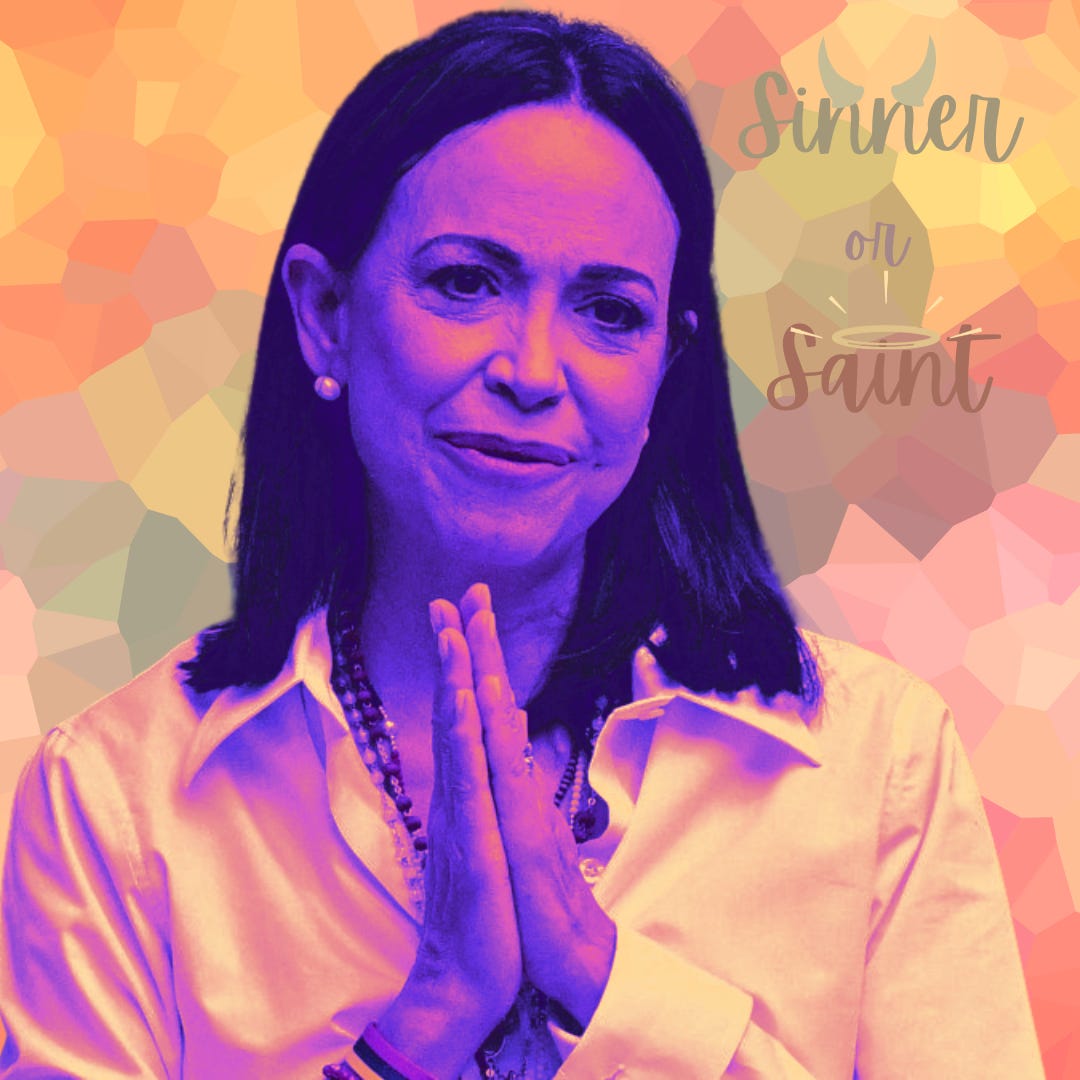
On October 10, 2025, the Nobel Peace Prize was awarded to María Corina Machado, a Venezuelan opposition figure known for challenging the country’s authoritarian regime and attempting to unify its fractured pro-democracy movement. The Nobel Committee cited her “tireless work promoting democratic rights” and praised her role in advocating for a peaceful transition of power in Venezuela.
In theory, this should have been a rare moment of global consensus: a civilian dissident, working for democratic change, honored on the world stage.
But almost immediately, reactions fractured.
Donald Trump claimed that Machado called to tell him he “really deserved” the Nobel himself. He joked — or half-joked — that she probably would have given it to him if he asked. His allies used the moment to accuse the Nobel Committee of political bias. Machado, for her part, acknowledged Trump’s role in applying pressure on Nicolás Maduro’s regime. That was enough for some in U.S. right-wing circles to claim the prize as a vindication of Trump-era foreign policy.
On the left, however, the response was far more damning — not just skeptical of the symbolism, but alarmed by what it might represent. Critics pointed to Machado’s economic policies, her alignment with Washington, and her support for sanctions that have been devastating for ordinary Venezuelans. A searing statement from the antiwar group CODEPINK argued that the award had lost all meaning, accusing Machado of aiding a “regime-change machine” backed by U.S. imperial interests and steeped in economic warfare.
Her Nobel sparked a global conversation, not about Venezuela’s future, but about what we think peace really looks like.
We just hit 25,000 subscribers, 1,000 articles, and 1,000 podcast episodes. To celebrate, paid subscriptions are 20% off for a limited time. That’s just $64/year—less than $1.25 a week.
Join the resistance.
The Dissident No One Can Agree On
To many Venezuelans, Machado represents a long-standing voice of opposition to chavismo, first against Hugo Chávez, and now against Nicolás Maduro. She’s been arrested, banned from office, and exiled from parliament. She co-founded Súmate, a civil society organization that once monitored elections and promoted citizen engagement. In 2023, she won the Venezuelan opposition’s presidential primary with more than 90% of the vote, despite being disqualified by the regime.
Those facts are not in dispute. What is in dispute is what they mean.
Some see her as a democratic reformer. Others see her as a polished emissary for neoliberal policies and U.S. strategic interests. Her economic program includes privatization of state resources, reducing state subsidies, and opening Venezuela to global capital, moves that, in the Latin American context, evoke memories of the IMF-era austerity disasters of the 1990s.
She has supported sanctions which have gutted Venezuela’s economy and hit the poor hardest, and has praised Trump for applying what she called “decisive pressure” on the Maduro regime. Her solidarity with Israel, including a vow to reopen Venezuela’s embassy in Jerusalem, has drawn fire from critics who accuse her of aligning with militarized apartheid. She also played a visible role in past opposition campaigns like La Salida in 2014, which CODEPINK and others allege contributed to a wave of violent unrest.
This ideological record and her alliances have made her useful to some, suspect to others, and undecipherable to many.
The Crisis of the Binary Mind
In a world increasingly sorted by ideological tribes, Machado breaks the script, and that’s deeply destabilizing.
The global discourse — particularly in the West — increasingly functions through a binary lens. You’re either on the left or the right, an ally or an enemy, a freedom fighter or an imperial pawn. There is no room for contradiction, no patience for mixed signals.
Machado embodies those contradictions. She’s a dissident under siege. She’s also someone whose platform includes policies long associated with economic harm and external control in Latin America. That complexity is intolerable to a discourse built on clarity and tribal allegiance.
But it also reflects the nature of political survival in authoritarian systems. Under Maduro, Venezuela’s opposition has been fractured, infiltrated, and persecuted. To remain visible, to organize, to build pressure, it often requires working with external powers, softening ideological edges, and forming alliances of necessity. For some, that’s pragmatic. For others, it’s evidence of co-optation.
Peace, or Projection?
Peace prizes are rarely just about peace. They are often about which peace and who defines it.
María Corina Machado’s Nobel has been celebrated by European governments and American think tanks. But for those with memories of U.S.-backed coups and the legacy of neoliberal devastation across Latin America, her elevation raises alarms. CODEPINK’s critique is rooted in this history, not just in opposition to her economic policies or alliances, but in resistance to the entire system of Western-backed “democracy promotion” that has often masked extraction and domination.
This is not unique to Machado. It’s a pattern visible in other contexts, too.
Volodymyr Zelenskyy, once a comedic actor turned wartime president, is viewed by many as a democratic bulwark against authoritarianism. Yet others criticize his wartime restrictions on opposition parties, media, and civil liberties. Alexei Navalny, a symbol of resistance to Putin, has also faced scrutiny for past nationalist statements and the limited appeal of his platform beyond urban liberal enclaves. These figures, like Machado, operate under enormous pressure, where survival often requires hard compromises, imperfect coalitions, and decisions that may later be judged harshly.
What these examples reveal is not that they are all the same — they aren’t. But that public figures operating in desperate or repressive conditions will inevitably reflect contradictions, and those contradictions will be seized upon, reinterpreted, and politicized depending on the observer’s lens.
Trump’s Shadow, and the Spectacle of Appropriation
Trump’s reaction to Machado’s win — self-congratulatory, theatrical, and pointedly partisan — didn’t just hijack the news cycle. It revealed something more troubling: even a Nobel Peace Prize can’t escape the gravitational pull of American political ego.
Rather than seeing Machado as a Venezuelan figure, resisting Venezuelan repression, Trump’s base made her a pawn in a domestic culture war. She thanked him for foreign policy pressure — not ideology — but that was enough. Her win became another installment in a global narrative of Trump’s self-vindication.
And once again, a dissident’s moment became a backdrop for someone else’s drama.
The Nobel, and the Politics of Ambiguity
The Nobel Peace Prize has always been about more than merit. It is symbolic, political, aspirational, and sometimes, deeply controversial.
Awarding it to Machado is not a neutral act. It’s a declaration, one that says this is what democracy looks like. But to many, especially in the Global South, that declaration rings hollow. It raises old ghosts: of elite Venezuelan opposition figures backed by Washington, of economic models that devastated working-class communities, of U.S. fingerprints on “liberation” movements that left chaos in their wake.
It may also obscure a darker truth: that resistance movements, once elevated by Western institutions, can be reabsorbed into the very systems that created the crisis to begin with.C
We Don’t Have to Admire Her to Learn From Her
This piece does not attempt to canonize or demonize María Corina Machado. There is too much ambiguity in her record, too much tension in how she is seen, and too much historical weight behind the critiques she now faces.
But we can — and should — study the reactions to her Nobel.
Because what’s happening here isn’t just about Venezuela. It’s about how we view resistance, how we judge those under pressure, and what we expect of political figures caught between state violence and global scrutiny.
We have seen it before. Zelensky, Navalny, and now Machado — all transformed into global symbols, all praised and attacked for different reasons, depending on who’s watching. Each represents a different kind of struggle, but all have had their complexities flattened to fit our hunger for clarity.
Maybe the real lesson isn’t about who María Corina Machado is. Maybe it’s about who we demand our dissidents be and what that demand costs.
If you’ve made it this far, perhaps you’d like to take one further step. Join the resistance for deep analysis, thought-provoking op-eds, and yes, a bit of snark. Sound good?
Sources:
Venezuelan opposition leader María Corina Machado wins the Nobel Peace Prize — AP News
Who is Nobel Peace laureate Maria Corina Machado? — Reuters
María Corina Machado: What to Know About Nobel Peace Prize — TIME
White House slams Trump’s perceived Nobel peace prize snub as ‘politics over peace’ — The Guardian
Trump says he spoke with Machado after White House criticizes Nobel snub — Reuters
2025 Nobel Peace Prize — Press release — NobelPrize.org
María Corina Machado of Venezuela wins Nobel Peace Prize — The Washington Post
Donald Trump Speaks Out About Nobel Peace Prize Snub — Newsweek
Nobel Peace Prize goes to Venezuelan dissident María Machado: ‘Democracy is in retreat’ — ABC News
Nobel Peace Prize goes to Venezuelan opposition leader Maria Corina Machado: “Committed champion of peace” — CBS News
Venezuela’s opposition leader Machado wins Nobel Peace Prize, dedicates to Trump — Reuters
Venezuelan opposition politician María Corina Machado has won the Nobel Peace Prize — The Guardian
Nobel Peace Prize 2025 updates: Venezuela’s Maria Corina Machado — Al Jazeera
When Maria Corina Machado Wins the Nobel Peace Prize, “Peace” Has Lost Its Meaning — CODEPINK - Women for Peace
María Corina Machado— Wikipedia
