


Late on August 7th, Secretary of Defense Pete Hegseth took to X (formerly Twitter) to repost a nearly seven-minute CNN segment featuring Christian nationalist pastors, who advocated repealing the 19th Amendment, instituting household voting led by men, and enforcing biblical law in public life. Hegseth captioned his share with the slogan: “All of Christ for All of Life.”
The video quickly mobilized public attention. On social media, thousands reacted, with some expressing alarm at the secretary amplifying extremist views and others signaling agreement. Under pressure, the Defense Department issued a brief, firm response: “Of course the Secretary believes women should have the right to vote.” Notably, Hegseth himself offered no personal comment or explanation following the repost.
That should have been a major story. It could have made headlines across politics, religion, and civil rights desks. Yet it barely registered and disappeared almost as quickly as it surfaced.
Stay Informed. Stay Loud.
Subscribe to The Coffman Chronicle for no-BS political analysis, action guides, and daily truth bombs you won’t get from corporate media.
The Message Behind the Share
The video Secretary Hegseth reposted wasn’t a critique or a satire. It was a direct platform for pastors advocating theocratic rule, patriarchal authority, and a return to biblically governed law. One of the featured speakers, Doug Wilson, is a longtime proponent of dominionist theology, a worldview that rejects modern democracy in favor of male-led Christian hierarchy. Their message was clear: suffrage should belong to households, led by men; LGBTQ+ rights should be eradicated; and American law should be subordinated to scripture.
The phrase Hegseth chose to highlight—“All of Christ for All of Life”—is not a general affirmation of faith. It is the governing mantra of the religious movement to which Wilson belongs, and with which Hegseth is closely aligned. It signifies the belief that Christianity should shape not just personal morality, but law, policy, and civil society, without exception and without compromise.
This wasn’t Hegseth stumbling across content or reacting emotionally to breaking news. It was a deliberate amplification of a political theology he has promoted before, in language he has used before, alongside figures he has associated with before.
The Faith Behind the Power
The video Hegseth shared wasn’t an outlier. It was a reflection of long-held, publicly stated beliefs. In his 2020 book, Modern Warriors, Hegseth presents a vision of leadership rooted in military virtue, traditional masculinity, and a distrust of liberal democracy. The book reads less like a memoir and more like a manifesto for Christian-infused authoritarianism.
His church affiliation reinforces the point. Hegseth is connected to the Communion of Reformed Evangelical Churches (CREC), founded by pastor Doug Wilson, one of the central figures in the video. Wilson’s theology explicitly opposes women’s suffrage, LGBTQ+ inclusion, and democratic governance. The movement’s slogan—“All of Christ for All of Life”—isn’t poetic. It is a call for the total integration of religious law into public life.
Even Hegseth’s iconography reflects this alignment. Tattooed across his chest is a bold Crusader’s Cross, a symbol historically tied to religious conquest and, more recently, appropriated by far-right nationalist movements. It is not the cross of quiet devotion, but of militant faith.
Further, Deus Vult (God's will) is tattooed on his right bicep. While it may sound like a declaration of faith, historically, this was the slogan used in conjunction with the medieval Crusades.
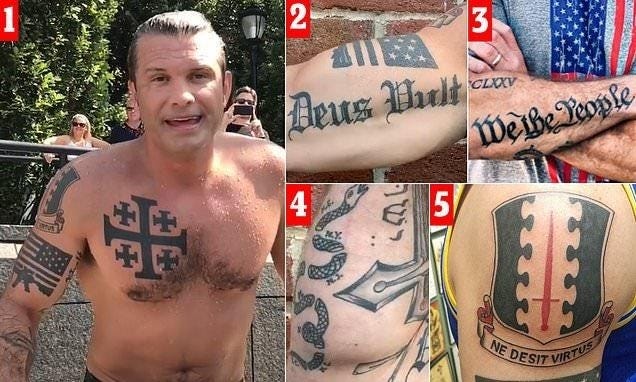
Photo = Political scientist Monica Marks X
Together, these affiliations, aesthetics, and writings draw a clear portrait. Hegseth isn’t just sympathetic to dominionist ideas. He is fluent in them.
A Government That Now Welcomes Evangelism
Just weeks before Hegseth’s repost, the federal government issued two memos that expanded the role of religion in public service. On July 16, 2025, the Office of Personnel Management (OPM) released updated guidance on Reasonable Accommodations for Religious Purposes, affirming that employees can request flexible schedules, dress code modifications, or time off to observe religious practices.
Twelve days later, on July 28, OPM followed with a second, more consequential directive: Protecting Religious Expression in the Federal Workplace. This memo declared that federal employees may “share their faith” with coworkers and even “encourage colleagues to re-think their beliefs,” provided it is done “respectfully” and does not amount to harassment.
Framed as a defense of religious liberty, the memos mark a quiet but significant shift in the culture of federal employment. Where neutrality was once the norm, shielding workers from both overt evangelism and faith-based scrutiny, there is now sanctioned space for persuasion. The language of “respect” is open to interpretation. In practice, it invites imbalance. A supervisor asking a subordinate to reconsider their beliefs, or a Christian employee engaging in faith-based dialogue with someone of another religion, is no longer a hypothetical HR issue. It’s protected activity.
For those who already believe their religion should guide the nation’s laws and culture, these memos are not protections. They are permissions.
The Shrinking Surveillance of Real Threats
While the federal government was expanding protections for religious expression in the workplace, it was quietly retracting its attention from the groups most likely to exploit that space for ideological gain.
Under the Trump 2.0 administration, key agencies, including the FBI, DHS, and FEMA, have significantly scaled back their focus on far-right domestic extremism, the very category under which most acts of politically motivated violence now fall. Initiatives that once tracked white nationalist groups, militia activity, and Christian nationalist networks have been defunded, reclassified, or simply dropped. Resources have been redirected toward “public disorder,” immigration enforcement, and gang activity, an institutional sleight of hand that treats organized bigotry as peripheral and paints dissent as danger.
See our reporting on this policy shift here:
Note: These articles are more than 45 days old and now live in our archive. Consider becoming a paid subscriber for exclusive perks including full access to our 900+ articles.


At the same time, surveillance of Islamist extremism remains robust. Federal intelligence briefings continue to prioritize threats from foreign terror groups and state-sponsored actors, despite the fact that statistically, it is far-right, often religiously motivated, domestic actors who pose the greater day-to-day risk to American lives.
This is not a neutral redistribution of resources. It is a political realignment. Christian nationalist ideology—once seen as a threat—is now tolerated, even welcomed, inside the halls of power. It is no longer the target of counterterrorism. It is shaping the counterterrorism agenda.
Shielding Power, Silencing Dissent
As Christian nationalist ideology gains protection in the halls of government, dissenting perspectives, especially those framed as anti-Christian, face growing scrutiny. On February 6, the Trump administration quietly launched the Anti-Anti-Christian Discrimination Task Force through the White House Office of Faith and Opportunity. Its stated mission is to investigate perceived anti-Christian bias in education, media, and the federal workforce.
Though branded as a civil rights initiative, the task force functions as a political shield. It targets policies, institutions, and individuals that challenge or critique the Christian right, chilling speech, and narrowing the space for pluralistic dialogue. Even academic discussions around the role of religion in public life have been flagged for review. In effect, it gives ideological grievance the force of government, and frames opposition to theocratic politics as discrimination against religion itself.
This chilling effect extends beyond government. In mainstream newsrooms, coverage of Christian nationalism remains cautious, softened by the fear of being labeled anti-faith. Editors worry about backlash, advertisers, and accusations of bias. It’s a pattern we’ve seen before. During the McCarthy era, mere criticism of anti-communist overreach was treated as disloyalty. Today, questioning dominionist ideology can be cast as religious bigotry.
At the same time, conservative leaders have amplified concerns about anti-Semitism on college campuses, turning Jewish identity into a rhetorical weapon. The goal is not to protect vulnerable students or communities, but to surveil dissent, especially protests against U.S. foreign policy or Israeli actions. Criticism becomes hate speech. Activism becomes extremism.
Meanwhile, Christian nationalist voices, many of whom openly reject pluralism and spread anti-Semitic conspiracies, face no equivalent inquiry. No task force reviews their rhetoric. No federal body scrutinizes their intent. One faith identity is shielded from critique; others are policed for existing.
See our previous reporting here:
Note: This article is more than 45 days old and now lives in our archive. Consider becoming a paid subcriber for exclusive perks including full access to our 900+ articles.

Talarico vs. Hegseth: Two Visions of Faith in Public Life
This is not a debate between believers and non-believers. It is a conflict within Christianity itself, between those who seek to live their faith in a pluralistic democracy and those who believe their faith must dominate it.
Texas State Representative James Talarico, a Democrat, is a practicing Christian and seminary student. He speaks frequently and openly about his belief in God, but insists that faith must be lived, not legislated. “My faith,” he’s said, “is what compels me to keep it out of government.” For Talarico, Christianity is a moral compass, not a political weapon.
Pete Hegseth, by contrast, offers no such restraint. From his public embrace of dominionist theology to his reposting of content that advocates revoking women’s suffrage, his vision of governance is explicitly religious and deeply authoritarian. His cross is not one of personal devotion, but of conquest.
These are not fringe figures. One is a state lawmaker, the other a Cabinet-level official. They share a religion but not a politics, a theology, and certainly not a vision for how that faith should engage with public power.
The Heretic Problem
The fundamental flaw of theocratic politics isn’t just that it’s undemocratic. It’s that it’s unworkable even within the faith it claims to serve.
Pete Hegseth and James Talarico are both Christians. Both cite scripture, attend church, and speak openly about the role of faith in their lives. But to someone like Hegseth—rooted in a dominionist theology that sees dissent as heresy—Talarico isn’t a fellow believer. He’s a traitor to the faith. His refusal to legislate his religion isn’t interpreted as humility. It’s apostasy.
The Crusader’s Cross on Hegseth’s chest isn’t a symbol of fellowship. It’s a warning. A declaration that his interpretation of Christianity is the only legitimate one, and that all others, even those inside the Church, must be subdued or erased.
This is not new. It’s the logic that governed Puritan New England, where dissenters like Quakers were exiled or executed. It’s the ethos behind medieval Catholic inquisitions, where doctrinal deviation was punished as treason. It’s visible today in Islamic theocracies, where one sect’s dominance means suppression of all others.
The problem with theocracy isn’t that it favors one religion. It’s that it favors one interpretation of one religion. And once that interpretation holds power, everyone else—secular, interfaith, or even devout—is at risk of becoming the enemy.
The Soft Landing of Theocracy
None of this arrived overnight. There was no coup, no declaration, no moment of rupture. The transformation came quietly, through memos, reposts, task forces, and silence. And now, what once would have been seen as a scandal barely registers at all.
The same Christian nationalists who claim the Founders intended a Christian nation often ignore the plainest fact: that those same Founders explicitly separated church and state, not because they were anti-Christian, but because they understood what happens when faith becomes law. They didn’t want to end religion. They wanted to keep it from becoming a weapon. Today, that wisdom is being willfully forgotten.
A Cabinet secretary can elevate voices calling for the repeal of women’s suffrage and the institution of biblical law, and not even make a personal statement. The federal government now explicitly protects faith-based persuasion in the workplace. A White House task force is devoted not to defending religious freedom, but to shielding a specific religious identity from criticism. Law enforcement no longer prioritizes the groups most likely to carry out religiously motivated political violence. Meanwhile, the press hesitates to report on any of it, for fear of being seen as hostile to faith.
This is not separation of church and state. It is their convergence, engineered not with force, but with familiarity, not through mandates, but through normalization.
And that’s the danger. Not that theocracy will arrive wrapped in fire and scripture, but that it will walk in through the front door, smiling, saying grace, and insisting it just wants to talk.
What You Can Do
Theocracy doesn’t arrive overnight. It builds in silence. It thrives on inaction. It relies on people of good conscience, especially those of faith, to remain silent.
Call your representatives at the Congressional switchboard: (202) 224-3121
Ask to speak to your House member or Senator.
Sample script:
“My name is [Your Name], and I’m a constituent in [Your City]. I’m deeply concerned about the growing influence of Christian nationalist ideology in the federal government, including efforts to roll back rights and inject religion into policy. I support the constitutional separation of church and state, and I want my representative to publicly oppose any policies or appointees that advance a theocratic agenda.”
Support the organizations doing the work:
Faithful America – mobilizing Christians against religious extremism
Freedom From Religion Foundation (FFRF) – defending secular governance
PRA (Political Research Associates) – tracking the religious right’s influence
Vote Forward or Swing Left – to turn this moment into action in November
Use your voice. Especially if you’re a believer.
The loudest Christians right now are not speaking for all Christians. If you know your faith calls for compassion—not control—it’s time to say so.
Stay Informed. Stay Loud.
Subscribe to The Coffman Chronicle for no-BS political analysis, action guides, and daily truth bombs you won’t get from corporate media.
Bibliography:
“Defense Secretary Pete Hegseth Shares Video Calling for Repeal of Women’s Suffrage, Pentagon Responds.” AP News, August 14, 2025.
Baldor, Lolita C. “Hegseth Supports Women’s Right to Vote, Pentagon Says after Video Post.” Military Times, August 14, 2025.
“Pentagon Aide Rages When Grilled on Hegseth's Views on Women’s Voting.” The Daily Beast, August 15, 2025.
“Female Vets in Congress Slam Hegseth’s Repost of Christian Nationalist Views,” Military Times, August 13, 2025.
“Pete Hegseth Reposts Video of His Pastor Criticizing a Woman's Right to Vote,” Vanity Fair, August 10, 2025.
“Pete Hegseth Reposts Video That Says Women Shouldn’t Be Allowed to Vote,” The Guardian, August 9, 2025.
Duane Morris LLP. “Two Recent Federal Memos Address Religion in the Workplace.” Duane Morris Alerts, August 4, 2025.
Office of Personnel Management. Protecting Religious Expression in the Federal Workplace, July 28, 2025.
Office of Personnel Management. Reasonable Accommodations for Religious Purposes, July 16, 2025.
“Federal Employees Can Pray and Preach in the Workplace under New Trump Rules,” Politico, July 28, 2025.
“Trump Administration Lets Federal Employees Promote Religion at Work,” Time, July 28, 2025.
“US to Allow Federal Workers to Promote Religion in Workplace,” Reuters, July 28, 2025.
“Trump Administration Urges Federal Employees to Talk Religion at Work,” The Washington Post, July 28, 2025.
“Eradicating Anti-Christian Bias,” The White House, February 6, 2025.
United States. Federal Register. “EO 14205: Establishment of the White House Faith Office.” Executive Orders—Donald Trump (2025), signed February 7, 2025; published February 12, 2025.
The American Presidency Project. “Executive Order 14291—Establishment of the Religious Liberty Commission.” May 1, 2025.
“FBI scales back staffing, tracking of domestic terrorism probes.” USA Today, March 21, 2025.
I'm guessing Margaret Atwood never saw this administration coming. Who would have thought The Handmaid's Tale would become a history book.
Thank you, Marie, for this clear elucidation of how theocratic politics is becoming embedded in our government. The founding fathers would be horrified; and, I am horrified at how fast we as a country let this happen.