


The Trump administration’s repeal of the Bureau of Land Management’s 2024 Public Lands Rule is being framed by supporters as a return to “multiple use” management of federal lands. The rule, finalized under the Biden administration, attempted to place conservation on equal footing with grazing, mining, drilling, logging, and recreation in federal land management decisions. This week, the administration formally rescinded it.
On paper, it is another rule change. Washington produces them constantly. Administrations come and go, priorities shift, and rules are written, challenged, delayed, repealed, and rewritten.
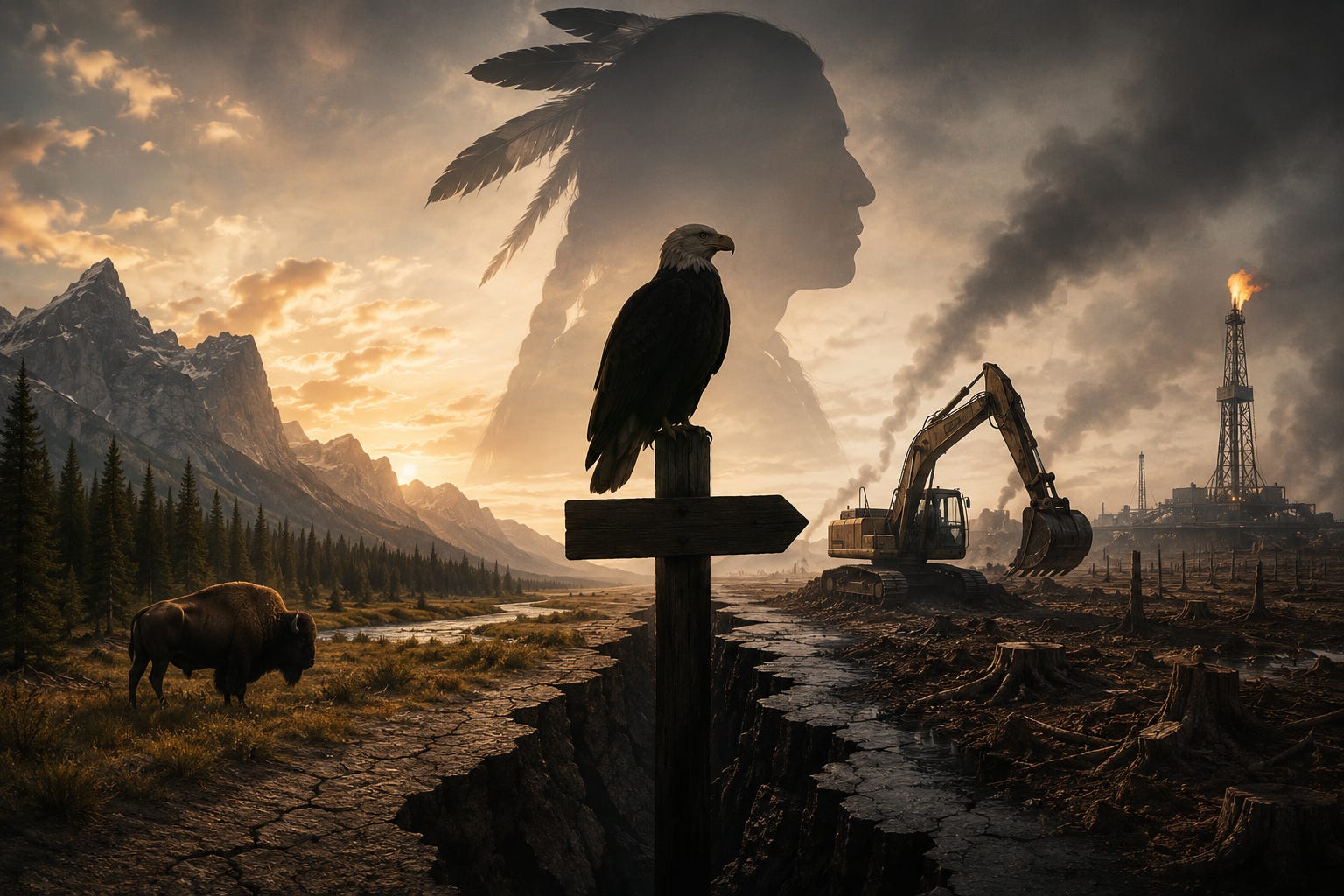
Yet the repeal also serves as a reminder of something larger and more troubling. America’s public lands have increasingly been governed through temporary executive interpretation rather than durable legislative settlement. Congress has spent generations avoiding the hardest questions about what public lands are for, leaving agencies, courts, presidents, tribes, conservationists, ranchers, miners, and corporations to fight the same battles over and over again.
The result is instability, but the greater danger is that landscapes are not nearly as reversible as the policies governing them.
This Community Is Powered by You
What started as a small circle has grown into something much bigger, and it’s all because of readers like you.
Every time you forward this email, post it on socials, or bring someone new into the fold, you’re helping build one of the most passionate, independent political communities out there.
Want to keep the momentum going?
Share this newsletter with someone who should be part of this conversation.
Thank you for being here. It means everything.
Exhibit A: The Rule That Could Be Undone
The Biden administration’s Public Lands Rule represented one of the most significant shifts in federal land philosophy in decades. The Bureau of Land Management oversees roughly 245 million acres of federal land, much of it concentrated in the American West. Historically, those lands have been managed under the principle of “multiple use,” a broad framework that includes grazing, recreation, drilling, mining, timber, and wildlife habitat.
For decades, conservationists argued that “multiple use” most often translated into extraction-first management in practice. Grazing permits, drilling leases, mining claims, and timber interests generally entered the process with stronger institutional footing than ecosystem restoration or habitat preservation.
The 2024 rule attempted to change that balance by formally recognizing conservation itself as a legitimate land use. Restoration projects, ecosystem resilience, habitat protection, and conservation leasing were elevated alongside traditional commercial uses. The rule was politically controversial, though not obscure or quietly imposed. Conservation organizations noted that roughly 92% of public comments submitted during the rulemaking process supported the measure, even as industry groups, grazing interests, and many Republican officials argued it exceeded the agency’s authority. Public-comment processes are self-selecting rather than scientific polling instruments, yet the response still reflected substantial, organized public support for treating conservation as a legitimate use of public land.
On May 11, the Trump administration formally rescinded the rule following its own public comment period, which opened in September 2025. Conservation groups reviewing those submissions reported that roughly 98% of commenters opposed repeal. The administration moved forward anyway, arguing the 2024 rule improperly elevated conservation above traditional multiple-use management.
This recent action is seen to many as proof that conservation protections built solely through agency rulemaking can disappear as quickly as they arrived.
That vulnerability exists because Congress never codified conservation parity into law. One administration interpreted federal land law one way. The next interpreted it another way. The land itself remains caught between them.
Exhibit B: The Bison Question
The fight over bison grazing illustrates how these policy disputes move quickly from abstract legal arguments into tangible land-use decisions.
On January 16, the Bureau of Land Management announced it would revoke grazing permits used by American Prairie for bison restoration projects across several federal allotments in Montana. The decision reversed years of prior federal approvals, including some granted during Trump’s first administration and finalized under the Biden administration in 2022. American Prairie formally challenged the move in February, arguing the agency was abruptly redefining bison as incompatible with “production-oriented” grazing despite decades of federal precedent allowing bison permits on public land.
On the surface, the dispute may sound oddly technical. Cattle graze public lands routinely. Bison also graze grasslands. Both can be commercially managed. Both can produce meat.
The deeper disagreement is philosophical.
Conservation advocates see bison restoration as ecological repair. Tens of millions of bison once shaped the Great Plains ecosystem before near-extermination in the late 19th century. Modern restoration efforts are often tied not only to conservation but also to tribal cultural renewal and grassland biodiversity.
Critics of these projects argue that federal grazing systems were designed for traditional livestock production, not landscape-scale conservation initiatives. Many ranchers also fear the gradual displacement of cattle grazing by large conservation projects.
The larger issue is not merely whether bison should graze on a particular allotment in Montana, but whether public lands are fundamentally intended to preserve native ecosystems or primarily to support commercial production. The answer changes depending on which administration currently controls the agencies.
Exhibit C: Forests as Industrial Landscapes
The same pattern has emerged in recent reporting about glyphosate use in California forests.
In late April, Mother Jones and Reveal published Nate Halverson’s yearlong investigation into glyphosate spraying in California forests, reporting that the Forest Service and timber companies were using the herbicide in record amounts. The reporting found that glyphosate use in California forests had quintupled over roughly two decades, raising a familiar public-lands question: are forests being managed as ecosystems, or as industrial production zones?
Supporters of these practices argue that herbicides are necessary for efficient forest management, wildfire recovery, and commercial timber production. Environmental advocates have raised concerns about ecological impacts, public health risks, and the long-term consequences of managing forests primarily for rapid timber regeneration.
The details differ from the BLM rule or the bison dispute, yet the underlying question does not. What is the purpose of public land management? Is it maximizing production, preserving ecosystems, balancing both, or something else entirely?
Exhibit D: Alaska and the Industrial Corridor
On May 6, the Department of the Interior announced the transfer of roughly 1.4 million acres along Alaska’s Dalton Utility Corridor to the State of Alaska. Interior explicitly framed the conveyance as part of the administration’s “American Energy Dominance” agenda, tying it to the Alaska LNG project, the Ambler Road, the Trans-Alaska Pipeline, and broader mineral and energy development.
Supporters describe these projects as essential for energy security, domestic production, jobs, and strategic resource development. Critics see something different: a continued transformation of public land into industrial infrastructure corridors with potentially lasting ecological consequences.
The debate surrounding Alaska often becomes emotionally polarized. One side invokes economic necessity. The other invokes wilderness preservation. Reality is more complicated than either slogan allows.
Modern society requires energy, infrastructure, and minerals. Green energy systems themselves depend heavily on extraction. Copper, graphite, lithium, transmission lines, and industrial manufacturing do not appear without mines, roads, and supply chains.
Yet acknowledging that reality does not eliminate the need for restraint or planning. The question is not whether extraction will occur somewhere. The question is where it should occur, under what rules, and which places are too important to sacrifice.
Exhibit E: Sacred Sites and the Emergency Brake
The recent conflicts surrounding Pe’Sla in South Dakota and Oak Flat in Arizona reveal where these unresolved questions become most morally and politically explosive.
In early May, nine tribes sued to stop exploratory graphite drilling near Pe’Sla, a sacred Lakota site in the Black Hills. A federal judge temporarily halted drilling on May 5, and Pete Lien & Sons withdrew its current plan days later amid tribal litigation, public pressure, and protests.
Oak Flat, which we have covered previously, offers a darker parallel. Apache Stronghold filed an updated lawsuit on April 22 after the federal government moved forward with transferring sacred land to Resolution Copper while litigation continued. The proposed mine would create one of the largest copper mining operations in North America on land sacred to Western Apache communities.
Tribal nations are currently functioning as the emergency brake in many of these disputes. Lawsuits, protests, consultation demands, and public pressure are often the only mechanisms slowing projects before irreversible transformation begins.
Congress could have settled many of these conflicts long ago through durable legislation protecting sacred sites and ecologically significant areas. It largely chose not to.
The Question Congress Never Settled
This is not solely a failure of the current Congress, the current administration, or even the modern Republican Party.
Congress has avoided fully resolving these tensions for generations across party lines.
Lawmakers could have established durable frameworks balancing extraction, conservation, tribal sovereignty, recreation, ecosystem protection, and energy development. They could have modernized mining laws, codified protections for sacred sites, clarified conservation mandates, and designated clear no-go zones for industrial activity.
Instead, Congress repeatedly deferred the hardest decisions to agencies and executive administrations.
That approach created a system where public land policy swings dramatically with elections. One administration expands conservation authority. The next dismantles it. One administration slows extraction, while the next accelerates it.
In the meantime, industry faces uncertainty, tribes are forced into endless litigation, and conservationists fight defensive battles project by project. Courts become referees for questions Congress never resolved legislatively.
Physical landscapes, however, do not reset every four years.
An executive order can be revoked quickly. A rule can be rescinded. An agency interpretation can change with a new secretary or president.
A destroyed sacred site cannot simply be reinstated. A fragmented ecosystem may never fully recover. A watershed contaminated by industrial activity cannot always be restored by a future administration that regrets the decision.
This is where the public land debate often becomes distorted. The argument is frequently framed as conservation versus extraction, as though one side must permanently defeat the other.
Reality is more complicated and more solvable than that.
The United States possesses hundreds of millions of acres of federal land. Some of those lands are appropriate for energy development, mining, grazing, infrastructure, and industrial use. Others are ecologically fragile, culturally sacred, strategically important for conservation, or too valuable to risk.
A stable democratic society should be capable of making those distinctions through durable law.
Compromise would require accepting that no faction gets everything it wants. Conservation advocates cannot preserve every acre untouched. Industry cannot treat every public landscape as available inventory. Even green energy development cannot be a blank check to sacrifice sacred land or irreplaceable ecosystems.
However, compromise also requires permanence. Public land policy cannot remain an endless pendulum swinging between administrations while irreversible consequences accumulate on the ground.
Congress has known the locations of many sacred sites for generations. Scientists have mapped critical ecosystems, wildlife corridors, watersheds, forests, and fragile habitats in extraordinary detail. The conflict is not rooted in ignorance. It is rooted in the political failure to convert knowledge into durable law.
The Trump administration’s repeal of the Public Lands Rule is not merely another bureaucratic reversal. It is a reminder of what happens when a nation governs permanent landscapes through temporary politics.
Rules can be repealed. Damage often cannot.
Public lands debates are often framed as isolated controversies: one mine, one forest, one grazing dispute, one lawsuit. We believe the larger story matters more. Congress’s long failure to create durable public-land policy has left sacred sites, ecosystems, and communities trapped in a cycle of temporary governance and potentially permanent consequences.
If you value reporting and commentary that connects the headlines to the broader political and institutional story shaping the country, consider subscribing to support our work.
Sources:
Federal Register, “Rescission of Conservation and Landscape Health Rule,” May 12, 2026.
Associated Press, “Trump administration cancels rule that made conservation a ‘use’ of public lands,” May 11, 2026.
Center for Western Priorities, “New analysis finds 98% of public comments oppose rescinding the Public Lands Rule,” November 10, 2025.
Bureau of Land Management, “BLM revokes American Prairie bison grazing permit,” May 8, 2026.
People, “Trump Administration Working to Displace 900 Bison in Montana, After Authorizing Grazing Permits During First Term,” May 6, 2026.
Reveal / WNYC, “Poisoning the Forest for the Trees,” April 25, 2026.
Department of the Interior, “Interior Transfers 1.4 Million Acres in Dalton Utility Corridor to State of Alaska,” May 6, 2026.
E&E News, “Interior transfers 1.4 million acres to Alaska,” May 6, 2026.
Associated Press, “Tribes sue to halt exploratory drilling in Black Hills near sacred ceremonial site,” May 4, 2026.
ICT News, “Federal judge rules in favor of tribes, halting drilling at Black Hills,” May 4, 2026.
Associated Press, “Black Hills drilling project canceled after backlash from tribes,” May 8, 2026.
Native News Online, “Apache Stronghold Files Updated Lawsuit Over Oak Flat Land Transfer,” April 24, 2026.
AP, “Apache women seek court intervention as federal land is turned over for copper mining,” March 16, 2026.
The destruction and rape of America's public lands and natural resources for the benefit of environmentally destructive corporate interests by the Trump regime is vastly underreported by mainstream US media. Most Americans are likely completely unaware or ambivalent.
Come on… face it. The uber wealthy put Trump in power. It irrelevant to the uber wealthy what happens to our country or our environment as long as they make money. They can jet off to their private islands, or hunker down in the Maldives. America needs to admit that they live in a fascist dictatorship… a true kleptocracy. We must band together and forcibly remove these corrupt individuals from office. Please notice that Trump and his ilk have destroyed the Republican Party. Very few citizens or whatever is left of us after Trump opens up the killing fields will ever trust Republicans again.