


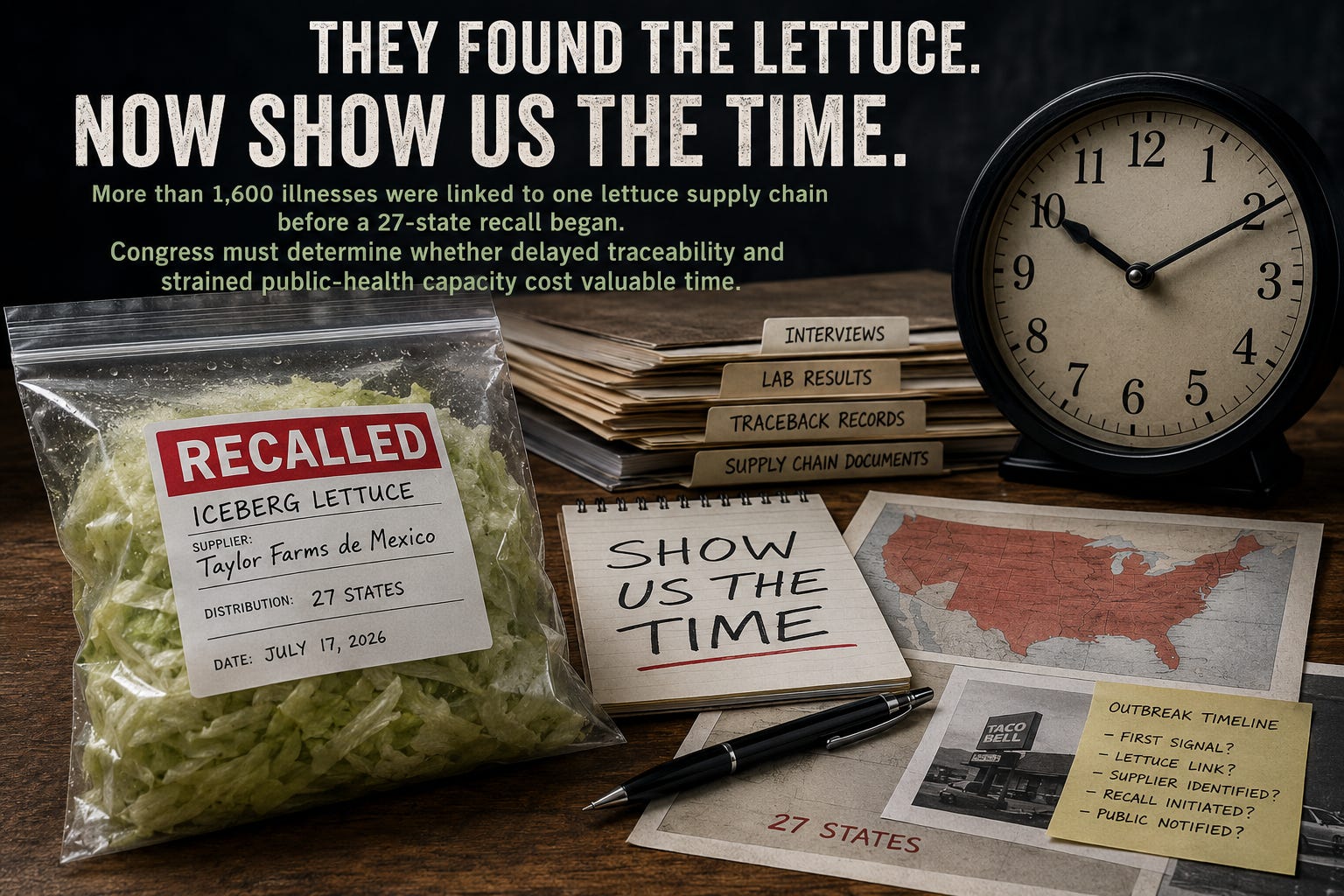
They Found the Lettuce
For weeks, the lettuce had no name. It appeared as an ordinary ingredient scattered across tacos and other meals. The people eating it had no reason to preserve a wrapper, save a receipt, or remember which toppings had been placed on an unremarkable lunch. Then they became sick.
Cyclospora does not usually announce itself immediately. Symptoms often begin about a week after exposure and may take two weeks or longer to appear. More time can pass before a patient seeks care, receives the correct test, and hears from a health department. By then, the meal may have become a fading memory.
On July 16th, federal officials connected a five-state outbreak to shredded iceberg lettuce served at Taco Bell locations in Indiana, Kentucky, Michigan, Ohio, and West Virginia. The following day, the Food and Drug Administration publicly identified Taylor Farms de Mexico as the supplier on which its traceback had converged. Taylor Farms then recalled all iceberg lettuce sourced from central Mexico, including retail and food-service products distributed from June 29th through July 16th in 27 states.
The linked outbreak included at least 1,644 illnesses, 94 hospitalizations, and no reported deaths, with illness onsets ranging from May 13th through July 13th. Those cases represented only one part of a larger national surge. Michigan’s broader state tally had reached 5,002 reported cases by July 17th, but that figure included all cases reported during the state’s investigation and was not equivalent to the narrower five-state outbreak count.
The recall gave the public an answer it had not possessed before. It also created a question the case count cannot answer: What happened between the first recoverable clues and the decision to remove lettuce from a supply chain that stretched far beyond the five states where the restaurant cluster was identified?
Some of that time may have been unavoidable. Cyclospora is difficult to diagnose, connect through laboratory analysis, and trace through meals eaten weeks earlier. Investigators may have moved as quickly as the evidence allowed, but difficulty is not the same as inevitability.
This is not a story about politicians placing a parasite on lettuce. It is about whether the government reached the lettuce as quickly as it reasonably could, and whether decisions made in Washington left investigators with fewer tools when time mattered most.
By the time the lettuce had a supplier, thousands of sick people had already supplied investigators with theirs.
This Community Is Powered by You
What started as a small circle has grown into something much bigger, and it’s all because of readers like you.
Every time you forward this email, post it on socials, or bring someone new into the fold, you’re helping build one of the most passionate, independent political communities out there.
Want to keep the momentum going?
Share this newsletter with someone who should be part of this conversation.
Thank you for being here. It means everything.
One Surge, Several Trails
The lettuce gave investigators a path, but it did not give them the whole map. Federal officials have emphasized that the Taco Bell cases are a subset of the Cyclospora illnesses being investigated nationally. Other patients may eventually be connected to the same supply chain, while some may have encountered different contaminated foods or separate events. Identifying a single major outbreak trail does not address the broader surge.
Even within the Taco Bell investigation, identifying lettuce is not the same as identifying where contamination began. Michigan’s analysis of 190 patients who reported eating at the chain found that 90% remembered eating iceberg lettuce. Restaurant and distribution records then helped investigators converge on a common supplier. That combination can identify a likely vehicle without necessarily revealing the processing plant, lot, grower, field, or the point at which the parasite entered the food.
Cyclospora also gives investigators a weak starting point. By the time a patient is interviewed, the receipt may be gone, and the meal may have faded into a general memory of tacos or salad. Laboratory science cannot always resolve those uncertainties with the speed and precision available in some bacterial outbreaks. The CDC has said that the parasite's more complex genome requires targeted genotyping that is slower and lacks some of the capabilities of whole-genome sequencing.
That does not mean every delay reflects government failure. The parasite’s delayed symptoms and the complexity of a fresh-produce supply chain can make an outbreak difficult to trace even when agencies are working properly.
However, the difficulty makes time more important, not less. Prompt interviews preserve memories and receipts. Reliable records connect restaurants to distributors, suppliers, and growers. Strong surveillance helps officials separate one trail from another before evidence disappears.
The government deserves no blame merely because this investigation was hard. An outbreak this difficult, however, required every available tool. The question is whether Washington had already set some of those tools aside.
The Front Line Was Already Thin
The first useful clue in a foodborne outbreak often comes from a conversation. A state or local health worker calls someone who tested positive and reconstructs the days leading up to the illness. Enough overlapping answers can turn isolated cases into a recognizable pattern, but those interviews lose value over time. A patient contacted quickly may still have a digital receipt. Several weeks later, the same person may remember Taco Bell without remembering whether the meal contained lettuce.
Michigan said on July 13th that state and local workers had completed more than 1,000 in-depth interviews while investigating 2,640 reported cases. That gap did not prove a backlog because reports included patients at different stages of confirmation and review. It did show the scale of the work facing the people expected to recover detailed food histories from a rapidly growing caseload.
Four days later, Michigan’s reported total had reached 5,002 cases. The increase did not mean thousands of new exposures necessarily occurred during those four days, because diagnoses and reports can arrive long after the contaminated meal. It demonstrated how quickly the investigative workload was expanding while officials were still sorting cases, conducting interviews, and separating one outbreak trail from another.
During a July 14th briefing, the CDC acknowledged that state and local health departments are often under-resourced in foodborne outbreak detection and response. The agency described weekly coordination calls, federal subject-matter support, and assistance through five Integrated Food Safety Centers of Excellence. It did not provide a state-by-state accounting of how many additional interviewers had been requested, deployed, or still needed.
That missing accounting is key because coordination is not the same as capacity. The public needs to know how long patients waited for detailed interviews, how large the queues became in the hardest-hit jurisdictions, and whether requests for federal help were filled promptly.
The CDC may ultimately show that states received all the resources they requested, but when human memory is part of the evidence, the time before the interview is part of the investigation.
The CDC’s FoodNet Defense
The change to the Foodborne Diseases Active Surveillance Network is one of the easiest parts of this story to overstate. Beginning with data collected after July 1, 2025, the CDC stopped requiring FoodNet sites to submit FoodNet-specific information about Cyclospora cases. FoodNet operates through 10 participating sites and is primarily intended to measure disease trends over time rather than serve as the national system for detecting individual outbreaks.
The CDC says the change did not weaken the systems used to investigate this outbreak. Cyclosporiasis continued to be reported through national surveillance channels, and the agency said it was using the same systems and processes employed during earlier Cyclospora seasons.
There is no published evidence that the FoodNet decision caused investigators to miss the Taco Bell cluster or delay the traceback to Taylor Farms de Mexico.
However, the change still deserves oversight. Active surveillance helps establish what normal looks like before an alarm rings, and optional reporting can yield less consistent data across a network. Congress should ask how many FoodNet sites continued to collect the same Cyclospora information, which data were no longer collected, and whether any saved staff time strengthened other outbreak-response work.
FoodNet is not the strongest evidence that federal policy cost time. The next decision is much closer to the center of that question.
A Supplier’s Name Is Not a Completed Traceback
The Food Traceability Rule was designed for the stage that begins after investigators identify a likely food. It requires covered farms, processors, distributors, and other businesses handling foods on the FDA’s Food Traceability List to preserve standardized information about critical movements through the supply chain. During an outbreak, covered entities must provide required records to the FDA within 24 hours, or within another reasonable period agreed to by the agency. Fresh and fresh-cut iceberg lettuce are covered.
The FDA stated that the rule would allow faster identification and removal of potentially contaminated food, producing fewer illnesses and deaths. Its original compliance date was January 20, 2026, before the first known illnesses in this outbreak.
That deadline did not survive. The Trump administration’s FDA proposed moving compliance to July 20, 2028, arguing that businesses needed more time to coordinate systems across entire supply chains. Congress then directed the FDA not to enforce the rule before the same date, and the agency said it would comply.
The government has a legitimate defense. A traceability system implemented unevenly may fail at the first company that cannot exchange usable records with the next. Businesses faced real technical work, and additional preparation could produce stronger compliance. However, the extension also postponed the public health benefit that was used to justify the rule.
By July 17th, the FDA’s traceback had converged on Taylor Farms de Mexico. The company’s recall then revealed the scale of the supply chain investigators had entered. The affected lettuce included retail products sold under Walmart’s Marketside brand and numerous food-service products distributed in 27 states, with some listed best-by dates extending into early August.
A supplier’s name was progress, not a completed traceback. Investigators still needed to determine which lots were implicated, where the lettuce was grown or processed, how far the products traveled, and whether other outbreaks were connected to the same source.
That distinction became even more important on July 19th. The FDA withdrew a report from the previous day that a lettuce sample associated with Taylor Farms had tested positive for Cyclospora. After laboratory experts reviewed the result, the agency concluded that it represented a false positive. As of July 19th, the FDA reported no confirmed positive product-test results for Cyclospora.
The CDC continues to say that epidemiological and traceback evidence show that lettuce from Taylor Farms de Mexico was contaminated and made people sick. However, that conclusion does not rest on a confirmed laboratory finding of the parasite in a recalled product. It rests on patterns in patient interviews and the convergence of supply chain records.
The traceability rule would not have told health departments to suspect lettuce before interviews revealed the pattern, or diagnosed a patient, produced a positive sample, or guaranteed flawless records. It was designed to speed up the next stage by connecting restaurant deliveries to shipments, lots, processors, growers, and fields.
Congress must determine whether that would have mattered. Investigators should disclose when they requested records from Taco Bell, its distributors, and Taylor Farms; how quickly each company responded; and whether any missing or incompatible information slowed progress toward the source.
The evidence does not yet prove that the original deadline would have prevented any illness. The businesses may already have maintained records equal to the delayed requirements, and epidemiology may have been the limiting factor, but Washington cannot postpone a system because industry needs more time and then refuse to examine whether the public lost time during the delay.
The rule was built for the moment when investigators knew the lettuce but still needed to find the field.
The Water Question Begins at the Field
Finding the supplier tells investigators where the lettuce traveled. It does not explain how the parasite reached it.
Cyclospora infection occurs when people consume food or water containing the parasite. Contamination can be associated with produce exposed to human fecal material, making irrigation, wash water, nearby land use, worker sanitation, and processing conditions relevant to a root cause investigation. The FDA has not publicly identified water or any other specific mechanism as the source of this outbreak.
A federal rule finalized in 2024 requires covered farms to assess pre-harvest agricultural-water risks. The second Trump administration did not repeal it. Compliance began in April 2025 for larger farms and in April 2026 for small farms, while very small farms have until April 2027.
The public does not yet know which farms supplied the implicated lettuce, whether they were covered by the rule, whether required assessments were completed, or when they were last inspected. Mexican health and agricultural regulators have opened preventive inspections and traceability analyses, while cautioning that identifying Mexico as the country of origin does not establish that contamination occurred there.
Until those facts are available, no one can honestly claim that weaker water oversight contaminated this lettuce. No one should assume that a rule on paper meant the relevant hazards had already been examined in the field, either.
Traceback identifies the place investigators must reach. Prevention determines what they find upon arrival.
Congress Must Reconstruct the Lost Time
The available evidence does not show that Donald Trump, Robert F. Kennedy Jr., or any federal official caused the contamination. It does not prove that the FoodNet change, staffing pressure, water-rule implementation, or traceability delay added a single day. However, those possibilities must be tested rather than dismissed.
Congress should require the CDC, FDA, and affected health departments to produce one coordinated chronology. It should show when officials recognized the unusual rise, when Taco Bell emerged as a common exposure, when lettuce became the leading ingredient, and when the FDA requested records from each layer of the supply chain. It should identify how long patients waited for interviews, how long businesses took to produce records, and what investigators knew before Taylor Farms initiated the 27-state recall.
The recall notice says the affected lettuce was distributed from June 29th through July 16th. Illness onsets in the five-state outbreak began on May 13th, while the supplier was publicly identified on July 17th. Those dates alone do not prove officials could have acted earlier, because symptom onset, diagnosis, reporting, and epidemiological analysis all take time. Instead, they demonstrate why the intervals between stages must be measured rather than assumed.
That review must distinguish unavoidable investigative time from preventable administrative time. A delayed diagnosis is not an understaffed interview. A difficult epidemiological signal is not an incomplete shipment record. A complicated supply chain is not a congressional decision to postpone the system created to make that chain easier to follow.
This is Congress’s responsibility because Congress helped postpone enforcement. Lawmakers cannot delay the tracking system and then become spectators when investigators struggle to track the food.
The inquiry may show that agencies and businesses moved as quickly as the evidence allowed. It may show that the postponed rule would not have changed the outcome. Congress cannot reach either conclusion through assurances alone.
It must reconstruct the lost time before deciding that no time was lost.
The Kitchen-Table Standard
A family ordering dinner cannot inspect an irrigation system in Mexico, compel a restaurant chain to produce shipment records, or trace shredded lettuce through processors and distributors. That work belongs to the government because no individual household has the power to do it.
Food-safety requirements impose real costs. Companies must maintain records, examine hazards, train workers, and respond to regulators. Poorly designed rules can waste time and money. However, the burden does not disappear when the government delays a requirement. It moves.
A company receives more time to update its systems. A sick worker loses wages while recovering. Parents pay for appointments, testing, and medication while investigators identify which meal caused the illness. The public waits while the government rebuilds a supply chain from records it had already decided should be standardized.
The public did its part. Patients sought care, provided samples, and tried to remember meals eaten weeks earlier. State and local workers conducted interviews. Laboratories processed tests. Businesses supplied enough information for investigators to identify a major trail and initiate a recall.
Government stewardship requires maintaining the capacity that allows an answer to arrive before more people encounter the same danger. It cannot promise that contaminated food will never reach a plate. It can promise not to waste avoidable time finding out why people are getting sick.
That is not regulatory excess. It is the minimum return citizens should receive from the institutions they fund.
Show Us the Time
The public should not have to choose between two unsupported stories. One says federal policy had nothing to do with the number of illnesses because Cyclospora is difficult to trace. The other says every delayed rule or staffing shortage directly caused the outbreak.
While neither has been proved, it has been established that at least 1,644 illnesses were linked to a single lettuce supply chain before a 27-state recall began. Washington had postponed a traceability requirement intended to track high-risk foods more quickly. State and local departments carried a heavy interviewing burden. Federal officials were separating several outbreak trails while working backward through a complicated supply chain.
The false-positive laboratory result makes evidentiary discipline even more important. The government corrected the record when a test did not withstand expert review. Congress should apply the same discipline to the timeline by refusing to claim failure without evidence and refusing to assume success without records.
The agencies should not hide behind the complexity of the outbreak, and critics should not erase that complexity to create a cleaner accusation. Accountability requires distinguishing the time no government could have saved from the time its decisions may have wasted.
The government should show when officials knew the cases were unusual, when they connected the restaurants, when they suspected the lettuce, and when they reached the supplier. It should reveal how long each step took and whether investigators needed more people, businesses needed more time, or Washington had postponed a tool that would have helped. Then the evidence can decide the argument.
The public already supplied the illness reports, laboratory samples, interviews, and hospital bills. It should not also have to supply blind trust. By the time the lettuce was pulled, the government had accumulated weeks of decisions. Now it must show us the time.
Support Independent Accountability Journalism
If this investigation helped you understand what the government still owes the public, please share it with someone who cares about food safety, public health, and congressional oversight.
Subscribe to the Coffman Chronicle for reporting that asks not only what happened, but whether the institutions funded to protect us acted with the speed, transparency, and stewardship the public had a right to expect. Paid subscriptions help sustain this work, but only if you can afford one.
Sources:
“Cyclospora Outbreak Linked to Iceberg Lettuce in Five States,” Centers for Disease Control and Prevention, updated July 18, 2026.
“Investigation of Five-State Outbreak of Cyclospora Illnesses: Iceberg Lettuce,” U.S. Food and Drug Administration, updated July 19, 2026.
“Investigation Update: Cyclospora Outbreak, July 2026,” Centers for Disease Control and Prevention, updated July 18, 2026.
“Taylor Fresh Foods Recalls Iceberg Lettuce from Central Mexico Because of Possible Health Risk,” U.S. Food and Drug Administration, July 18, 2026.
“Transcript—Update on CDC’s Cyclosporiasis Response—7/14/26,” Centers for Disease Control and Prevention, July 14, 2026.
“MDHHS Updates Recommendations for Cyclosporiasis Prevention,” Michigan Department of Health and Human Services, July 13, 2026.
“Infectious Disease Outbreaks,” Michigan Department of Health and Human Services, updated July 17, 2026.
“FSMA Final Rule on Requirements for Additional Traceability Records for Certain Foods,” U.S. Food and Drug Administration, updated July 2, 2026.
“Challenges and Solutions in Lot-Level Food Traceability,” U.S. Food and Drug Administration, July 2, 2026.
“FSMA Final Rule on Pre-Harvest Agricultural Water,” U.S. Food and Drug Administration, updated September 30, 2025.
“Mexico Ministries Investigate Cyclospora Linked to Mexican Farm,” Reuters, July 18, 2026.
This serious problem could have been avoided, or at least mitigate greatly if the relevant agencies had the manpower and resources to do the job. You cannot operate efficiently with a skeleton crew and very limited funding. The Fapweasel (Trump) is a cheapskate and an idiot!
Thank MAGA for cutting essential personnel with experience in science and safety! Vote blue 🗳 in November