


On December 11, 2025, the final full day Congress was scheduled to be in session this year, the Senate held two votes on the future of the Affordable Care Act’s enhanced premium subsidies. One was introduced by Democrats, aimed at extending the subsidies for three more years. The other came from Republicans, proposing a replacement built around Health Savings Accounts and high-deductible plans.
Both failed. Neither was ever expected to pass. Yet, both parties got what they needed from the exercise, just not the millions of Americans facing a spike in health insurance costs on January 1.
Republicans can now say they kept their promise. They held a vote on the ACA subsidies, the very vote that several Democrats had demanded in exchange for crossing the aisle to end a prolonged government shutdown earlier this fall. And those Democrats? They can say they got their vote, as agreed, and the GOP blocked it.
However, for the roughly 22 million Americans who rely on enhanced subsidies to afford their ACA marketplace plans, that vote amounted to nothing more than procedural theater. No deal was struck, no compromise was reached, and no action was taken to stop what now appears inevitable: a massive premium spike for millions starting in 2026.
This is the story of two policy proposals, two political strategies, and one shared outcome: failure by design.
Want to Know Your Rights?
Download a free digital copy of the U.S. Constitution, the same document Trump is trying to bulldoze. Learn exactly what he’s breaking, and how to fight back.
80,000+ strong — and counting.
This holiday, become a paid subscriber for just $1 a week and help us keep the truth alive.
Join The Coffman Chronicle — $1/Week
The Democratic Plan: Lifeline, Not Luxury
Senate Democrats, led by Minority Leader Chuck Schumer, introduced a plan to extend the enhanced ACA subsidies for another three years. These subsidies, originally expanded during the pandemic through the American Rescue Plan, were extended once before but are now set to expire at the end of 2025.
The price tag for the Democratic proposal was projected at $80 to $90 billion over the next decade, or roughly $8–9 billion per year. The plan would maintain the current structure, which provides income-based subsidies, capping enrollees' out-of-pocket costs as a percentage of their earnings. It eliminated the so-called “subsidy cliff” that previously cut off assistance above a hard income threshold, allowing more middle-income Americans — especially in high-cost states — to receive support.
The Criticisms
Critics, led by Republican senators including Majority Leader John Thune, labeled the plan fiscally irresponsible. Thune complained that the bill “lacks an income cap” and sends “money straight to insurance companies.” While factually misleading — subsidies already phase out at higher incomes — the talking point played well to a familiar narrative: bloated government programs enriching private players.
Yet here’s the truth. Subsidies do go to insurers. That’s how they lower premiums. And yes, premiums are far too high. However, that’s not the fault of the people receiving subsidies, but rather the fault of the insurance companies, hospital conglomerates, and pharmaceutical giants whose prices go unchecked.
If that’s really the problem, then where is the GOP legislation to regulate those costs? Where is the fire to rein in the insurers profiting off the system? Where is the plan to address the structural rot at the heart of American health care?
Democrats could have — and arguably should have — used that GOP criticism as leverage. They could have flipped the narrative: “If we all agree insurers are charging too much, then let’s regulate them. Let’s cap premiums. Let’s mandate price transparency. And yes, while we work on fixing the market, let’s extend the subsidies so people aren’t bankrupted in the meantime.”
Predictably, they didn’t. Instead, they stood by the clean extension, which, while necessary, offered no structural reforms to address the costs that drive the need for subsidies in the first place.
The GOP Plan: A Fix for the Few, Abandonment for the Many
Republicans introduced their own plan, led by Senators Bill Cassidy and Mike Crapo, offering a market-oriented alternative. This proposal would end the ACA’s enhanced subsidies and instead provide direct deposits into Health Savings Accounts for people enrolled in high-deductible plans.
The Criticisms
In theory, this was framed as empowering consumers with more choice. In practice, it would have helped only a sliver of the ACA’s total enrollees — about 2% — who are already in HSA-eligible plans. These plans tend to attract younger, healthier, and higher-income individuals who can afford high deductibles while also saving for future care.
For the 98% who rely on subsidies to afford their monthly premiums, especially low-income families, older adults, rural residents, and people with chronic conditions, the GOP plan offered nothing.
Democrats and health care experts criticized the proposal as unworkable, ineffective, and dangerously out of step with the realities of the ACA marketplace. It was built on years-old ideas that have failed to deliver affordability or stability, and would have done little to stop the premium spikes now looming.
This wasn’t a real replacement. It was a political placeholder, a gesture to ideology that offered no meaningful help to the people who need it most.
The 2% Doctrine
The Republican plan wasn’t an outlier. It reflected their broader approach to governance. It was yet another policy designed to serve the few while leaving the many behind.
It echoes tax cuts that overwhelmingly benefit the top 1%, deregulation that protects corporate profits over public safety, vouchers that defund public schools under the guise of “choice,” and wage stagnation justified as market realism. Now, a health care proposal joins the ranks, helping 2% of enrollees while leaving 22 million twisting in the wind.
This is not new. It’s just consistent.
Strategic Failure Was the Strategy
The timing of the vote was no accident. Republicans waited until December 11, the final full day Congress was expected to be in session, to permit votes on the two health care plans. The window for real negotiation, compromise, or a hybrid solution had long since closed.
There was no time to build a coalition or to explore a deal that could both extend subsidies and implement cost-control reforms. There has been no serious outreach from the GOP to bring Democrats into their process. With no path to 60 votes for either plan, failure was guaranteed.
However, now, everyone walks away with political cover. Republicans kept their promise to hold a vote. Democrats can blame the GOP for blocking subsidy extension. Meanwhile, millions of Americans get a premium hike, one that could ripple beyond the ACA marketplace, driving up costs even for those on non-subsidized private plans as insurers adjust to a sicker, smaller risk pool.
We Had the Money. We Just Didn’t Spend It on You.
The Democratic plan would have cost about $8 billion a year to protect 22 million Americans from being priced out of coverage. Republicans said that was too expensive, a deficit risk.
And yet, just this week, Congress approved an $8 billion increase to the Pentagon’s budget — money the Defense Department didn’t ask for, on top of a bloated war machine that already exceeds $900 billion annually. That single-year bonus could have covered the entire first year of ACA subsidies.
There’s always money for weapons, never for wellness.
We broke down this contrast in more detail in our article published earlier this week. Read that here.

See our related reporting here:


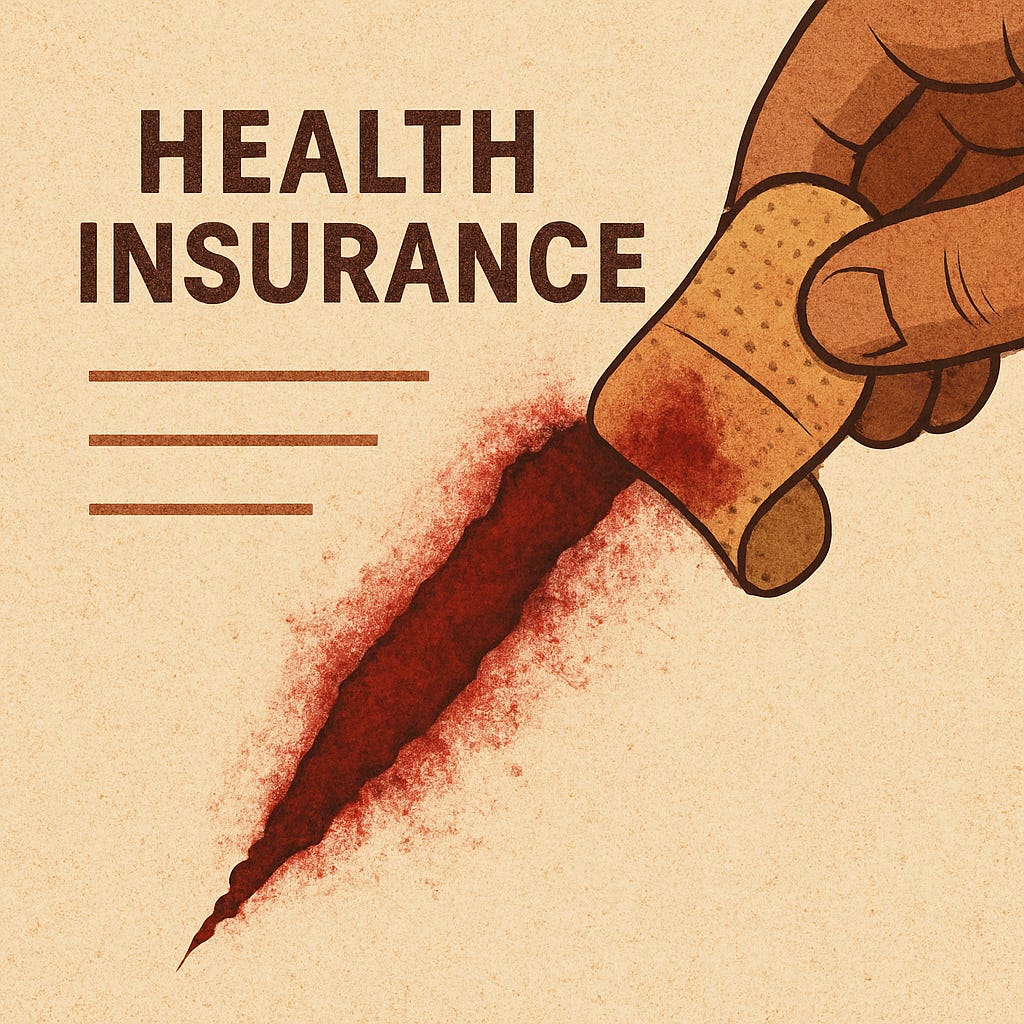
Band-Aids, Always
This is what we do.
We don’t reform systems. We patch them. Instead of confronting the forces that make health care unaffordable, we subsidize the cost and call it a solution. We never ask why this is the way it is. We don’t consider what else is possible.
We call it compromise, pragmatic. In truth, it’s cowardice wrapped in procedure, hollowed out by lobbyists, and sold back to the public as incremental progress.
Yes, subsidies help people. Yes, they should be extended. However, they’re not a long-term solution. They’re a tourniquet. Unless we address the underlying causes — the monopolies, the profiteering, the political capture — we will keep fighting this same battle every few years, and we will keep losing.
We protect the vulnerable, but never challenge the systems that make them vulnerable in the first place.
You can only bleed through so many Band-Aids before the wound becomes fatal.
Don’t let the bastards sneak anything past you. Subscribe and get your daily dose of rage and receipts delivered fresh, before the spin doctors can scrub it.
Sources:
Senate back to square one on health care after both bills fail (ABC News)
Republican‑controlled US Congress poised to allow Obamacare health subsidies to expire (Reuters)
Bills to Address Expiring ACA Subsidies Fail to Pass Senate (AJMC)
Schumer rails against GOP for opposing ACA tax credit extension (CBS News)
Senate rejects 2 rival health care proposals as higher premiums loom (The Guardian)
Senate blocks ACA subsidies extension: What this means (Fox4News)
APHA urges bipartisan effort to extend ACA subsidies after failure (APHA)
Where the blame will fall if ACA subsidies expire (WUSF/KFF poll)
Your point is well taken. I would add that another consequence of the cancellation of governmental support for health insurance, especially such a huge withdrawal of funding, is that much of the medical sector will have a serious shortfall of income, because great numbers of would-be patients will not be trying to get care- either they dropped out of the insurance plan, or they don't want to face high copays. Doctors and other personnel, and hospitals, will suffer. It's sad that health care has become a commodity rather than treated as a necessity for all.
All Republicans, take note. YOU belong to a criminal organization.