


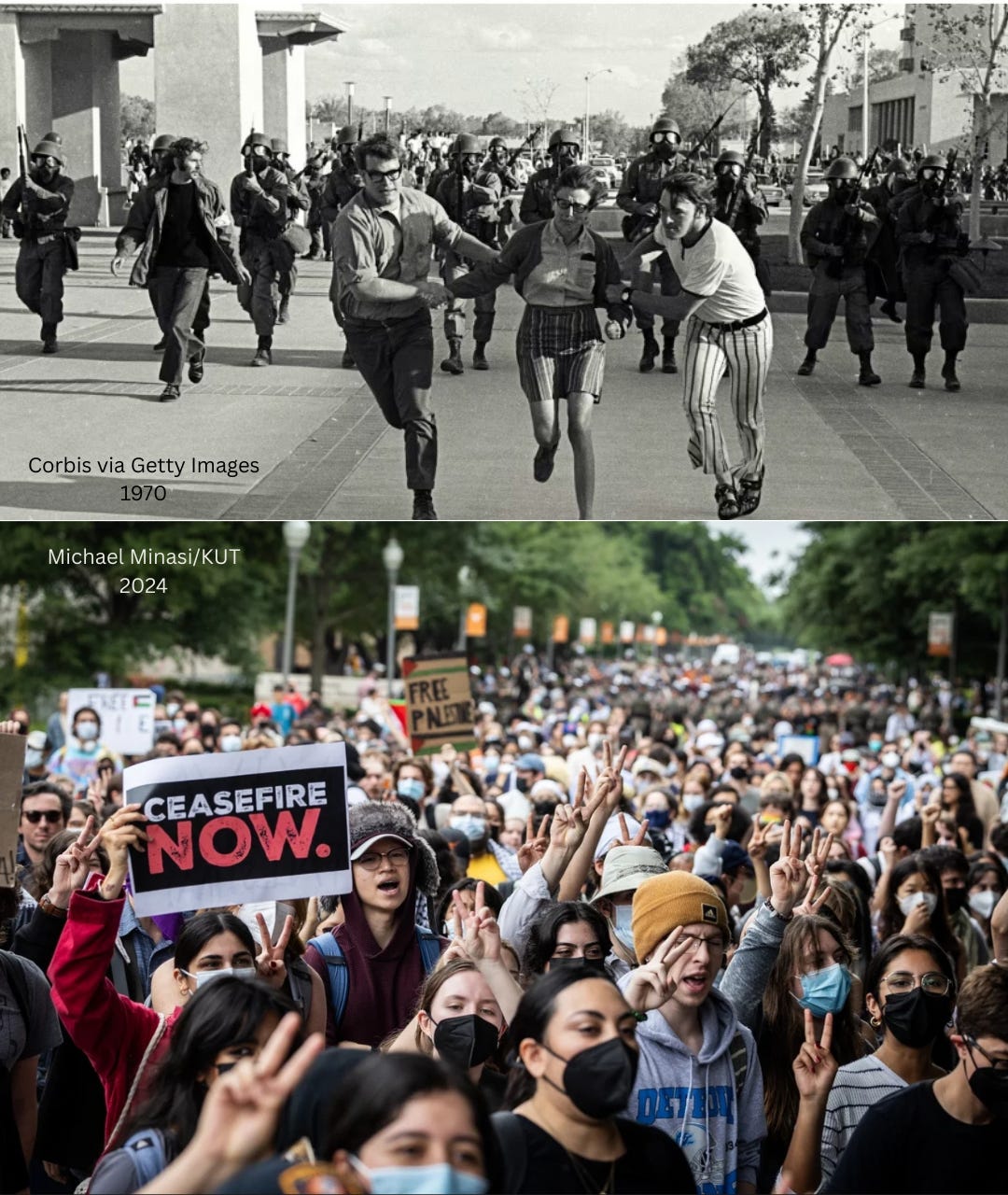
It’s been 55 years since the National Guard opened fire on unarmed student protesters at Kent State University on May 4, 1970. Four were killed, nine injured, most of them teenagers. They were protesting a war. The country was divided. Leaders called them agitators. Schools called in the police. And before the dust had settled, a generation learned just how violently the state could respond to dissent.
This week, that history doesn’t feel so far away.
We just hit 13,000 subscribers—thank you! We’re offering full access to The Coffman Chronicle at 50% off to celebrate.
Get exclusive analysis and fearless reporting you won’t find in corporate media.
Support truth. Stay informed.
Across the country, college campuses are once again sites of mass protest, and once again, of institutional fear and state repression. At Columbia, UCLA, the University of Texas, and dozens of others, students are being arrested, suspended, and met with riot police for organizing sit-ins and encampments. The slogans are different. The war is different. But the response to dissent is eerily familiar.
It would be easy, maybe even tempting, to reduce these protests to a question of what side you’re on in the Israeli-Palestinian conflict. But that framing misses the deeper issue: Who gets to protest in America without being criminalized? And what happens when institutions are more afraid of discomfort than they are of injustice?
Universities should be bastions of open debate and moral inquiry, not staging grounds for surveillance, militarized police, and political theater. Instead, we’re watching a crackdown driven not by student violence (which is nearly nonexistent), but by donor pressure, media panic, and the political costs of letting young people think too freely.
What’s more alarming is the infrastructure now being used to suppress this dissent. In the years since 9/11, the U.S. government has built a powerful surveillance and enforcement apparatus—justified in the name of fighting terrorism—that is now being turned inward.
Thanks to expanded powers under the PATRIOT Act, federal agencies can demand student records, monitor communications, and revoke visas, all without traditional oversight or due process. For international students, the risk is existential: legal status can be revoked, and deportation can happen based on vague “national security” justifications, sometimes without even being told the evidence.
See some of our reporting on campus protest detentions here:

But these tools don’t stop at the border. Many of the same powers—mass surveillance, data collection, watchlisting—are also used against U.S. citizens. Protesters can be monitored, flagged, and added to federal databases under suspicion of providing “material support” to extremist groups, even when that “support” is nonviolent speech or association.
No one is immune. American citizens can’t be deported, but they can still be harassed, blacklisted, or charged. Some have already been placed on no-fly lists or targeted for prosecution. The chilling effect is real. And it’s working.
We’ve normalized this. And now it’s being used to quietly thin out resistance, particularly among the most vulnerable: international students, Muslim students, and students of color. They’re not just risking arrest; they’re risking their homes, futures, and place in this country. And for all of us, the cost is the same: a democracy that punishes dissent and rewards silence.
You don’t have to agree with the protesters to defend their right to protest. In fact, if we only defend speech we agree with, we’re not defending free speech at all; we’re just protecting our own comfort.
We’ve seen this before. We know what happens when the powerful respond to dissent with force. And we know, painfully, that sometimes the consequences are fatal.
We’re not saying this is Kent State. But we are saying: it could be.
What will we tell the next generation if this ends in violence again?
We just hit 13,000 subscribers—thank you! We’re offering full access to The Coffman Chronicle at 50% off to celebrate.
Get exclusive analysis and fearless reporting you won’t find in corporate media.
Bibliography:
Brennan Center for Justice. “Rolling Back the Post-9/11 Surveillance State.” Brennan Center for Justice, August 25, 2021.
Gallup. “Less Than Half in U.S. Now Sympathetic Toward Israelis.” Gallup News, March 6, 2025.
Inside Higher Ed. “Five Key Takeaways From Tracking Student Visa Revocations.” Inside Higher Ed, April 21, 2025.
Kent State University. “May 4 Visitors Center.” Kent State University, accessed May 5, 2025.
Pew Research Center. “Younger Americans Stand Out in Their Views of the Israel-Hamas War.” Pew Research Center, April 2, 2024.
The Associated Press. “U.S. Government Expands Grounds for Canceling International Student Visas.” AP News, April 30, 2025.
The Associated Press. “Student Visas Revoked: Hundreds Fear Deportation Without Explanation.” AP News, April 24, 2025.
The Associated Press. “Immigration Agents Arrest Palestinian Activist Who Helped Lead Columbia University Protests.” AP News, March 9, 2025.
The Associated Press. “Pressed for Evidence Against Mahmoud Khalil, Government Cites Its Power to Deport People for Beliefs.” AP News, April 12, 2025.
The Associated Press. “A Palestinian Student at Columbia Is Freed After His Arrest at a Citizenship Interview.” AP News, April 30, 2025.
The Associated Press. “Lawsuit Challenges Trump Administration Crackdown on International Students.” AP News, April 22, 2025.
The Associated Press. “College Journalists Wrestle with Transparency as Students Fear Deportation for Speaking Out.” AP News, April 28, 2025.
The Associated Press. “International Students in the US Skip Travel Amid Visa Crackdown.” AP News, April 29, 2025.
The Associated Press. “ICE Is Reversing Termination of Legal Status for International Students.” AP News, May 2, 2025.
The Associated Press. “Visa Revocations: International Students Challenge Status Terminations.” AP News, May 3, 2025.
The Associated Press. “Colleges' International Students See F-1 Visas Canceled in New Crackdown.” AP News, April 15, 2025. https://apnews.com/article/college-international-student-f1-visa-ice-trump-7a1d186c06a5fdb2f64506dcf208105a.AP News
The Associated Press. “Some Push Back as Trump Revokes Hundreds of Student Visas.” Inside Higher Ed, April 15, 2025.
The Associated Press. “ICE Reveals How It Targeted International Students.” Inside Higher Ed, May 1, 2025.
The Associated Press. “International Student Lawsuits Result in Restored SEVIS Records.” Inside Higher Ed, April 24, 2025.
The Associated Press. “International Students Navigate Escalating Threats.” Inside Higher Ed, March 18, 2025.
The Associated Press. “Colleges Fear Decline in International Student Enrollment.” Inside Higher Ed, March 19, 2025.
The Associated Press. “The Resistance Is Here.” Inside Higher Ed, April 29, 2025.
American Civil Liberties Union. “End Mass Surveillance Under the Patriot Act.” ACLU, accessed May 5, 2025.
American Civil Liberties Union. “Surveillance Under the USA/PATRIOT Act.” ACLU, accessed May 5, 2025.
American Civil Liberties Union. “The Sun Must Go Down on the Patriot Act.” ACLU, accessed May 5, 2025.
American Civil Liberties Union. “House Holds Hearing On Reauthorization Of The Patriot Act.” ACLU, accessed May 5, 2025.
American Civil Liberties Union. “The Score on USA Patriot Act.” ACLU, accessed May 5, 2025.
American Civil Liberties Union. “Revised ACLU Interested Person's Memo on the Security and Freedom Ensured (SAFE) Act.” ACLU, accessed May 5, 2025.
Brennan Center for Justice. “US Surveillance of Americans Must Stop.” Brennan Center for Justice, May 20, 2022.
Brennan Center for Justice. “How to Fix U.S. Surveillance Law.” Brennan Center for Justice, July 18, 2023.
