


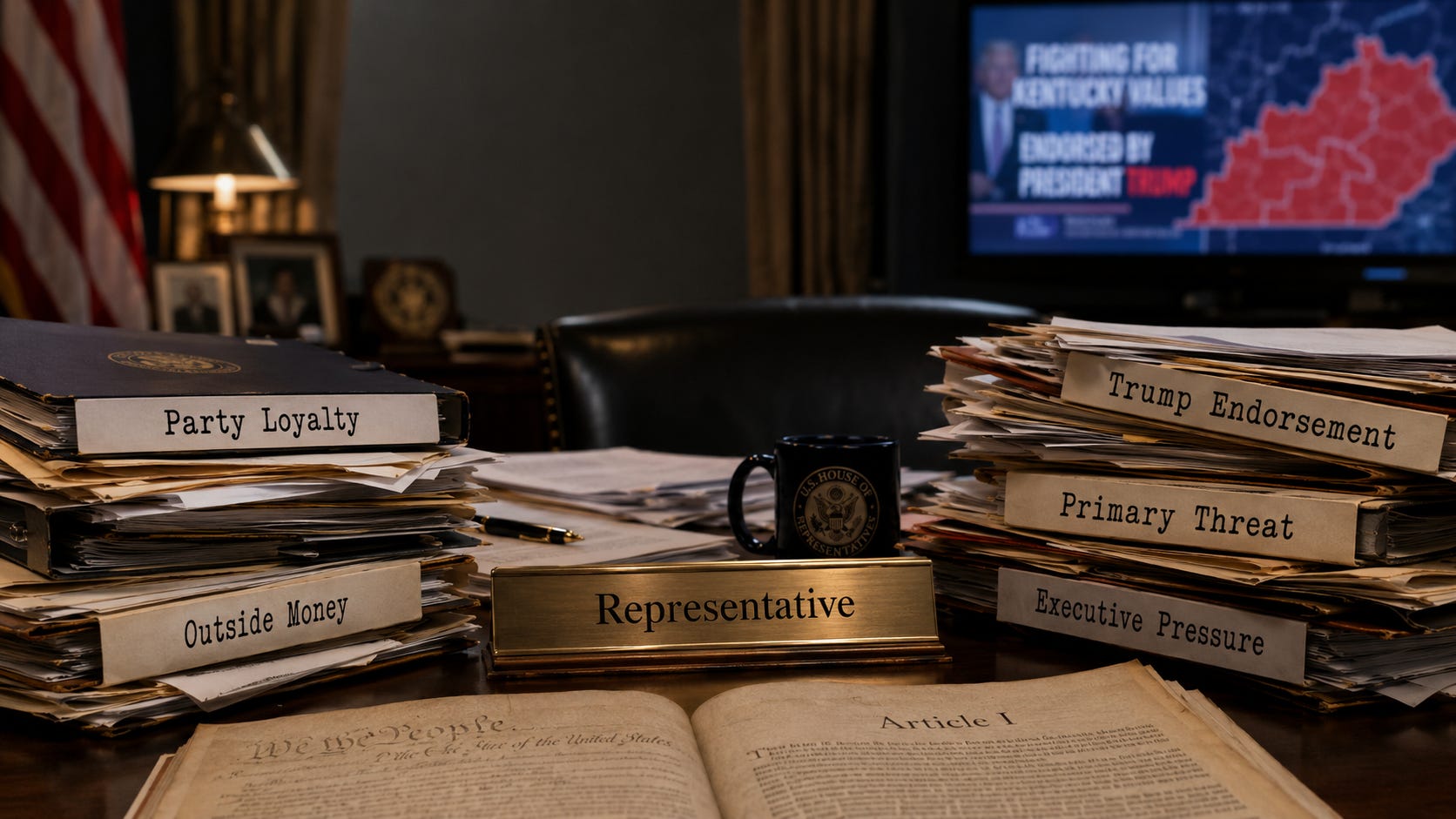
You do not have to like Thomas Massie’s politics to understand why his Kentucky primary matters. This is not a defense of Massie’s record nor an endorsement of his worldview. It is not an attempt to turn a conservative libertarian Republican into a resistance hero. Massie has spent his career taking positions many Americans strongly oppose, and any honest article about him has to say that plainly.
However, this race was bigger than Thomas Massie. It was about what happens when concentrated power decides that voting conservative is no longer enough. It was about what happens when a member of Congress can agree with a president much of the time, vote with the party much of the time, represent a deeply Republican district, and still become a target because he refuses to become automatic.
That was the warning in Kentucky. Massie was not challenged because he became a liberal. He was not punished for joining the Democratic caucus. He was not cast out for abandoning conservative politics. He was targeted because he said no too many times to the wrong power center. In today’s Republican Party, that may be the greater sin.
Trump-backed Ed Gallrein defeated Massie in Kentucky’s 4th Congressional District Republican primary, according to NBC News projections cited by Reuters. Gallrein, a former Navy SEAL, was backed by President Donald Trump, while Massie, who had served in Congress since 2012, had become one of Trump’s most visible Republican critics. The Associated Press also described the result as another victory for Trump’s influence over the GOP.
That kind of national attention does not happen because one congressional district suddenly becomes the center of the universe. It happens because someone is meant to be made an example. That is what concentrated power does. It not only punishes enemies. It disciplines allies.
The question was not simply whether Massie would survive. The question was whether members of Congress are still allowed to act like members of Congress. The House is supposed to control spending, ask hard questions about war, decide where public money goes, and represent districts rather than transmit orders from the top of a party structure. That is not a procedural technicality. That is the constitutional design.
Article I comes before Article II for a reason. The legislative branch was not placed first because the founders wanted Congress to be decorative. It was placed first because lawmaking, spending, representation, and war powers were intended to be separated from the ambitions of any one person. The president was not supposed to own Congress. The president was supposed to be checked by it.
But concentrated power rarely announces itself by saying it wants to erase Congress. It usually does something quieter. It teaches Congress to be afraid. It teaches members that asking questions has consequences. It teaches them that voting no can trigger a primary. It teaches them that opposing a war, questioning spending, demanding transparency, or refusing to rubber-stamp a leader’s agenda can bring the money machine, the party machine, and the presidential machine down on their heads.
Massie voted conservative. Concentrated power still came for him. Not because he was insufficiently right-wing, but because he was insufficiently obedient. Once obedience becomes the test, representation becomes conditional. The voters may still cast the ballots. The district may still hold the election. The member may still have an office, a staff, and a title. But the message becomes clear: your seat may belong to the people on paper, while your survival depends on pleasing the power above you.
That is not representative government. That is managed democracy inside a party structure.
This Community Is Powered by You
What started as a small circle has grown into something much bigger, and it’s all because of readers like you.
Every time you forward this email, post it on socials, or bring someone new into the fold, you’re helping build one of the most passionate, independent political communities out there.
Want to keep the momentum going?
Share this newsletter with someone who should be part of this conversation.
Thank you for being here. It means everything.
A Local Primary Became a National Loyalty Test
On paper, this was a Republican primary in Kentucky’s 4th Congressional District. In reality, it became a national loyalty test.
Massie faced Gallrein, a retired Navy SEAL and Trump-backed challenger. That alone would have made the race notable, but the scale of the fight told the deeper story. Reuters reported that the contest became the most expensive U.S. House primary in history, with more than $32 million spent on advertising. The race drew heavy outside involvement from pro-Israel groups and Trump-aligned forces.
That kind of money does not flood into a congressional district by accident. It arrives when powerful interests decide that one seat has symbolic value beyond its vote total. Massie’s district did not become the center of attention because Kentucky’s 4th District suddenly became uniquely unpredictable. It became the center of attention because Massie became a warning sign.
Massie was a Republican who supported Trump much of the time, but not all of the time. He often voted with the party, but not automatically. He embraced conservative politics, but not full submission to one leader. That distinction made him dangerous to the machine.
Reuters framed the race as part of Trump’s effort to purge Republican critics and reported that Massie had drawn anger over issues including his push for Epstein-file transparency, criticism of U.S. actions in Iran, and opposition to aid for Israel.
That is the part of the story that matters most. The conflict was not simply ideological. It was disciplinary. Massie’s defeat sends a message to every Republican in Congress: voting with Trump most of the time may not be enough if the times you say no are too visible, too consequential, or too embarrassing to the leader.
The voters still matter. The ballots still matter. The district still decides the outcome, but the pressure applied to this race was national, not local. The message was not only sent to Massie’s constituents. It was sent to Congress. Step out of line, and this can happen to you.
That is the machinery of concentrated power. It takes a congressional district and turns it into a warning shot.
Massie Broke the Usual Script
The race was important not because Thomas Massie is easy to defend. He is not.
Massie is a hard-right libertarian Republican with a long record that many Americans oppose. He has taken positions on guns, federal programs, climate policy, public health, and social spending that place him far outside the political comfort zone of most Democrats and many independents.
Massie is useful as a case study precisely because he is not a moderate. He was not punished for becoming liberal. He was not punished for joining the Democrats. He was not punished for abandoning conservative politics. He was punished for refusing to be automatic.
In a normal ideological fight, a party tries to defeat members who no longer fit the party’s agenda, but this was different. Massie’s defeat reveals a party culture where ideological agreement is not enough if independence remains intact. A member can oppose spending, question foreign aid, attack centralized government, support broad parts of the Republican agenda, and still become a target if he refuses to surrender judgment.
That is why the Massie race cuts through the usual noise. The standard being enforced was not simply conservatism. It was obedience.
Massie did not stop being conservative. He stopped being reliable to the power center. He became unpredictable. He asked questions the leader did not want asked. He opposed actions that the leader wanted supported. He refused to treat the president’s position as the end of the debate. Even people who disagree with almost everything else Massie believes should care about that.
If Congress is going to function, members have to retain the ability to say no. They have to ask where the money goes. They have to question war. They have to demand transparency. They have to represent their districts rather than serve as branch managers of presidential power. That is not a left-wing principle or a right-wing principle. That is representative government.
Once a party decides that independent judgment is disloyalty, Congress becomes weaker even before any law is changed. The institution hollows out from the inside.
The Concentrated Power Triangle
This race was not only about Trump. Trump was the loudest part of the story, but he was not the only force at work. What made the Massie primary so revealing was the convergence of three kinds of power: presidential power, money power, and party power.
First, there was presidential power. Trump personally backed Gallrein, publicly attacked Massie, and turned the race into a test of whether one of the few Republicans willing to defy him could survive. Reuters described the race as a key test of Trump’s influence inside the GOP, especially his ability to rally voters against critics within his own party.
Massie became a target because he represented something centralized power cannot easily tolerate: a member of Congress who is conservative but not fully controllable. Then there was money power. More than $32 million poured into the race, with outside groups, including pro-Israel organizations and pro-Trump forces, spending heavily against Massie.
That kind of spending changes the meaning of a local election. It tells every member of Congress that powerful interests can take a district-level disagreement and nationalize it overnight. One vote on foreign aid, one vote on war, one demand for transparency, one refusal to fall in line can become the reason millions of dollars flood into your district. That is not just campaigning. That is discipline.
Finally, there was party power. When a president, outside money, and national political networks all move in the same direction, the pressure on other elected officials becomes obvious. The goal is not merely to defeat one incumbent. The goal is to make an example visible enough that others do not need to be targeted later.
That is how concentrated power works at its most efficient. It does not have to fight every member. It only has to punish one loudly enough. The real audience was not only the voters of the 4th Congressional District. The real audience was every Republican in Congress who might be tempted to remember their own constitutional role.
The point was not only to beat Massie. The point was to teach Congress what independence costs.
Congress Is Not Supposed to Be a Branch Office
This is where the Massie race becomes bigger than a fight between one candidate, one district, or one party. Congress is Article I for a reason.
The legislative branch comes first in the Constitution because lawmaking, spending, representation, and war powers were not supposed to be concentrated in one person. The House was designed to be close to the people. Its members were supposed to answer to districts, not presidents. They were supposed to bring local concerns into national debates, control the purse, check executive ambition, and force hard questions into the open.
A member of Congress is not supposed to be an employee of the president. That principle does not disappear when the president is popular with the member’s party. It does not disappear when the district is red. It does not disappear when the president has a devoted political movement behind him. In fact, that is exactly when the principle matters most.
A Congress that only checks presidents from the other party is not a coequal branch. It is a partisan instrument. A Congress that gives up oversight when its own side holds the White House is not protecting constitutional government. It is protecting power.
That is the deeper danger in the Massie primary. The issue is not whether Massie was always right. He was not. The issue is whether Congress is still allowed to say no without being treated as a traitor to the party.
War powers require Congress to say no sometimes. Spending power requires Congress to say no sometimes. Oversight requires Congress to say no sometimes. Representation itself requires Congress to say no sometimes, because the people in a district are not always served by whatever the president wants that week.
When that ability gets punished, the institution weakens. A president does not have to formally seize congressional power if members of Congress learn to surrender it voluntarily. He does not have to padlock the Capitol. He does not have to abolish the House. He only needs to create a political environment in which members understand that independence carries consequences.
That is the quiet way executive power expands. It does not always arrive with a dramatic constitutional crisis. Sometimes it arrives through a primary. Sometimes it arrives through a flood of outside money. Sometimes it arrives through a threat posted online, a rally speech, a donor network, or a national campaign to turn one dissenting member into an example.
The result is the same. Congress becomes more obedient. The executive becomes more dominant. The voter gets less representation. Article I slowly becomes a permission slip for Article II.
A representative can be wrong on policy and still be right to insist that Congress has its own job. A member can have a record worth criticizing and still become a warning sign when concentrated power tries to make independence unacceptable.
This is not about turning Massie into a hero. It is about refusing to normalize a political system where the only safe vote in Congress is yes.
The Kitchen-Table Cost of Obedient Government
The constitutional argument matters on its own, but it also lands at the kitchen table.
Debt is not abstract. War is not abstract. Foreign aid is not abstract. Public spending is not abstract. Secrecy is not abstract. Every one of those decisions eventually finds its way into ordinary life. It shows up in taxes. It shows up in inflation pressure. It shows up in veterans’ care. It shows up in whether money is available for infrastructure, disaster relief, rural hospitals, schools, broadband, emergency services, or basic public needs.
It also shows up when families are told there is no money for them after watching Congress move money quickly for someone else. That is why Congress was given the power of the purse. The question of who pays the bill was never supposed to be left to one person. It was supposed to be debated, argued over, voted on, and defended in public by representatives who had to answer to their districts.
When Congress becomes obedient, that debate collapses. The public loses one of the few institutions still capable of asking the most basic questions in government: Where is the money going? Who benefits? Who pays? Who gets protected? Who gets ignored? Those questions are not partisan luxuries. They are the foundation of representative government.
Massie challenged Trump and party leadership on issues that touch the core powers of Congress: spending, foreign aid, war, debt, and transparency. Reuters reported that Trump’s anger at Massie included Epstein-file transparency, criticism of U.S. actions in Iran, and opposition to aid for Israel.
People can disagree with Massie’s answers, but a Congress that is afraid to ask the questions is a Congress that has already surrendered too much.
That surrender does not stay in Washington. It comes home when working people are told to tighten their belts while powerful interests get access. It comes home when war decisions create costs that outlast the speeches. It comes home when secrecy destroys trust. It comes home when lawmakers stop acting like representatives and start acting like political employees.
The kitchen-table issue is not only whether Thomas Massie keeps his seat. He lost it. The kitchen-table issue is whether voters still have representatives willing to ask who is using their money, their sons and daughters, their public trust, and their government.
When Congress stops asking, the bill does not disappear. It just gets passed down.
The Obedience Test Worked
Now the voters have spoken, and the warning is no longer theoretical. Gallrein defeated Massie, giving Trump a victory over one of the party’s most visible Republican dissenters. Reuters reported that the result showed Trump’s continuing influence inside the party and his ability to rally support against critics.
This was never just a primary about one seat. It was a test. Could a conservative Republican survive inside Trump’s party after opposing the president on high-profile issues? Could a member of Congress represent a deep-red district and still retain enough independence to cross the leader on spending, war, foreign aid, and transparency? Could Article I independence survive Article II pressure when the president, the party machine, and outside money all pointed in the same direction?
The answer, at least in Kentucky’s 4th District, was no. Massie did not lose because he stopped talking like a fiscal hawk, a libertarian, or a small-government Republican. He lost after becoming a public example of what happens when a member of Congress refuses to become automatic.
That is the darker meaning of this result. Conservatism was not enough. Voting with the party most of the time was not enough. The demand was obedience.
This race will echo beyond Kentucky. Every Republican in Congress watched it. Every member who has ever considered voting no on a Trump-backed bill watched it. Every lawmaker who has ever questioned a war, challenged a spending package, criticized foreign aid, or demanded transparency watched what happened when Massie became the target.
The lesson is not subtle. If concentrated power can make an example out of Thomas Massie, it can make an example out of almost anyone.
What Congress Learns From a Race Like This
This is how institutions weaken before the public fully notices—not always through a single dramatic law, troops in the streets, or a formal declaration that Congress no longer matters. Sometimes institutions weaken through fear.
A member watches another member get punished. A safe seat becomes unsafe. National money floods into a district. Party leaders fall in line. The president turns disagreement into disloyalty. Outside groups make clear that one wrong vote can become a career-ending liability. Then the next member thinks twice.
That is the point. The punishment of one lawmaker becomes the discipline of many.
Massie’s defeat sends a message that reaches far beyond his district: if you want to survive, do not merely be conservative. Be useful. Be predictable. Be compliant. Do not embarrass the leader. Do not ask too many questions. Do not make Congress look like a coequal branch when the movement wants it to act like support staff.
A president does not have to personally control every vote if enough members learn to anticipate what will anger him. A donor network does not have to defeat every dissenter if defeating one or two teaches the rest to stay quiet. A party machine does not have to formally abolish independence if it can make independence feel politically suicidal.
That is how centralized power wins without changing the text of the Constitution. Article I can still sit there on paper. Congress can still meet. Members can still vote. Committees can still hold hearings.
However, the culture of representation changes. The question becomes less “What does my district need?” and more “What will happen to me if I cross the power center?” The representative becomes less independent. The district becomes less sovereign. The institution becomes less capable of checking the executive.
The public gets a Congress that looks functional from a distance, but becomes more submissive up close. That is the real cost of the Massie result.
It is not merely that one Republican incumbent lost a primary. Incumbents lose. Voters replace representatives. That is democracy. The problem is what this particular race reveals about the machinery surrounding the choice. Trump backed the challenger. Outside money helped nationalize the race. The contest became a referendum on whether a conservative member could survive after publicly defying the leader.
That is not a normal ideological disagreement. That is a warning system. And it worked.
The Warning Beyond Massie
Representative government does not only matter when the representative is someone we like. That is the hard part. The principle matters most when it protects the independence of people we may not support. Congress either has a constitutional role or it does not. Members either have the authority to say no, or they do not. Districts either send representatives to Washington or placeholders who survive only by pleasing the party's dominant leader.
That is the question this race exposed. If a member of Congress can be deeply conservative and still be treated as disposable because he refused to obey, then the standard has shifted. The test is not ideology. The test is submission.
That should worry people across the political spectrum. Today it was Massie. Tomorrow, it may be another Republican who questions a war, who refuses a spending deal, who asks why files remain hidden, who says that Congress should debate before the country commits money, troops, or authority to a decision driven from the top.
Eventually, this logic does not stay inside one party. Concentrated power is contagious. Once one side normalizes obedience as the price of survival, the pressure spreads. Lawmakers learn to fear presidents more than voters. Donors learn they can discipline dissent. Party machines learn that primaries can be used not only to choose candidates, but to enforce submission.
That is how representative government narrows— not all at once, but seat by seat, vote by vote, warning by warning. The Massie primary was one of those warnings. The machine came for him, and the machine won.
The Only Safe Vote Is Yes
Thomas Massie voted conservative. Concentrated power came for him anyway. That is the story. He lost after becoming too independent for a party increasingly organized around loyalty to one man.
A healthy Congress needs members willing to say no: no to bad spending, no to unnecessary war, no to secrecy, no to executive overreach, no to party pressure, and no to the idea that a president’s demand should automatically become a congressional vote.
That does not mean every no vote is wise. It does not mean every dissenter is noble. It does not mean Thomas Massie was right on every fight that brought him here. It means Congress cannot function if independence becomes punishable.
The House of Representatives was not designed to be a branch office of the presidency. It was not designed to be a loyalty club. It was not designed so that national money and presidential pressure could turn local representation into a warning system for everyone else.
Article I came first because representation was supposed to matter. Spending was supposed to matter. War powers were supposed to matter. Oversight was supposed to matter. The people’s branch was supposed to have a spine.
Massie’s defeat does not end that constitutional design by itself. But it shows how that design can be hollowed out in practice. Not by repealing Article I, but by teaching the people inside it that independence can cost them their careers.
That is the lesson other lawmakers will take from Kentucky: vote with the leader, do not ask too many questions, and do not become the example. The most dangerous part of concentrated power is not only what it does to its enemies. It is what it teaches its allies to become.
And after this primary, the lesson is brutally clear. In Trump’s Republican Party, voting conservative may no longer be enough. The only safe vote is yes.
Support Independent Media - The Coffman Chronicle
If this piece helped you see the pattern, support the work that keeps following it.
The Coffman Chronicle is built to connect the dots between power in Washington and the consequences at the kitchen table. We are not here to defend politicians. We are here to defend the public’s right to know when concentrated power is being normalized, when Congress is being weakened, and when obedience is replacing representation.
If you can, become a paid subscriber. Your support helps keep this work independent, reader-powered, and focused on the stories legacy media too often treats as isolated events instead of warning signs.
Sources:
“US Rep. Thomas Massie Loses Kentucky GOP Primary to Ed Gallrein in Another Victory for Trump.” AP News, May 19, 2026.
“Trump Targets Massie in Tuesday Primary as Purge of Republican Critics Intensifies.” Reuters, May 19, 2026.
“Trump-Backed Ed Gallrein Ousts Thomas Massie in Kentucky Fight for US Congress Seat, NBC News Projects.” Reuters, May 19, 2026.
Maine Dems need to hold up Massie as an example. Independent, concerned Susan isn’t going to be so independent in the next term with daddy’s retribution machine boot on her neck. Mainers should be made aware they’ll be losing their so called “maverick”.
What is Kentucky thinking? Or should that election be investigated for voter fraud. I wouldn't trust a MAGA has far as I could throw'em