


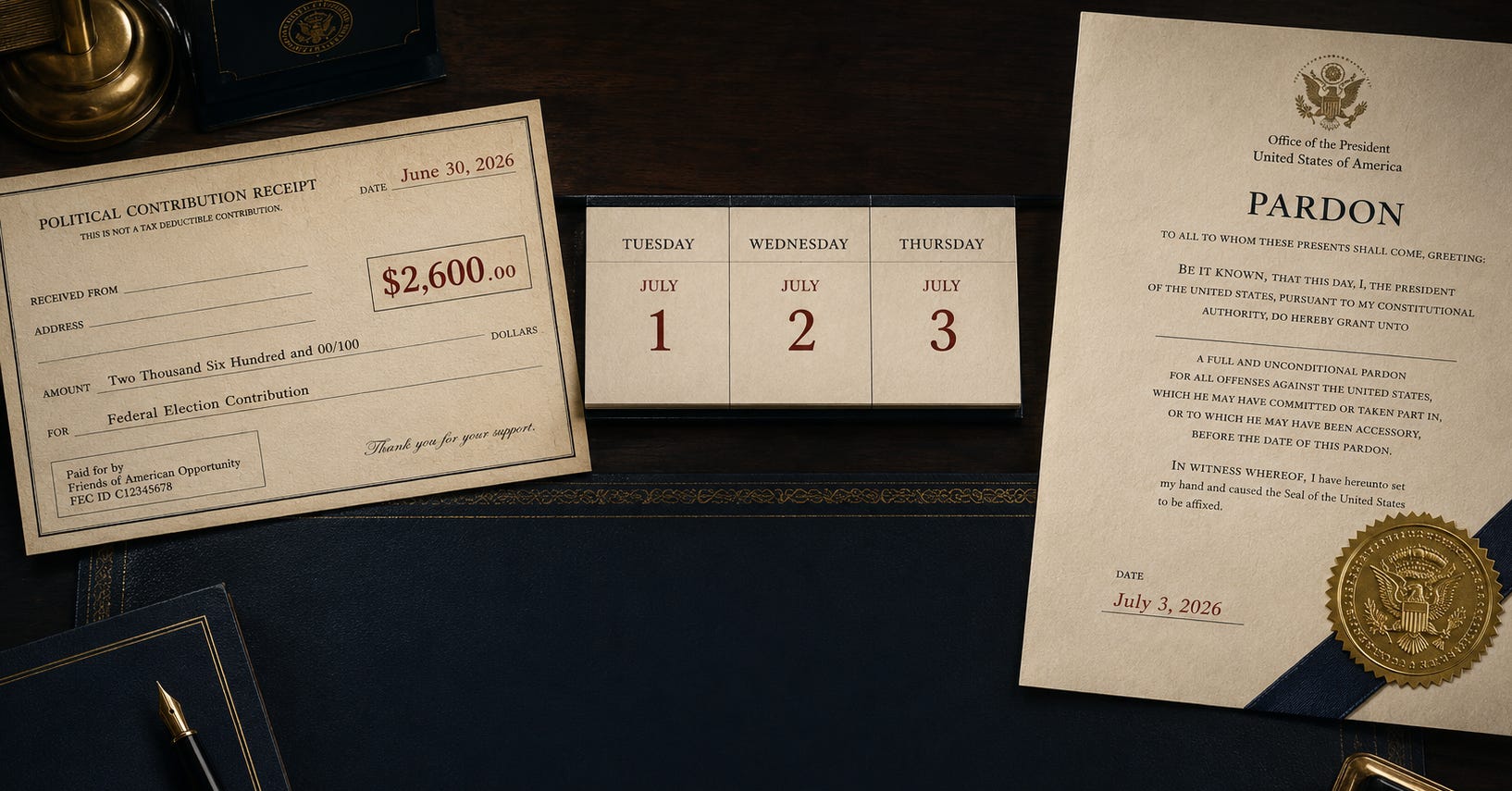
Three Days
The contribution was recorded on Monday. The pardon was signed on Thursday. Between those dates stood three days, a wealthy Republican donor, a Pennsylvania congressman’s political committee and one of the most extraordinary powers the Constitution places in a president’s hands.
On June 30th, Adam Kidan contributed $2,600 to a leadership political action committee connected to Representative Ryan Mackenzie. Three days later, President Donald Trump granted Kidan a full and unconditional pardon for his federal fraud conviction.
The sequence is real. What it means remains unproved. There is no public evidence that Mackenzie asked Trump to pardon Kidan. Mackenzie says he did not advocate for the pardon or discuss Kidan’s request with the president or the White House. The contribution went to Mackenzie’s committee, not to Trump. A suspicious timeline is not proof of a completed bargain, but it is enough to ask how the pardon arrived.
Kidan was not politically situated like an ordinary applicant entering the federal clemency system with a form, a personal statement and the hope that someone would eventually read them. He was an active political donor with access to Republican fundraising circles and a conviction carrying consequences beyond the prison term he had already served.
The White House says the request received legal review. That tells the public that lawyers encountered it, but does not reveal who placed it before them, who promoted it, what they recommended, or when Trump decided to act.
The check arrived on Monday. The pardon followed on Thursday. Three days do not prove the accusation. They are more than enough to require the record.
This Community Is Powered by You
What started as a small circle has grown into something much bigger, and it’s all because of readers like you.
Every time you forward this email, post it on socials, or bring someone new into the fold, you’re helping build one of the most passionate, independent political communities out there.
Want to keep the momentum going?
Share this newsletter with someone who should be part of this conversation.
Thank you for being here. It means everything.
The Conviction Was Real. The Remaining Balance Is Unknown.
The pardon did not concern a paperwork violation or a technical offense inflated into something larger. Kidan’s conviction arose from the financing of the 2000 purchase of SunCruz Casinos, a fleet of gambling ships operating from Florida ports. Prosecutors said Kidan and lobbyist Jack Abramoff presented lenders with a fabricated $23 million wire transfer to create the appearance that they had supplied the cash required to complete the deal. That false representation helped them obtain approximately $60 million in financing.
Kidan pleaded guilty to conspiracy and fraud charges. A federal judge sentenced him to 70 months in prison and imposed a substantial restitution obligation shared with Abramoff. Some recent reporting has placed that obligation at $217 million. Contemporary accounts of the sentencing reported approximately $21.7 million. The difference is significant. A misplaced decimal point multiplies the judgment by ten and gives defenders of the pardon an easy way to dismiss legitimate scrutiny as exaggeration.
The smaller figure is still not small. More importantly, neither number answers the question that matters now: How much remained unpaid when Trump signed the pardon?
Federal restitution can follow a defendant long after prison. Payments may continue through collection orders, liens, garnishment or negotiated schedules. A person can complete every day of confinement while still owing money under the judgment.
The government has not disclosed Kidan’s payment history, the balance remaining on July 3rd, or whether collection efforts were still active. It has not clearly identified who remained entitled to receive that money or whether those parties were consulted before Trump acted.
The records may show that little or nothing remained unpaid. They may show the opposite. Restitution is not money owed to the president. It is money a court ordered paid because someone else was forced to carry the cost of the crime.
The White House announced the mercy. It did not disclose the balance that mercy may have reached or identify who would be left carrying it.
A Pardon Can Reach More Than a Prison Sentence
Kidan had already completed his prison term. The pardon’s value may therefore have rested somewhere else. A full and unconditional pardon can remove consequences that continue after custody ends. It can restore legal standing, soften the public meaning of a conviction, and affect financial obligations attached to the judgment.
That last possibility is of interest here. The Justice Department has previously concluded that presidential clemency may reach restitution that has not yet been paid. Once money has been transferred to the party entitled to receive it, the president cannot pull it back. An unpaid obligation, however, may remain vulnerable to the pardon power.
The precise effect depends on the judgment, the status of collection, and the language of the clemency warrant. We do not know that Trump erased the entire restitution order. The public record does not establish how much Kidan paid, what remained, or whether every part of the obligation was affected, but the possibility cannot be dismissed merely because Kidan was no longer behind bars.
This may not have been a pardon from prison. It may have been a pardon from the remaining bill. If nothing remained unpaid, the government can say so and produce the record. If a balance did remain, the public deserves to know what disappeared, who was entitled to receive it, and whether anyone asked what presidential mercy would cost them. The pardon’s most important consequence may be the one the White House has not explained.
The Donation Does Not Prove the Deal
The timing invites suspicion, but does not establish a crime. Kidan’s $2,600 contribution went to Mackenzie’s political committee, not to Trump. Mackenzie says he did not ask the president to pardon Kidan, raise the case with the White House, or advocate for clemency on Kidan’s behalf.
Those denials are important, but so is the absence of public evidence showing that the contribution was offered in exchange for official action. A three-day sequence can justify scrutiny without becoming a bribery case. A denial cannot become the final record.
The public still does not know when Kidan’s request entered the process, who carried it, whether outside advocates promoted it, or when Trump decided to approve it. It does not know whether Kidan knew his request was under active consideration when he contributed, whether the pardon had already been approved, or whether the money arrived while the request was still moving through political or legal channels.
Those possibilities lead to different conclusions. Documents can distinguish among them while a press statement cannot. Mackenzie should return or segregate the contribution. Keeping money from a donor who received presidential clemency three days later creates an appearance problem that no member of Congress should ignore.
Returning the money would not explain the pardon, identify Kidan’s representatives, reveal whether fundraisers or political advisers spoke for him, or show whether anyone connected to Mackenzie communicated with those advancing the request.
The check is not proof of the deal, but the reason the path must be reconstructed.
A denial answers an accusation. It does not replace the documents needed to determine whether the accusation is false.
Mercy Should Not Have a Donor Entrance
Kidan’s contribution to Mackenzie did not occur in isolation. He had already contributed to Republican candidates and Trump-aligned political organizations, and moved through fundraising circles that place wealthy supporters near candidates, advisers and people capable of carrying requests into rooms ordinary Americans will never enter.
None of that disqualifies him from clemency. Political donors retain the same right as anyone else to seek mercy. Wealth does not erase rehabilitation, and access does not prove corruption. The problem begins when proximity appears to provide a different process.
An ordinary applicant is expected to complete forms, explain the conviction, document rehabilitation, demonstrate remorse, and account for restitution. The application may pass through the Office of the Pardon Attorney, federal prosecutors, and layers of review before anyone close to the president sees it. A politically connected applicant may possess something the forms cannot provide: someone who knows which adviser to call and whose call will be returned.
That does not prove the answer was purchased. It means the pathway may not have been equal. The White House says Kidan’s request received legal review. It has not explained whether the ordinary process produced that review, whether political advocates supplemented it, or whether access carried the request around the line.
Presidential mercy should reflect justice, rehabilitation, and the public interest. It should not depend on whether an applicant can hire the right lawyer, attend the right event, or reach the right intermediary.
Mercy does not become illegitimate because its recipient has money. It becomes suspect when money appears to purchase a pathway through the process that ordinary people cannot enter. Presidential mercy should not have a donor entrance.
The Pardon Is Presidential. The Record Belongs to Congress.
The Constitution gives the president broad authority to pardon federal offenses. Congress cannot vote Kidan’s pardon away, restore the punishment Trump removed, or treat a valid act of clemency as though it never occurred, but constitutional finality is not evidentiary secrecy.
The president may own the decision, but he does not own the facts showing how it reached his desk.
Congress can determine whether the ordinary clemency process was followed, bypassed, or supplemented by political access. It can demand the date Kidan’s request entered the system, the names of the lawyers and intermediaries who advanced it, and the communications that moved it through the Justice Department and the White House.
It can examine whether anyone connected to Mackenzie, his staff or his political committees communicated with those promoting the pardon. It can obtain the restitution judgment, payment ledger, and balance remaining when Trump acted. It can ask whether prosecutors, the sentencing judge, or those entitled to restitution were consulted.
Congress does not need to prove a corrupt exchange before requesting evidence capable of proving or disproving one. That is what oversight is for.
The people’s branch should also write rules for the next pardon. A president may retain final constitutional authority while Congress requires the machinery surrounding that power to leave a public record. Future disclosures should identify who submitted or promoted a request, whether the Office of the Pardon Attorney reviewed it, whether restitution remained unpaid, and whether paid lobbyists or political intermediaries were involved.
The public should also know whether victims were consulted and whether the recipient or the advocates carrying the request made significant political contributions within a defined period.
None of those requirements would command the president to deny a pardon. They would make it harder to conceal the pathway that produced one.
Presidential power becomes more dangerous when Congress mistakes its inability to reverse a decision for an inability to investigate it. The Constitution gave Trump the authority to sign Kidan’s pardon. It did not require Congress to accept an unexplained timeline, an undisclosed financial consequence, and a hidden chain of access.
Congress cannot take this pardon back, but it can refuse to let presidential clemency remain a room where political money enters, and the public record disappears.
The Power to Forgive Is Not the Power to Conceal
The pardon power exists because justice is not always completed when a sentence is imposed. It can correct excessive punishment, recognize rehabilitation, and restore people whose continued legal burdens no longer serve the public interest. A constitutional system capable of punishment should also be capable of mercy.
That principle does not weaken because the recipient is politically connected. Kidan completed his prison sentence years ago. He may have presented legitimate evidence of rehabilitation. Trump possessed the constitutional authority to consider it. Mackenzie’s denial deserves to be reported accurately, and the available evidence does not prove that he arranged the pardon or that Kidan purchased it.
However, legitimate mercy does not require public blindness. The government has not explained who advanced the request, how it moved through the executive branch, or what remained unpaid when Trump acted. It has not shown whether political access changed the speed, visibility or treatment of Kidan’s application. It has not provided the record necessary to separate an ordinary exercise of clemency from preferential access to presidential power.
That uncertainty does not justify declaring guilt, but it does justify oversight. A pardon may be constitutionally final while the conduct surrounding it remains open to investigation. The president’s authority to forgive an offense does not erase Congress’s responsibility to examine whether money, influence or hidden intermediaries shaped the process. Mercy should survive that scrutiny. Secrecy should not.
The Constitution placed the pardon power in the president’s hands. It did not convert the facts surrounding its use into presidential property. Three days may ultimately prove to be a coincidence. Congress must obtain the record before coincidence becomes the government’s final explanation.
Mercy is a public power, but the power to forgive is not the power to conceal, and the pathway to presidential mercy must not belong only to the people wealthy enough to find the private entrance.
Support Independent Media
If this work matters to you, please subscribe, share this article, and help put it in front of someone who still believes public power should leave a public record.
And if you can afford it, consider becoming a paid subscriber. Your support helps keep The Coffman Chronicle independent, accessible and focused on the places where power expects the public to stop asking questions.
Sources:
Casino City Times. “Abramoff, Kidan Sentenced to 70 Months.” March 30, 2006.
Christensen, Dan. “GOP Bigshot Adam Kidan: A Life of Luxury Despite Owing Millions in Restitution from SunCruz Fraud.” Florida Bulldog, October 6, 2024.
———. “SunCruz Fraudster Adam Kidan Who Paid Trump Millions Draws Pardon from Trump.” Florida Bulldog, July 5, 2026.
Federal Election Commission. “Itemized Receipt for Adam Kidan’s June 30, 2026 Contribution.” FEC filing image. Accessed July 29, 2026.
Kalra, Avani. “Megadonor Received Trump Pardon Three Days After Donation to Pennsylvania Congressman.” NOTUS, July 29, 2026. Updated July 29, 2026.
Library of Congress. “Congress’s Role in Pardons.” Constitution Annotated. Accessed July 29, 2026.
United States Department of Justice. “Justice Manual § 9-140.000: Pardon Attorney.” Accessed July 29, 2026.
United States Department of Justice, Office of Legal Counsel. “Effects of a Presidential Pardon.” June 19, 1995. Updated July 31, 2014.
United States Department of Justice, Office of the Pardon Attorney. “Executive Grant of Clemency: Adam R. Kidan.” July 3, 2026.
———. “How Clemency Works.” Updated July 1, 2024.
Trump and friends use their power and capture of the Department of Justice to violate or circumvent laws in order to make money. This must stop.