


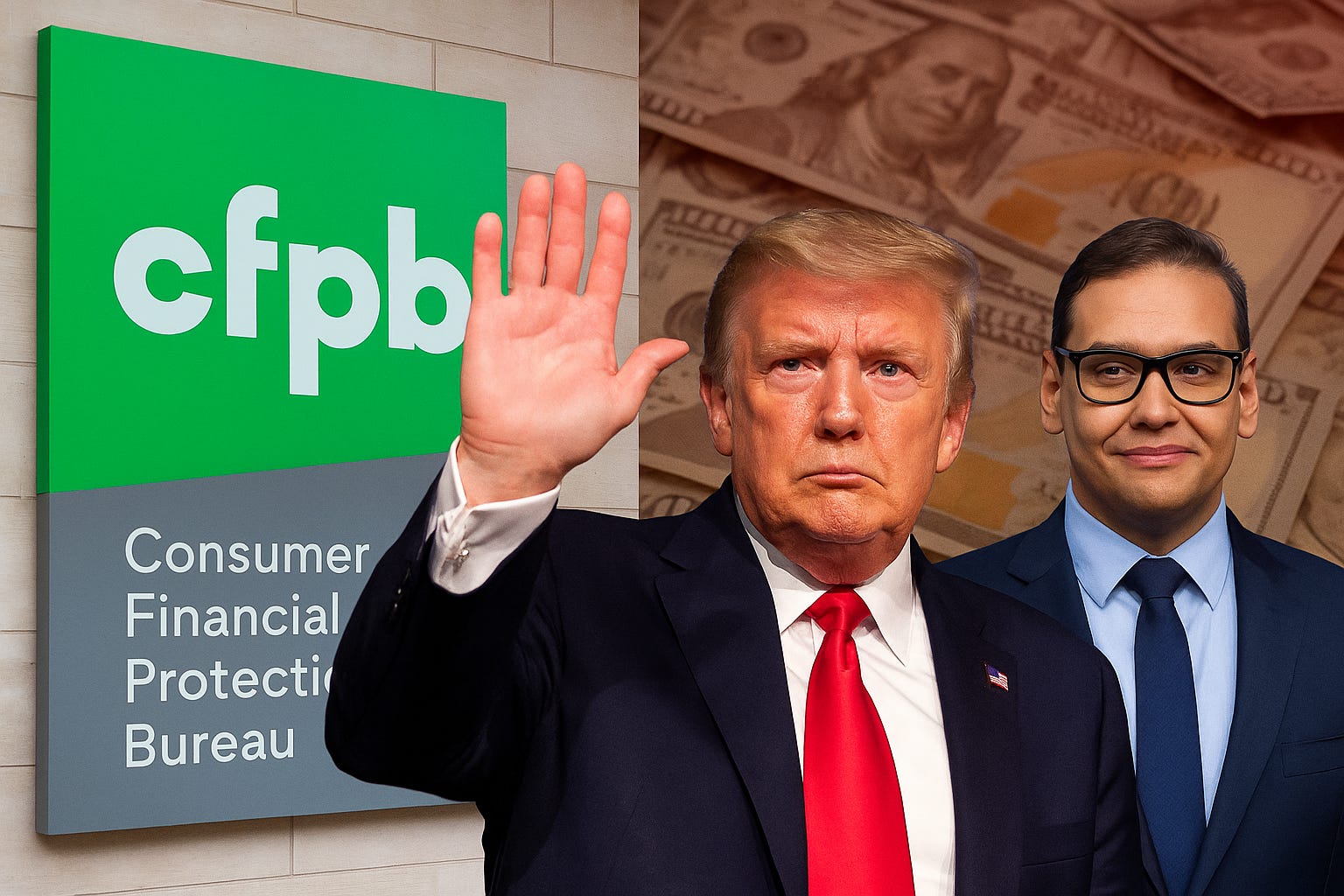
On October 17, 2025, the Trump administration confirmed what had long been in motion: the Consumer Financial Protection Bureau — the only federal agency dedicated solely to defending Americans against financial exploitation — will be shut down “within two to three months.”
There was no press conference or national address, just a statement from Russell Vought’s Office of Budget Management confirming the Bureau’s dissolution and promising that its “core responsibilities” would be absorbed elsewhere. It was a bureaucratic death sentence disguised as an optimization plan.
But make no mistake, this was never about making government more efficient. It was about stripping away one of the few institutions that ever dared to stand between the financial elite and the people they exploit.
Because democracy doesn’t defend itself, and neither does your sanity. Subscribe here to keep your eyes open and your sarcasm sharp.
Who is Russell Vought, you ask? See our previous coverage here:
Note: This article is more than 45 days old and now lives in our archive. Consider becoming a paid subscriber for exclusive perks including unlimited access to our full 1100+ article archive.

Why the CFPB matters
The CFPB was born out of crisis. After the 2008 financial collapse — a meltdown triggered by predatory lending, unchecked mortgage fraud, and the willful negligence of regulatory agencies — Congress created a new kind of watchdog, one that wasn’t there to protect Wall Street, but to protect everyone else.
For over a decade, the CFPB held that line. It returned billions of dollars to consumers. It cracked down on payday lenders, abusive debt collectors, and banks that lied to their customers. It offered something rare in Washington: enforcement with teeth.
It was never radical. It simply did its job, and in doing so, it made enemies.
Death by a thousand cuts
The campaign to destroy the CFPB wasn’t announced with fanfare. It was executed in pieces.
First came the layoffs — nearly 90% of staff cut between April and July under Department of Government Efficiency efforts. Then the budget was slashed. Funding caps strangled the Bureau’s ability to draw resources from the Federal Reserve. Investigations were quietly shelved. Public complaint portals slowed. Enforcement dried up. By late summer, the agency’s core functions had been gutted, and its leadership left paralyzed.
See our reporting from February on these cuts.
Note: This article is more than 45 days old and now lives in our archive. Consider becoming a paid subscriber for exclusive perks including unlimited access to our full 1100+ article archive.

But they didn’t need to abolish the agency on paper. They just needed to make it irrelevant.
This is how institutions die now, not with a bill or a repeal, but with silence, memos, and layoffs, but with no one left to answer the phone.
Who benefits when no one’s watching?
The answer isn’t theoretical. It’s visible in every predatory lender who breathes easier today, every megabank that knows no one is watching, and every private equity-backed loan servicer that can now operate with impunity.
And perhaps more importantly, it sends a message to anyone in power — or hoping to be — that the rules don’t apply if you play your cards right.
Because this isn’t just about the CFPB.
The grifter walks free
Just one day after the shutdown announcement, Donald Trump commuted the sentence of George Santos — a man convicted of wire fraud, identity theft, and defrauding donors. This is the man who built his entire political career on a foundation of lies, a man who stole — repeatedly, blatantly — and walked free after serving barely three months of a seven-year sentence.
See our recent reporting here:

The timing wasn’t coincidental. It was clarifying.
At the exact moment the federal government announced it would no longer protect Americans from financial predators, it gave a convicted one a get-out-of-jail-free card.
The signal is impossible to ignore: If you defraud the public from the inside, we’ll call it politics. If you exploit the poor but stay loyal to the right people, we’ll call it a misunderstanding. And if you try to stop it — if you build an institution that actually works for the powerless — we’ll burn it down quietly and move on.
The price of loyalty
This isn’t deregulation. It’s a reward system. It’s corruption in formalwear. It’s a government that punishes accountability and protects exploitation, so long as the victims are the poor and the perpetrators are rich, useful, or obedient.
The dismantling of the CFPB isn’t just a policy shift. It’s a worldview. It says: justice is conditional. Oversight is negotiable. And if the grift is big enough — if it’s dressed in a flag and blessed by the right donors — we’ll let it slide.
That’s not oversight. That’s organized abandonment.
And it’s happening in real time in the name of the Grifter-in-Chief. No one can accuse him of being subtle.
Don’t let the bastards sneak anything past you. Subscribe and get your daily dose of rage and receipts delivered fresh, before the spin doctors can scrub it.
Sources:
“White House budget director plans to shut US consumer finance watchdog within months” — Reuters, October 15, 2025.
“Trump commutes prison sentence of former US Rep. George Santos in federal fraud case” — AP News, October 17, 2025.
“Trump says he has commuted sentence of former Rep. George Santos” — The Guardian, October 17, 2025.
“Dive Deposits: Vought sees CFPB shuttered in ‘2‑3 months’” — BankingDive, October 17, 2025.

Another reason to STOP BUYING non-essentials.
It’s a time when the despicable and evil people are ascendant, from jewelry thieves to politicians and thugs