


The Biggest Visa Sweep in American History
Fifty-five million. That’s the number of people now under scrutiny in the Trump administration’s latest immigration crackdown, a policy so sweeping it touches nearly every corner of the globe. Students in Boston, truck drivers in Texas, scientists at Silicon Valley labs, and even tourists planning a Disney vacation could find themselves swept up in an unprecedented review of U.S. visas. The official term is “continuous vetting,” but the reality is something far more aggressive: a mass surveillance project that treats every foreign visitor as a potential suspect.
This isn’t just another White House press release about “tougher vetting.” It’s the largest re-examination of visas in American history. And it comes at a time when deportations are already spiking, ICE is in the middle of a recruitment surge, and student visa revocations have quietly topped 6,000 in the past few months alone. What makes this different is scale: instead of targeting a narrow group of immigrants or suspected violators, the Trump administration has decided to throw a net over the entire visa system, 55 million people worldwide.
The stated justification? National security. Administration officials say revocations will target those linked to terrorism, criminal activity, or “anti-American ideologies”, a phrase vague enough to capture everything from violent extremism to a social media post criticizing U.S. foreign policy. Critics argue this is where the real danger lies: the government isn’t just policing behavior anymore, it’s beginning to police thought.
Supporters see strength in this show of force, framing it as a decisive move to protect Americans from foreign threats. But immigration experts, legal scholars, and civil liberties advocates are warning of something else entirely: a policy that risks criminalizing dissent, chilling speech, and weaponizing visas as political tools.
As Trump leans harder into his image as the president who “protects America first,” the visa sweep offers a revealing glimpse of his second-term immigration agenda: expansive, punitive, and unconcerned with collateral damage. The question isn’t whether this will affect millions of people. It’s whether it will redefine what it means to have a place in America at all.
To grasp just how sweeping this is, it helps to look at what the policy actually does and how it works in practice.
Want to Know Your Rights?
Download a free digital copy of the U.S. Constitution—the same document Trump is trying to bulldoze. Learn exactly what he's breaking… and how to fight back.
📬 Stay Informed. Stay Loud.
Subscribe to The Coffman Chronicle for no-BS political analysis, action guides, and weekly truth bombs you won’t get from corporate media.
What the Policy Is
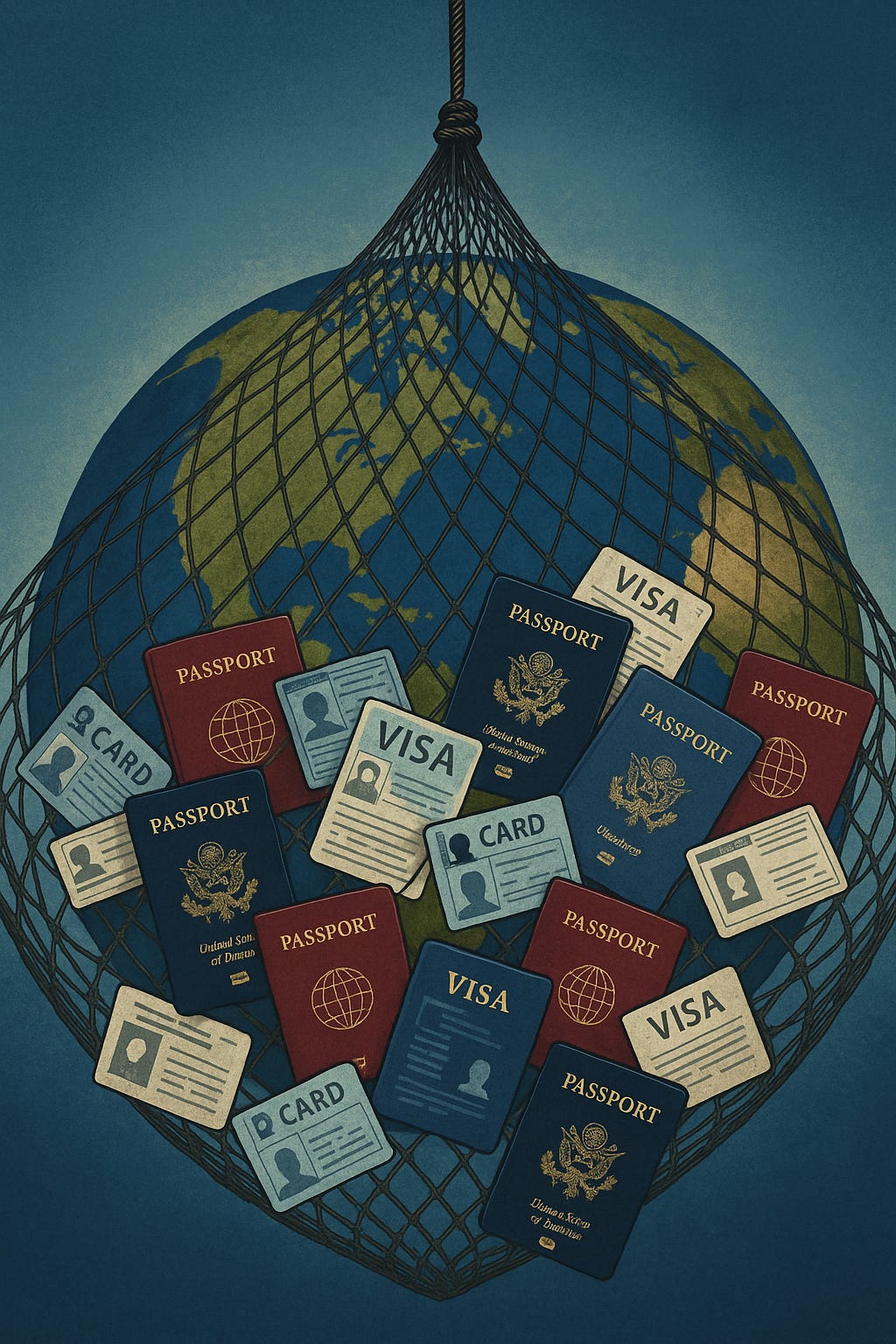
The Trump administration calls it “continuous vetting.” At its core, the policy authorizes federal agencies to conduct ongoing reviews of every single person holding a U.S. visa, an estimated 55 million people worldwide. That number includes not just those currently inside the United States, but also people abroad who may never actually enter.
The scope is breathtaking. It covers:
Tourist visas (B1/B2), which make up a massive share of the total and often last for ten years.
Student visas (F-1 and J-1), now under particular scrutiny after thousands have been revoked in recent months.
Work visas such as H-1B, H-2B, and L-1, which drive sectors from tech to agriculture.
Specialized categories, such as truck driver work visas, have already been suspended outright by the administration.
Under this system, visa holders aren’t just checked once, at entry. They’re monitored continuously through government databases and flagged if new “derogatory information” appears. That could mean a criminal charge, a terrorism watchlist hit, or even posts on social media deemed “anti-American” or “antisemitic.” Officials insist the system is designed to identify threats before they materialize, but the criteria remain vague, and the machinery opaque.
We’ve already seen hints of how this plays out. According to the Associated Press, more than 6,000 student visas have been revoked in recent months. Some were tied to genuine national security concerns, but others appear to have been triggered by minor legal issues or even campus protests. For those caught in the net, there’s little transparency and virtually no due process. A visa can be canceled overnight, and the holder given mere days to leave the country.
In effect, the United States is asserting the power to revoke permission to enter or stay not only for clear violations of law, but also for beliefs, associations, or expressions that officials interpret as hostile. That’s a radical expansion of executive discretion, one that transforms the visa system from a legal framework into a tool of mass surveillance and political control.
That alone would raise red flags. But immigration scholars and civil liberties advocates say the dangers go much deeper: this is not just a policy problem, it’s a constitutional one.
Expert Reactions: ‘This Is Not Normal’
If the administration’s line is that this sweeping visa review is about security, experts are raising a very different alarm: this is an unprecedented use of government power that risks sliding from law enforcement into thought-policing.
David Bier, an immigration policy expert at the libertarian Cato Institute, told The Washington Post that the administration’s new standard “could increasingly be based on speech rather than conduct.” In other words, what a visa holder says online — not what they do — could now trigger deportation. That is, as Bier emphasized, “not normal.” It’s a departure from long-standing U.S. practice, where deportations and revocations were supposed to hinge on actual criminal violations or fraud, not political expression.
Julia Gelatt, associate director at the Migration Policy Institute, flagged another fundamental break from precedent: resources are now being devoted to scrutinizing people who may never even set foot in the United States. Millions of visa holders live abroad, holding long-validity tourist visas they might use once a decade, yet they are now swept into the dragnet. “It’s not clear,” she told Arise News, “why we would devote resources to vetting people who may never enter.”
The Associated Press has documented that more than 6,000 student visas have already been revoked in recent months, some tied to terrorism-related concerns, but many others to minor legal infractions or even campus protests. That number represents a dramatic escalation from previous administrations, which typically revoked only a few hundred visas per year for national security reasons.
And then there’s the matter of the numbers themselves. Social media posts have amplified the White House’s claim of “55 million visa holders,” sometimes suggesting that nearly a third of the U.S. population is foreigners living inside the country. That’s wildly misleading. A fact check by AP makes clear the 55 million figure refers to visas issued worldwide — not residents. In reality, only about 3.6 million people live in the U.S. on temporary visas, alongside 12.8 million green card holders. By lumping global visas together, Trump’s team inflates the threat and justifies a dragnet of extraordinary size.
Put bluntly: this is not a normal review. Past administrations targeted suspected violators, not entire categories of people. They revoked visas based on evidence of wrongdoing, not dissent. And they did not attempt to fold tens of millions of people outside U.S. borders into a permanent surveillance regime.
If the experts are right that this is unprecedented, then we need to ask the harder question: why now?
The Political Context: Fear as a Campaign Strategy
To understand why Trump is suddenly dragging 55 million visa holders into his immigration dragnet, you have to zoom out. This isn’t about security. It’s about politics.
Trump has always thrived on creating an enemy. In his first term, it was “the caravan,” the Muslim ban, and the wall. In his second, he’s scaled up the same formula. Migrants at the border aren’t enough anymore. Now, it’s every foreigner with legal permission to visit or study in America. By inflating the number to 55 million, his team paints a picture of a country on the brink of being “overrun,” even though only a fraction of those people actually live here. The goal isn’t accuracy. It’s fear.
And fear works. This dragnet arrives just as Trump ramps up for the 2026 midterms, when keeping his base riled is essential. MAGA rallies thrive on the narrative that America is under siege: by immigrants, by elites, by critics who supposedly “hate America.” A policy that lets the White House strip visas for “anti-American ideology” isn’t just immigration law. It’s red meat for the culture war, a signal that dissent itself can be punished.
The echoes are unmistakable. The Muslim ban was sold as a matter of national security. The “extreme vetting” promise was pitched the same way. Each time, the actual targets were less about terrorists and more about scoring political points. This new policy follows that same arc, only now the net is bigger, the categories looser, and the tools sharper.
Even more alarming: by blurring the line between speech and crime, Trump is normalizing a dangerous precedent. Today, a student loses their visa over a protest. Tomorrow, does a journalist lose theirs over a critical op-ed? Does a worker lose theirs for tweeting support for a strike? This is the political logic of authoritarianism — redefine dissent as disloyalty, then weaponize the law against it.
Make no mistake: this isn’t “normal” immigration enforcement. It’s a deliberate reshaping of the political battlefield, one where Trump positions himself as the only strongman willing to “defend” America from imagined hordes. The real target isn’t just visa holders. It’s the boundaries of democracy itself.
And Trump knows exactly why he can get away with it: because the law has left visa holders exposed.
Legal & Constitutional Questions: When Speech Becomes a Crime
Visa holders are not U.S. citizens, and that’s precisely what makes them politically useful for Trump. They exist in a legal gray zone: inside the country, but without the full protections of citizenship. That vulnerability has always given presidents wide discretion to deny entry or revoke visas. But there’s a crucial distinction between using that power to stop actual threats — and using it to police speech.
This is where the Trump administration is breaking dangerous ground. When officials start talking about revoking visas for “anti-American ideologies” or “antisemitic” content online, they’re not talking about terrorism plots or criminal enterprises. They’re talking about opinions. And once speech becomes grounds for expulsion, the United States drifts into territory it has historically condemned in other countries, authoritarian states where criticizing the government is treated as subversion.
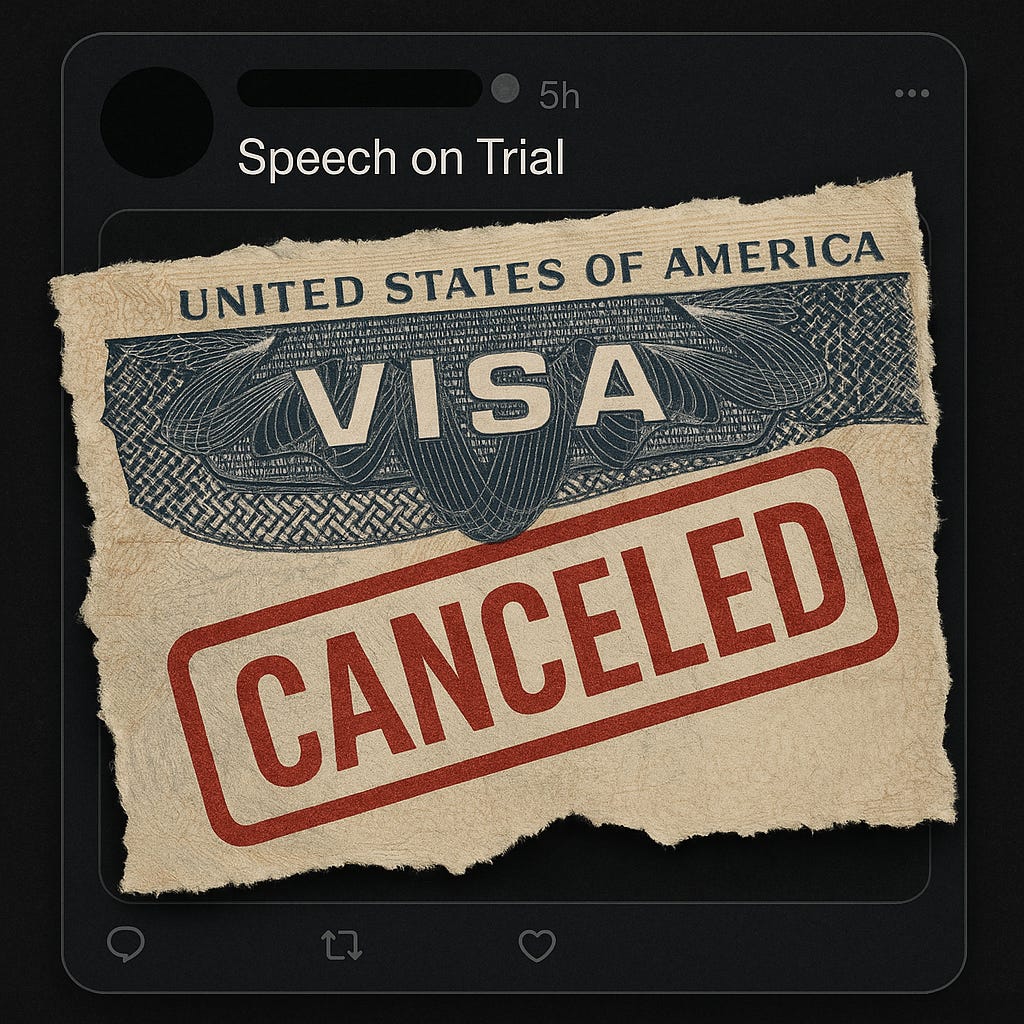
Civil liberties lawyers warn that this amounts to an end-run around the First Amendment. While non-citizens outside the U.S. don’t enjoy constitutional protections, those inside the country do have certain rights, including the right to express unpopular views. The administration’s move challenges that line, daring courts to either bless or block a system where a visa can vanish with a single tweet.
There are grim historical precedents. During World War II, Japanese Americans were interned not because of crimes, but because of suspicions about loyalty. During the McCarthy era, immigrants with left-wing associations were targeted and deported under the banner of fighting communism. In both cases, fear justified extraordinary abuses, and the courts failed to intervene until long after the damage was done.
What Trump is attempting now looks like a twenty-first-century update of those same loyalty tests. The question isn’t whether courts can stop him — the Immigration and Nationality Act gives the executive enormous power. The question is whether they will. If history is any guide, the odds aren’t encouraging.
And that’s the quiet genius of this policy from Trump’s perspective. It doesn’t require new laws. It doesn’t need Congress. It exploits executive discretion already on the books, wielding it in ways no prior administration dared. But here’s the deeper problem: this discretion itself is the product of decades of congressional abdication. The Constitution is clear. Article I gives Congress the power to regulate immigration and naturalization. Yet over time, lawmakers ceded that power to the executive branch, creating a system where presidents can reshape immigration policy unilaterally. Trump is not inventing this imbalance; he’s exploiting it at scale.
Which means this isn’t just about one man’s overreach. It’s about a structural failure in American democracy, a failure that lets a president rule by fiat in an arena the framers intended for Congress. If left unchecked, it hardwires authoritarian power into the very structure of U.S. immigration law.
But abstract debates about power only matter because of what happens next: the consequences ripple far beyond the 55 million people under review.
Broader Implications: When Fear Becomes Policy
The Trump administration wants Americans to see this visa sweep as a narrow security measure. In reality, its ripple effects will stretch far beyond the people it directly targets. By dragging 55 million visa holders into a permanent surveillance regime, the White House is reshaping the very meaning of America — who gets to come here, who gets to stay, and what freedoms they can exercise once they arrive.
1. A Chilling Effect on Free Speech
The most immediate consequence is silence. Students, workers, and tourists will censor themselves online, terrified that a stray tweet or a campus protest could end their futures. Imagine a foreign Ph.D. candidate at MIT hesitating to sign a petition about climate change, or a visiting journalist avoiding criticism of U.S. foreign policy. That isn’t “security”. It’s a global gag order. America, once the country that championed free speech, now exports fear.
2. An Economic Own-Goal
Immigrants and visa holders are not just visitors; they are the backbone of sectors from technology to agriculture. Revoking thousands of student visas, as has already happened, doesn’t just punish individuals. It cuts off the talent pipeline that feeds American innovation. Suspending truck driver visas in the middle of a supply chain crisis doesn’t protect the U.S. It sabotages it. If even legal, vetted workers feel unwelcome, they will take their skills elsewhere: to Canada, to Europe, to Australia. In the long run, America bleeds competitiveness while Trump gets his campaign talking point.
3. A Blow to U.S. Credibility Abroad
Every country watches how America treats foreigners within its borders. Revoking visas for political beliefs will not go unnoticed in capitals from Berlin to New Delhi. Allies who once looked to Washington as a defender of liberal democracy now see a government openly mimicking the authoritarian tactics it used to condemn. Enemies, meanwhile, get a propaganda victory: China, Russia, and Iran can point to Trump’s policies as proof that the U.S. is no different from them.
4. The Slippery Slope to Normalization
Perhaps the most dangerous effect is the normalization of the abnormal. If the United States can monitor and revoke visas based on ideology, what stops the next step? Today it’s student protests. Tomorrow it could be journalists. Next year, dual citizens. Once the machinery of surveillance and punishment is in place, it rarely shrinks. It grows. What begins as a tool against “foreigners” easily mutates into a weapon against dissent at home.
Trump’s visa sweep is not just an immigration policy. It is a test run for a new model of governance: rule through fear, justified by “security,” wrapped in the veneer of legality. The danger is not only what happens to the 55 million visa holders caught in this dragnet. The danger is what happens to the rest of us if this becomes the new baseline for what America is willing to accept.
Which brings us to the central truth: this isn’t just policy. It’s a turning point.
Conclusion: The Line in the Sand
The Trump administration’s review of 55 million visas is not just another bureaucratic policy. It is a seismic shift in how America defines itself — not as a nation of laws, but as a nation of suspicion. It transforms the visa system from a gateway into a dragnet, one where ideas are treated like crimes and speech becomes evidence.
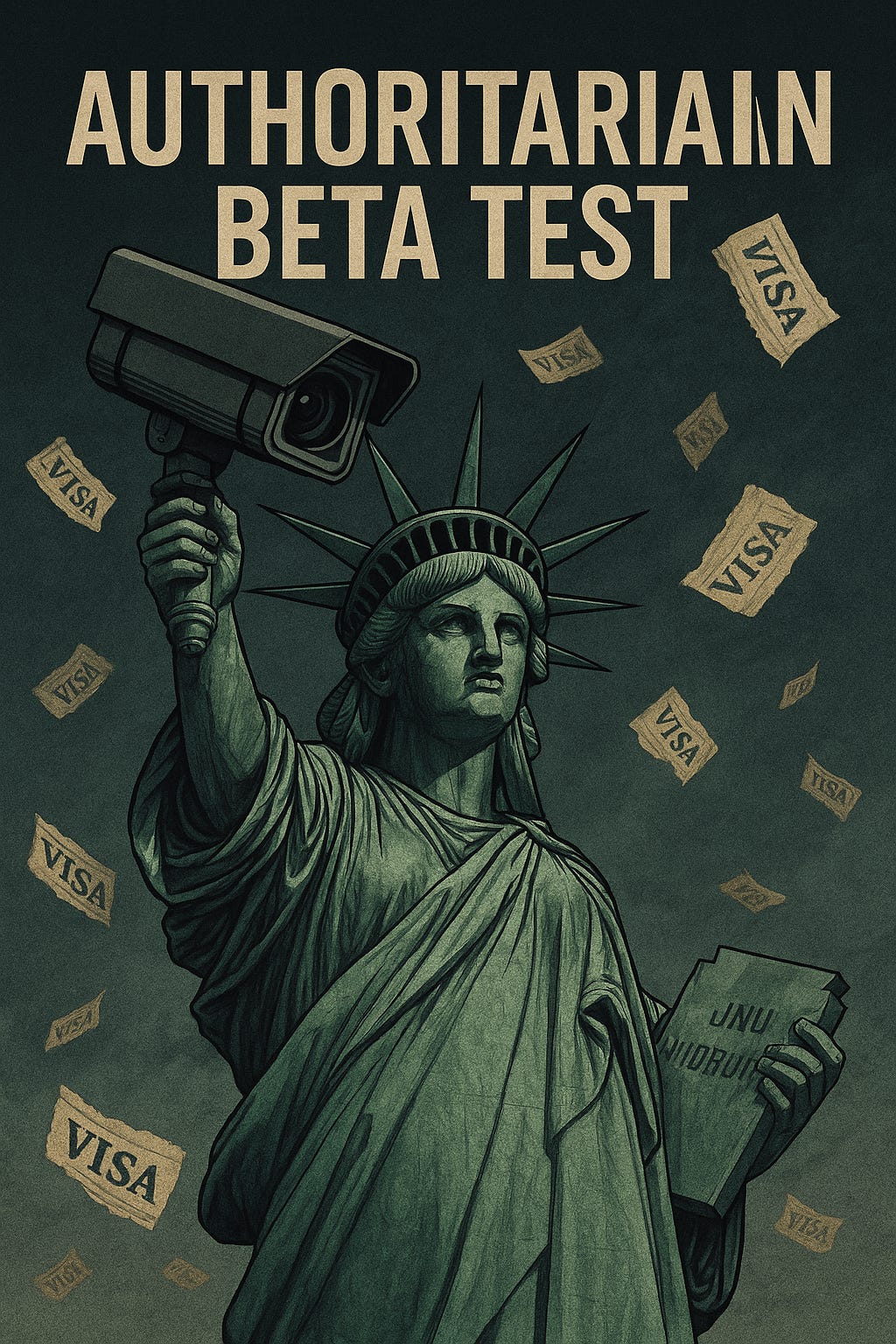
For all the official talk of “security,” the real project is fear. Fear that keeps students silent. Fear that drives workers away. Fear that tells Americans themselves that the government decides not only who belongs here, but what thoughts are permissible once you arrive. This is not normal immigration enforcement. This is authoritarianism in beta testing.
History has shown us where this road leads. From the internment camps of World War II to the loyalty oaths of McCarthyism, America has stumbled before when fear eclipsed freedom. Each time, the nation paid a price in both shame and lost liberty. The question now is whether we are willing to watch the same pattern repeat, only bigger, faster, and harder.
This moment demands clarity: if speech can cost you a visa today, what stops it from costing you your citizenship tomorrow? If Trump can strip status from millions of foreigners with a flick of his pen, what’s to prevent him from turning that power inward, against permanent residents, naturalized citizens, or even political opponents?
The Constitution gave Congress, not the president, authority over immigration. Yet Congress has stood by for decades, ceding power until one man could hold it like a weapon. The line in the sand must be drawn here.
What you can do:
Contact your representatives. Demand hearings on this visa dragnet and insist that Congress reclaim its Article I power over immigration. The Capitol switchboard number is (202) 224-3121. Call today.
Support watchdogs and legal groups — the ACLU, Migration Policy Institute, and Cato’s immigration team are tracking and challenging this abuse of executive discretion.
Don’t look away. Authoritarianism thrives on silence and fatigue. Share this story, talk about it, and refuse to let “normalization” do its quiet work.
America has always defined itself not by who it fears, but by who it protects. If we let 55 million people be treated as suspects, we are not just losing control of immigration policy. We are losing control of democracy itself.
Stay Informed. Stay Loud.
Subscribe to The Coffman Chronicle for no-BS political analysis, action guides, and daily truth bombs you won’t get from corporate media.
Bibliography:
“FACT FOCUS: Posts Overestimate Number of Noncitizens Living in U.S. by Tens of Millions.” AP News, August 22, 2025.
“Trump Administration Is Reviewing All 55 Million Foreigners with U.S. Visas for Any Violations.” AP News, August 21, 2025.
“Over 6,000 Student Visas Revoked for Crimes and Overstays, U.S. Says.” The Washington Post, August 19, 2025.
“Trump Administration to Vet All 55 Million Foreigners with U.S. Visas.” The Washington Post, August 21, 2025.
“State Department Restarts Student Visa Interviews with Tougher Social-Media Vetting.” The Washington Post, June 18, 2025.
“No Evidence Linking Tufts Student to Antisemitism or Terrorism, State Dept. Office Found.” The Washington Post, April 13, 2025.
“Trump Administration Says It's Reviewing All 55 Million U.S. Visa Holders.” Al Jazeera, August 21, 2025.
“Trump Administration Vetting All 55 Million U.S. Visa Holders in Growing Crackdown.” PBS, August 21, 2025.
“Trump Administration to Vet All 55 Million Visa Holders — and Keep Tabs on Their Social Media.” Salon, August 22, 2025.
Finally, someone else has picked up on this story. I've been posting it since it was announced earlier this week. I think it is very serious. Thank you.
It seems that there are no limits on executive powers. We were told otherwise in school. We live in "let's pretend land."