


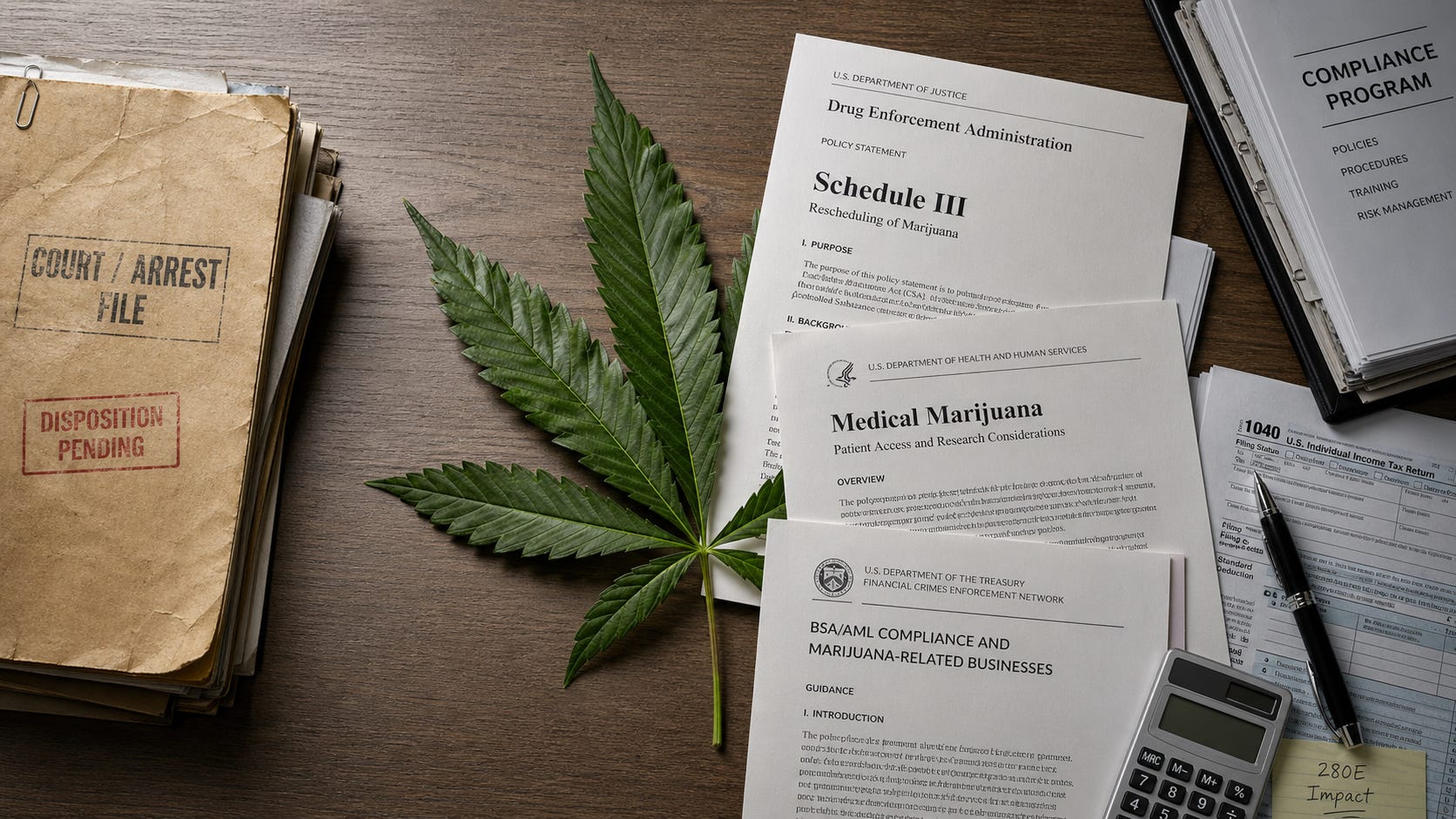
Trump did not legalize marijuana. He did something narrower, more complicated, and more revealing: he gave certain medical marijuana products a new lane of federal legitimacy while leaving the rest of the cannabis fight largely where it was.
The Justice Department’s move shifts FDA-approved marijuana products and state-licensed medical marijuana from Schedule I to Schedule III under the Controlled Substances Act. That is significant. For decades, federal law treated marijuana as a drug with no accepted medical use, placing it in the same harsh legal category as heroin. Moving covered medical cannabis into Schedule III is an admission that the old federal posture no longer fits at least part of the medical reality already recognized by patients, researchers, providers, and state medical programs across the country. DOJ says a separate hearing beginning June 29, 2026, will evaluate broader changes to marijuana’s federal status.
However, this is not legalization. It does not make recreational marijuana legal under federal law. It does not automatically clear past convictions. It does not resolve the contradiction of a country where cannabis can be sold openly under state law while still being treated as illegal under federal law.
What it does do is tell us who gets relief first. Licensed medical marijuana businesses may now move toward a more legitimate federal footing. Researchers may face fewer barriers. Manufacturers, distributors, dispensaries, tax attorneys, investors, and state-regulated operators may get a clearer path forward. Treasury and the IRS are already preparing guidance on the tax consequences, because moving covered medical marijuana out of Schedule I could open the door to business deductions long denied under federal tax law.
That is the real story. This is not simply marijuana reform. It is selective legitimacy.
The federal government is finally admitting that cannabis has medical value, but it is doing so in a way that benefits the regulated medical market before it fully addresses the people still carrying the consequences of the drug war. Patients may benefit. Research may benefit. That matters. But the first major institutional relief appears to flow toward the parts of cannabis that can be licensed, taxed, studied, invested in, and monetized.
Trump can call that reform. And in one sense, it is. But it is also a reminder that in America, even when prohibition starts to crack, the first question is often not who was harmed. It is who profits from the repair.
This Community Is Powered by You
What started as a small circle has grown into something much bigger, and it’s all because of readers like you.
Every time you forward this email, post it on socials, or bring someone new into the fold, you’re helping build one of the most passionate, independent political communities out there.
Want to keep the momentum going?
Share this newsletter with someone who should be part of this conversation.
Thank you for being here. It means everything.
What Trump Actually Changed
The first thing to understand is that this was a classification change, not a legalization bill.
The Justice Department moved FDA-approved marijuana products and marijuana products covered by qualifying state medical licenses from Schedule I to Schedule III. It also ordered a separate DEA hearing process to consider broader marijuana rescheduling. This move has two parts: immediate relief for a defined medical lane, and a future process for a bigger federal question.
Schedule I is the category for substances that the federal government treats as having no accepted medical use and a high potential for abuse. Schedule III is still controlled but less restrictive. Reuters reported that the newly covered marijuana products are being moved into a lower category that includes substances such as ketamine and testosterone.
For decades, that Schedule I label created an obvious contradiction. State after state built medical cannabis systems around patients using marijuana for serious conditions, while federal law still treated the drug as if it had no legitimate medical role. This move does not settle every medical debate about cannabis, nor does it make marijuana risk-free. However, it does mark a federal admission that the old blanket posture no longer fits the regulated medical market.
Still, the scope matters more than the headline. This does not make marijuana legal across the country. It does not legalize recreational cannabis, nor does it automatically protect adult-use dispensaries. It does not erase past marijuana convictions, and it does not mean cannabis can be treated like alcohol.
The move is real, but limited. It gives state-licensed medical cannabis a better legal footing, and it opens the door to research, tax changes, and business normalization, but it leaves the larger marijuana system fractured: medical cannabis gets a path toward legitimacy, while recreational cannabis remains stuck in the old federal conflict.
The Official Story: Patients, Research, and Medical Access
The public argument for this move is not hard to understand. Millions of Americans already live in states where medical cannabis is legal. Patients can get cards, buy products from licensed dispensaries, and use cannabis under state law. However, federally, the product remained trapped in the harshest drug category. Doctors, researchers, patients, and state regulators were all operating within a system in which state and federal law told two different stories.
The Justice Department is now trying to narrow that contradiction. DOJ says the rescheduling order is meant to support medical research, provide clarity to researchers, patients, and providers, and recognize state-regulated medical marijuana systems while maintaining controls against illicit trafficking.
Studying a Schedule I substance brings extra barriers, extra approvals, and extra friction. Moving covered medical marijuana into Schedule III does not make research effortless, but it should make it easier to study cannabis with the seriousness that a widely used medical product requires.
Policy should not be built around old assumptions when the public, the states, and the medical marketplace have already moved far beyond them. However, this is also where the story turns.
The official argument is patients and research. Once the federal government creates a more legitimate lane for medical cannabis, the benefits do not stop at the patient’s bedside or the research lab. They move quickly into the marketplace.
A product that is easier to study can become easier to regulate. A business that is easier to regulate can become easier to finance. A company no longer attached to Schedule I can receive tax treatment that was previously blocked. A market that once lived under federal stigma can begin looking more like a conventional industry.
That does not make the policy bad, but it does make the policy revealing. The clearest institutional relief does not first reach the person with an old marijuana conviction, the recreational user still exposed to federal illegality, or the community that paid the highest price for prohibition. It reaches the people and companies already positioned inside the licensed medical market.
The Material Result: Business Relief
While the administration’s public argument is patients, doctors, research, and medical access, the immediate material benefits also move directly into the business side of the cannabis economy. Once medical marijuana moves from Schedule I to Schedule III, state-licensed medical cannabis operators are no longer trapped in the same federal box that made ordinary business life so expensive, uncertain, and legally complicated.
The biggest change is taxes.
For years, cannabis businesses have been squeezed by Section 280E of the federal tax code. That provision generally blocks deductions or credits for businesses trafficking in Schedule I or Schedule II controlled substances. That meant cannabis operators could be legal under state law, licensed by state regulators, paying employees, renting storefronts, maintaining inventory, and collecting sales tax, while still being denied deductions ordinary companies rely on every year.
The Treasury and the IRS now say DOJ’s action is expected to have “significant positive tax consequences” for medical marijuana businesses. The Treasury also said rescheduling generally removes Section 280E as a barrier for businesses that, because of the final order, no longer traffic in Schedule I or II substances.
That is not a side effect, but rather a structural shift.
A medical marijuana company that can deduct payroll, rent, security, insurance, professional services, and other ordinary expenses is in a very different position from one treated as if it is operating inside the most restricted category of federal drug law. It can plan differently and attract investment differently. It can survive on thinner margins and grow with less tax pressure. It can look more like a regulated medical business and less like a tolerated exception living under the threat of federal action.
That may help patients, too. A more stable medical market could keep licensed dispensaries open, support better research, improve product development, and bring more conventional oversight. However, it also means the first clear institutional relief goes to the organized, licensed, legally advised, capital-ready side of the cannabis world.
AP reported that the reclassification sets up an expedited system for state-licensed medical marijuana producers and distributors to register with the DEA, allows licensed medical marijuana companies to deduct business expenses on federal taxes, and keeps non-state-licensed marijuana in Schedule I. That is the line that matters.
The federal government is not saying cannabis is simply legal now. It is saying that certain cannabis, moving through certain licensed channels, can be treated differently. The plant did not become legal for everyone. It became more legitimate for some.
That is why this moment deserves scrutiny. The question is not whether medical marijuana businesses should receive normal tax treatment. There is a strong argument that they should. If a state licenses a medical cannabis operator, and the federal government now recognizes a medical lane, it makes little sense to keep taxing that business as though it belongs in the most restricted category of federal drug law.
The question is why business relief moves faster than human repair. This is where marijuana reform exposes America’s deeper habit. First, the government criminalizes. Then it concedes. Then it regulates. Then it monetizes. Somewhere in that process, the people punished under the old system are told to wait while the new system gets built around licenses, deductions, compliance rules, and market share.
Who Is Still Left Out
The people left outside this reform are just as important as the people invited into it.
Start with recreational users. In many states, adults can walk into a licensed dispensary and legally buy cannabis under state law. They can pay state taxes on it and buy from a regulated business. They can follow the rules their state created. However, under federal law, recreational marijuana remains illegal. Trump’s rescheduling move does not change that.
That leaves recreational users in the same strange legal position they were in before: legal in their state, illegal under federal law.
Then there are recreational cannabis businesses. Some of these businesses operate in states with fully developed adult-use markets. They hire workers, sign leases, pay state taxes, comply with state regulations, and sell products permitted by state law. Yet if they are not operating through the qualifying medical lane recognized by this order, they do not get the same federal legitimacy. The medical side gets a door opened. The recreational side is still told to wait.
Legalization has never moved evenly. A person selling marijuana in one context can be branded a criminal. A company selling cannabis in another context can become a regulated business. The difference is not always the plant. Sometimes it is the paperwork, the license, the political timing, and the capital needed to enter the legal market.
That brings us to the people with past marijuana convictions. This rescheduling move does not automatically clear anyone’s record. It does not go back and repair the damage done to people arrested, jailed, fined, deported, denied housing, denied jobs, or marked for life because of marijuana enforcement. It does not undo the years when police, prosecutors, courts, and prisons treated cannabis as a reason to derail someone’s future.
That is the moral gap in the policy. The federal government is creating a more legitimate lane for medical cannabis, but it has not matched that urgency with a repair lane for people punished under the old system. The same substance that once helped justify arrests and criminal records can now help create tax relief, investment opportunities, research programs, and corporate growth.
That does not mean medical marijuana businesses should be punished forever, but reform that reaches balance sheets before it reaches criminal records is incomplete.
The communities hit hardest by drug-war enforcement know this pattern well. First, marijuana was treated as a public threat. Then, as public opinion changed and states built legal markets, cannabis became a business opportunity. Now, the federal government is beginning to legitimize part of that market, but the people and neighborhoods that paid the highest price for prohibition are not automatically made whole just because licensed operators get a cleaner federal lane.
Schedule III may help patients. It may help researchers. It may help medical businesses survive and expand. It does not answer the deeper question: what happens to everyone left behind by the old Schedule I world?
The recreational user is still exposed to federal illegality. The adult-use business remains mired in uncertainty. The person with a marijuana conviction is still carrying the mark. The community overpoliced under prohibition is still waiting for repair. And the federal government is still moving faster to normalize the market than to heal the damage that made reform necessary in the first place.
The Two-Tier Cannabis Economy
This move does not erase the marijuana double standard. It reorganizes it.
For years, the contradiction was obvious: states were legalizing medical cannabis while the federal government still treated marijuana as having no accepted medical use. Now the contradiction changes shape. The federal government is separating the licensed medical lane from everything else.
On one side are FDA-approved products, state-licensed medical marijuana operators, researchers, manufacturers, distributors, dispensaries, tax attorneys, compliance firms, investors, and companies that can afford to operate inside the rules. Those entities now have a clearer argument for federal recognition. They may get easier research pathways, tax relief, and capital. They may be able to plan for expansion with less federal uncertainty.
On the other side are recreational users, adult-use businesses, people with old marijuana convictions, small operators locked out of expensive licensing systems, and communities that lived through marijuana enforcement before cannabis became a regulated industry.
That is the new line. It is not cannabis versus prohibition anymore. It is which cannabis, through which channel, for whose benefit, under whose paperwork.
This is where the policy becomes bigger than marijuana. It becomes a story about how America often reforms injustice only after it finds a way to commercialize the thing it once punished. The old system said marijuana was too dangerous to recognize as medicine. The new system says medical marijuana can be recognized, regulated, taxed differently, researched, distributed, and folded into the business world. Yet the human beings punished under the old system do not automatically move with it.
The market gets a pathway. The record does not.
That is how selective legitimacy works. It does not simply say yes or no. It says yes to the organized, licensed, compliant, and capitalized parts of the system. It says not yet to everyone else.
That is why Trump’s move should not be dismissed, but it also should not be oversold. It is a real federal shift that could help patients and researchers. It could stabilize medical cannabis businesses that were operating under an irrational tax and legal burden.
However, it also builds a wall inside reform. Medical cannabis gets pulled closer to legitimacy, while recreational cannabis remains federally exposed. Industry gets a clearer path, but people with records do not. Companies may get deductions, but impacted communities do not get repair.
That is not the end of the drug war. It is a more carefully managed version of it.
The Political Branding Problem
This is where the politics becomes obvious.
Trump can now say he delivered one of the most significant federal marijuana reforms in decades. On paper, that claim is not empty. Moving state-licensed medical marijuana and FDA-approved cannabis products out of Schedule I is a real federal shift. It acknowledges medical use and creates a path for research. It opens the door to tax relief for qualifying businesses and moves federal policy closer to the reality already operating in most states.
However, the branding is bigger than the policy. That is the danger.
“Marijuana rescheduling” sounds like the federal government finally ended the cannabis fight. It did not. What Trump gets is the political upside of reform without the full burden of legalization, expungement, descheduling, banking clarity, or a repair agenda for people harmed by prohibition.
That is politically useful. It lets the administration stand in the glow of modernization while keeping the hardest questions outside the frame. It can say it supported patients and researchers while the clearest immediate economic relief flows toward licensed medical businesses. It can say it changed federal cannabis policy while leaving recreational users and adult-use companies in legal limbo. It can celebrate movement without fully confronting the damage caused by the system still standing behind the reform.
That does not make the reform fake, but it does make it selective.
Selective reform is still worth scrutinizing, especially when it allows political leaders to celebrate progress while leaving the hardest questions unanswered. What happens to recreational users? What happens to adult-use businesses? What happens to people with records? What happens to communities where marijuana enforcement helped fuel arrests, fines, probation, incarceration, family separation, housing barriers, and job loss?
Those questions are not answered by a Schedule III label. They are postponed.
The administration will emphasize medical access, research, public safety, and modernization, but beneath that message is a harder truth: the federal government is willing to legitimize cannabis when it is licensed, regulated, taxable, and commercially useful. It is still far less willing to repair the damage done when cannabis was treated as a criminal threat.
That is the branding problem. The headline says reform. The structure says hierarchy.
What Real Reform Would Require
A scheduling change can move part of the marijuana policy forward. It can acknowledge medical use and reduce barriers to research. It can make life easier for state-licensed medical cannabis operators and begin correcting the absurdity of treating medical marijuana as though it has no legitimate purpose at all.
However, it cannot, by itself, repair the drug war.
Real reform would start by being honest about recreational marijuana. Reuters reported that 24 states and Washington, D.C., have legalized recreational marijuana, while 40 states have medical marijuana programs. That contradiction cannot be managed forever. A person should not be treated as a lawful customer under state law and as a federal criminal under federal law for the same basic conduct.
Real reform would also have to address records. If the federal government is now willing to say marijuana has legitimate medical use, then the country cannot simply ignore the people punished under the older logic. Expungement, resentencing, pardons, record sealing, and reentry protections would have to be part of the conversation. Otherwise, reform becomes a one-way door: the market moves forward, while the people marked by prohibition stay stuck in the past.
Real reform would have to include banking and tax clarity across the legal cannabis market, not just the easiest licensed medical lane. The Treasury and the IRS have already acknowledged that this rescheduling has major tax implications because Section 280E applies to Schedule I and II substances, but if only certain medical operators receive relief, the broader legal cannabis economy remains fractured.
Real reform would also have to protect small businesses and communities that were harmed by enforcement. That means equity rules with teeth. It means licensing systems that not only reward companies with access to lawyers, investors, consultants, and compliance departments. It means making sure reform does not become another pipeline where the people criminalized under prohibition are locked out while better-capitalized players enter after the risk has been reduced.
Patients matter, research matters, and licensed businesses should not be trapped forever under irrational tax rules, but none of that answers the deeper question: what does the country owe the people who were arrested, jailed, fined, separated from families, denied jobs, denied housing, or branded with criminal records over marijuana?
That question is bigger than Schedule III. The real test of marijuana reform is not whether the government can create a cleaner category for businesses already inside the regulated system. The real test is whether reform reaches the people who had no lobbyist, no tax attorney, no license application, and no investor waiting for federal policy to change.
If reform only makes cannabis easier to monetize, it is not justice. It is a market correction.
Legitimacy Was Rationed
So yes, Trump’s move matters. It matters because the federal government is finally admitting that medical marijuana should not be trapped in the same category as drugs it says have no accepted medical use. It matters because patients, researchers, doctors, and state medical programs have been forced to operate for years inside a contradiction the government helped create. It matters because businesses licensed by states to sell medical cannabis should not be taxed and regulated as though they are operating outside reality.
However, the limits matter just as much. This is not legalization. It is not expungement. It is not a full repair of the drug war. It is not equal treatment across the cannabis economy. It is rationed legitimacy.
The medical lane gets recognition. The licensed business gets relief. The researcher gets a clearer path. The investor gets a more stable market. The manufacturer and distributor get closer to federal normalcy. Meanwhile, the recreational user is still waiting. The person with a marijuana conviction is still waiting. The community damaged by years of enforcement is still waiting. The small operator locked out of expensive licensing systems is still waiting. The adult-use business, following state law but still exposed under federal law, is still waiting.
That is the uncomfortable truth underneath the headline. The government did not decide that marijuana policy had finally been fixed. It decided one part of the cannabis world was ready to be treated differently.
Trump can call that a breakthrough. In a narrow federal policy sense, it is, but the breakthrough is real, and so is the hierarchy.
The federal government has not ended marijuana prohibition. It has created a more respectable lane inside it. The people invited into that lane first are not necessarily the people who paid the highest price for the old system. They are the people best positioned to benefit from the new one.
This new reform may reward businesses first, but until marijuana policy moves with the same urgency for records, communities, workers, patients, small operators, and recreational users as it now moves for licensed medical businesses, it will remain what it has always been: a story about who gets protected, who gets punished, and who gets paid.
Coffman Chronicle
The Coffman Chronicle exists to follow power past the headline and into the fine print, where the real story usually lives.
If this kind of independent, evidence-driven journalism matters to you, please consider becoming a paid subscriber. Your support helps keep this work independent, accountable, and focused on the people too often left out of the official story.
Sources:
American Civil Liberties Union, “A Tale of Two Countries: Racially Targeted Arrests in the Era of Marijuana Reform,” April 16, 2020.
Drug Enforcement Administration, “Drug Scheduling,” Accessed April 26, 2026.
Goudsward, Andrew, and Bhargav Acharya. “US to Loosen Marijuana Rules in Major Shift for $47 Billion Industry.” Reuters, April 23, 2026.
Richer, Alanna Durkin, and Gene Johnson. “Trump Reclassifies State-Licensed Medical Marijuana as a Less-Dangerous Drug in a Historic Shift.” Associated Press, April 23, 2026.
U.S. Department of Justice, “Justice Department Places FDA-Approved Marijuana Products and Products Containing Marijuana Subject to a Qualifying State-Issued License in Schedule III, Strengthening Medical Research While Maintaining Strict Federal Controls,” April 23, 2026.
U.S. Department of Justice, Drug Enforcement Administration, “Schedules of Controlled Substances: Rescheduling of Food and Drug Administration Approved Products Containing Marijuana From Schedule I to Schedule III; Corresponding Change to Permit Requirements.” AG Order No. 6754-2026, April 23, 2026.
U.S. Department of Justice, Drug Enforcement Administration, “Schedules of Controlled Substances: Rescheduling of Marijuana.” Notice of Hearing on Proposed Rulemaking, AG Order No. 6753-2026, April 23, 2026.
U.S. Department of Justice, Drug Enforcement Administration, “Schedules of Controlled Substances: Rescheduling of Marijuana.” Withdrawal of Notice of Hearing, AG Order No. 6752-2026, April 23, 2026.
U.S. Department of the Treasury, “Treasury, IRS Announce Process for Tax Guidance Following DOJ Final Order on Medical Marijuana Rescheduling,” April 23, 2026.
White House, “Increasing Medical Marijuana and Cannabidiol Research,” December 18, 2025.
Another lie, any fu to everyone, and another way to grift cash, what a loser
Its all about the 💲💲💲