


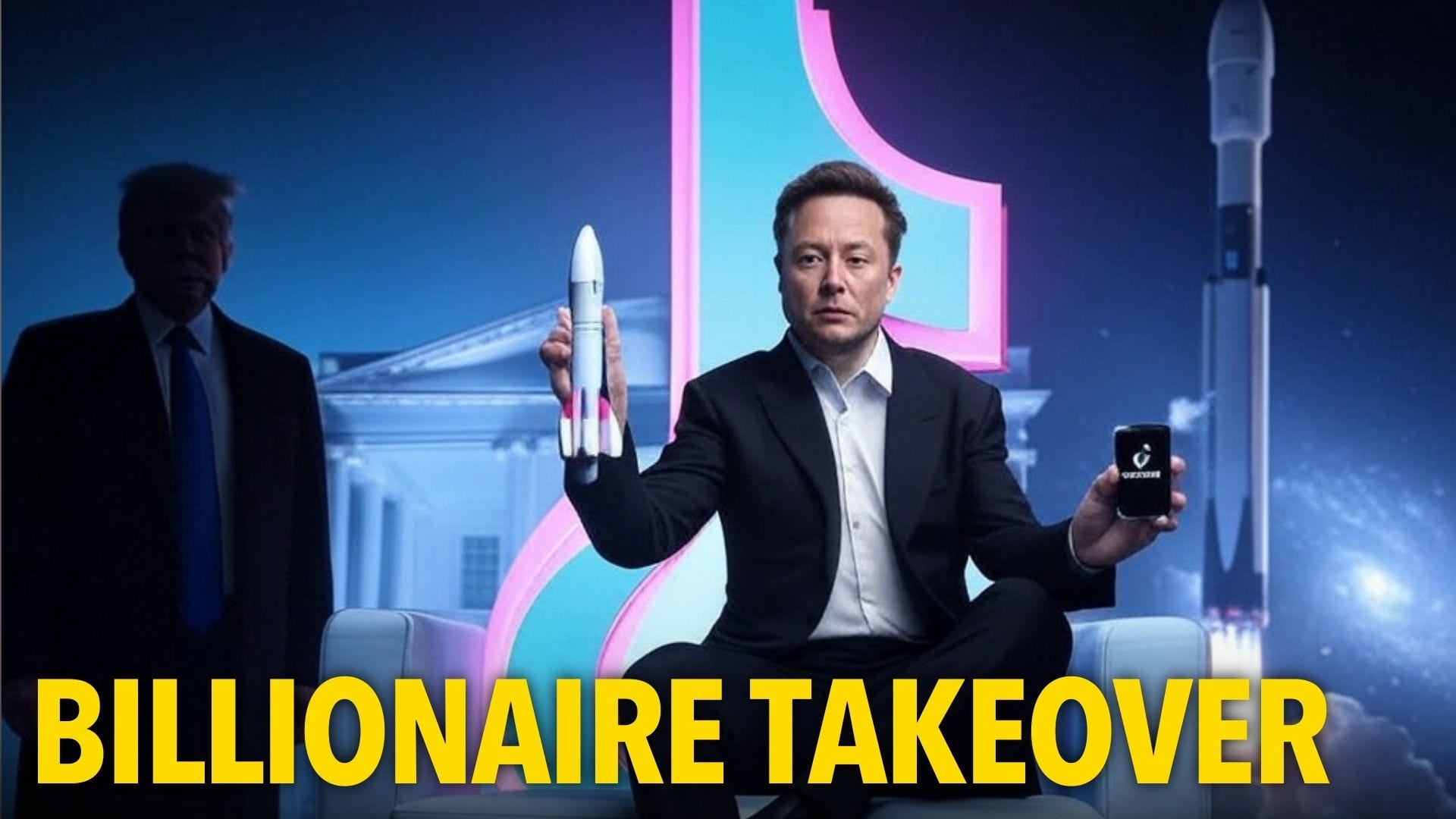
Two interconnected stories emerging today — less than 48 hours after the inauguration— reveal Elon Musk's sheer reach into the fabric of U.S. policymaking. Both underscore his unique ability to blur the lines between private ambition and public governance and pose crucial questions about the concentration of power in the hands of billionaires, furthering the view that Musk bought the White House.
TikTok: A $1 Trillion Power Play
According to Reuters on Tuesday, Former President Donald Trump expressed openness to Elon Musk purchasing TikTok, demonstrating the vast influence Musk wields in the political sphere. Trump proposed an extraordinary demand: if Musk or Larry Ellison (Oracle) buys TikTok, the U.S. government should receive half of the estimated $1 trillion purchase price as a condition for allowing the platform to continue operating domestically (Reuters), suggesting the attacks on TikTok were never about national security.
Oligarch Watch at The Coffman Chronicle is powered by YOU—no billionaires, no media moguls, no corporate puppeteers. We’re here to expose their BS, break down their schemes, and shine a light on the growing billionaire takeover.
For just $8 a month or $80 a year, you can fuel the fight and help us stay sharp, loud, and unfiltered.
Not ready to subscribe? No problem—chaos thrives on company, and you’re always welcome here. But if you’re ready to stand up to the billionaire class and stay informed, hit that subscribe button now!
Musk’s potential involvement as a buyer puts him in a unique position to control yet another global communication platform, adding TikTok’s influence over cultural and digital trends to his portfolio, which already includes X (formerly Twitter). The idea of Musk consolidating control over platforms that dictate much of our online interaction should sound alarm bells about the unchecked rise of tech magnates as arbiters of free speech, political discourse, and social trends (Bloomberg News). And we know how things panned out with X.
Trump’s framing of the deal also reflects a transactional view of governance, where the sale of a company doubles as a bargaining chip for national security and fiscal policy. This unprecedented intertwining of private acquisitions with public policy-making could set a dangerous precedent where government decisions depend on appeasing corporate behemoths.
Space Policy and Musk’s Influence
Simultaneously, revelations that SpaceX's lobbying efforts are likely to result in the dismantling of the White House’s National Space Council further illustrate Musk’s influence in shaping national priorities. According to sources, SpaceX lobbyists have labeled the council as a “waste of time,” reflecting an effort to eliminate oversight that may limit the company’s dominance in space exploration (Reuters). The council serves as a vital check on public-private space ventures. Its potential removal diminishes transparency and prioritizes corporate interests over national and global concerns in space policy.
Musk’s fingerprints on this decision raise questions about his outsized lobbying power. This decision risks eroding checks and balances between the government and private sector, leaving space policy—and the taxpayer dollars funding it—largely in the hands of Musk and other tech elites.
The Bigger Picture: Musk as the Ultimate Power Broker
The TikTok and Space Council stories are not isolated incidents but part of a larger narrative about Musk’s influence over critical areas of policy and governance. With his deep pockets, unparalleled media presence, and ability to sway political leaders, Musk exemplifies the growing influence of tech billionaires in areas that were once firmly the domain of democratic institutions.
As these stories demonstrate, Musk is uniquely positioned to exploit public and private spheres. Trump's proposal to Musk as the ideal buyer for TikTok and SpaceX's push to dissolve institutions that provide oversight demonstrate Musk’s growing power and highlight the urgent need for accountability. As Musk continues to shape the political landscape, society must ask: How much influence should one person wield in our democracy?
Sources: Reuters, Bloomberg News, AP News.
Elon Musk - An Analysis of His Behaviour
( Roman/Nazi Salute)
In a meticulous analysis of the recent inauguration event for former President Donald Trump, it has been observed that Elon Musk, the wealthiest individual globally, executed two conspicuous gestures reminiscent of the Hitler salute. These actions were deliberate and unambiguous, embodying a symbol historically associated with the atrocities committed by the Nazi regime, which resulted in the deaths of millions. The pertinent inquiry arises: what motivated such a display?
Upon rigorous examination, it becomes evident that Musk’s actions were not merely performative but emblematic of a deeper ideological alignment. Historical records indicate that Musk’s maternal lineage harboured sympathies towards Nazi ideology, with documented instances of Holocaust denial. His father, Errol Musk, has been characterized by pronounced elitist and eugenicist beliefs, further complicating the familial narrative.
The nomenclature of “Elon” is purportedly derived from Errol’s fascination with rocketry during the apartheid era in South Africa, specifically influenced by Wernher von Braun, a former Nazi scientist. This connection is further substantiated by references to von Braun’s science fiction work, “Marsprojekt,” wherein a leader named “Elon” governs a Martian colony. Such historical intersections suggest a deliberate cultivation of ideological continuity.
Musk’s public persona reveals inclinations towards eugenicist thought, advocating for increased reproduction among certain demographics and expressing views that can be interpreted as supportive of hierarchical social structures. His endeavours, ranging from support for specific political movements in Europe to ambitious projects like Mars colonization, can be viewed through a lens that perceives a pursuit of ideological propagation.
The public execution of gestures associated with Nazi symbolism serves multiple functions. It acts as a litmus test for societal tolerance, gauging the extent to which such actions can be normalized or dismissed. The relative silence or muted response from mainstream media and political entities may indicate a broader desensitization or unwillingness to confront such displays, potentially due to complex socio-political dynamics.
In summation, Musk’s actions and historical affiliations suggest a nuanced and deliberate engagement with ideologies that warrant critical examination. The interplay between personal history, public behaviour, and societal response underscores the importance of vigilance in recognizing and addressing the resurgence of such ideologies in contemporary contexts.
GQ