


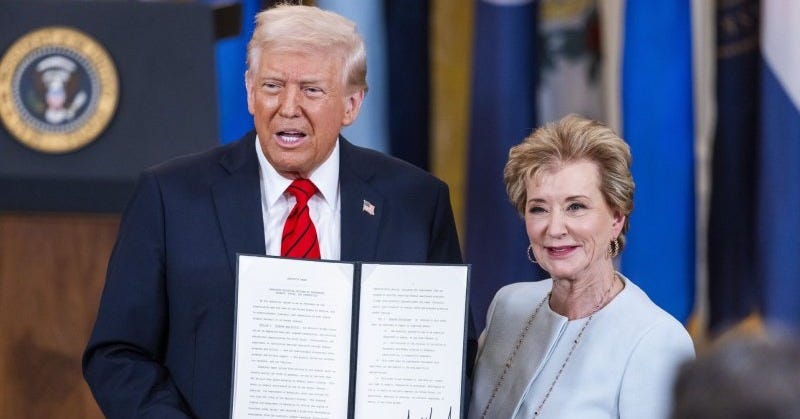
The Trump administration has approved a first-of-its-kind waiver letting Iowa reshape how it spends certain federal education funds, a development that could signal broader state flexibility in the years ahead.
The decision by Education Secretary Linda McMahon to ease federal rules confirmed the administration’s push to “return education to the states,” a priority for many conservative policymakers. According to The Associated Press, McMahon signed off on Iowa’s request Jan. 7, 2026.
McMahon’s approval lets Iowa consolidate about $9.5 million from four federal programs, primarily used for teacher training, support for English learners, after-school activities, and academic enrichment into a single block of funding with fewer federal restrictions. State officials say the change will save roughly $8 million in federal compliance costs previously devoted to reporting and oversight.
The waiver applies mainly to funds used by the Iowa Department of Education, not the larger sums flowing directly to more than 300 public school districts statewide. It runs through September 2028. Other states, including Indiana and Kansas, have also submitted requests for similar exemptions, and officials in additional states have expressed interest.
Follow The Coffman Chronicle on NewsBreak for daily breaking political coverage.
Critics warn that loosening federal requirements could reduce accountability and allow money to be diverted away from vulnerable populations, such as low-income and English-learning students. “It could divert federal funding away from students with the greatest needs,” said an education equity advocate.
Supporters argue that greater flexibility will let states tailor spending to local priorities. McMahon told reporters the shift will free up resources previously tied up in compliance work.
The move matters because it reflects a broader federal rollback of oversight, raising constitutional, legal and equity questions as states weigh whether to seek similar waivers in 2026 and beyond.
What happens next…
Other states’ waiver applications and congressional responses will shape how far this policy expands.
Follow The Coffman Chronicle on NewsBreak for daily breaking political coverage.