


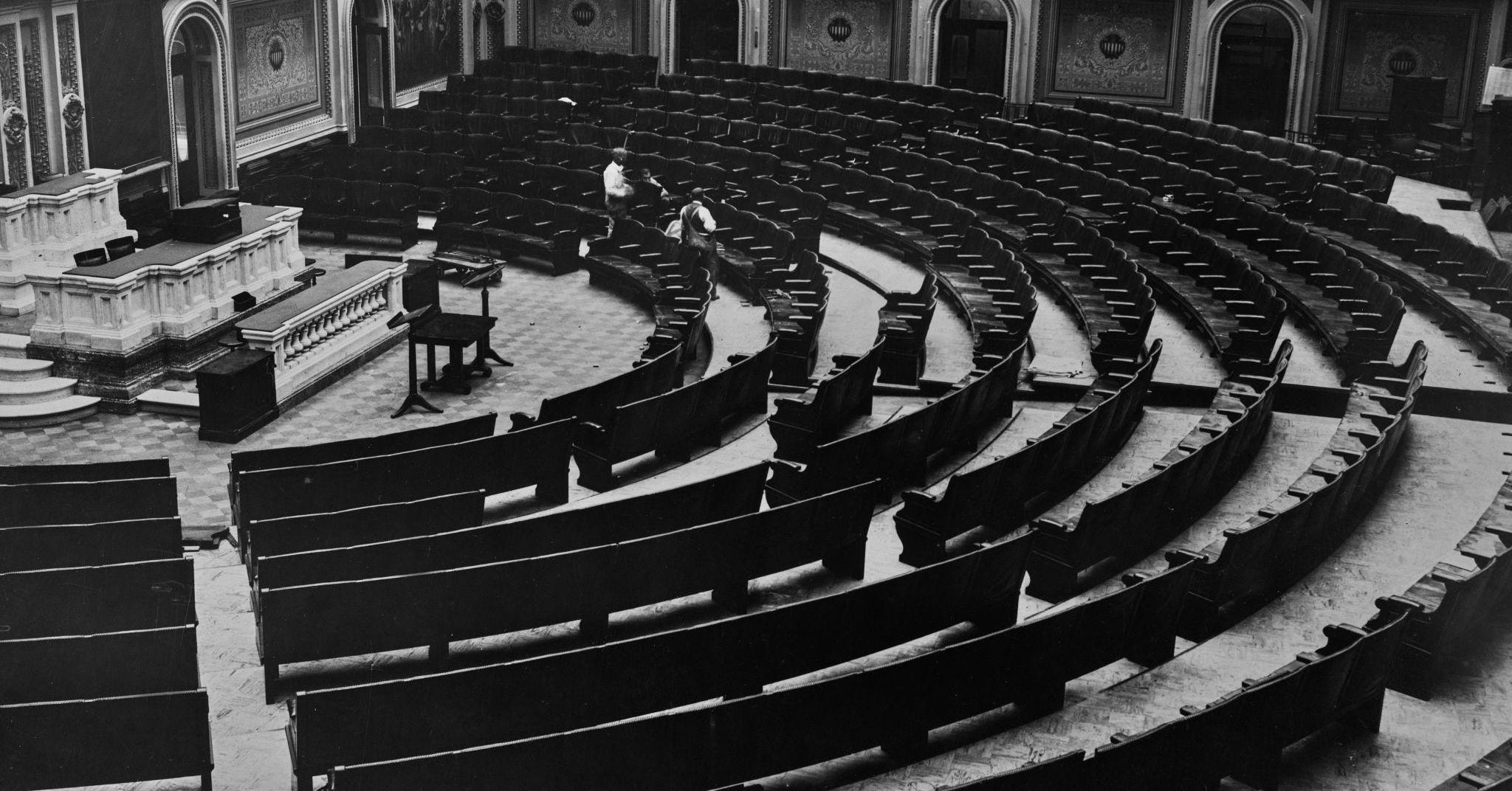
The Decision That Was Supposed to Belong to Congress
The United States launched airstrikes on Iranian targets this week. The order came from the White House. Congress never voted on it.
Under the Constitution, the power to declare war does not belong to the president. It belongs to Congress, the branch meant to represent the American people in the gravest decision a nation can make.
Yet before most Americans even heard about the operation, U.S. forces had already struck targets tied to Iran’s military infrastructure. In a matter of hours, the United States crossed a threshold that could draw the country into another conflict in the Middle East.
Over the past several decades, that kind of moment has become increasingly common. Presidents from both parties have launched military strikes, limited wars, and overseas operations without receiving explicit authorization from Congress. Each time it happens, the precedent grows stronger. And each time Congress chooses not to challenge it, the balance of power moves a little further toward the White House.
President Trump’s strike on Iran may now be the clearest test yet of how far that shift has gone, because the most important question raised by the attack is not simply whether it was justified. The deeper question is how the United States reached a point where a president can bring the country to the edge of war without a vote from the representatives Americans elected to make that decision.
This Community Is Powered by You
What started as a small circle has grown into something much bigger, and it’s all because of readers like you.
Every time you forward this email, post it on socials, or bring someone new into the fold, you’re helping build one of the most passionate, independent political communities out there.
Want to keep the momentum going?
Share this newsletter with someone who should be part of this conversation.
Thank you for being here. It means everything.
The Constitutional Design: War Powers Were Never Meant for One Person
When the framers of the Constitution debated how the new American government should function, one question carried enormous weight: Who should have the power to take the country to war?
The answer they settled on was deliberate. The authority to declare war was placed in Congress, not the presidency.
Under the United States Constitution, Congress holds the power to declare war, raise and fund armies, regulate the armed forces, and control military spending. The president, meanwhile, serves as commander in chief, responsible for directing the military once Congress authorizes its use.
That separation was not accidental. It reflected a deep suspicion among the founders of concentrating power over war in a single individual.
James Madison warned that war was the greatest threat to liberty because it strengthened executive power and weakened democratic oversight. Allowing one person to decide when the nation would fight, the founders believed, was precisely how monarchies and empires had dragged their people into costly and unnecessary conflicts.
The Constitution was designed to prevent that.
Instead of a king deciding matters of war, the framers created a system that forced debate and accountability. If the United States were to enter a war, it would require public deliberation in Congress, a vote by representatives chosen by the people.
In theory, that structure ensured that the decision to fight would carry the weight of national consent.
However, constitutional design and political practice are not always the same thing. Over the last century, the balance envisioned by the framers has slowly shifted. Presidents have increasingly taken the lead in initiating military action abroad, often before Congress has weighed in.
That shift did not happen overnight. It unfolded gradually, through crises, conflicts, and political decisions that expanded the scope of presidential power.
Vietnam and the Law That Was Supposed to Stop This
By the early 1970s, Congress had begun to realize how far presidential war-making power had expanded.
The Vietnam War had escalated for years with only limited congressional authorization, and many lawmakers believed they had effectively lost control over one of the most consequential decisions the Constitution had entrusted to them. Presidents had ordered troop deployments, expanded bombing campaigns, and widened the conflict across Southeast Asia with little meaningful restraint from Congress.
In response, Congress attempted to reassert its authority.
In 1973, lawmakers passed the War Powers Resolution, a measure designed to place firm limits on a president’s ability to commit U.S. forces to hostilities without congressional approval. The law established several key requirements. Presidents must notify Congress within 48 hours of introducing U.S. forces into combat situations. More importantly, military operations must end within 60 days unless Congress formally authorizes their continuation. A 30-day withdrawal period was also included to allow time for disengagement.
In theory, the War Powers Resolution was meant to restore the balance the Constitution envisioned. If a president initiated military action, Congress would quickly decide whether to approve it or bring it to an end.
Predictably, from the moment the law was passed, presidents resisted it.
Richard Nixon vetoed the measure, arguing it improperly restricted the authority of the commander in chief. Congress overrode that veto, but the constitutional dispute never truly disappeared. Presidents from both parties have since treated the War Powers Resolution less as a binding limit and more as a procedural formality.
Administrations have often complied with the notification requirement while disputing the law’s core premise that Congress can force an end to military operations.
As a result, the War Powers Resolution has rarely functioned as the restraint its authors intended. Instead of preventing unilateral military action, it has often served as little more than a post-fact notification system.
And over time, presidents learned that launching limited strikes abroad rarely produced serious consequences from Congress. That pattern would become the foundation of modern presidential war powers.
The Rise of the Modern “Presidential War”
The War Powers Resolution was meant to reestablish Congress as the central decision-maker on matters of war, but over the decades that followed, presidents found ways to operate around its limits.
The shift did not happen through a single dramatic confrontation. Instead, it unfolded through a series of military actions that were framed as limited operations rather than formal wars.
In 1999, the United States participated in the 1999 NATO bombing of Yugoslavia, an air campaign launched without explicit authorization from Congress. President Bill Clinton argued that the operation was limited in scope and conducted as part of a NATO mission, even though American forces were actively engaged in sustained combat operations.
More than a decade later, the United States again entered a conflict without a congressional vote during the 2011 NATO intervention in Libya. The Obama administration maintained that the operation did not constitute “hostilities” under the War Powers Resolution because American forces were primarily providing air support rather than deploying ground troops.
The interpretation drew criticism from legal scholars and lawmakers, but Congress ultimately took no decisive action to halt the operation.
The pattern continued in the following years. In 2017, President Donald Trump ordered the 2017 Shayrat missile strike after the Syrian government was accused of using chemical weapons. The attack involved dozens of cruise missiles launched at a Syrian airfield and was carried out without congressional approval.
Three years later, the United States conducted one of its most consequential targeted strikes in decades when a U.S. drone killed Iranian General Qasem Soleimani.
Each of these operations was described by the White House as a limited military action rather than a war. Each time, Congress debated the legality of the move but ultimately stopped short of imposing meaningful restrictions.
The result has been the gradual emergence of what some scholars call the era of the “presidential war.” Military force can now be used abroad quickly, often through airstrikes, drones, or special operations, without the extended troop deployments that historically triggered congressional debate.
In practice, the threshold for using military force has shifted. The United States can engage in combat operations without a formal declaration of war and often without explicit authorization from Congress.
Over time, that pattern has reshaped expectations about who actually decides when the country goes to war. Just as importantly, it has reshaped how Congress responds when presidents act first.
Congress’s Quiet Surrender
If the Constitution gives Congress the authority to declare war, and if the War Powers Resolution was designed to enforce that authority, then an obvious question follows: Why hasn’t Congress stopped presidents from acting alone?
The answer is not that Congress lacks the tools. In fact, lawmakers possess several powerful mechanisms that could immediately limit or halt unilateral military action.
Congress controls the federal budget, including funding for military operations. It has the ability to pass legislation restricting how the armed forces can be used. It can demand hearings, conduct investigations, and vote to terminate military engagements initiated by the executive branch.
In theory, these powers allow Congress to reclaim its constitutional role at any time.
In practice, however, those powers are rarely used to challenge a president’s decision to employ military force.
Part of the reason is political calculation. Voting to oppose military action can carry risks, particularly if lawmakers fear being portrayed as weak on national security. Members of Congress also face pressure from their own parties, which may discourage public confrontation with a president of the same political affiliation.
Institutional inertia also plays a role. Once a military operation has begun, the political cost of reversing course often becomes difficult to manage. Lawmakers may question the legality of an action, but many hesitate to cut funding or force an abrupt withdrawal once American forces are already engaged.
The result has been a pattern that repeats itself across administrations. Presidents initiate military action. Congress raises questions and holds debates, but meaningful restrictions rarely follow.
Over time, that dynamic has quietly shifted the balance of power the Constitution attempted to preserve. Instead of deciding whether the United States should enter a conflict, Congress increasingly finds itself reacting after military operations have already begun.
The authority to declare war still exists on paper, but in practice, the decision to use force abroad is often made first by the president, with lawmakers responding only after the fact.
That evolving reality is what makes the current moment so significant. When a president orders strikes against a country like Iran without a prior vote in Congress, the question is no longer simply whether the action was justified. It is whether the constitutional system designed to decide such questions is still functioning as intended.
The Iran Strike: A Test of the System
President Trump’s recent strike on Iranian targets did not occur in a constitutional vacuum. It arrived at the end of a decades-long shift in how the United States exercises military power.
Airstrikes ordered by the White House without prior congressional authorization are no longer unusual. What makes this moment different is the potential scale of what could follow.
Iran is not a non-state militant group or an isolated military installation operating outside a sovereign government. It is a nation-state with a large military, regional alliances, and the capacity to respond to attacks in ways that could rapidly escalate beyond a single strike.
That reality raises the stakes of the constitutional question.
Historically, presidents have often justified unilateral military actions as limited responses to immediate threats or as narrowly targeted operations designed to avoid broader war. Those arguments have helped successive administrations claim that congressional approval was not required.
However, conflicts rarely remain static. Once military force is used between states, the possibility of retaliation and escalation increases dramatically. A single strike can quickly lead to counterstrikes, regional instability, or a broader military confrontation.
If that escalation occurs, the United States could find itself moving closer to a full-scale conflict with Iran, a scenario that the Constitution originally intended Congress to evaluate and authorize before it began.
Legal scholars and lawmakers are already debating whether the strike falls within the traditional boundaries of presidential authority. Some argue that presidents possess inherent powers to respond quickly to threats against U.S. interests abroad. Others contend that initiating military action against another sovereign state without congressional approval stretches those powers beyond their intended limits.
What remains uncertain is whether Congress will attempt to assert its authority in response, because the strike itself may ultimately prove less significant than what happens next.
If Congress chooses not to challenge the action through legislation, funding restrictions, or a formal vote under the War Powers framework, the precedent that presidents can initiate hostilities against another nation without congressional authorization may become even more firmly established.
That possibility leads to a broader question about the role the American public still plays in the decision to go to war.
The Question Americans Rarely Ask
For most Americans, debates about constitutional war powers can feel distant and abstract. The language of Article I and Article II, congressional resolutions, and legal interpretations often unfolds far from everyday life. However, the decision to use military force is anything but abstract.
When the United States enters a conflict, the consequences ripple through the country in very tangible ways. Service members are deployed overseas. Families face the possibility of loved ones entering combat. Taxpayers finance the enormous cost of military operations. Energy prices, global markets, and national priorities can all shift as a result of a single decision to use force abroad.
Those consequences are precisely why the framers of the Constitution believed the decision to go to war should not rest in the hands of a single person.
The structure they created was meant to force a national conversation. Members of Congress would debate the risks, goals, and potential costs of military action before the country crossed the threshold into war. Lawmakers would then vote, publicly and on the record, allowing voters to hold them accountable for the decision.
In theory, that process ensured that the American people, through their elected representatives, had a voice in the gravest choice a nation can make.
Yet the gradual expansion of presidential military authority has changed how those decisions occur in practice. Military operations can now begin within hours of a presidential order, often long before Congress has the opportunity to deliberate.
For voters, that means one of the most consequential powers in a democracy may no longer pass through the institutions designed to represent them.
The United States still maintains the constitutional framework that places war powers in Congress, but the way those powers are exercised today increasingly raises a fundamental question: How much influence do the American people still have over the decision to send their country into conflict?
The War Power That Slipped Away
The immediate consequences of the strike on Iran are still unfolding. Diplomats are watching for retaliation. Military planners are preparing for possible escalation. Lawmakers are debating whether the president had the authority to order the attack.
Those questions matter, but the larger issue raised by this moment may be far older than the strike itself.
For more than 2 centuries, the Constitution has said that the power to declare war belongs to Congress. Yet over the past several decades, that constitutional structure has gradually eroded. Presidents have repeatedly ordered military action without explicit authorization from Congress, while lawmakers have often responded with criticism but little enforcement.
Each time that cycle repeats, the precedent grows stronger.
The strike against Iran may now represent the clearest example yet of how far the balance of power has shifted. A single decision made inside the White House could draw the United States into a wider conflict with another nation-state without a vote in Congress beforehand.
Whether this moment leads to escalation or restraint remains uncertain. What is far less clear is whether the constitutional system designed to decide such questions is still operating as intended. If presidents can initiate hostilities against another nation without congressional approval, the United States may already be living under a system very different from the one the framers envisioned.
If that shift has already occurred, the question is no longer when Congress lost the power to decide war. It is when the country stopped noticing.
Support Independent Media: The Coffman Chronicle
If you believe Americans deserve to understand how power really works in Washington, support the journalism that explains it.
The Coffman Chronicle is completely reader-funded. No corporate sponsors. No political patrons. Just readers who believe the truth matters.
If you want more reporting like this, consider becoming a paid subscriber and helping keep independent journalism alive.
Sources:
National Archives. The Constitution of the United States: A Transcription.
National Archives. The Constitution of the United States.
U.S. Congress. War Powers Resolution (Public Law 93-148). Washington, DC: U.S. Government Publishing Office, 1973.
U.S. Government Publishing Office. War Powers Resolution (Public Law 93-148) – Statute Compilation.
U.S. Congress. House of Representatives. Letter Informing Congress of Action Taken Consistent with the War Powers Resolution. 119th Cong., 2nd sess., 2026.
Goldsmith, Jack. “War Powers: The Broken Balance Between the Branches.” Lawfare, February 6, 2020.
Policy Roundtable. “The War Powers Resolution.” Texas National Security Review, November 14, 2019.
Donald Trump is acting on the belief that Congress has no authority and no purpose other than to rubber stamp anything he does, on those rare occasions he allows comments. He has been acting with no authority in everything he has done by Executive Order and now by sending our troops and ships into battle on his whim to distract us from his many crimes.
He only makes pronouncement and never listens to anyone (except perhaps Stephen Miller and Russell Vought(). He is a sadistic sociopath and pathological liar.