


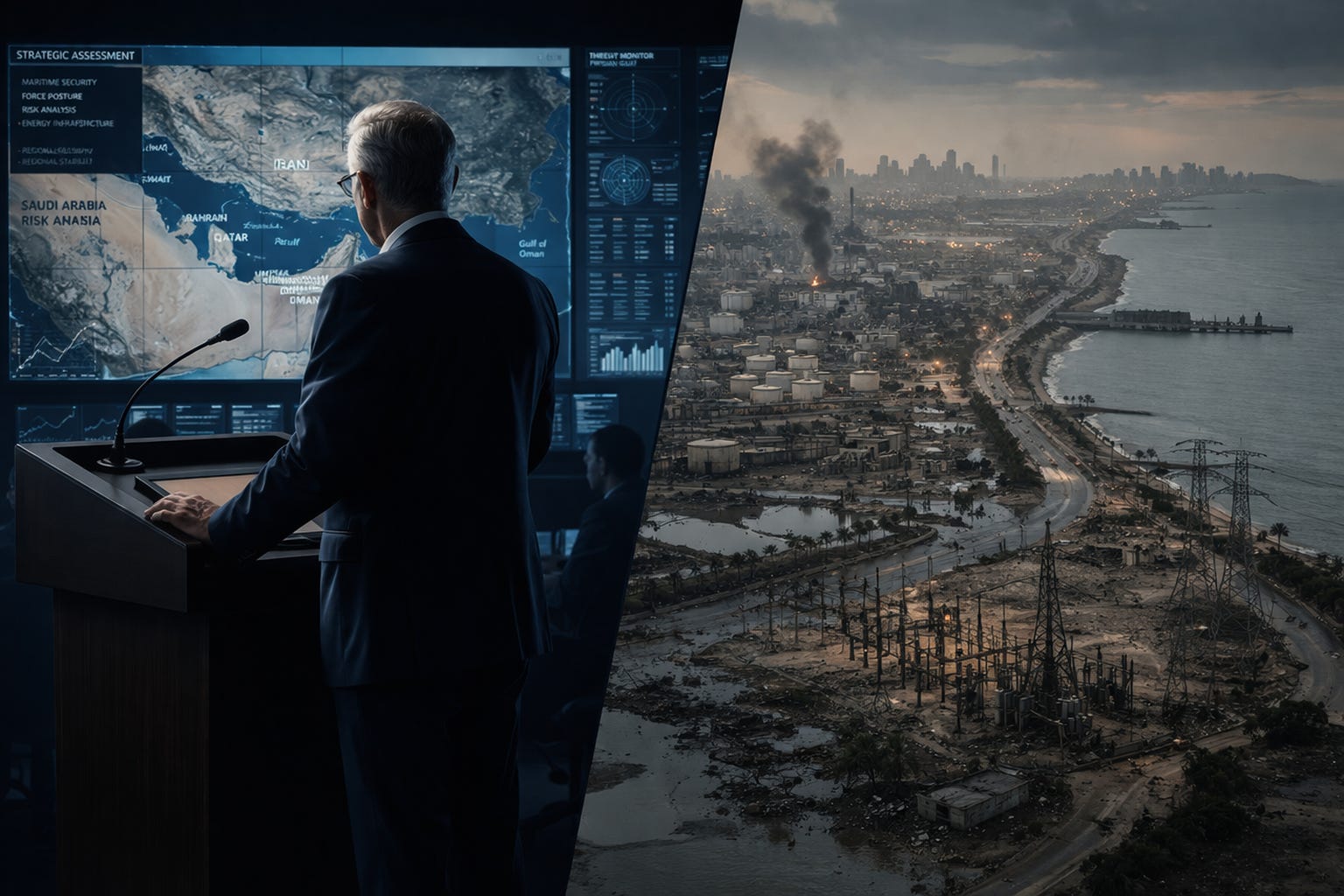
Donald Trump sold this war as strength. What it has revealed, instead, is how little serious planning there was for the war after the first strike. In the weeks since the joint U.S.-Israeli attack on Iran on February 28, the conflict has widened into exactly the kind of regional war that should have been foreseeable: U.S. troops were wounded and American aircraft damaged at Prince Sultan Air Base in Saudi Arabia, an Iranian strike hit a Kuwaiti power-and-water desalination plant, and Trump is now publicly threatening to destroy Iranian power plants, oil infrastructure, and desalination facilities if Tehran does not submit.
That is not what control looks like. It is what strategic failure looks like when it is packaged as toughness. Benjamin Netanyahu helped drive the momentum toward escalation, and Trump chose to go along with it, but neither seems to have honestly reckoned with what four years in Ukraine should have made obvious to anyone paying attention: modern war does not remain confined to military targets. It spreads through bases, logistics, infrastructure, and civilian life. CSIS’s review of Ukraine’s battlefield lessons highlights autonomous systems, electronic warfare, contested logistics, and changing air-defense dynamics as defining features of contemporary conflict.
Now the proof is visible across the region. The opening strike was the easy part. The aftermath is where the illusion collapsed. And the people paying for that collapse are not the men who sold the war from podiums and war rooms, but the troops, civilians, workers, and families caught in the widening blast radius of a conflict launched without a protected middle or a believable end.
This Community Is Powered by You
What started as a small circle has grown into something much bigger, and it’s all because of readers like you.
Every time you forward this email, post it on socials, or bring someone new into the fold, you’re helping build one of the most passionate, independent political communities out there.
Want to keep the momentum going?
Share this newsletter with someone who should be part of this conversation.
Thank you for being here. It means everything.
The opening strike was the easy part.
Launching the attack was never the hard part. The harder part was everything that should have been expected to follow: retaliation, spillover, infrastructure targeting, alliance strain, market shock, and civilian fallout. That is the distinction at the center of this story. Planning a strike package is not the same thing as planning a war. This administration appears to have prepared for the first job and treated the second as something that could be improvised later. That was not strategy. It was sequencing.
What has happened since February 28 makes that distinction impossible to ignore. The conflict widened across multiple theaters, putting Gulf infrastructure and the Strait of Hormuz at risk and exposing civilians to the consequences almost immediately. Yet the administration’s public posture has swung between maximalist threats and vague talk of a deal, which is not the language of a government pursuing a clear end state. It is the language of a war still being figured out after it has already begun.
That is why the defense that “there was planning” is too weak to matter. Of course there was some planning. Missiles were launched. Aircraft moved. Targets were hit. The relevant question is whether there was a credible plan for what a modern regional war would look like once the other side responded. Was there a plan to protect exposed bases? A plan for attacks on civilian infrastructure? A plan for the Strait of Hormuz, for energy shocks, for desalination systems, for allied vulnerability, for the political escalation that comes when the first round fails to impose order? Nothing visible so far suggests those questions were answered with the seriousness they demanded.
The administration prepared to ignite the conflict. The region is now living with the consequences of not seeing a durable plan for what came after ignition.
The push toward war was shared. The failure to plan for it was still Trump’s.
This war did not emerge in a vacuum. It was a joint U.S.-Israeli escalation from the start, which means Benjamin Netanyahu belongs in the story. But he belongs there in the right way: as an accelerant, not an excuse. Trump still owned the American decision.
That distinction matters because Netanyahu had obvious incentives to prefer escalation. Reuters reported that Israel’s 2026 budget sharply increased defense spending and helped Netanyahu avoid early elections, giving his government both political breathing room and a continued wartime footing. In plain English, confrontation was not just a security posture for Netanyahu. It was politically useful.
But Trump was not dragged unwillingly into anything. He aligned himself with a partner whose incentives favored escalation and then acted as though the United States could absorb the consequences later. Once he made that choice, the consequences became American consequences: American troops exposed, American aircraft damaged, American credibility tied to a war whose risks were broader than the sales pitch that launched it.
That is how reckless wars are often made. Not by one leader acting alone, but by aligned leaders with overlapping incentives, each reinforcing the other’s escalation, and neither showing much evidence that they have thought seriously enough about retaliation, infrastructure warfare, regional spillover, or the civilian toll that follows. Netanyahu helped create the momentum. Trump chose to make it America’s problem.
Saudi Arabia exposed the gap between bravado and reality.
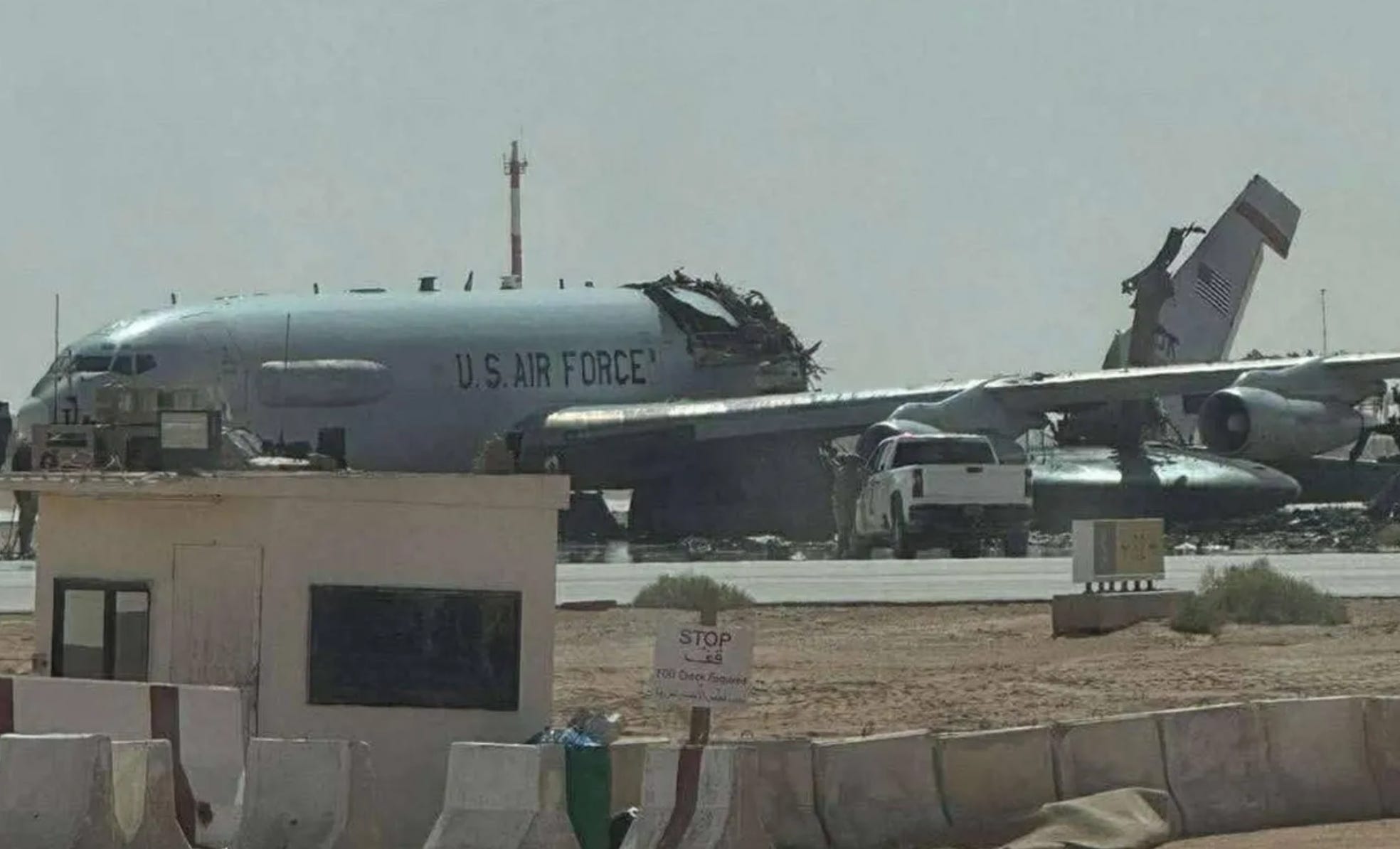
If the lede states the thesis, Saudi Arabia provides the receipt. Iranian retaliation reached Prince Sultan Air Base, where U.S. personnel were wounded, and American aircraft were damaged. A war sold as overwhelming force and restored deterrence still left a major U.S. installation in Saudi Arabia vulnerable to the very response the administration implied had already been broken.
That fact matters because Prince Sultan was not some obscure or unforeseeable target. It was exactly the kind of fixed, high-value site modern warfare keeps punishing: visible, important, reliant on layered defense, and vulnerable to missile and drone retaliation. If the White House and Pentagon were serious about what this war would become, then protecting exposed regional bases should have been central from the start, not a weakness revealed by damage reports.
The strike did more than wound personnel and damage equipment. It punctured the illusion that escalation could be tightly controlled from Washington. It also undercut the administration’s implied claim that Iran had been so degraded that meaningful retaliation was unlikely. Yet the war kept answering back. That is the real significance of Saudi Arabia in this story. It showed, in public, that the administration had entered a widening conflict with more confidence than protection.
Once U.S. troops are bleeding at a major allied base, the language of “control” starts to collapse under the weight of reality.
Four years of Ukraine should have killed the old fantasy of war.
The Saudi strike matters on its own. It matters even more because it should not have been surprising. Four years of Ukraine should have ended the old fantasy that a modern war can be opened with force and then neatly contained through prestige, air power, and threats alone. The war in Ukraine has spent years teaching the opposite lesson in public: fixed bases are vulnerable; expensive platforms can be threatened by cheaper, mass attacks; logistics are contested; air defense is a problem of volume as much as technology; and the systems that keep societies functioning are now part of the battlespace. CSIS and RAND both frame Ukraine as a watershed for understanding how contemporary conflict is changing.
What has unfolded here looks less like an exception than an application of those lessons. Iranian retaliation reached a major U.S. base in Saudi Arabia. A power-and-water desalination plant in Kuwait was struck. Trump is now threatening to expand the target list further into Iranian power and desalination infrastructure. None of that fits the old fantasy of a clean opening strike followed by restored deterrence. It fits a newer reality in which wars spread quickly through infrastructure, logistics, and civilian systems.
Reuters underscored the point in a striking way: Ukraine is now actively marketing its drone-defense expertise to Gulf states threatened by Iranian attacks. In other words, the knowledge was there in plain sight. The lessons were not hidden in military journals or buried in after-action reviews. They were visible enough that a country still fighting for survival is trying to export the playbook. This administration launched the war as if the old rules still applied anyway.
That makes this more than a story about recklessness. It is a story about learned blindness. After years of evidence from Ukraine, this administration still behaves as though force could be projected from the top down without triggering the very kinds of retaliation and infrastructure warfare that now define modern conflict.
Once water systems are in the war, the war has already gone off the rails.
If Saudi Arabia showed exposed military vulnerability, Kuwait showed something even broader. Once water systems enter the war, the war has already gone off the rails. Reuters reported that an Iranian strike hit a Kuwaiti power-and-water desalination plant, killing an Indian worker and damaging a service building. In much of the Gulf, desalination is not a convenience. It is the backbone of daily life. When those systems are hit, the danger does not stop at the blast site. It ripples outward into sanitation, hospital function, public health, and the basic ability of communities to endure daily life.
That is why this moment matters so much. A strike on an air base reveals the vulnerability of military assets. A struck desalination plant reveals that the conflict is no longer operating inside any meaningful boundary between force projection and social breakdown. Once power-and-water systems become targets, the war is no longer just about deterrence or battlefield positioning. It becomes a threat to ordinary people’s ability to drink, clean, cook, and care for the sick.
It also sharpens the argument about planning. Any serious administration choosing war in this region should have understood from the outset that desalination plants, power grids, ports, and fuel infrastructure were obvious pressure points. In the Gulf, water and energy are deeply intertwined, and attacks on those systems can generate civilian panic far faster than troop movements alone. The moment those systems were endangered, a disciplined administration would have been talking about protection, resilience, and de-escalation. Instead, the target map kept widening.
When wars reach water, they reach the most basic layer of human vulnerability. That is where the rhetoric of “strength” starts to sound especially hollow, because what is really being exposed is how quickly the burden of elite recklessness falls onto workers, families, patients, and ordinary civilians who had no say in starting any of it.
Trump’s target list kept expanding because the end-state was never clear.
Trump’s own rhetoric makes the drift harder to deny. On March 30, he again threatened to destroy Iranian electric-generating plants, oil wells, infrastructure on Kharg Island, and desalination facilities if Iran does not reopen the Strait of Hormuz and agree to terms quickly. AP likewise reported that Trump threatened Iranian civilian infrastructure, including power stations, desalination plants, and oil facilities. That matters because it shows a widening target list in real time. This is not the language of a war moving toward a stable political end. It is the language of a war still searching for one.
A government with a serious plan for the war after the opening strike would be talking about containment, protection of exposed assets, resilience of civilian systems, and believable off-ramps. Instead, the administration is threatening to expand the war deeper into the infrastructure that keeps modern society functioning. When the answer to a widening conflict is to broaden the menu of targets to include power and water systems, that is not evidence of control. It is evidence that the original theory of the war failed to impose the order it promised.
This is also where poor preparation becomes strategic drift. The administration did not merely fail to prevent foreseeable consequences. It is now responding to those consequences by threatening a larger target set and a deeper willingness to endanger civilian systems. That is not how coherent strategy narrows a conflict. It is how incoherence widens one.
This is what “no real plan” looks like in practice.
At this point, the phrase “no real plan” needs to mean something exact. It does not mean nobody in Washington drafted options. It means there is little visible evidence that the administration had a credible framework for the war after the launch: no convincing plan for retaliation, no convincing plan for defending exposed bases and aircraft, no convincing plan for protecting civilian infrastructure, no convincing plan for managing regional spillover, and no convincing plan for how the conflict was supposed to narrow rather than widen once the first round failed to impose order.
Defenders of this war will try to hide inside the most technical definition of competence. They will point out that the opening strike happened, that military assets moved when ordered, that targets were hit, and that threats continue to be issued. But competence at ignition is not the same as competence over the life of a war. A serious plan would have accounted for the obvious things first: Iran and its partners would retaliate, Gulf bases and infrastructure would be exposed, energy routes and civilian systems would come under pressure, and the political objective of the war would need to be more coherent than simply threatening broader destruction each time the conflict widened. So far, the visible pattern suggests an answer for how to start the war and a much weaker answer for everything after that.
The receipts matter because they show the pattern, not just the incidents. Wounded U.S. troops and damaged aircraft in Saudi Arabia show the weakness of the assumptions about deterrence and base protection. A struck desalination plant in Kuwait shows how quickly the conflict entered the realm of civilian life-support systems. Trump’s threats against Iranian power and water infrastructure show the target list expanding in public because the promised order never materialized. Taken together, these are not isolated events. They are the outline of a war whose consequences were larger, faster, and less controlled than its advocates either understood or admitted.
There was planning for the launch, but there is little visible evidence of a durable strategy for the aftermath. That is not a semantic failure. It is a strategic one.
The regional consequences were always going to spread beyond the battlefield.
The consequences were never going to stop at the blast sites. A war in this corridor was always going to spill outward into shipping lanes, energy markets, airspace, and the fragile systems that connect the Gulf to the rest of the world. The war is dimming the outlook for many economies, with the closure of the Strait of Hormuz and damage to infrastructure creating a severe oil market shock. Roughly one-fifth of the world’s oil and gas flows through the Strait, so once the conflict widened there, the damage was never going to stay local.
That is not a side effect. It is one of the most foreseeable consequences of war in the Gulf. Any serious plan for a war against Iran had to begin with the recognition that the Strait of Hormuz is one of the central pressure points of the global economy. Once the conflict spread there, it was always going to hit oil prices, shipping costs, industrial supply chains, and food systems, especially in countries already under strain. Reuters also reported warnings that the war could push oil far higher and deepen food insecurity through higher energy and fertilizer costs.
The spillover is not only economic. It is logistical and geographic too. Europe’s aviation safety agency is warning of rising risk as the conflict squeezes flight corridors and increases drone-related dangers, with advisories against flying over Iran, Israel, and parts of the Gulf extended into April. Once a regional conflict expands, it not only threatens soldiers and ships. It distorts civilian transport, raises commercial risk, and pushes instability outward into sectors far removed from the original strike package.
This is why the failure here was not merely tactical. It was strategic in the broadest sense. A government that had seriously planned for this war would have planned for chokepoints, airspace disruption, energy shocks, allied exposure, and the economic pain that radiates outward from a Gulf conflict almost immediately. Instead, the visible pattern suggests an administration that treated these consequences as problems to be addressed later, only to discover that in modern war, later arrives almost at once.
Kitchen-table consequences do not stop at the region.
The damage does not stay in the region, and it does not stay abstract. Wars like this reappear in ordinary life as higher prices, tighter supply, and the slow pressure of instability working its way into household budgets. The bombs fall there, but the bill keeps arriving here. Reuters reported that the war and the closure of the Strait of Hormuz have already contributed to a severe oil shock, while broader reporting has warned of rising costs for food, shipping, and household energy if the conflict continues.
Strategic failure is connected to everyday consequences. A war launched without a serious plan for retaliation, infrastructure damage, and chokepoint disruption does not just endanger troops and civilians in the blast zone. It shows up at the gas pump, in freight costs, in grocery aisles, in utility bills, and in the cost of moving goods through a global system suddenly under strain. Even before the worst-case scenarios arrive, the anxiety arrives first: businesses start pricing in risk, airlines reroute, fuel traders react, shipping costs adjust, and ordinary households absorb the pressure a little at a time.
The same logic is even harsher inside the Middle East. When desalination plants, power systems, and transport corridors come under threat, the first people to feel it are not the leaders who sold the war. They are workers on shift, parents trying to keep routines intact, hospital staff managing instability, migrant laborers living near exposed infrastructure, and families already balancing on the edge between order and crisis. This is not just collateral stress. It is risk transferred downward, from leaders who choose escalation to ordinary people who inherit the exposure.
That is where the kitchen-table frame comes fully into focus. Trump and Netanyahu may have treated this war as a show of force or a test of resolve. But modern war does not stay at the level of statecraft. It reaches into grocery bills, utility costs, disrupted work, medical strain, travel uncertainty, and public fear. That is the real measure of strategic failure: not simply that the war widened, but that ordinary people were always the ones most likely to pay for the widening.
This was an opening move without a protected middle or a believable end.
By now, the pattern is hard to miss. Trump launched a war that was sold as decisive strength, but the evidence piling up across the region points to something far less disciplined and far more dangerous: a strike-first strategy without a credible plan for retaliation, infrastructure warfare, regional spillover, and civilian fallout. The wounded U.S. troops and damaged American aircraft at Prince Sultan Air Base, the strike on Kuwait’s power-and-water desalination plant, the threats against Iranian power and desalination infrastructure, and the growing disruption to oil flows, airspace, and daily life all point in the same direction. This was not a stable strategy unfolding as intended. It was an opening move outrun by its own consequences.
This is not a critique of one military decision. It is an indictment of a political mentality that still imagines modern war can be launched, narrated, and controlled from above even after years of evidence to the contrary. Four years of Ukraine should have made clear that contemporary conflict does not stay contained, does not spare infrastructure, and does not neatly separate military targets from civilian systems. Netanyahu helped drive the momentum toward escalation, but Trump still chose to make that escalation America’s problem without showing he had a credible middle or a durable end state.
And in the end, that is the clearest measure of failure. The people who sold this war will always have language ready for it: strength, deterrence, credibility, resolve. But the reality looks different. It looks like troops bleeding at an exposed base, water systems pulled into the battlespace, flight corridors under stress, oil shocks spreading outward, and ordinary people absorbing the cost of decisions made by leaders who will never personally carry the heaviest burden. That is not control. That is not strategy. That is what happens when war is launched with confidence in the strike and carelessness about the aftermath.
The final truth is the simplest one. Trump planned the strike. He did not plan the war that followed. And the region, along with everyone tied to its water, energy, trade, and stability, is now paying the price.
Support Independent Media
The Coffman Chronicle exists to follow power, expose the pattern, and tell the truth about who pays when reckless men make dangerous decisions. We are here to connect the headlines to the systems underneath them, to name the consequences they try to hide, and to keep showing who gets protected and who gets left to absorb the damage. If that kind of independent journalism matters to you, and you can afford to support it, please consider becoming a paid subscriber.
Sources
AP News, “Iranian Attack on Saudi Base Wounds at Least 10 US Troops and Damages Several Planes,” March 27, 2026.
Center for Strategic and International Studies, “Lessons from the Ukraine Conflict: Modern Warfare in the Age of Autonomy, Information, and Resilience,” May 2, 2025.
RAND, “Lessons Learned: Understanding the Role of Military Organisational and Adaptation Culture for the Future of Ukraine’s Defence,” November 20, 2025.
Reuters, “Egypt’s Sisi Says Only Trump Can Stop War, Warns Oil Could Top $200,” March 30, 2026.
Reuters, “European Aviation Body Eyes Safety Risks as Conflict Squeezes Flight Corridors,” March 30, 2026.
Reuters, “Indian Worker Killed in Iranian Attack on Kuwait Power, Desalination Plant,” March 29, 2026.
Reuters, “Iran War ‘Shock’ Is Dimming Outlook for Many Economies, IMF Says,” March 30, 2026.
Reuters, “Israel Economy to Grow 3.3% in 2026 If Iran War Continues, Finance Ministry Says,” March 30, 2026.
Reuters, “Trump Again Warns Iran to Open Strait of Hormuz,” March 30, 2026.
Reuters, “Trump Interested in Calling on Arab States to Help Pay for Iran War, White House Says,” March 30, 2026.
Reuters, “Trump Issues New Warning to Tehran, Iran Calls US Peace Proposals ‘Unrealistic,’” March 30, 2026.
Reuters, “Twelve US Troops Wounded in Iran Strike on Base in Saudi Arabia, US Official Says,” March 27, 2026.
Reuters, “Ukraine’s Drone Masters Eye Iran War to Kickstart Export Ambitions,” March 30, 2026.
Poor Trump, no more Noble Peace Prize. The Chronicle was excellent but is also useful to point out that the U.S. is using missiles costing over a million dollars each to shoot down drones and missiles from handheld rocket launchers worth maybe $200,000- each. Trump and Hecdeath don't understand modern warfare. Armies today are spread out and impossible to bomb out. Trump didn't understand because he's an idiot who just likes to see things blow-up (like his promises) and Hecdeath because he has no military strategic planning experience other than purging the military of all women and minorities.
People need to get real about Trump. Of course there was no plan except to make money for select groups and individuals. The public needs to stop thinking Trump follows any other logic. He saw a great opportunity to manipulate world markets and jumped on it. Trump also will try anything to get his way and drain the US economy into his pockets and if a court stops him he will appeal and continue what the court tried to block. Get real America you got a kleptocrat in office and of course in his cabinet and probably in his Supreme Court. The real war is right here at home and not in Iran which is a money making “excursion”. As a US citizen whom has visited Tehran and its surrounds it’s quite disturbing to see it destroyed and its citizens suffering because America has a greedy president.