


On September 2, 2025, Donald Trump made one of the most politically charged military decisions of his presidency — again. In a move that stunned defense officials, betrayed decades of strategic infrastructure, and sent shockwaves through Colorado’s aerospace ecosystem, Trump announced the relocation of U.S. Space Command headquarters from Colorado Springs to Huntsville, Alabama.
The decision wasn’t based on cost. It wasn’t based on operational advantage. It wasn’t about infrastructure, proximity to launches, or improving national defense. In every measurable category — readiness, efficiency, security, cost, and continuity — this relocation fails the test.
And yet, it’s happening. Not because it’s the smart move, but because it’s the loyal one. Trump’s new Space Command decision isn’t about defending space. It’s about dominating political space. Alabama is a red state. Colorado is blue. This wasn’t a military reshuffle. It was a MAGA loyalty reward.
This piece is not about what might happen. The move is real. The consequences are real. This is about bearing witness to what happens when power trumps policy, and when legacy projects become tools of retaliation.
Stay Informed. Stay Loud.
Subscribe to The Coffman Chronicle for no-BS political analysis, action guides, and daily truth bombs you won’t get from corporate media.
What Is U.S. Space Command?
Before we get to the politics, we need to be clear about what’s at stake.
U.S. Space Command (USSPACECOM) is the military's operational brain for space-based defense and combat operations. It’s responsible for things most Americans never see but absolutely rely on: missile warning systems, satellite communications, GPS integrity, space surveillance, and the protection of U.S. assets in orbit.
It’s not the same as the U.S. Space Force, which Trump also established in his first term. That’s a military branch, like the Army or Navy, tasked with training, equipping, and managing personnel.
Space Command is the warfighting arm. It executes real-time operations, tracks real-world threats, and coordinates with other branches, allies, and intelligence agencies to ensure U.S. dominance and security in the space domain.
It’s also currently located right where it makes sense: in Colorado Springs, co-located with:
NORAD (North American Aerospace Defense Command)
U.S. Northern Command
Three major Space Force bases
A world-class civilian contractor network built around space warfare and aerospace
This isn't just a headquarters. It’s a nerve center. It’s the place where global missile detection, satellite monitoring, orbital threat response, and international coordination all come together in real-time.
And now, that nerve center is being ripped out, not for strategic gain, but for symbolic loyalty.
Colorado vs. Alabama: The Hard Facts
Let’s skip the spin and look at the facts.
Colorado Springs is the current home of U.S. Space Command. It’s where the infrastructure exists, the personnel are stationed, and the mission is already fully operational. This isn’t a temporary setup. It’s a command center decades in the making, sitting at the intersection of military leadership, technical infrastructure, and real-world readiness.
Alabama’s Redstone Arsenal, by contrast, has none of that in place. It’s a respected defense hub, home to Army missile programs and NASA’s Marshall Space Flight Center, but it lacks the personnel, proximity, infrastructure, and mission alignment that Colorado already possesses.
Here’s how the two stack up:
Colorado Springs vs. Huntsville: A Comparison
Infrastructure: Colorado Springs already has a fully operational headquarters with over $100 million in upgrades underway. Huntsville will require more than $2 billion in new construction to catch up.
Military Integration: Colorado is co-located with NORAD, U.S. Northern Command, and key Space Force bases. Huntsville is not.
Launch Proximity: Neither location is near launch pads, but Colorado is better integrated into national space operations. Huntsville has no launch facilities.
Civilian Contractor Support: Colorado has a dense, highly specialized contractor ecosystem built around space warfare. Huntsville’s contractor base is broader, but not space-specific.
Natural Disaster Risk: Colorado faces snow and wildfire threats — seasonal and predictable. Huntsville lies in Tornado Alley, where fast-moving, deadly storms are common and harder to prepare for.
Workforce Mobility: Most civilian personnel in Colorado are not expected to move. Alabama lacks a ready pool of workers with necessary security clearances.
Operational Impact: Colorado already has full operational capability. Moving to Huntsville will disrupt years of mission development and delay national security operations.
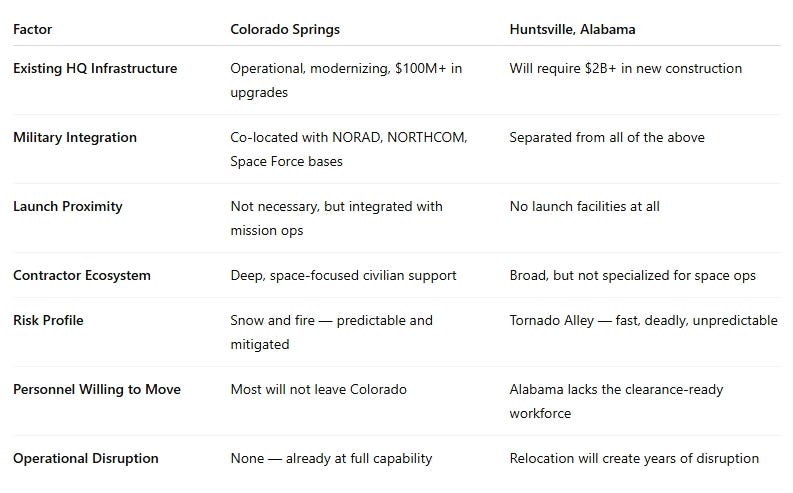
From top to bottom, Colorado wins — strategically, economically, logistically, and operationally.
This isn't about upgrading or expanding. It’s about gutting what already works and rebuilding it, slower and worse, somewhere else.
And it will cost more, delay operations, disrupt existing teams, waste ongoing infrastructure upgrades, and reduce the nation's ability to respond to space threats.
So why do it?
False Justifications Exposed
In public remarks and behind closed doors, Trump allies have floated reasons to justify relocating the U.S. Space Command to Huntsville. But every one of those justifications falls apart when examined with basic logic or facts.
Let’s break them down.
“Huntsville has better facilities.”
False.
Colorado Springs already has a fully operational headquarters, with over $100 million in ongoing infrastructure upgrades. Huntsville will require entirely new construction, estimated to cost upwards of $2 billion. That’s not an upgrade. It’s a reset button with a massive price tag.
“It’s cheaper in the long run.”
False.
The Government Accountability Office has already confirmed: expanding in Colorado would cost less than moving to Alabama. This isn’t about savings. It’s about spending taxpayer money to make a political point.
“It’s closer to launch sites.”
Completely false.
Neither location is near major launch facilities, which are in Florida (Cape Canaveral) and California (Vandenberg). If proximity to launches were a real concern, the command would be moving to one of those states, not Alabama.
“Huntsville has a strong defense presence.”
Technically true, but irrelevant.
Huntsville does have Army missile programs and NASA facilities, but it lacks the specialized contractor ecosystem built around space warfare. Colorado Springs does, and moving the command will shatter it.
“Time zones help coordination.”
Laughable.
The move shifts Space Command from Mountain Time to Central Time, a one-hour difference. Meanwhile, the command operates 24/7 on global secure networks. Time zones are irrelevant to orbital warfare. This is not customer service. It’s national security.
Bottom line:
Every reason given is either misleading, illogical, or entirely manufactured. The command is already where it works best. This move isn’t about capability. It’s about politics. Period.
The Political Motivation
If the move doesn’t improve readiness, save money, or streamline operations, then why is it happening?
The answer is simple: politics.
Colorado is a blue state. It has embraced mail-in voting, expanded access to the ballot box, and rejected Trump in every election. It’s home to Democratic Governor Jared Polis, two Democratic U.S. Senators, and a pro-democracy congressional delegation that has been openly critical of Trump’s policies.
Alabama, on the other hand, is one of the reddest states in the country. It voted overwhelmingly for Trump. Its senators and governor are among his most loyal allies. It represents everything Trump wants to reward, and everything he wants to signal loyalty to.
This isn’t speculation. Trump himself has hinted as much, criticizing Colorado’s election system repeatedly and praising Alabama as a place that “knows how to show real support.”
And while the Pentagon’s own reviews under the Biden administration concluded that Colorado was the best location for Space Command, Trump reversed that decision within months of retaking office, without any new data, without any military recommendation, and without any public hearings.
This wasn’t a strategic reassessment. It was a loyalty test.
A Red State Reward
The relocation of Space Command fits into a broader pattern, one where military infrastructure, federal grants, and public investment are funneled toward red states as rewards for political alignment.
And Colorado’s punishment isn’t just symbolic. It’s economic. It’s institutional. It’s deeply personal for the thousands of workers and families whose futures are now being slowly pulled out from under them.
This isn’t about defending American assets in orbit.
This is about defending a political ego on Earth.
Who Loses And How Much
Behind the headlines and the dollar signs, real people are going to lose a lot, and Colorado will pay the price for a political calculation it didn’t make.
Here’s the impact:
Civilian Jobs at Risk
Up to 1,400 jobs are expected to relocate to Alabama over the next five years.
Many are civilian contractors, including highly specialized engineers, software experts, systems analysts, and professionals with a focus on space.
Most of them won’t move. They have families, mortgages, community ties, and kids in schools. You can’t uproot 20 years of life for a political whim.
Wage and Economic Fallout
The average salary for these roles ranges between $80,000 to $120,000.
That’s a loss of $100 million or more in annual wages pulled from the Colorado economy.
The broader economic impact, including indirect business and service expenditures, is estimated to be $675 million to $1 billion per year.
Aerospace Ecosystem Disrupted
Colorado has built one of the most concentrated and advanced aerospace hubs in the nation.
Major companies, including Lockheed Martin, Raytheon, L3Harris, and Ball Aerospace, are embedded there.
This move fractures that ecosystem, forcing companies to either split operations or walk away from Space Command contracts entirely.
Brain Drain & Readiness Decline
Institutional knowledge can’t be packed in boxes and shipped to Alabama.
When experienced staff refuse to relocate, we lose expertise, continuity, and readiness.
Space Command is already operational. Now it will be de-operationalized and rebuilt slowly, painfully, and inefficiently elsewhere.
Families in Limbo
This isn’t just a job shift. It’s a five-year period of uncertainty, stress, and instability for military and civilian families.
Will they have jobs in five years? Should they sell their homes? Move their kids? Stay and hope for a reversal?
This isn’t a cut. It’s a slow bleed. And Colorado, after years of building a high-functioning defense hub, is being left to hemorrhage for political sport.
Space Command Leadership Warnings
This wasn’t just a bad political decision. It was a decision military leadership openly warned against, and then had to publicly accept once it became an order.
Before the Move Was Finalized
In 2023, when the Biden administration decided to keep U.S. Space Command in Colorado, top generals cited one reason above all others: relocating it would harm military readiness.
General James Dickinson, then head of U.S. Space Command, was clear in his assessment: “Relocating the headquarters from Colorado would hurt readiness.”
That wasn’t political noise. It was a commander speaking directly to national defense capability. Space Command had already reached full operational capability in Colorado. Moving it would mean downtime, disconnection, and disruption.
After the Move Was Ordered
Following Trump’s announcement in September 2025, Space Command released a brief, sterile statement: “We stand ready to carry out the direction of the President…”
That’s what military institutions do. They salute and execute. But the silence spoke volumes. There was no celebration, no praise, no argument that this would improve anything. Just quiet compliance.
The people who run U.S. Space Command know this is a step backward. They just don’t have the freedom to say it anymore.
The military warned this would harm readiness. The civilian experts warned it would break an ecosystem. Local leaders warned it would devastate jobs and families.
And yet, it’s happening anyway.
The Slow Burn: A Timeline of Displacement
The relocation of U.S. Space Command isn’t a hammer drop. It’s a slow, calculated bleed.
Trump’s announcement triggered a multi-year transition, expected to unfold across five years, dragging out uncertainty and quietly unraveling everything that made the command functional, integrated, and efficient in Colorado.
Here’s what that “timeline” really means:
2025: The Order Drops
Trump announces the move. The Pentagon begins planning.
Colorado’s leadership pledges legal challenges, but the machinery of the move is already turning.
2026–2028: The Hollowing Begins
Initial waves of military personnel begin relocating — slowly and selectively.
Civilian contractors begin to lose contract renewals or prepare for shutdown.
Colorado’s local economy begins to feel the tremors of hiring freezes, family departures, and stalled investment.
2029–2030: The Great Departure
Space Command reaches “full operational capability” in Huntsville, at least on paper.
Colorado’s remaining positions are reassigned, phased out, or eliminated.
Decades of embedded talent are scattered, retired, or lost.
The Human Cost of a Timeline
Yes, the timeline gives families and businesses time, but not certainty, not protection, and not a backup plan.
It’s five years of:
Living in limbo
Watching contracts expire
Debating whether to uproot families
Waiting for inevitable losses to land
It’s not a transition. It’s a countdown.
Big Picture: Why This Matters
This story isn’t just about Colorado losing a command.
It’s about how power is being used — and abused — in the most consequential corners of government. It’s about what happens when politics override military judgment, and when loyalty becomes the metric for national security decisions.
This Move Sets a Dangerous Precedent
If a fully operational military command, located in the most strategically sound place, can be ripped up and relocated purely for political gain, then what’s off the table?
What happens to:
Climate science agencies in blue states?
Defense labs that contradict the administration?
Any institution that makes a state less “loyal” in the eyes of a political machine?
This Undermines National Security
We are living in an era of increasing threats in space, ranging from anti-satellite weapons to cyberattacks on global positioning systems. The U.S. needs readiness, not real estate deals.
However, this move isn’t about strengthening the command. It’s about making a red state stronger politically. And that weakens all of us.
This Breaks Trust in the System
Thousands of families were told, under one administration, that the command would stay. Jobs were accepted. Homes were bought. Schools were chosen.
Then the political winds shifted, and with one announcement, years of stability evaporated.
If this is how national security decisions are made now, who’s next?
This isn’t just about Colorado. It’s about how a country operates, and whether strategic decisions will be guided by policy or by self-interest.
No Illusions, No Fixes. Just the Record
This is a done deal.
The order is signed. The timeline is set. The relocation will proceed, and, as it stands, Congress will take no action to stop it.
Colorado’s lawsuits may delay the damage, but they won’t undo it. The workforce will be scattered. The infrastructure will be wasted. The readiness will be fractured. And by the time a future administration could reverse course, the damage will already be baked in.
So no, this piece doesn’t end in a call to action. There’s no hotline to call, no petition to sign, and no pressure campaign to launch.
All we can do now is record the truth: A fully functional military command was uprooted, not because it made us safer, but because it made a president look powerful.
Not because it was broken but because it was blue.
There’s no sugarcoating it. This is political vandalism dressed in uniform, and like most damage done by ego and loyalty, it leaves behind no hero, just wreckage.
So we mark it down. We remember, and we carry it forward for the next time someone tells us national security is their priority, but loyalty is their currency.
Stay Informed. Stay Loud.
Subscribe to The Coffman Chronicle for no-BS political analysis, action guides, and daily truth bombs you won’t get from corporate media.
Sources:
Trump to move U.S. Space Command headquarters from Colorado to Alabama — The Washington Post
Trump announces that Space Command is moving from Colorado to Alabama — Associated Press
Trump is moving Space Command to Alabama — The Verge
Colorado officials decry Trump plan to relocate Space Command headquarters out of state — Colorado Newsline
Colorado leaders react to President Trump’s decision of Space Command move — KKTV
Colorado vows to challenge Space Command move to Alabama — Axios
Trump’s move of SPACECOM to Alabama has little to do with national security — Ars Technica
Trump announces plans to relocate U.S. Space Command to Alabama — CBS News
Space Command to leave Colorado Springs, move to Alabama — Colorado Public Radio
Trump says moving Space Command to Alabama is about... — Newsweek

When Bush Sr get elected in 1988, his administration got a brilliant idea. They cut all military contracts to any state that had not voted Republican. I caused a recession in those blue states and they celebrated. But when the recession metastasized and spread nationwide, they had to deny the obvious. Remember "Its the economy stupid"? That is why Bush Sr lost to Clinton 1992.
So, we've already been there done that. Why not do it again?
Who the f--k with any higher education at all really wants to be stationed in Huntsville, arguably near the epicenter of low education in this country.