


In early May 2025, Donald Trump stood before cameras in Abu Dhabi and boasted that foreign companies were lining up to pour trillions into the U.S. economy. “There’s never been anything like it,” he said, estimating the inflow at anywhere between $9 and $12 trillion. The message was clear: America was open for business, and Trump was the dealmaker bringing it all home.
But just four months later, the fantasy began to unravel thanks to Trump’s own actions.
On September 5th, ICE agents raided a Hyundai–LG battery facility in Ellabell, Georgia. Over 300 South Korean nationals were detained, many of them engineers on short-term business visas. The workers were in the U.S. to help launch a new $5 billion battery plant, part of the foreign investment boom Trump had been touting just months earlier.
South Korea’s labor minister called the raid “shocking,” saying, “Not even prisoners of war would be treated like that.”
Because democracy doesn’t defend itself, and neither does your sanity. Subscribe here to keep your eyes open and your sarcasm sharp.
A $100,000 Price Tag for Progress
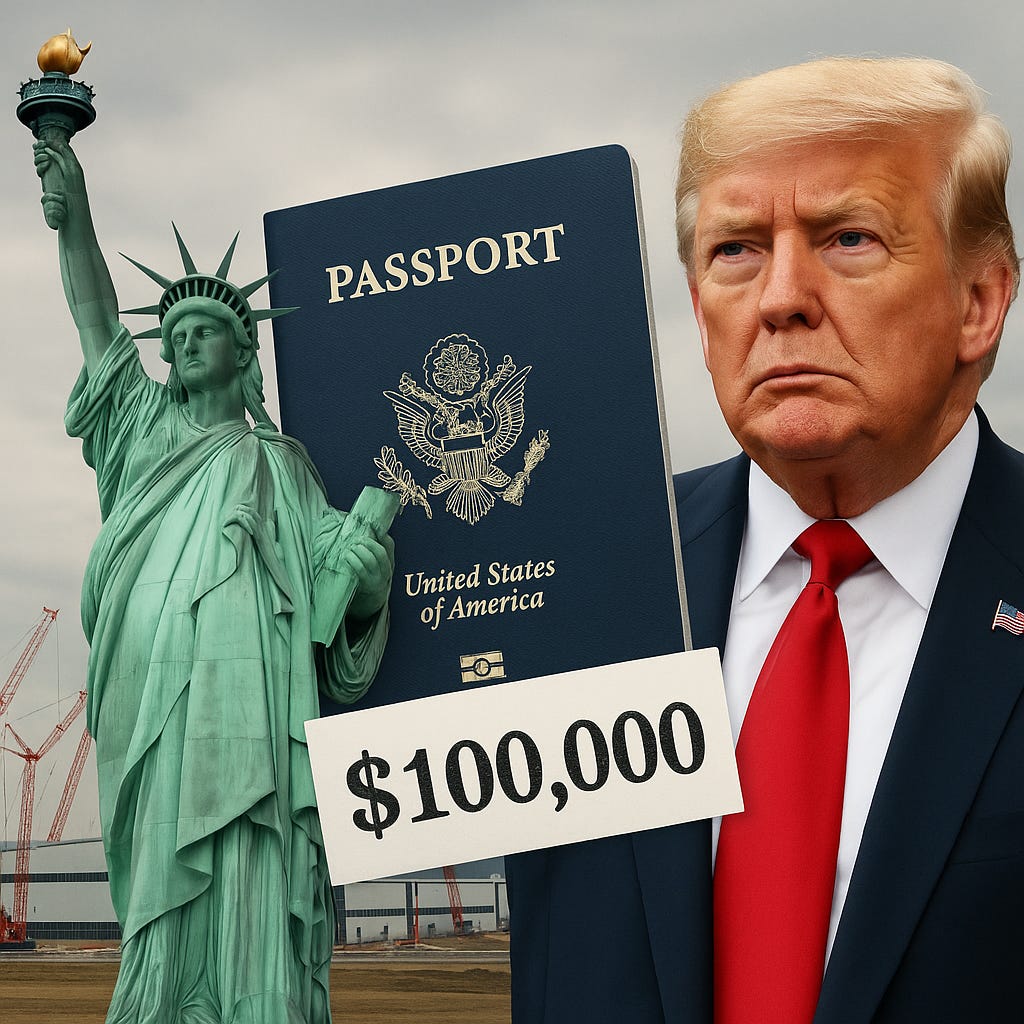
Just two weeks after the ICE raid, the Trump administration unveiled a policy that sent even more shockwaves through the international business community. Beginning September 21, the cost to apply for a new H‑1B visa — the most common visa used by high-skilled foreign workers — would jump to $100,000. For many companies, this represents a 10- to 50-fold increase over current costs.
Commerce Secretary Howard Lutnick defended the move bluntly: “If you have a very sophisticated engineer and you want to bring them in … then you can pay $100,000.” He claimed “all of the big companies are on board,” though few seem to agree.
Deedy Das, a partner at Menlo Ventures, warned that the fee hike “creates disincentive to attract the world’s smartest talent.” Even major U.S. firms, such as Amazon and Goldman Sachs, issued internal guidance to visa holders: stay put, avoid travel, and prepare for uncertainty.
But for many foreign investors, the damage was already done. LG Energy Solution immediately paused all Korean worker deployments to the U.S. Hyundai began pressuring the administration for a clearer, more functional visa pathway, or risk delays to its flagship Georgia facility.
Meanwhile, India’s IT industry also sounded the alarm. Nasscom, the country’s tech trade group, warned that the fee and its one-day implementation timeline “creates considerable uncertainty for businesses, professionals, and students across the world.”
The Cost of Contradiction
To understand the full extent of the damage, you have to follow the money.
Take a foreign company committing $1 billion to a new EV or semiconductor plant. Until now, maybe 1–2% of that budget would have gone toward visa and compliance costs — the price of rotating in a few hundred engineers, site leads, or QA specialists. However, with Trump’s new policy, those costs could increase to $30 million or more. That’s money now diverted from construction, local hiring, or supply-chain integration.
And it’s not just hypothetical. Many of these foreign specialists are essential for setup and training, the critical early phases that determine whether a plant can be successfully opened at all. When they’re locked out or detained, the entire industrial project can stall. or worse, vanish.
“You don’t secure jobs by scaring off the people who make those jobs possible,” said one immigration attorney familiar with the Hyundai case.
In effect, Trump has built a wall around U.S. industry — not to keep people out, but to keep progress from coming in.
A Manufactured Crisis Disguised as Economic Nationalism
Publicly, the Trump administration has framed these moves as pro-worker. Lutnick said the quiet part out loud: “Train Americans. Stop bringing in people to take our jobs.” The underlying assumption is that foreign workers are a threat to domestic labor.
However, that assumption is incorrect, and it is dangerously so.
The workers detained in Georgia weren’t replacing Americans. They were engineers flown in to install equipment, oversee quality control, and train American workers to operate facilities that otherwise wouldn’t exist. Many were here for just a few weeks.
As one attorney noted, “They were doing work that is authorized under the B‑1 business visitor visa program … installation, after-sales service.”
This isn’t about protecting U.S. jobs. It’s about ensuring they’re ever created in the first place.
From Promise to Paralysis
Trump’s May boast about foreign investment may have been inflated — as his numbers often are — but it wasn’t entirely hollow. There were real commitments. Real money. Real momentum.
But now? That $10 trillion promise is colliding headfirst with $100,000 visa fees, ICE raids, and nationalist rhetoric. The result is paralysis, or worse, retreat.
Foreign companies are watching. They’re reconsidering deployments. They’re recalculating risk. And in some cases, they’re walking away.
“Adding new fees creates disincentive,” said Menlo’s Das. And in this economy, the U.S. can’t afford to be turning away investment or talent.
You Can’t Build Walls Around an Economy
If Trump thinks he can revive American industry by walling off foreign workers, he’s already failed.
The clean energy transition, semiconductor resurgence, and AI race all depend on open, predictable flows of talent across borders and time zones. Without foreign specialists, factories don’t get built. Supply chains stall. The future gets delayed.
In a struggling economy, this isn’t just bad policy — it’s sabotage.
Trump said he was bringing trillions home. But with every raid and every fee hike, he’s driving them away.
Don’t let the bastards sneak anything past you. Subscribe and get your daily dose of rage and receipts delivered fresh, before the spin doctors can scrub it.
Sources:
"Trump administration to propose new $100,000 fee for H-1B visa applications" – Reuters Link
"India says Trump’s H1-B visa fee hike could ‘disrupt families’" – Al Jazeera Link
"South Korea denounces ‘shocking’ US treatment of detained workers" – Financial Times Link
"Attorney says detained Korean Hyundai workers had special skills for short-term jobs" – PBS NewsHour Link
"Trump touts trillions in foreign investment" – Peterson Institute for International Economics (PIIE) Link
"Trump to impose $100,000 fee per year for H-1B visas, in blow to tech" – Reuters Link

This would be comical if it weren't so sad. Foreign companies send their skilled workers here, as in the case of Hyundai, to launch start-ups using their proprietary information, familiarity with equipment and processes, and to train US workers. Maybe if this Administration were smarter, they'd leave institutions of higher learning alone and allow them to teach instead of focusing on eliminating programs that actually attract and retain students in STEM programs. But what do we hear from the Oval Office? We need more plumbers, carpenters, and electricians. While that's not entirely incorrect, we also need engineers of all specialties, physicists, biologists, and mathematicians. Try hiring an electrical engineer. Those positions at my company sometimes sit vacant for months. I don't think there's a big line of foreign workers raising their hands to come to the US right now, anyway. Why would they? Most of the rest of us are planning our escape!
He's doing a fine job of leading the US into a complete financial Chernobyl.
Hope everyone is ready for a full-blown Great t-Rump-cession.