


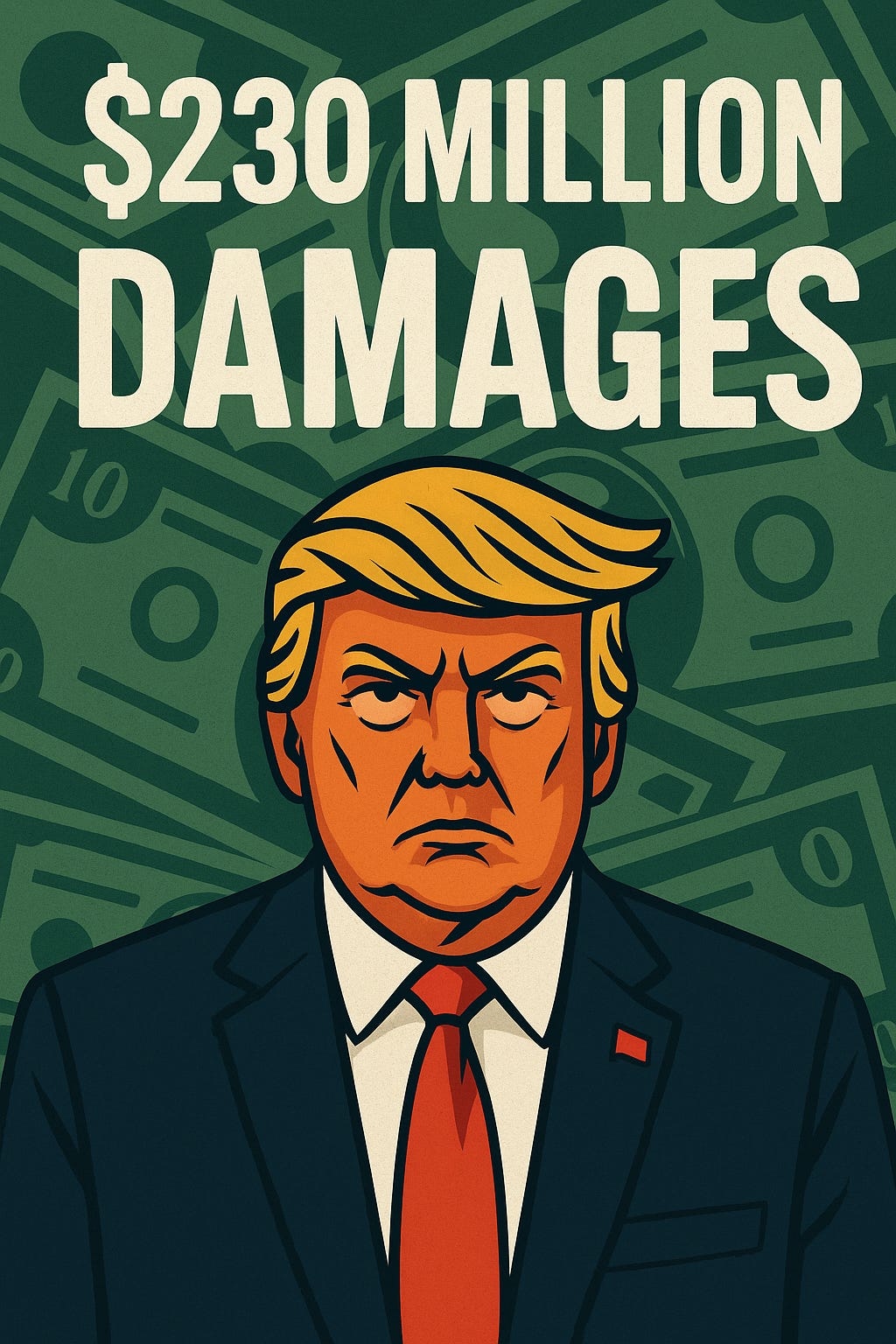
Donald Trump believes the Justice Department owes him money — $230 million, to be exact, not for services rendered, not for a project completed, but for the “emotional and reputational harm” caused by the federal investigations into his actions before, during, and after his first term as president.
The claim is real. It stems from administrative filings submitted by Trump’s legal team between 2023 and 2024, seeking damages under the Federal Tort Claims Act. The justification? He argues that investigations like the Mueller probe and the classified documents case were politically motivated attacks. In his words: “They owe me a lot of money.”
And maybe, in a different timeline, this would be nothing more than a headline — a former president suing his own government for a bruised ego. But Trump isn’t a private citizen nursing old grudges. He’s the president of the United States — again (somehow), and he now controls the very Justice Department he claims wronged him.
Which raises a much bigger question than whether this payout is legal. The question is whether it’s happening in plain sight — with taxpayer dollars — while basic services go unfunded, justice is bent, and institutions are gutted from within.
Hint: The answer is yes. (Sigh)
Because democracy doesn’t defend itself, and neither does your sanity. Subscribe here to keep your eyes open and your sarcasm sharp.
The Story He’s Telling, and the One the Record Tells
According to Trump, the federal investigations that shadowed his first term weren’t just misguided, but were, instead, malicious. He claims that the Russia probe, the Mar-a-Lago search, and multiple criminal inquiries were part of a coordinated political attack designed to weaken him personally and damage his reelection chances. In seeking $230 million from the DOJ, he is not just asking for damages. He’s demanding vindication.
The official record, however, tells a different story. These investigations weren’t backroom smears or partisan fantasies. They were launched in response to serious questions about national security, election interference, and the handling of classified materials. And in Trump’s first term alone, the House of Representatives found those concerns grave enough to justify two impeachments — one in December 2019, and another in January 2021.
The first was for abuse of power and obstruction of Congress, stemming from Trump’s efforts to pressure Ukraine into announcing an investigation of Joe Biden. The second came after the insurrection at the Capitol, when Trump attempted to overturn the 2020 election and was charged with incitement of insurrection.
Neither impeachment resulted in conviction, but both confirmed that the concerns driving federal scrutiny of Trump weren’t political fantasies. They were matters of constitutional gravity.
If anything, the fact that Trump was impeached while in office and is now seeking a personal payout for those same inquiries raises an even more unsettling question: Is this about justice, or revenge?
Justice, Reversed
Since returning to the presidency, Trump has done more than revive his grievances. He’s begun rewriting the system that held him accountable. At the center of that effort is the Department of Justice. The very agency he accused of overreach now operates under his authority. And increasingly, its actions suggest that Trump isn’t seeking justice. He’s wielding it, or at least his version of it.
Over the past year, the DOJ has launched or revived investigations into a striking number of Trump’s most vocal critics. Former FBI Director James Comey was indicted after career prosecutors initially declined to bring charges — and only after Trump replaced the U.S. attorney overseeing the case. New York Attorney General Letitia James, who led the civil fraud case against Trump, is now facing criminal charges of her own, brought by a DOJ team following months of Trump’s public calls for her prosecution.
See some of our previous reporting on these cases here:


And the list grows longer: Jack Smith, the special counsel who pursued the classified documents case; Christopher Krebs, the former cybersecurity official who debunked Trump’s false election claims; Miles Taylor, John Bolton, even Chris Christie — all have been targeted by investigations or administrative actions that appear retaliatory in nature.
What connects them isn’t criminal behavior. It’s criticism or the threat of testimony against Trump in ongoing legal cases. At a moment when Trump is demanding $230 million from the very department he now controls, these moves look less like routine oversight and more like a systematic effort to discredit witnesses before they can speak.
And the damage isn’t limited to Trump’s perceived enemies. Inside the DOJ itself, there’s been a quiet but devastating exodus. The Civil Rights Division has lost 368 employees since Trump returned to office, nearly 100 through resignations. The Federal Programs Branch, tasked with defending federal policies, has seen two-thirds of its attorneys quit. Across the department, more than 4,000 employees have exited through buyouts or resignations.
Oversight has eroded alongside capacity. In July 2025, the department’s longtime senior ethics advisor, Joseph Tirrell, was abruptly fired by Attorney General Pam Bondi. Tirrell had overseen conflict-of-interest reviews for DOJ leadership, including financial disclosures. His dismissal came amid a broader purge of internal watchdogs and legal staff tied to prior investigations into Trump and January 6.
And yet, it is this hollowed-out department — under the control of Trump loyalists, missing thousands of career professionals, and stripped of its internal guardrails — that now holds the power to approve or deny Trump’s $230 million claim. There is no court involved. No neutral third party. Just Trump’s Justice Department, deciding whether its boss deserves a payout.
When a legal system becomes this compromised, the question isn’t whether justice will be served. It’s whether justice is still possible.
See our earlier reporting here:
Note: Some of these articles may be over 45 days old and thus now live in our archive. Consider becoming a paid subscriber for exclusive perks including full access to our nearly 1200 articles.


Pardons as Payoffs
To understand how Trump sees justice, you don’t need to guess. Just look at whom he forgives.
During his first term, Trump used the pardon power not to address systemic injustice, but to protect personal allies. Two of the most notable recipients were Michael Flynn, his former national security adviser, and Roger Stone, a longtime confidant. Both men were deeply entangled in the Russia investigation. Flynn twice pleaded guilty to lying to federal investigators. Stone was convicted of witness tampering and lying to Congress.
See our reporting on Trump’s use of the power of the pardon here:
Note: This article is more than 45 days old and now lives in our archive. Consider becoming a paid subscriber for exclusive perks including full access to our extensive archive.

In a traditional White House, those outcomes might have prompted a president to distance himself — to express regret, even if only for appearances. But Trump went the other way. He publicly praised both men, criticized the prosecutors, and eventually wiped their slates clean.
The message was unmistakable: if you stay loyal, you’ll be protected. If you tell the truth — or pose a threat — expect consequences.
That logic now echoes in Trump’s $230 million damages claim. In this telling, the wrongdoing wasn’t committed by the men who lied or obstructed justice. It was committed by the institutions that tried to hold them accountable. And in that logic, Trump isn’t just entitled to erase their crimes. He’s entitled to be compensated for the mere inconvenience of being investigated.
In a legal sense, pardons eliminate punishment, not guilt. But in Trump’s orbit, the distinction is meaningless. What matters is who you serve, not what you did.
For Trump, justice is punishing your enemies and rewarding your allies.
Even Some Republicans Are Saying the Quiet Part Out Loud
While most current Republican leaders have remained silent about Trump’s demand for $230 million, not everyone in the party is looking the other way. In a rare and striking public statement, a group of nearly 40 prominent Republican figures — many of them former governors, cabinet officials, and senior Justice Department veterans — warned that Trump’s actions amounted to an “abuse of power” that “threatens the rights of every American, as well as the stability of our economy.”
Their concern wasn’t just about the payout itself. It was about what it symbolizes: a sitting president using the machinery of government to settle personal scores and then demanding public funds as compensation. As one part of the statement read, “Whenever one believes politicization of justice started, there’s no question that it has entered a new and disturbing chapter.”
Most of the signatories no longer hold office, and that, too, is revealing. Those speaking out are the ones who no longer depend on party loyalty, campaign donations, or Trump’s approval to stay afloat. Their titles may carry the word “former,” but their message carries weight: this is not politics as usual. This is something darker.
That their warning was met with silence from the current GOP leadership says just as much. The cost of dissent in today’s Republican Party is high. The cost of silence, it seems, is even higher, at least for the country.
History Repeating, This Time from Inside the System
It’s tempting to treat Trump’s demand for DOJ damages as a fresh outrage, just another headline in a long list. But the truth is, this moment was foretold. It’s the logical next step in a pattern that Congress recognized years ago.
In 2019, Trump was impeached for abuse of power and obstruction of Congress after pressuring Ukraine to launch a baseless investigation into Joe Biden, the same kind of fabricated scandal Trump now claims damaged him. He tried to use the powers of the presidency to smear a political opponent under the guise of law enforcement. Congress called it what it was: a violation of his oath.
Then, in 2021, he was impeached again, this time for incitement of insurrection after encouraging a violent attack on the U.S. Capitol to overturn a democratic election. That second impeachment wasn’t just about a riot. It was about a president trying to bend the institutions of democracy to serve himself.
Now, with Trump back in office, the story hasn’t changed. What has changed is the venue and scale. He no longer needs to twist the rules from the outside. He has control of the Justice Department, a loyal party apparatus, and an appetite for retribution. The very things he was impeached for — using the government to silence opponents, delegitimize accountability, and consolidate power — are now core functions of his administration.
This isn’t political theater. It’s a test of whether the impeachment warnings meant anything, because if they didn’t, Trump’s latest demand isn’t just bold. It’s proof that the Constitution’s safeguards are only as strong as our willingness to enforce them.
A Price Tag Paid by Everyone Else
The $230 million Trump is seeking wouldn’t come from a private settlement or personal opponent. It would come from the federal government, which means from taxpayers. These are the same people already stretched thin by rising prices, diminished services, and economic policy choices that were championed by Trump himself.
During his first term, Trump’s aggressive tariff policies increased costs on everyday goods, and starting in April 2025, he doubled down. New rounds of tariffs targeting steel, aluminum, electric vehicles, and other imports sent fresh price shocks through the economy. His administration has continued to champion budget cuts to social services, including housing and education, under the familiar banner of “efficiency.” And while corporate donors rally to fund Trump’s pet projects — including a newly started White House ballroom — working families are left to navigate shrinking benefits and rising costs.
See our recent reporting here:

Now, just nine months into his second term, he wants $230 million in “damages” — money he claims is owed to him because he was investigated for wrongdoing that was never fully adjudicated. But the DOJ doesn’t print its own money. That payout would be public money — taxpayer money — redirected not to schools, or healthcare, or food programs, but to the personal bank account of a man who already owns golf courses, high-rises, and a donor-funded ballroom.
Trump has made various claims about how he might use the funds, from donating it to charity to paying for his (now corporate donor funded) ballroom. He has, notably, not committed to any particular plan. However, a logical solution would be to cut out the middleman and just fund the programs he has already decimated.
To put the figure in real terms: $230 million could provide nearly 300,000 American students with a full year of school lunches. That’s not a talking point — that’s a federal calculation based on current reimbursement rates.
We can feed the ego of an independently wealthy elected official — or 300,000 children. This isn’t a hard decision.
What We Reward, We Repeat
Donald Trump isn’t just asking for money. He’s asking for something far more dangerous: a reward for evading accountability.
He wants the public to pay him for being investigated, for being held to the same standard every public official should meet. He wants to turn scrutiny into profit, oversight into grievance, and public money into a personal prize.
But this moment is not just about him. It’s about what kind of government we’re willing to accept, and what kind of public we’re willing to be. Are we a country that cuts school lunches while handing out cash to billionaires with bruised egos? Are we a democracy that punishes truth-tellers and pardons liars? Are we still brave enough to say no to power when it demands something it hasn’t earned?
The Senate in 2019 and 2021 failed to impeach him. He was reelected in 2024. Will we allow him to be rewarded for his evasion of justice? Or will we finally say: Enough.
Don’t let the bastards sneak anything past you. Subscribe and get your daily dose of rage and receipts delivered fresh, before the spin doctors can scrub it.
Sources:
“Trump says he’d have final say on money he seeks over past federal investigations into his conduct,” AP News, Oct 21, 2025.
“Trump says he’s owed a ‘lot of money’ over federal probes. Here’s how the government could pay him,” AP News, Oct 22, 2025.
“Trump says he has final say on paying himself $230m for past investigations,” The Guardian, Oct 22, 2025.
“Trump seeks up to $230M from DOJ over alleged targeting — may spend on WH ballroom,” New York Post, Oct 21, 2025.
“Two‑thirds of the DOJ unit defending Trump policies in court have quit,” Reuters, Jul 14, 2025.
“US Justice Dept civil rights unit faces mass exodus,” Reuters, Jul 23, 2025.
“US justice department asks civil rights division attorneys to stay after mass exits,” The Guardian, May 14, 2025.
“Trump has asked Justice Dept. for $230 million for claims …”, CBS News, Oct 22, 2025.
“Exclusive: Prominent Republicans slam Trump for ‘abuses of power’,” Axios, Oct 9, 2025.
“Trump Hit With Humiliating Attack From Republicans Over …,” Yahoo News, Oct 9, 2025.

Trump is a serial deadbeat bankruptcy filer. He can add this to the list of everyone he's stiffed in his miserable life. Satan is still waiting.
Why is there not a single Republican congressman who thinks this is wrong and is protesting against it? I really cannot imagine that all Republican congressmen approve of this.