


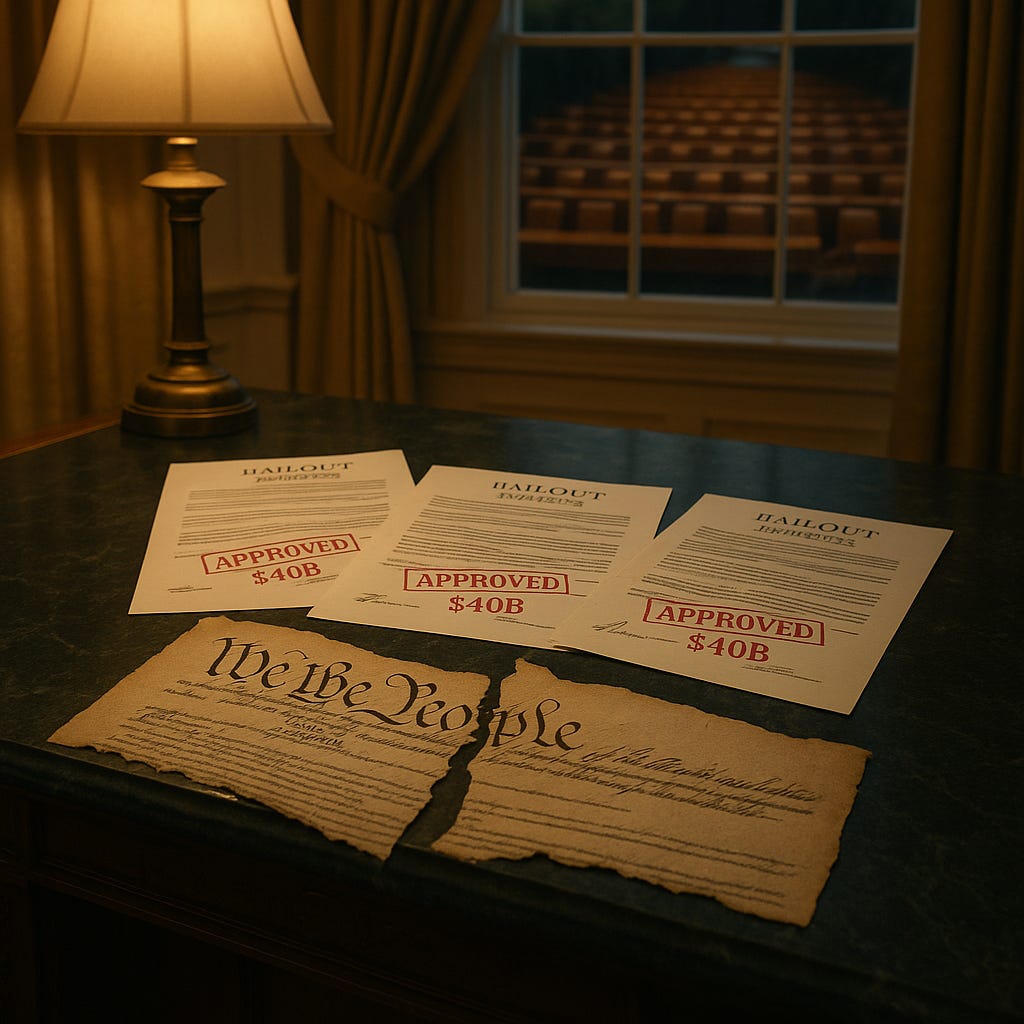
While Washington is locked in yet another shutdown fight and farmers are counting pennies to keep combines running, Donald Trump just found forty billion dollars — not for veterans, not for drought relief, not for rebuilding the Midwest — but for Argentina.
Late last week, Treasury Secretary Scott Bessent quietly confirmed that the administration has already opened a $20 billion currency-swap line with Argentina’s central bank. It’s meant to “stabilize the peso,” he said, as if the U.S. taxpayer moonlighted as a global currency doctor. Then, almost in the same breath, he floated a second $20 billion package of “debt-relief financing,” cobbled together through private banks and sovereign-wealth funds. Add it up, and the Trump administration is dangling a $40 billion lifeline to Buenos Aires, a sum larger than the entire annual budget of the Department of Education.
We just hit 25,000 subscribers, 1,000 articles, and 1,000 podcast episodes. To celebrate, paid subscriptions are 20% off for a limited time. That’s just $64/year—less than $1.25 a week.
The official story is that this is about “regional stability” and “friendship with President Javier Milei,” the far-right libertarian who models himself after Trump. But look a little closer, and the math gets ugly. Argentina competes directly with American farmers in the production of soybeans, corn, and beef. Helping Milei shore up his currency means helping Argentine exports flood the same markets that U.S. producers are struggling to keep. Even Senate Republicans from farm states are grumbling to Axios that the bailout “makes no economic sense.” They’re right — unless the goal isn’t economics at all, but politics.
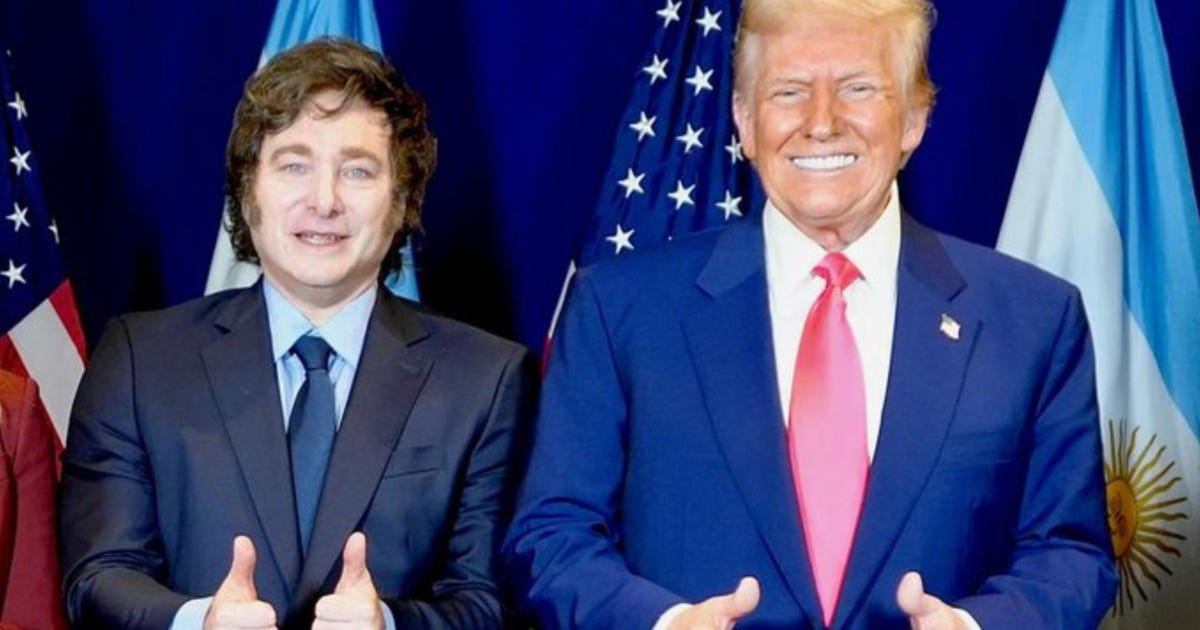
Trump has consistently viewed foreign aid as a test of loyalty. If you praise him, the vault opens. If you cross him, the credit line shuts. This Argentina deal isn’t charity; it’s patronage on a continental scale, a favor to a friend wrapped in the flag of free markets.
And he’s doing it without a single vote from Congress.
The Constitutional Problem
Here’s the part Trump and his loyalists hope no one remembers: the Constitution puts Congress — not the President — in charge of the money.
Article I, Section 9, Clause 7 — the Appropriations Clause — couldn’t be plainer: “No Money shall be drawn from the Treasury, but in consequence of appropriations made by law.”
That single sentence is the spine of America’s fiscal democracy. It means the people, through their representatives, decide how public money is spent. Every program, every check, every dollar that leaves the Treasury must trace back to a law passed by Congress. When a president spends outside that authority, it’s not “policy innovation.” It’s theft.
Trump’s $40 billion Argentina scheme ignores that line completely. There’s no statute that allows a president to wire tens of billions overseas for a foreign “bailout.” The Foreign Assistance Act of 1961 lays out how and when aid can be given, and none of its sections authorize an open-ended rescue of a foreign central bank. That act caps what agencies like USAID or the Treasury can do without a congressional appropriation. Even the International Development Finance Corporation, which backs private investment abroad, is limited by congressional ceilings. None of those channels adds up to $40 billion.
Trump’s team is hinting they’ll use the Exchange Stabilization Fund (ESF), a Depression-era account at Treasury originally designed to smooth short-term currency shocks. The ESF is funded by prior congressional appropriations and gold-reserve profits, and it can be used in coordination with the Federal Reserve for temporary liquidity swaps. But that authority has strict boundaries. It’s meant for emergencies that protect U.S. monetary stability, not to underwrite a foreign government’s debt.
The Government Accountability Office (GAO) has repeatedly warned that large ESF interventions must be “necessary to protect the exchange value of the dollar,” not foreign currencies. Argentina’s peso doesn’t qualify.
The Impoundment Control Act of 1974 reinforces Congress’s supremacy over spending. It was written precisely because presidents — including Nixon — tried to redirect or withhold funds for political reasons. The Act requires any change in how appropriated funds are spent to be submitted to Congress for approval. Trump isn’t submitting anything. He’s bypassing the entire process.
Bottom line: there is no emergency declaration, no enabling law, and no congressional authorization.
If he proceeds, Trump will be drawing tens of billions from federal accounts without legal authority, an impeachable offense in every sense of the word.
And as usual, creativity is just camouflage for corruption.
The Workaround: How Trump Is Trying to Pull It Off
When a president knows what he’s doing isn’t legal, he doesn’t stop. He gets creative. And Scott Bessent, Trump’s hand-picked Treasury Secretary and former hedge-fund manager, is creativity in a tailored suit. His plan reads like something dreamt up in a Cayman Islands conference room: use the Exchange Stabilization Fund (ESF) as the seed money, then “leverage” it with private banks, sovereign wealth funds, and off-book credit guarantees to multiply its effect.
On paper, it’s not a direct appropriation. In practice, it’s a back-door bailout using taxpayer assets as collateral.
The ESF isn’t supposed to be a slush fund for presidential diplomacy. Created in 1934, it was intended to stabilize the U.S. dollar during times of crisis — for example, to intervene when currency markets posed a threat to domestic financial stability. It operates quietly, under the Treasury Secretary’s control, but within clear boundaries. When previous administrations used it to set up small swap lines, such as during the 1994 Mexican peso crisis, they did so under explicit congressional notification, with narrowly defined limits and oversight.
Trump’s version obliterates those norms. A $20 billion swap line with Argentina’s central bank has already been announced. The Treasury then plans another $20 billion “debt-relief facility” underwritten by a patchwork of international financiers who, according to Politico and Reuters, will receive implicit U.S. guarantees. That means that if Argentina defaults, American taxpayers will bear part of the loss.
No law authorizes that. No Congress approved it. And no modern president — not Obama, not Bush, not even Reagan — has ever attempted to deploy the ESF at this scale, let alone for the benefit of a foreign ally’s political survival.
The deeper concern is precedent. If Trump can conjure $40 billion in “outside financing” by pledging U.S. credibility, what stops a future president from doing the same for any friendly autocrat who flatters them on TV? This isn’t foreign policy. It’s a shadow budget, diplomacy by IOU.
And that’s the point. The complexity isn’t a bug; it’s a cover. Because behind every “innovative” financing scheme lies the same motive.
The Politics Behind the Payout
If you strip away the economic jargon, Trump’s $40 billion Argentina bailout looks less like policy and more like political patronage on a continental scale. The beneficiary isn’t the American taxpayer. It’s Javier Milei, the self-styled libertarian who calls himself Trump’s “spiritual twin.”
Every major outlet covering this story confirms that Trump’s Treasury is designing this rescue specifically to prop up Milei’s fragile government. Reuters reported on October 15 that Treasury Secretary Scott Bessent said the U.S. “is working on a $20 billion debt facility” after already extending a $20 billion swap line with Argentina’s central bank. AP News described it more bluntly: the U.S. is “working on doubling aid to Argentina to $40 billion” to support Milei’s “market reforms.”
Those “reforms,” by the way, include privatizing Argentina’s public utilities, gutting labor protections, and deregulating exports, policies that make the peso temporarily stronger but flood global commodity markets with cheap Argentine soy, corn, and beef.
That’s why Axios reported that Senate Republicans from farm states are “furious,” warning the bailout “makes no economic sense” because it hurts U.S. farmers already losing market share to Argentina and Brazil.
It’s a fair warning: Argentina has replaced the U.S. as China’s top soybean supplier this year. Bailing out Buenos Aires helps Milei keep shipping those beans abroad while American producers face higher costs and shrinking export orders. Farmers who once sold to China at $15 a bushel are now watching that price sink and wondering why their president is stabilizing someone else’s economy while theirs is in crisis.
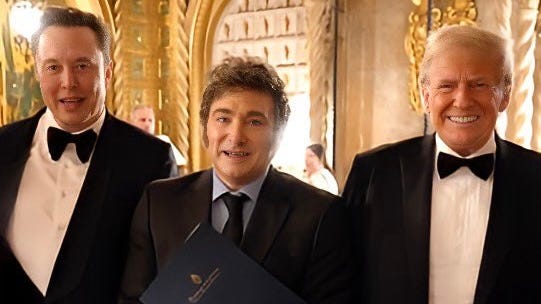
Photo: Javier Milei / X
Politically, the logic is simpler. Milei praises Trump, mimics his slogans, and frames himself as a “global crusader against socialism.” In return, Trump rewards him with billions. It’s the same transactional pattern we’ve seen from Trump’s White House since day one: personal loyalty first, legal authority last.
And while Trump boasts that he’s countering “Chinese influence” in Latin America, none of this money actually counters China. It simply subsidizes a foreign competitor. The real losers are at home: the Iowa soybean farmer, the Illinois meat-packer, the Kansas grain co-op.
As one Senate aide told Politico, “We’re watching the president raid Treasury to bankroll a campaign poster in Buenos Aires.”
Milei gets a bailout. U.S. farmers get foreclosure notices. And the Constitution gets ignored.
The Legal Verdict
Let’s strip the politics away and look purely at the law.
There is no legal pathway for a president to unilaterally commit $40 billion in public funds — directly or indirectly — to a foreign bailout.
Every major authority that governs spending, aid, and fiscal control points in the same direction: Congress holds the purse, not the White House.
Start with the Appropriations Clause in Article I, Section 9:
“No Money shall be drawn from the Treasury, but in Consequence of Appropriations made by Law.”
That clause is more than a technicality. It’s the legal firewall separating democracy from monarchy.
Then there’s the Foreign Assistance Act of 1961, which defines how aid can be given to foreign nations. Section 531 sets strict conditions for development loans and credits, all of which require congressional approval and annual appropriation ceilings. Nothing in that statute authorizes an emergency “bailout” or “currency swap” of this magnitude.
Next comes the Impoundment Control Act of 1974, Congress’s answer to Nixon’s attempts to redirect and withhold appropriated funds. The Act requires that any presidential proposal to rescind or repurpose funds be submitted to Congress within 45 days. Trump hasn’t done that because no existing appropriation covers this bailout in the first place.
The Government Accountability Office (GAO) has long held that the ESF “may not be used primarily for foreign policy or development assistance purposes.” Its 1989 and 1995 rulings both warned that using the ESF to subsidize foreign governments exceeds Treasury’s statutory authority unless the action “protects the value of the U.S. dollar.” Argentina’s bailout does not.
When the Clinton administration used the ESF to address Mexico’s peso crisis in 1995 — an intervention of $20 billion — it did so under the explicit authorization of the Emergency Mexican Stabilization Act, which Congress passed following debate. Trump has no such authorization.
Finally, in Train v. City of New York (1975), the Supreme Court held that the president cannot alter or ignore spending laws passed by Congress. The logic cuts both ways. The president also cannot create spending authority where Congress provided none.
So when Trump moves $40 billion through Treasury accounts and private intermediaries without a single appropriation, it’s not “economic strategy.” It’s a constitutional violation, one that mirrors his first impeachment, when he withheld congressionally approved funds from Ukraine for political leverage. Only this time, he’s not freezing aid. He’s fabricating it.
And that’s what makes this moment more dangerous than the last — because it’s not just a single violation, it’s a governing philosophy.
The Bigger Pattern
Donald Trump has never believed in the separation of powers. He believes in the separation of loyalty. The only line that matters to him is whether you serve him or not. Everything else — the Constitution, Congress, the courts — are obstacles to be bulldozed, bypassed, or bribed.
The Argentina bailout isn’t an exception to that rule. It’s the latest entry in a long, familiar pattern: use public money to reward friends, punish enemies, and reshape institutions to obey the will of one man.
We’ve seen this movie before. In 2019, Trump froze $391 million in congressionally approved military aid to Ukraine, demanding “a favor” before releasing it, a quid pro quo that triggered his first impeachment. When that scandal broke, his defense was the same as today: that foreign policy is his domain, and oversight is “political.” The courts disagreed then, and the Constitution still disagrees now.
Since returning to office, the same pattern has metastasized. He has directed agencies to defy subpoenas, purged civil servants who question him, and attempted to convert the Justice Department into a private enforcement arm. Now, with Treasury under Scott Bessent, he’s extending that corruption into global finance, turning the Exchange Stabilization Fund into what one economist called a “shadow State Department with a checking account.”
The bailout also exposes how Trump defines “America First.” It doesn’t mean American farmers, workers, or taxpayers. It means whoever flatters him most gets to cash the check. Javier Milei praises him as a “hero of capitalism,” and suddenly $40 billion materializes. Meanwhile, the administration slashes farm support, guts rural broadband grants, and tells struggling households that “the budget is tight.”
The deeper danger is institutional. Once a president proves he can move billions through gray-zone mechanisms like the ESF without congressional approval, the precedent outlives him. Future presidents — of any party — could do the same, claiming “emergency authority” while funneling money to their chosen allies. That’s how democracies drift into monarchies: one discretionary act at a time.
This is why the No Kings movement resonates. It’s not about hating Trump; it’s about refusing to accept that any leader can rule by decree. The United States was built on a simple promise: that no one — not even a billionaire in a red tie — gets to spend your money without your consent.
No Kings, No Blank Checks
Every democracy eventually faces a test like this, a moment when the person in power dares the public to notice that he’s stopped asking for permission.
Trump’s $40 billion Argentina bailout isn’t about pesos or policy. It’s about precedent. It’s about whether one man can claim the right to spend your tax dollars on his friends without the people’s representatives ever voting on it.
If we let that stand, we stop being a constitutional republic and start being an empire run on credit. The Founders understood this danger intimately. That’s why they gave Congress the power of the purse — not as a budgetary convenience, but as a safeguard against exactly this: a ruler who treats the Treasury like a campaign fund.
The same man who once withheld aid from Ukraine to pressure a foreign leader is now writing aid checks to another who flatters him. The playbook hasn’t changed. Only the scale has.
And while he funnels billions overseas, everyday Americans are told to tighten their belts — farmers scraping by, small towns losing hospitals, students crushed under debt. The message is clear: there’s always money for politics, never for people.
That’s not “America First.” That’s power first.
No one elected Donald Trump to act as a global banker, and no law grants him the right to do so. Yet he moves forward anyway, daring Congress, the courts, and the press to stop him.
This is the moment to draw the line. Not just for this administration, but for every one that follows. If a president can unilaterally move $40 billion without a vote, then the power of the purse is dead, and with it, the idea of consent.
No kings. No blank checks. No more pretending this is normal.
What Trump is testing isn’t Argentina’s credit, but America’s memory of who holds the purse.
Support Independent Media
Legacy media will frame this as a “policy disagreement.” It’s not. It’s a constitutional crisis with a price tag, and the bill lands in your mailbox. Independent outlets like this one are the last line keeping the receipts visible and the truth unspun.
If you value this kind of reporting and analysis — the kind that isn’t afraid to name names or follow the money — become a paid subscriber today.
It’s how we keep the lights on.
It’s how we stay free.
And it’s how we remind those in power that the people are still watching.
Bibliography:
U.S. Is Working on Doubling Aid to Argentina to $40 Billion by Tapping Private Funding Sources — October 15, 2025, AP News
U.S. Buys Argentine Pesos, Finalizes $20 Billion Currency Swap — October 9, 2025, AP News
Bessent Says U.S. Considers Doubling Aid to Argentina by Tapping Outside Funding— October 15, 2025, Politico
U.S. Buys More Argentine Pesos, Working on $20 Billion Debt Facility, Bessent Says — October 15, 2025, Reuters
Use of Exchange Stabilization Fund Resources: Arrangement with Treasury Provides Access to Information, ID-77-42. (1977), U.S. Government Accountability Office
Institute for International Economics. The Exchange Stabilization Fund (PDF).
These corrupt organized criminals just can't wait to destroy the value of the dollar and replace it with with meme coins. The fact that it is down on FX 10% ytd is in no way satisfactory to them. This is just the beginning of a plan to essentially sell massive amounts of dollars and drive it down at least 50%. We are a consumer driven economy. This is an impending economic catastrophe!
I've lost track of how many things that this orange clown should he impeached for. I've also lost track of whether it matters, because it clearly doesn't. He didn't go to jail and he did run again, so it seems like it doesn't matter. Our government has checks and balances except when the people in charge say that it doesn't. So where does that leave us?