


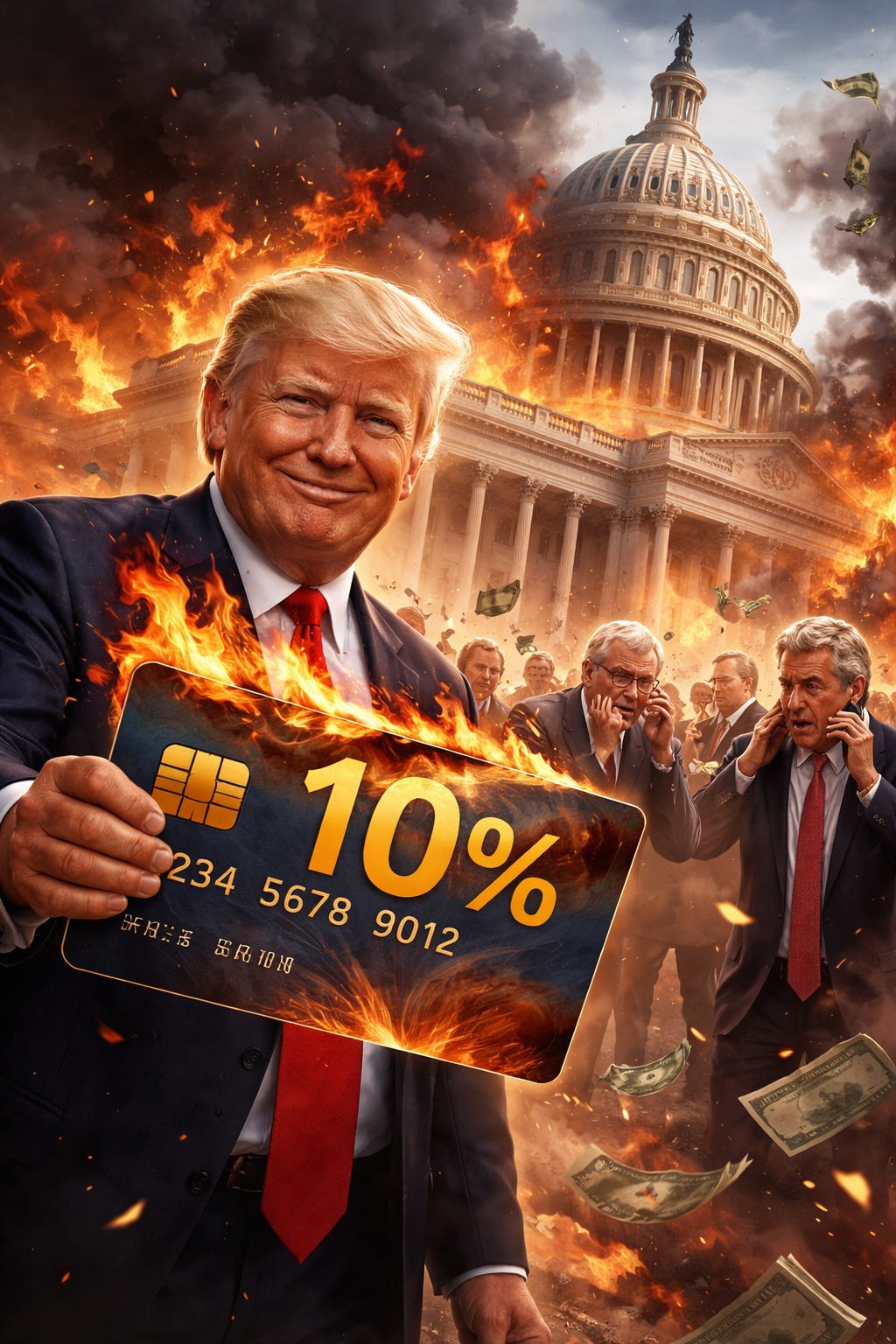
In an election season dominated by inflation, housing insecurity, and healthcare debates, no one expected credit card interest rates to become the newest flashpoint in American politics. Yet in a moment that caught even his own party off guard, President Donald Trump announced in early January that credit card interest rates should be capped at 10%. The message was clear, dramatic, and familiar in tone: the big banks are ripping you off, and I’m here to stop it.
At first glance, it seemed like another Trumpian populist swerve, a bold, plainspoken attack on corporate greed, tailor-made for midterm campaign trail applause. However, there was no executive order, legislative proposal, or enforcement mechanism. There was just the announcement, delivered with all the confidence of a policy already decided.
In that void, a political game was set in motion, one that may ultimately backfire on Trump’s own party and unravel one of the GOP’s most carefully guarded contradictions: the delicate balance between populist rhetoric and corporate loyalty.
Want to Know Your Rights?
Download a free digital copy of the U.S. Constitution, the same document Trump is trying to bulldoze. Learn exactly what he’s breaking, and how to fight back.
100,000+ strong — and counting.
This winter of our discontent, become a paid subscriber for just $1 a week and help us keep the truth alive.
Join The Coffman Chronicle — $1/Week
Trump’s Populist Bluff
On January 10, 2026, Trump made headlines by calling for a one-year cap on credit card interest rates, stating that rates should be capped at 10% to protect American consumers from “predatory” practices. It was a proposal designed to strike a chord. With average credit card APRs hovering above 20%, and many working- and middle-class Americans struggling with ballooning debt, the idea was wildly popular, even among voters far outside Trump’s base.
However, there was a catch. Trump provided no details on how this cap would be implemented. There was no legislative plan, no executive directive, and no indication that he intended to use the actual levers of government to enforce such a policy. It was, in short, a populist bluff, a message crafted to sound like decisive action without delivering any of the substance required to make it real.
And yet, the political implications were very real.
The Real Legislation: Sanders and Hawley Take the Lead
Unbeknownst to many outside policy circles, Senator Bernie Sanders (I-VT) and Senator Josh Hawley (R-MO) had already introduced a bill that would do exactly what Trump claimed he wanted. The “10 Percent Credit Card Interest Rate Cap Act” (S.381) was introduced in March 2025, long before Trump’s announcement, and proposes a federally mandated 10% cap on credit card interest rates.
Unlike Trump’s vague demand, this bill contains concrete enforcement mechanisms, including provisions for consumer restitution and regulatory oversight. It is a rare piece of bipartisan economic populism, and the only viable path to actually capping interest rates at the level Trump promoted.
The bill, however, has been referred to committee and has not advanced. It remains stalled in a GOP-led Congress that has, thus far, shown little appetite for imposing hard caps on corporate profit centers like credit lending.
Why Trump Doesn’t Actually Want the Cap to Pass
For a president who thrives on control and narrative dominance, the existence of the Sanders–Hawley bill presents a problem. If Congress passes S.381, Trump would be faced with a dilemma: sign it into law and legitimize a bill written by two senators who are either ideologically opposed to him (Sanders) or potential rivals for his base (Hawley), or oppose it and reveal that his populist talk was just that — talk.
Signing the bill would mean validating Sanders’ lifelong campaign against corporate exploitation, which would undercut years of Trump’s branding of Sanders as a dangerous socialist. It would also elevate Hawley, a younger, ambitious conservative who has been maneuvering to claim the mantle of populist reformer within the GOP.
More importantly, it would anger Trump’s donor class, which includes banking and financial industry interests that stand to lose billions under a real rate cap. If the cap is implemented and has ripple effects such as tighter credit access and reduced lending, Trump would be president when the fallout hits, forced to defend a policy that many in his economic orbit quietly oppose.
What Trump needs, then, is not for the policy to pass, but for the appearance of the fight to continue. That allows him to claim the high ground without ever taking responsibility for the outcome.
The Political Trap for the GOP
This dynamic has now created an inescapable trap for congressional Republicans. Trump’s public call for a 10% cap on interest rates has put the party in a political vise, squeezed between the expectations of a populist base and the financial demands of Wall Street donors.
GOP lawmakers now face a no-win scenario. If they support the Sanders–Hawley bill, they anger corporate donors and risk being labeled anti-business by their own party establishment. If they oppose it, they appear to be standing in the way of their own president’s proposal, and more critically, standing against a wildly popular policy at a time when Americans are drowning in debt.
For Republicans who initially dismissed the cap as unrealistic or dangerous to the economy, a stance many took in early January, the trap gets even tighter. If they reverse course now, they face accusations of spineless backpedaling. If they stick to their opposition, they’re effectively undermining Trump, whose endorsement is still the most powerful weapon in any Republican primary.
In an election year, especially one where midterm control of Congress hangs in the balance, this kind of internal contradiction is toxic. Trump has set the stage. Now he’s watching to see who salutes and who hesitates.
A Loyalty Test Disguised as Policy
Whether Trump intended it or not — and there’s a strong case to be made that this was accidental populist theater rather than strategic 4D chess — the credit card cap has become an unspoken loyalty test for Republican lawmakers.
Those who rush to back the idea, even symbolically, may earn Trump’s praise, or at least avoid his wrath. Those who don’t may find themselves out of step with the base, staring down primary challengers, or quietly cut off from the MAGA machine.
This is classic Trump politics: float a popular, unsubstantiated idea. Watch who scrambles. Punish those who hesitate. Take credit if something good happens. Blame Congress if it fails.
Why Democrats Should Sit This One Out
For Democrats, this is not a fight worth jumping into directly. The smartest move right now is to let Sanders and Hawley do the work. Sanders is not technically a Democrat, and his reputation as a relentless crusader against corporate greed makes him the perfect face for this issue. Hawley’s involvement ensures the bill stays in the bipartisan realm, exactly where it needs to be to force the GOP to fracture.
Democrats in leadership should resist the temptation to turn this into a partisan battle. If they press too hard, they give Republicans a reason to circle the wagons. Instead, they should let the GOP's internal contradiction continue to fester. The longer it does, the more visible and damaging it becomes.
Let Sanders call for votes. Let Hawley apply pressure. Let Trump keep talking. Meanwhile, Democrats can quietly prepare for the midterms with a clear narrative: Republicans blocked their own president’s plan to help working Americans.
The Irony: Credit Card Interest Could Break the GOP
After all the crises, all the cultural battles, all the impeachments, and all the policy failures, it might be credit card interest rates that finally split the Republican Party— not immigration, not taxes, not even democracy, but the simple, universally understood injustice of being charged 25% interest on a gallon of milk you bought in 2022.
That’s the quiet brilliance of this moment, intentional or not. The issue is accessible, emotional, relatable, and impossible to defend on the merits.
Trump doesn’t want to fix it. He wants to own it rhetorically and let others take the fall for not delivering. If Republicans in Congress fall into that trap and lose the midterms, they won’t just lose seats. They’ll lose their shield. Trump has already said that if Democrats retake the House, they will impeach him again.
The stakes aren’t just political. They’re existential.
Final Thoughts
Trump never planned to cap credit card interest rates. He planned to sound like he would, take the credit if someone else made it happen, and punish his enemies if they didn’t.
Yet the bill is real, and so are the consequences. Now, so is the risk, not just to his party, but to his presidency.
In trying to sound like a hero of the working class, Trump may have finally created a policy dilemma he can’t control, and a wedge that could tear the GOP in two.
Enjoyed this breakdown?
Subscribe to get more sharp, narrative-driven analysis of U.S. political theater, power plays, and the fault lines that actually matter. No noise, just clear reporting and commentary on the real dynamics shaping Washington.
Stay informed. Stay ahead. Stay sharp.
Sources:
“S.381 — 10 Percent Credit Card Interest Rate Cap Act (2025‑2026)” — Congress.gov (Official Legislative Record) (Introduced Feb 4, 2025)
“NEWS: Sanders, Hawley Introduce Bill Capping Credit Card Interest Rates at 10%” — Sen. Sanders Press Release (Feb 4, 2025)
“Hawley Urges Congress to Pass His Legislation to Cap Credit Card Rates Following Trump Statement” — Sen. Hawley Office (Jan 12, 2026)
“Trump calls for one‑year cap on credit card interest rates at 10%” — Reuters (Jan 10, 2026)
“Banks balk as Trump pushes for 1‑year, 10% cap on credit card interest rates” — PBS NewsHour (Jan 10, 2026)
“Trump proposes card rate cap; banks eschew idea” — PaymentsDive (Jan 12, 2026)
“Trump announces one‑year 10% cap on credit card interest rates” — The Guardian (Jan 10, 2026)
“Trump Revives 10% Credit Card Rate Cap Proposal, Offers No Details On Enforcement” — Cutoday.info (Jan 11, 2026)
“Mike Johnson criticizes Trump’s 10% credit card cap” — Axios (Jan 13, 2026)
“JPMorgan CFO warns credit card rate cap could hurt US consumers, economy” — Reuters (Jan 13, 2026)
“Citi’s top execs say a credit card cap would hurt the economy and the bank won’t support it” — Business Insider (Jan 2026)
Kind of like "I would release the Epstein files." Or $2,000 tariff refunds. Or never again will the power of the state be weaponized to prosecute political opponents. Or I will end the Russia Ukraine war on day one. Or I will reduce prices on day one or before. Or I will bring back free speech and stop all government censorship. Or I will free the military to focus on defeating America's enemies. Or I will put America and Americans first in all things...
You elected the GOP republicans now you’ll pay the price. They want you to pay not corporations, When will you learn Trump and the republicans don’t care what it cost you. As long as they get corp funding, jobs and the perks that benefit them.