


This week, two things happened that would be front-page news in any functioning democracy:
The United States dropped a precision-guided bomb on a small vessel in the Caribbean Sea, killing eleven people off the coast of Venezuela.
President Donald Trump signed an executive order renaming the Department of Defense the Department of War.
One action was violent, the other, symbolic. Taken together, they reveal something much deeper, something far more dangerous than either headline can convey on its own.
This is not just a branding shift or a military operation. This is a regime that increasingly governs by performance, escalates by instinct, and signals authoritarianism through aesthetic and bloodshed alike. The empire may be aging, but it’s lashing out with a president who has traded diplomacy for domination and is cosplaying a strongman in real time.
Stay Informed. Stay Loud.
Subscribe to The Coffman Chronicle for no-BS political analysis, action guides, and daily truth bombs you won’t get from corporate media.
The Renaming Heard Around the World
On September 4th, President Trump signed Executive Order 14683, officially renaming the Department of Defense to the Department of War. The announcement was made from the Pentagon’s Hall of Heroes under dramatically lit flags and flanked by generals, some noticeably stone-faced.
Trump justified the change as a return to “honesty and strength.” “We don’t defend anymore — we win,” he declared, ignoring the fact that the U.S. hasn’t officially won a war since 1945.
The renaming is more than a stunt. The original Department of War was dissolved after World War II, as the nation sought to project a new post-war image — not of conquest, but of security, cooperation, and deterrence. That department became the Department of Defense in 1949 by a literal act of Congress, under President Harry Truman, as part of a broader shift toward diplomacy and multilateralism during the Cold War.
Trump’s reversal is not just a semantic shift. It’s a rebranding of America’s military posture and a message to both allies and adversaries that the U.S. is pivoting away from restraint, and toward force-first nationalism.
Blood in the Caribbean
On the night of September 2nd, a U.S. MQ-9 Reaper drone launched a missile that struck a small fishing vessel operating near Isla La Blanquilla in disputed waters between Venezuela and international maritime zones. The Pentagon claimed the boat was acting as a courier for the Sinaloa cartel and presented it as a “high-value target.” Eleven people aboard were killed instantly. None were confirmed cartel operatives.
The Venezuelan government immediately condemned the strike, calling it an “act of war” and a violation of international law. President Nicolás Maduro accused the U.S. of “imperial aggression” and ordered naval patrols to shadow American warships in the region.
Though the vessel was technically outside Venezuela's territorial waters, the legality of the strike remains murky and deeply troubling.
In a statement published by the Naval War College, Pentagon legal advisor Lt. Col. Alexander Nevitt questioned the justification for such use of force under international law. He warned that launching a deadly strike on a civilian-operated vessel in international waters “may amount to a criminal act if done without clear military necessity.”
Nevitt added: “At a minimum, even in the most generous interpretation, this action opens the United States to accusations of unlawful aggression. In a rules-based international order, that matters — or at least, it should.”
His caution underscores what many in the legal community have echoed since: unilateral military action in international waters, especially against non-state actors, without congressional authorization or an imminent threat, flirts with illegality under international law and undermines the very norms the U.S. has historically claimed to uphold.
And yet, this strike — provocative, unaccountable, and possibly illegal — passed with barely a ripple in the American press, overshadowed, ironically, by the week’s other bombshell: the symbolic rebranding of the Pentagon itself.
Puerto Rico: Forward Operating Base or Staging Ground?
The same week, the White House confirmed the deployment of a new stealth F-35 squadron to Muñiz Air National Guard Base in Puerto Rico, a move Trump framed as a “security precaution” for regional anti-cartel operations.
But regional analysts see something more strategic.
The base’s location within striking distance of Venezuela, Panama, and much of the Caribbean basin raises red flags about long-term military intentions. The Trump administration’s rhetoric around “narco-terrorism” has grown increasingly aggressive, borrowing language from his early presidency but now untethered from multilateral cooperation or transparency.
Meanwhile, local Puerto Rican leaders say they were not consulted. Civil rights advocates warn the increased military footprint echoes the colonial posture that has long defined U.S.–Puerto Rico relations.
The Isolationist Who Found a Useful War
Trump campaigned in 2024 on pulling America out of “forever wars.” He called NATO “obsolete,” promised to wind down support in Ukraine, and mocked U.S. interventions in the Middle East.
But in practice, 2025 has seen a sharp escalation:
Airstrikes in Syria and Iraq in April.
Naval skirmishes in the Red Sea.
Covert drone operations in Yemen.
And now, military action in Latin America, with whispers of troop deployments to Panama if “sovereignty becomes threatened.”
This isn’t isolationism. It’s imperial opportunism, the kind that disguises aggression as deterrence and hides empire-building behind the language of “safety” and “sovereignty.”
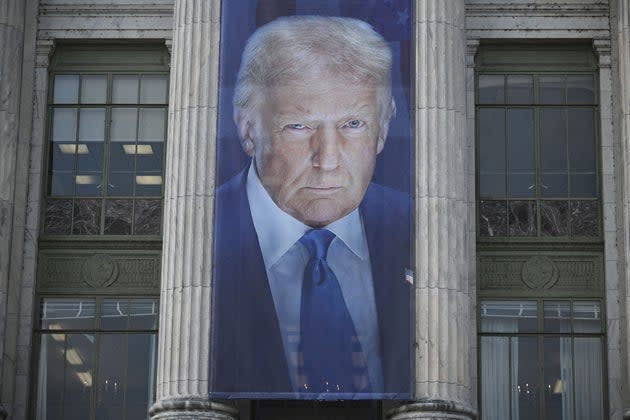
A banner showing an image of President Donald Trump hangs on the side of a U.S. Department of Agriculture building in Washington, D.C. MANDEL NGAN via Getty Images
Authoritarianism in the Open
Trump no longer hides his authoritarian aesthetic. He celebrates it.
In May, two 40-foot banners of his portrait were draped over the Department of Agriculture building in Washington. One featured Trump’s face in brooding grayscale, positioned next to Abraham Lincoln as if they were co-equal guardians of the republic. His expression? Not pride. Not calm. But a scowl. Big Brother–style.
It didn’t stop there. On June 14th — his birthday — Trump held a full military parade on the National Mall, complete with (squeaking) tanks, flyovers, and a closing speech where he declared, “This country will be strong again — and that means strength in every direction.”
The imagery isn’t subtle, nor was it meant to be. And when Trump jokes, as he did in August, that “if we happen to be at war in 2028, there may be no election,” he’s not testing punchlines. He’s testing boundaries.
The General Without a Uniform
This is where the performance cracks.
Trump didn’t build a military career. He didn’t serve. He received five draft deferments during the Vietnam War — four for education, one for alleged bone spurs. His own former lawyer, Michael Cohen, testified to Congress in 2019 that Trump fabricated the condition to avoid service.
He has mocked prisoners of war, belittled generals, and described fallen soldiers as “suckers” and “losers,” according to reports by The Atlantic.
And yet, here he is playing emperor, renaming the Pentagon, dressing the nation in fatigues while he salutes from a stage built on other men’s service.
Trump wants the uniform, but not the code, the war room, but not the strategy, the power, but not the cost.
The Empire Is Weak & That’s When It’s Most Dangerous
This isn’t the birth of an empire. It’s the desperate flailing of a declining one. A superpower that lost in Vietnam, lost in Iraq, lost in Afghanistan and is now led by a man who didn’t win anything, but inherited everything and called it success.
America’s institutions are weaker. Our global reputation is diminished. Our civil rights are eroding.
And in the center of it all is a man who governs not through competence or courage, but through spectacle, vengeance, and fear.
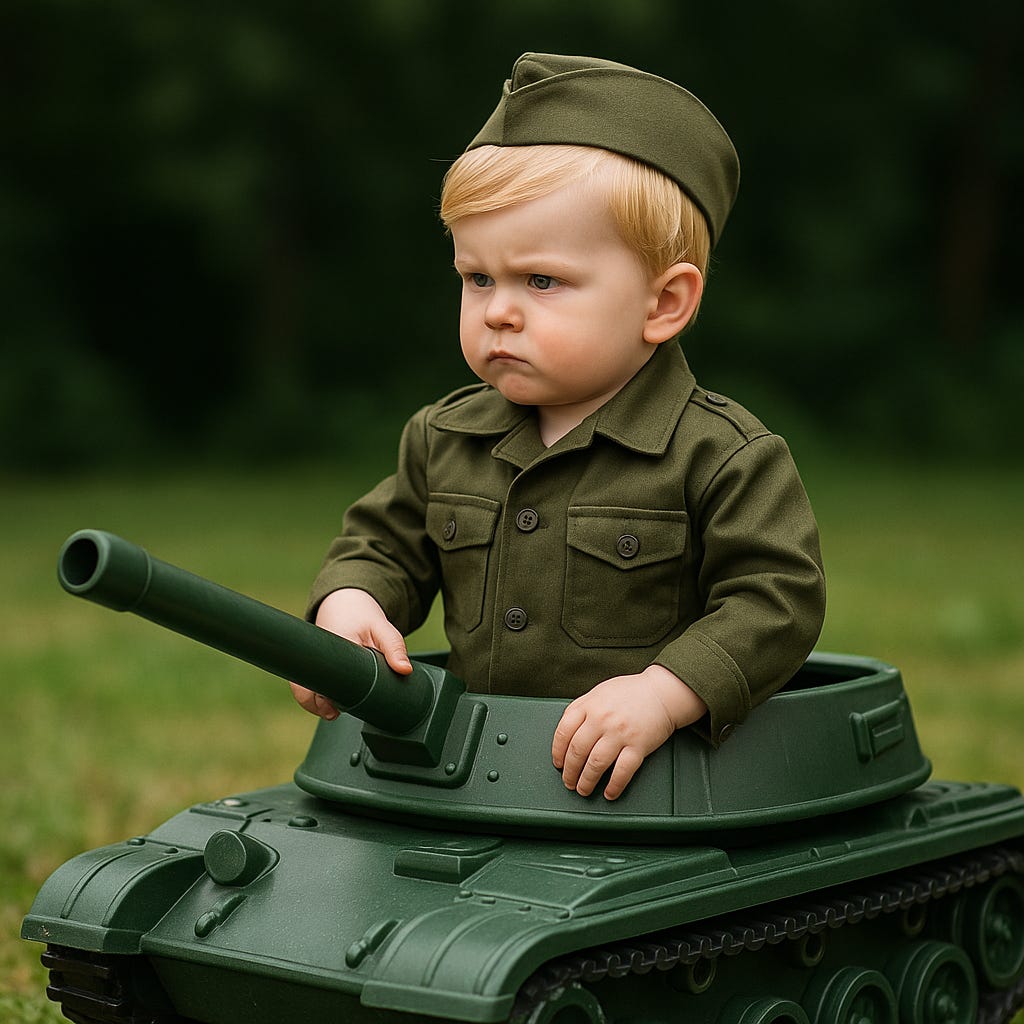
Trump isn’t leading a country. He’s LARPing an empire. And every American should ask: What happens when a man with no uniform, no plan, and no brakes finds himself in the cockpit of the world’s largest war machine?
if we wait to ask that question until after the next strike, the next banner, or the next EO, it might be too late.
Stay Informed. Stay Loud.
Subscribe to The Coffman Chronicle for no-BS political analysis, action guides, and daily truth bombs you won’t get from corporate media.
Sources:
“Trump Signs Order Calling Pentagon the Department of War” - The Wall Street Journal
“Trump launches War Department rebrand without congressional approval” - The Washington Post
“Trump executive order aims to rename the Department of Defense as the Department of War” - Associated Press
“Trump orders return to the US 'War Department’” - Reuters
“Trump signs executive order rebranding Pentagon as Department of War” - The Guardian
“Fact Sheet: President Donald J. Trump Restores the United States Department of War” - The White House
“Was the deadly US attack on the Venezuelan vessel legal?” - Reuters
“Labels, Not Law, to Justify Lethal Force: Venezuela Boat Strike” - Just Security
“2025 United States strike on a Southern Caribbean boat” - Wikipedia

MAGA Drones mouthing both peace and war at the same time. Seem to have the priorities reversed. War with our Allies and anyone who opposes Dear Leader's demented rantings and Peace with Russia and North Korea with China's assistance to surplant USA as supreme economic and political power. Dear Leader cries about it! There is nothing sane or normal about how USA government is current being run. Goal is to flood the zone with crap and more crap.
Domestic terrorism is now an acceptable enforcement tool for the GOP.