


When Pam Bondi fired court-appointed U.S. Attorney Desiree Leigh Grace and reinstalled Trump’s personal lawyer Alina Habba into the New Jersey post, it triggered a predictable media storm. Legal scholars denounced the move. Senate Democrats fumed. Bondi’s memo was vague, and the legal basis was shaky. At the time, it felt like a one-off, a political strike to protect the boss’s interests in a high-profile jurisdiction.
But it wasn’t a one-off. It was a test case, and the model worked.
Don’t let the bastards sneak anything past you. Subscribe and get your daily dose of rage and receipts delivered fresh, before the spin doctors can scrub it.
A Playbook Emerges
What followed was a quiet, calculated escalation. First in California. Then Nevada. And now, across the Justice Department, a new strategy has crystallized, a deliberate and legalistic subversion of Senate confirmation rules, engineered to permanently install Trump loyalists into the most powerful prosecutorial offices in the country, without ever facing a confirmation hearing.
The Mechanics of the Workaround
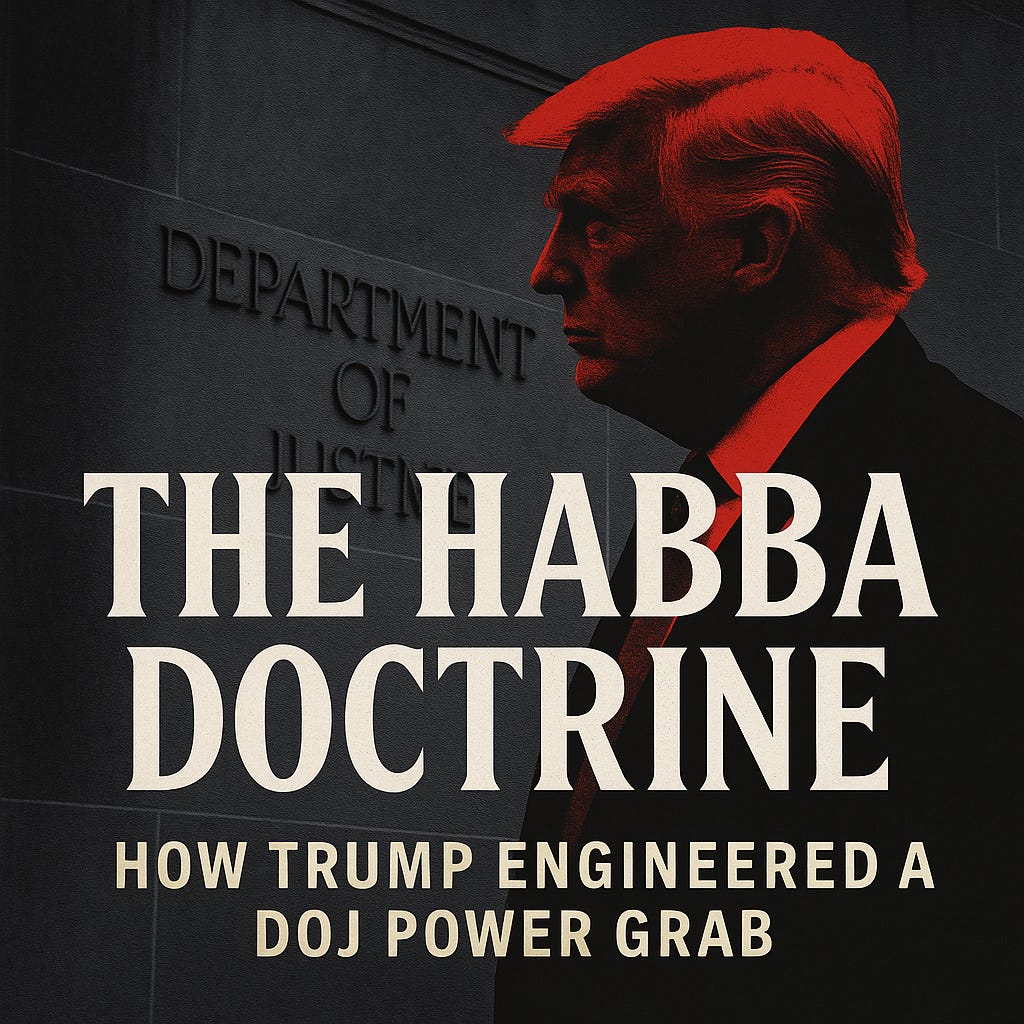
Alina Habba was the prototype. Her original 120-day appointment in New Jersey was set to expire under long-established rules that date back to the 1980s. But just before that deadline, the Trump administration withdrew her Senate nomination, fired the court-selected successor chosen by a bipartisan panel, and reappointed Habba as “First Assistant”, a bureaucratic maneuver that re-triggered a fresh clock under the Federal Vacancies Reform Act.
That clock allows her to serve for an additional 210 days, and potentially much longer if Trump re-nominates her and then withdraws again.
The result? The same person is allowed to serve indefinitely in one of the most powerful federal law enforcement roles without a single vote cast, and without any of the vetting, public scrutiny, or constitutional checks that Senate confirmation is supposed to provide.
See our earlier reporting here:

It’s Not Just New Jersey
In California, the tactic was applied to Bill Essayli, a former state lawmaker known for incendiary rhetoric on immigration and LGBTQ+ issues. Essayli had previously worked in the U.S. Attorney’s Office but had no senior leadership experience. When his nomination drew resistance from California’s Democratic senators, the Trump administration sidestepped the blue slip process by withdrawing his name and reappointing him in an acting capacity. Essayli remains in charge of the Central District of California, one of the largest and most high-profile DOJ offices in the country, including Los Angeles.
In Nevada, Sigal Chattah, a former GOP candidate for Attorney General and conservative activist, was installed using a near-identical maneuver. Her appointment sparked immediate backlash from civil rights organizations due to her public comments about Muslim Americans, immigrants, and transgender people. When local judges raised concerns and proposed a neutral alternative, the DOJ fired the replacement and reinstalled Chattah through the same Vacancies Reform Act cycle used in New Jersey and California.
This isn’t improvisation. It’s a full-blown strategy, and it’s being executed systematically.
The Roots of the Loophole
Like most things in Trump-world, it’s not new, but it’s bolder, more sweeping, and more legally insulated than ever before.
This playbook has been in the works for decades. In the late 1990s, the Clinton administration used similar maneuvers to fill civil rights and immigration posts after Senate obstruction. That triggered the Federal Vacancies Reform Act in 1998, a bipartisan attempt to rein in the executive’s power to unilaterally install acting officials. The law created time limits and narrowed eligibility. But even then, loopholes remained.
In 2006, the Bush administration tested the edges of the system again, dismissing seven sitting U.S. Attorneys mid-term and attempting to install loyal replacements under a little-noticed change in the Patriot Act. The backlash was swift and brutal. Congressional hearings exposed the politicization, and Congress quickly passed a law reinstating the 120-day limit on acting U.S. Attorneys.
Trump, of course, took the next step. In his first term, he tested the limits with Matt Whitaker at the Justice Department and Ken Cuccinelli at USCIS. In both cases, courts raised serious constitutional concerns. Cuccinelli’s appointment was ruled unlawful. Whitaker’s authority was challenged. But the system didn’t break. It bent.
And now, in his second term, Trump is using that flexibility with ruthless efficiency.
Congress Saw It Coming
As early as 2007, then–Senate Judiciary Chair Patrick Leahy issued a chilling warning in response to the Bush administration’s midterm dismissal of U.S. Attorneys. The issue wasn’t just who got fired. It was how the administration planned to install replacements without Senate confirmation. Leahy cautioned:
“Presidents may try to evade the Constitution and the Senate’s role by installing temporary appointees indefinitely—without ever seeking confirmation. That’s not an emergency measure. That’s an end run around our system of checks and balances.”
Nearly two decades later, his warning has become reality.
Bipartisan Resistance Builds
When Trump demanded that the Senate eliminate the blue-slip tradition—a 100-year-old practice allowing home-state senators to block judicial and U.S. Attorney nominees—he targeted a central pillar of bipartisan Senate oversight. His ire was focused in part on Chuck Grassley, the Republican chair of the Senate Judiciary Committee, who refused to advance Trump’s preferred candidates when Democratic senators withheld their blue slips.
Grassley pushed back immediately. “I was offended,” he told reporters. “That’s not how we do things here.” He affirmed that he had no intention of scrapping the tradition, arguing that it preserved local accountability and balanced federal power.
He wasn’t alone.
Senator Thom Tillis called Trump’s proposal “brain-dead.” John Cornyn backed Grassley’s authority. Even John Kennedy, one of Trump’s more reliably theatrical defenders, voiced support for keeping the tradition in place, insisting it gave states meaningful input into who would enforce federal law on their turf.
On the Democratic side, Senate Majority Leader Chuck Schumer used the tradition to block Trump’s U.S. Attorney picks in New York, describing the administration’s nominees as “unqualified political loyalists.” Senator Dick Durbin defended the custom’s value in preserving bipartisanship and insulating the justice system from total executive capture.
The blue slip isn’t law. It’s custom. However, in this moment, it has become a rare institutional tripwire, one of the only remaining barriers to a total top-down DOJ loyalist takeover.
That’s what makes Trump’s new playbook so dangerous. It’s not just about evading blue slips or confirmation hearings. It’s about making those processes irrelevant altogether, relying instead on rotating “acting” appointments to quietly nullify the Senate’s power.
Why It Matters Now
What’s at stake here is more than personnel. It’s the principle of independent prosecution. U.S. Attorneys wield enormous power. They control indictments, negotiate plea deals, approve surveillance warrants, and direct federal law enforcement priorities in their districts. When those positions are filled with loyalists—especially those never confirmed by the Senate—it’s not just a political win. It’s the infrastructure of power. Quiet. Unchecked. Durable.
We recently reported on the DOJ upheaval due to Trump nominees, most notably Emil Bove, here:

The Consequences Are Already Here
In New Jersey, federal defendants are filing motions to dismiss charges, arguing that Habba lacks legal standing to prosecute. In California, civil rights groups are preparing lawsuits. Across the DOJ, veteran prosecutors are resigning or being reassigned. And yet, the public outrage hasn’t kept pace with the stakes.
That’s the danger of this tactic. It’s slow and procedural. It doesn’t look like a coup. It looks like a personnel memo. It exploits laws most people have never heard of. But in the end, it rewrites the architecture of democratic accountability.
Bush Tested It. Clinton Exploited It. Trump Perfected It.
Each president stretched the rules. Only Trump turned them into a governing doctrine.
And unless Congress acts or the courts intervene, this will become the new normal, a Justice Department run not by Senate-confirmed prosecutors, but by political operatives who never had to answer to anyone but the President.
Because democracy doesn’t defend itself, and neither does your sanity. Subscribe here to keep your eyes open and your sarcasm sharp.
Bibliography:
“Trump administration seeks to keep US Attorneys in place before court can act.” Reuters, July 29, 2025.
“Republican US Senator Grassley clashes with Trump over nominations.” Reuters, July 30, 2025.
“Alina Habba’s future as New Jersey’s top federal prosecutor faces legal test.” Washington Post, July 29, 2025.
“Some of Trump's loyalty‑first picks for prosecutors draw opposition from senators…” AP News. May 24, 2025.
Wikipedia. “2006 dismissal of U.S. attorneys.”
Wikipedia. “Patrick Leahy.”
U.S. Congress. S. Hrg. 110‑35800: From the U.S. Senate Committee on the Judiciary; Hearing on U.S. Attorneys and Prosecution Oversight, January–June 2007.

How is this possible??? Can’t the Dems do anything to stop this???
Trump administration is corrupted. DOJ should be investigating.