


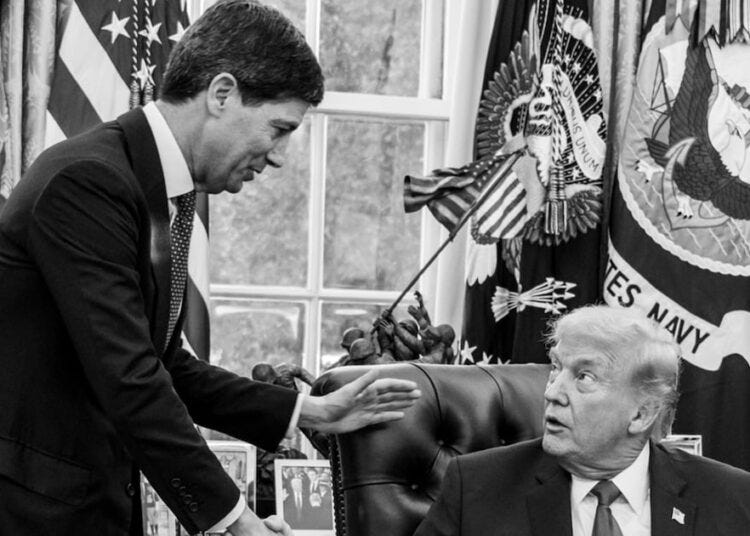
President Donald Trump has nominated Kevin Warsh to lead the Federal Reserve, setting the stage for one of the most consequential shifts in U.S. economic policy in a generation. With Jerome Powell’s term set to expire in May 2026, Trump’s choice reflects a sharp pivot toward loyalty, market-friendliness, and political control, exactly what critics have feared would happen if Trump reclaimed power.
Warsh, a former Federal Reserve governor who served from 2006 to 2011, is no stranger to economic crisis. He was in the room during the 2008 financial meltdown, and he helped shape the Fed’s response to the worst collapse since the Great Depression. But instead of becoming a steady, pro-worker hand during the recovery, Warsh emerged as one of the central bank’s most vocal skeptics of aggressive intervention.
That legacy is exactly why his return now, with the economy once again on shaky ground, has so many economists and policy advocates sounding the alarm.
This Community Is Powered by You
What started as a small circle has grown into something much bigger, and it’s all because of readers like you.
Every time you forward this email, post it on socials, or bring someone new into the fold, you’re helping build one of the most passionate, independent political communities out there.
Want to keep the momentum going?
Share this newsletter with someone who should be part of this conversation.
Thank you for being here. It means everything.
Warsh opposed stimulus when Americans needed it most
During the early aftermath of the 2008 crash, when unemployment soared, and millions lost their homes, Warsh was arguing inside the Fed against bold action. He opposed a second round of quantitative easing—a key policy that helped stabilize the economy—and warned of inflation that never materialized. His caution was rooted in traditional economic orthodoxy, but in that moment it looked like a failure to grasp the severity of the crisis.
As other central bankers called for more support to help families, businesses, and workers, Warsh remained deeply skeptical. He feared that too much intervention would distort markets. In hindsight, that position is seen by many progressives not only as wrong but also as harmful. The recovery took longer than it should have. Wage growth stalled, inequality deepened, and Wall Street bounced back far faster than Main Street.
To put it plainly, Warsh may have had the credentials, but his instincts served the investor class, not the American worker.
Wall Street’s man inside the Fed
The concern now is that those same instincts will drive Fed policy once again if Warsh is confirmed. His background reads like a checklist of elite financial connections. He worked at Morgan Stanley, advised the Bush administration on economic policy, and has moved in the same policy circles as the country’s most powerful financiers.
That doesn’t inherently disqualify him. However, the question is who Warsh will prioritize if the economy stumbles again. Will he center the needs of workers facing rising costs, unaffordable housing, and massive personal debt? Or will he cater to markets, investors, and the Fed’s image among the elite?
Progressives worry it will be the latter. Warsh has rarely spoken forcefully about wage stagnation or inequality. He has shown little concern for strengthening labor markets or correcting structural imbalances that harm low-income Americans. His worldview sees the economy through the lens of Wall Street stability and market performance, not through the lives of working people.
Trump wants control, not competence
This nomination also cannot be divorced from the man who made it. Trump spent much of his first term attacking Jerome Powell for not cutting interest rates fast enough. He often made his dissatisfaction with the Fed known, even joking at a recent rally that he would sue Warsh if he failed to slash rates on command. The comment was meant as humor, but the underlying message was clear: Trump expects obedience.
By picking Warsh, Trump is trying to mold the Fed into something it was never meant to be, a politically obedient institution that serves the president’s short-term agenda rather than the long-term stability of the economy.
If confirmed, Warsh would take over the most powerful economic institution in the country at a time when millions of Americans are struggling with high living costs, stagnant wages, and mounting household debt. It is not hard to imagine how Trump’s political pressure, combined with Warsh’s Wall Street instincts, could lead to monetary policy that favors asset holders over workers.
History threatens to repeat itself
The parallels between 2008 and 2026 are not comforting. In both cases, the U.S. faced economic uncertainty, rising inequality, and growing public distrust in institutions. Warsh’s role then was to advocate caution, discipline, and restraint, even when those choices came at the expense of everyday people.
If he follows that pattern now, we could see rate hikes pushed too soon, policies that overlook the labor market, and a renewed focus on “market confidence” while households fall further behind.
And once again, it will be the most vulnerable who bear the brunt.
The stakes are higher now
Warsh is qualified. That’s not the issue. The issue is that he brings with him a philosophy that has already been tested, and it didn’t work for most Americans. In a moment that demands bold, inclusive, worker-focused leadership, his nomination feels like a step backward.
Trump has made clear that he wants a Fed Chair who will follow orders. Kevin Warsh has not shown the independence to resist that demand. His nomination is a test of whether we’ve learned anything from the mistakes of the past, or whether we’re ready to repeat them.
If you’re tired of Wall Street writing the rules and Washington playing along, you’re in the right place.
Subscribe for clear, unapologetically progressive coverage of the power plays shaping our economy, our democracy, and our future before they make headlines.
No spin. No hedge fund sponsors. Just the truth.
Sources:
Trump nominates Kevin Warsh to replace Powell as Fed chair — Al Jazeera, January 30, 2026
Trump picks Kevin Warsh to chair Federal Reserve amid pressure campaign to cut rates — CBS News, January 30, 2026
Trump has tapped a new Federal Reserve chair. Has he finally found his yes‑man? — The Guardian, January 31, 2026
Is Trump’s choice for US Fed chair a ‘chameleon’ or a ‘solid’ pick? — Al Jazeera, January 31, 2026
Trump Nominates Kevin Warsh as Federal Reserve Chair — TIME, January 30, 2026
Trump nominates Federal Reserve critic Kevin Warsh as its next chair — The Guardian, January 30, 2026
Trump’s choice of Warsh to lead Fed could reshape the world’s most influential central bank — Associated Press, January 30, 2026
Federal Reserve live: Donald Trump nominates Kevin Warsh to be Fed chair, Dollar jumps by the most since May 2025 — Financial Times, January 30, 2026
Warsh’s challenge: Navigating Fed independence and Trump’s demands — Associated Press, January 30, 2026
Trump jokes about suing new Fed chair nominee Kevin Warsh if he doesn’t slash rates — New York Post, February 1, 2026
Typical republican let the people fend for themselves while you steal from them.
Paul Krugman wrote an opinion piece regarding trumps pick for Fed chairman which outlined Warshs idiocy and incompetence. I agree with Paul Krugman that Warsh is absolutely the worst pick for this job.