


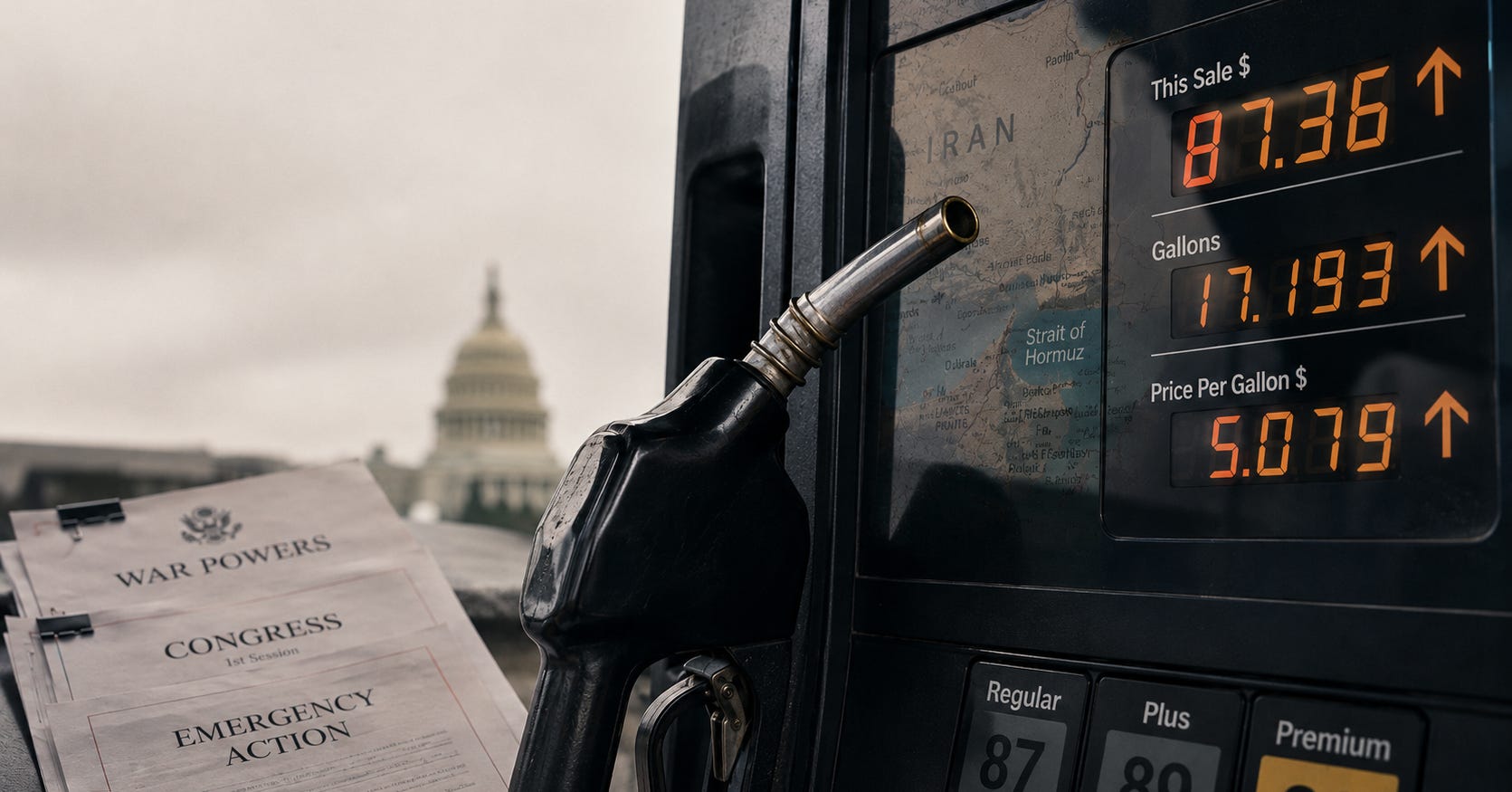
War is where concentrated power stops being theory.
A president does not have to announce the collapse of checks and balances for the public to feel it. Sometimes it arrives as a military operation described as necessary, limited, defensive, or temporary. Sometimes it arrives as another failed vote on Capitol Hill, where lawmakers debate whether to reclaim a power the Constitution already gave them.
That is what happened on May 13, 2026, when the Senate rejected another effort to limit President Donald Trump’s Iran war powers. The measure failed 50-49 after the War Powers Resolution’s 60-day deadline had already become part of the fight. Three Republicans — Rand Paul, Susan Collins, and Lisa Murkowski — joined most Democrats in supporting the resolution, while Sen. John Fetterman voted with Republicans to block it.
However, the cost of concentrated power does not stay in Washington. It moves through the Strait of Hormuz, oil markets, shipping lanes, diesel prices, grocery aisles, military deployments, emergency spending, and household budgets. Reuters reported that the International Energy Agency now expects global oil supply to fall short of demand in 2026 because of the war involving Iran, the United States, and Israel, with the effective closure of the Strait of Hormuz worsening the supply crisis.
That is the part Americans are trained to see last. The first question is usually whether the war is justified. The harder question is whether the country still has a functioning system for deciding that, before the bombs fall, the troops move and the bills come due.
The Iran war is not just a crisis overseas. It is a warning at home. When Congress surrenders its war power, the public does not just lose a vote. It inherits the danger, the precedent, and the bill.
This Community Is Powered by You
What started as a small circle has grown into something much bigger, and it’s all because of readers like you.
Every time you forward this email, post it on socials, or bring someone new into the fold, you’re helping build one of the most passionate, independent political communities out there.
Want to keep the momentum going?
Share this newsletter with someone who should be part of this conversation.
Thank you for being here. It means everything.
The Constitution Was Built to Keep War Power Divided
The Constitution does not treat war like ordinary policy. It treats it as the most dangerous power a government can wield, which is why the framers did not place the entire decision-making authority in one office.
Article I gives Congress the power to declare war. Article II names the president Commander-in-Chief. The House’s own history office describes war powers as one of the Constitution’s most consequential checks and balances because the power to declare war belongs to Congress while the president serves as commander in chief.
That division was not a drafting accident. It was a warning built into the structure of the republic. Executives are naturally drawn toward speed, secrecy, command, and crisis. Legislatures are slower by design. They argue. They deliberate. They answer to different districts, states, factions, and voters. That can make Congress frustrating, but it also makes Congress necessary.
War is exactly the kind of decision that should be hard to make alone. It can kill service members and civilians. It can drain the treasury. It can reshape alliances, expand surveillance, justify secrecy, and give the government new reasons to demand public obedience. Once the machinery starts moving, it becomes harder for every institution to stop it.
The president is not powerless in that design. The commander-in-chief has real authority to direct the armed forces, respond to immediate threats, and manage military operations. However, command is not the same as a blank check. A commander directs a war. A republic decides whether to enter one.
Concentrated power tries to erase that distinction. It turns the commander-in-chief clause into a permission slip for unilateral war. It treats congressional authorization as a courtesy instead of a constitutional requirement. It makes speed look like strength and deliberation look like weakness. But the Constitution was not designed to flatter speed. It was designed to restrain power before the damage became irreversible.
Congress Keeps Reacting After the War Has Already Started
The modern war-powers problem is not that Congress has no role, but rather that Congress too often waits until the president has already acted before deciding whether to use the role it already has.
That is how constitutional power quietly changes hands. The president moves first. The military operation begins. The public is told the action is limited, necessary, defensive, temporary, or already under control. Then Congress is asked to respond within a political reality that the executive branch has already created.
At that point, the debate is no longer clean. It is no longer simply, “Should the United States enter this conflict?” It becomes, “What happens if Congress tries to stop it now?”
The Iran war has exposed that weakness. Reuters reported that the May 13 Senate vote was the seventh time this year that Senate Republicans had blocked similar resolutions. It was also the first Senate vote after the conflict hit the 60-day deadline under the War Powers Resolution. Trump argued that a ceasefire had terminated hostilities. Democrats disputed that claim, pointing to continued U.S. and Iranian military actions, blockades, and attacks.
That timing is key. A constitutional check is strongest before the decision becomes a national commitment. It is weaker after missiles have flown, troops have moved, markets have reacted, allies have adjusted, enemies have responded, and the public has been told the country is already in the fight. At that point, even skeptical lawmakers can feel trapped by the momentum of the crisis.
The War Powers Resolution was supposed to prevent that drift. Its purpose is to ensure the “collective judgment” of Congress and the president when U.S. forces are introduced into hostilities. The law says presidential power to introduce armed forces into hostilities should be exercised only through a declaration of war, specific statutory authorization, or a national emergency created by an attack on the United States, its territories, possessions, or armed forces.
However, the statute only works if Congress is willing to enforce its own authority. If lawmakers complain, vote, fail, move on, and allow the operation to continue anyway, the message to the executive branch is obvious: act first, survive the vote later.
That is why this is not only a Trump story, but more importantly, a Congress story. Presidents of both parties have tested, stretched, and defended broad military authority. Each time Congress refuses to draw a hard line, the presidency grows stronger by precedent. The office learns that urgency can beat deliberation, secrecy can beat debate, and military momentum can beat constitutional design.
The greater danger is not only a president who claims too much power. It is a Congress that keeps proving him right by refusing to use its own.
Concentrated Power Acts First and Asks for Permission Later
This is the pattern by which concentrated power depends: act first, explain later, then dare the rest of the system to catch up.
A president does not need to formally erase Congress to weaken it. He only needs to move faster than Congress can respond. Once the operation begins, the legal debate changes shape. The question shifts from whether the country should enter the conflict to whether lawmakers are willing to be blamed for stopping it.
That shift is the advantage of executive power. It creates urgency, then uses that urgency as evidence that deliberation is too slow.
This is why concentrated power is so dangerous in foreign policy. It does not always look like dictatorship. Sometimes it looks like momentum. The first strike creates the next justification. The deployment creates the next obligation. The emergency creates the next exception. The exception becomes precedent.
Every time Congress lets the president act first and survive the fight later, the presidency inherits more room to maneuver next time. The legal theory may be contested. The vote may be close. The opposition may grow. But if the operation continues, the lesson absorbed by the executive branch is simple: the check exists on paper, but the power exists in practice.
That is how Article II swallows Article I, not always in a single dramatic seizure, but through a series of decisions in which Congress arrives late, complains loudly, votes narrowly, and then watches the war continue.
A republic can survive a hard debate over war. It is supposed to have one. What cannot survive forever is a system in which the debate begins only after the country has already been committed.
The Kitchen-Table Bill Always Comes Due
The cost of war rarely arrives with a single invoice. It shows up in pieces, scattered across daily life, until families feel the pressure without always seeing the decision that helped create it.
A war launched through concentrated power may begin as a national-security argument, but it does not remain inside the national-security system. It moves into energy markets, shipping costs, inflation reports, grocery bills, interest rates, and household budgets.
That is already happening with the Iran war. Reuters reported that the IEA expects global oil supply to fall by 3.9 million barrels per day in 2026 because of the war. The agency said more than 14 million barrels per day of oil were shut in, with losses in the Middle East Gulf supply already exceeding 1 billion barrels. It also projected supply would fall 1.78 million barrels per day below demand in 2026, reversing earlier forecasts of a surplus.
That is not just an energy story. It is a household story. AP reported that U.S. consumer inflation rose 3.8% in April, driven largely by gasoline prices tied to the war in Iran. The average price for a gallon of gas climbed above $4.50, and grocery prices also rose.
The chain is not complicated. Oil shocks raise fuel costs. Fuel costs raise the price of moving goods. Higher transportation costs pressure food, retail, shipping, and services. Families experience that chain not as foreign policy, but as a pump price, a grocery receipt, a delivery surcharge, or another month where the paycheck does not stretch far enough.
AP also reported that U.S. grocery prices rose in April, with fuel costs tied to the Iran war only one part of a broader set of pressures that included transportation, production, weather, tariffs, and commodity costs. The war is not the only reason prices rise, but it is one more pressure point created by decisions most Americans had no direct role in making.
This is where concentrated power becomes material. It is not only a constitutional abstraction. It is the difference between a government that deliberates before committing the country to war and a government that acts first, then hands the public the receipt.
The people standing at gas pumps and checkout lines did not get a meaningful vote on whether the country should enter the conflict. They did not sit in the room where the decision was made. They did not control whether Congress would enforce its own war powers. They simply inherited the result.
The people who never got a vote on the war still get a receipt for it.
War Narrows the Space for Dissent
War not only concentrates legal power, but also political pressure.
Once a president commits the country to military action, the public debate changes. Questions that should be constitutional become emotional. Was Congress consulted? Was force authorized? What is the mission? What is the exit? What are the costs? Those questions are supposed to come first. But once the conflict is underway, they are often treated as interruptions, distractions, or signs of weakness.
That is one of the oldest tricks of war politics. The flag comes out. The language hardens. Restraint gets framed as surrender. Oversight gets framed as sabotage. Demanding a vote becomes something other than what it is: an attempt to make the government follow the constitutional process before the country is pulled deeper into conflict.
Reuters reported that Republicans and the White House maintained Trump’s actions were legal and within his commander-in-chief authority, while Democrats argued that Congress had not authorized a continuing war. Some Republicans accused Democrats of bringing the resolutions because of partisan opposition to Trump.
That is the danger. Once a war begins, the debate over power gets swallowed by the debate over loyalty. The question is no longer simply whether the president had the authority to act. It becomes whether lawmakers, journalists, and citizens are willing to risk being accused of undermining the country by asking why one office was allowed to decide so much on its own.
Dissent is not the enemy of a republic. It is one of the tools a republic uses to keep power honest. If Congress cannot question a war while troops are deployed, then Congress does not really have war powers. If citizens cannot seek legal authorization without being accused of aiding the enemy, then public consent has been replaced by public pressure.
A democracy does not prove its strength by silencing questions during war. It proves its strength by still allowing those questions when power most wants them quiet.
This Is Bigger Than One Party
The old partisan frame is too small for this moment.
Yes, Trump is the president directing the war. Yes, most congressional Republicans have backed him. However, the deeper problem is not simply one party defending one president. The deeper problem is a political system that has grown too comfortable letting the presidency become the branch that acts first while Congress debates later.
That is why the Iran war powers fight is revealing. The Senate vote did not fall into a perfectly clean partisan box. Three Republicans joined most Democrats in supporting the latest effort to limit Trump’s Iran war powers, while Democrat John Fetterman opposed it. The measure still failed, but the vote showed that discomfort with concentrated war power is not limited to one side of the aisle.
Concentrated power survives by hiding inside partisanship. When a president from one party expands executive authority, supporters often defend it as a strength, a necessity, or a matter of loyalty. Opponents often condemn it as abuse. Then, when the White House changes hands, many of the same people switch scripts. The power remains as the outrage rotates.
That is how the presidency keeps growing.
The real divide is not simply Republican versus Democrat. It is checked power versus concentrated power. It is whether lawmakers believe the Constitution still requires Congress to make the hardest decisions before the country is committed, or whether Congress has become comfortable issuing objections after the executive branch has already created the crisis.
This is also why the Republican Party should be understood not only as the problem, but as a symptom of a larger institutional disease. A party that rallies behind unilateral war power is dangerous, but a Congress that has spent decades surrendering war authority to presidents of both parties created the conditions for that danger. Trump did not invent the imperial presidency. He is exploiting a system that previous presidents stretched, and previous Congresses failed to repair.
If we make this only about Trump, the warning becomes too small. If we make it only about Republicans, the solution becomes too shallow. The deeper issue is that America has allowed war power to drift away from the branch closest to the voters and toward the office most capable of acting alone.
That is the realignment underneath this fight. The country is not only dividing over ideology. It is dividing over whether power should be checked before it acts, or excused after it acts.
War makes that question impossible to avoid.
Precedent Outlives the President
The danger of concentrated war power is not limited to the president who first uses it. It becomes more dangerous when the system allows it to become normal.
That is why even people who support the Iran war should be concerned about the process. A person may believe the military action is justified. A person may believe Iran posed a real threat. A person may believe the president made the right call. However, none of that answers the constitutional question: should one office be able to carry the country into sustained hostilities without clear congressional authorization?
Precedent does not care whether the public liked the first example. Once power is accepted, it becomes available to the next president, the next administration, the next emergency, and the next target. What one side excuses in its own leader becomes the tool that the other side inherits later.
That is how constitutional drift works. It rarely arrives as a single announcement. It arrives as an exception, then another exception, then a legal theory. Then it is a political habit. Then a future president points backward and says, “They did it too.”
The Iran war-powers fight shows why that matters. Reuters reported that Trump argued a ceasefire made the War Powers deadline irrelevant, while Democrats said hostilities were still ongoing because of continued military activity and blockades. That dispute is exactly why Congress was supposed to be involved before the country got this deep.
If the president can define the conflict, define the deadline, define the emergency, define the scope of hostilities, and define when Congress is no longer needed, then Congress’s war power becomes conditional on the president’s interpretation of his own authority.
That is not a check. That is permission by another name.
The question is not whether someone trusts this president with concentrated war power. The question is whether they trust every president after him with the precedent, because once Congress allows Article II to absorb Article I in wartime, the damage does not end when the war ends. It remains in the office, waiting for the next crisis.
The Constitution Was Designed to Slow Down War
The Constitution does not slow down war because the framers loved procedure. It slows down war because war is the most dangerous power a government has.
A president can move quickly. That is sometimes necessary, but speed is not the same as wisdom, and command is not the same as consent. The whole point of dividing war power was to ensure that no single office could carry the country into conflict alone, then force every other institution to debate the decision after the damage had already begun.
The Iran war shows what happens when that design weakens. Article II acts. Article I reacts. The courts lag behind. The public gets told the action is necessary, the vote is complicated, the deadline is disputed, and the costs are unavoidable. By the time families feel it at the pump, in the grocery aisle, through higher shipping costs, or in the lives of service members placed in danger, the constitutional question can feel distant. But it is not distant. It is the first link in the chain.
This is not only about Iran. It is about whether the United States still believes war should require the collective judgment of the people’s representatives before the country is committed. It is about whether Congress exists to decide or merely to comment. It is about whether the Constitution remains a restraint on power, or just a document that officials cite after power has already moved.
A republic does not lose itself only when leaders seize power. Sometimes it loses itself when the institutions built to check that power decide it is easier to watch.
That is the warning in this war. Concentrated power does not ask everyone to agree. It only needs enough people to look away long enough for the decision to become reality.
Then the country is left with the danger, the precedent, and the bill.
Support Independent Media
Independent media matters because these stories cannot be reduced to partisan noise. War powers, congressional weakness, executive overreach, inflation, and the kitchen-table consequences of government decisions all belong in the same conversation.
If you can afford it, your paid subscription helps us keep doing that work: connecting power to consequences, policy to people, and headlines to the constitutional warning signs too often ignored until the bill comes due.
Support independent media. Become a paid subscriber to The Coffman Chronicle.
Sources:
“The Iran War Is Hitting Home as Gasoline Prices Fuel Inflation Surge of 3.8% in the US.” AP News, May 12, 2026.
“US Grocery Prices Rose in April, but Gas Spikes Weren’t the Only Reason.” AP News, May 13, 2026.
“Global Oil Supply to Plunge Below Demand This Year Due to Iran War, IEA Says.” Reuters, May 13, 2026.
Legal Information Institute. “50 U.S. Code § 1541 — Purpose and Policy.” Cornell Law School.
Legal Information Institute. “War Powers.” Cornell Law School.
“Overview of Declare War Clause.” U.S. Constitution Annotated. Cornell Law School.
U.S. House of Representatives: History, Art & Archives. “Power to Declare War.”
“US Senate Blocks Latest Bid to Rein in Trump Iran War Powers, Support Grows.” Reuters, May 13, 2026.
Donald Trump and MAGA voters have succeeded at destroying worldwide respect for America. Decisions at the highest levels of government require wisdom instead of bigotry, temperamental outbursts or POTUS profit motives. The humble beginning of American history was an example for the world to admire. The coarse, clumsy, untruthful expression of ideas at home and abroad, make such lack of leadership in all things by this POTUS an American disgrace. With resources to achieve greatness, in all things, America is wasting opportunity each day this POTUS is in elected office.
Principles over party means we replace name calling and insults with measurable goals. Trump name calling can be entertaining for some, but is a diversion from achieving progress. The absence of meaningful language makes it more difficult to create and change policy. Trump is great at criticizing others and firing them while offering no discussion for improvement.