


On Sunday, Donald Trump did what he often does when Congress is already in crisis. He opened his social media app and threw a grenade into the middle of the story.
Standing before House Republicans at a retreat in Florida and then posting online, Trump declared that he would not sign any new legislation until Congress passed the SAVE America Act, a sweeping federal voter ID and proof-of-citizenship bill that already cleared the House in February. He told allies that the bill “supersedes everything else” and repeated that he “will not sign other bills until this is passed.”
That vow collided with an ongoing partial shutdown at the Department of Homeland Security, which has now stretched into its fourth week. DHS funding expired on the night of February 13 after negotiations collapsed over immigration enforcement reforms. Congress let the deadline pass, and the department entered what officials gently call a “funding lapse.”
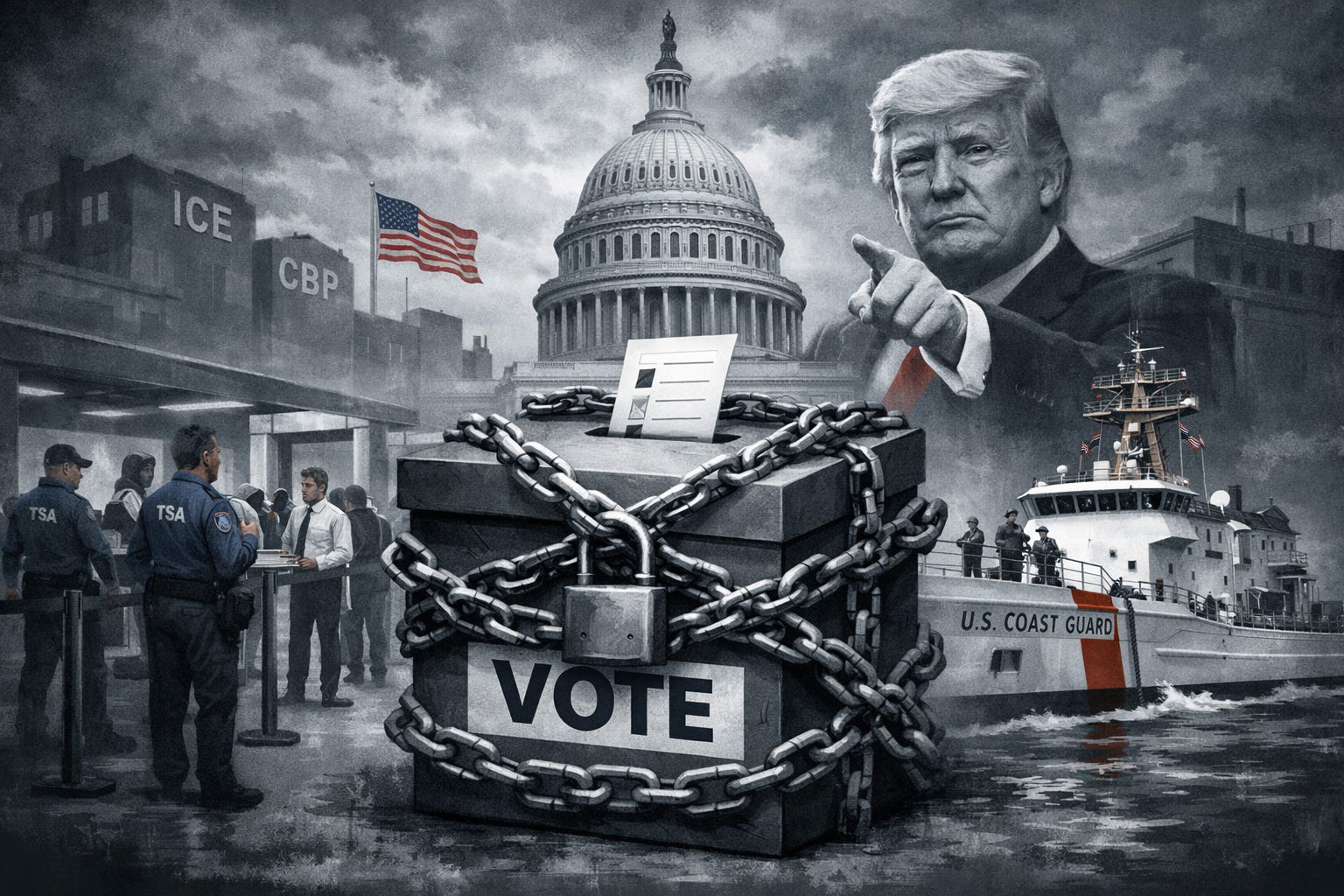
The result is a strange double crisis. DHS is partially shut down because Democrats are finally drawing a line on abusive immigration policing. At the same time, Trump is threatening to block unrelated bills unless Congress hands him a national voter-suppression package. The two fights are not actually linked in law. In practice, they are starting to feed each other.
This Community Is Powered by You
What started as a small circle has grown into something much bigger, and it’s all because of readers like you.
Every time you forward this email, post it on socials, or bring someone new into the fold, you’re helping build one of the most passionate, independent political communities out there.
Want to keep the momentum going?
Share this newsletter with someone who should be part of this conversation.
Thank you for being here. It means everything.
How We Got to a DHS Shutdown No One Wants to Fix
From Alex Pretti’s Killing to a Funding Line in the Sand
The DHS fight did not start as an abstract budget exercise. It started with a killing.
On January 24th, 37-year-old Alex Pretti was shot and killed in Minneapolis by Border Patrol officers assigned to a DHS task force. That killing weeks after another Minnesotan, Renee Good, was shot by an Immigration and Customs Enforcement officer. A House oversight report later described a pattern of aggressive tactics by federal immigration officers in the city.
Within days, Democratic senators who had been willing to compromise on DHS funding said they could not keep pouring money into immigration enforcement without real guardrails. Coverage at the time described moderate Democrats, including several who often vote with Republicans on border issues, announcing that they would block any bill that funded ICE and Border Patrol “as is” after the killings.
That was the moment when the usual partisan fight over DHS became something else. It turned into a demand for basic policing standards for federal immigration agents. Democrats began calling for mandatory body cameras, visible identification instead of masked and anonymous officers, stricter rules on use of force, and independent investigations when federal agents kill civilians.
Republicans, including then-DHS Secretary Kristi Noem, dismissed those demands as an attempt to “defund law enforcement.” Yet the public facts were stark. A state judge in Minnesota issued an emergency order in late January forbidding DHS from altering or destroying evidence related to the Pretti shooting, a remarkable move that underscored how little local authorities trusted federal accountability.
A House Bill Most Democrats Still Rejected
Congress did not immediately shut DHS down. Lawmakers bought themselves time. On February 3rd, Trump signed a two-week stopgap that kept the department open while negotiations continued. That deal was supposed to give both parties space to write new rules for immigration agents.
Instead, the talks stalled. On January 22nd, the House had already passed a DHS funding bill that increased money for immigration enforcement and included some Republican priorities. Most Democrats opposed it even then. After the Pretti killing, their patience evaporated.
When the stopgap expired on February 13th, DHS funding lapsed. A partial shutdown began. Essential operations continued. Non-essential workers were furloughed or told to work without pay.
House Republicans responded by passing a new full-year DHS appropriations bill on March 5. The vote was 221 to 209. The bill, H.R. 7744, included some reforms, such as body cameras and additional training for immigration agents. However, most House Democrats still voted no. Only four crossed over to support it, arguing that the changes did not do enough to prevent more cases like Minneapolis.
The bill moved to the Senate. There, it promptly ran into the same wall that everything else hits in that chamber.
The Senate’s Filibuster Wall
To become law, the House bill needed 60 votes to overcome a filibuster in the Senate. Republicans have a narrow majority. That is not enough.
When Senate leaders tried to advance DHS funding in February, they could not reach 60 votes. Democrats said they would not back any bill that funded ICE and Border Patrol without stronger reforms. Republicans insisted their version already included concessions and accused Democrats of gambling with national security.
Since then, the dynamic has barely moved. Senate Democrats blocked the latest House bill, just as they blocked an earlier attempt to move a combined spending package that included DHS. There is still no Senate version with different text. Without that, there is nothing to send to a conference committee.
Senate Democrats did offer a narrower bill that would have paid Transportation Security Administration workers, funded the Federal Emergency Management Agency and the Cybersecurity and Infrastructure Security Agency, and left ICE and Border Patrol for a later fight. Senate Republicans blocked it.
The result is a stalemate in which no one wants to own the shutdown, yet no one is prepared to accept the other side’s terms.
Trump’s ‘No New Laws’ Pledge and the SAVE America Act
A Sweeping Threat in a Short Post
Into that stalemate, Trump introduced a new demand that has nothing to do with DHS. At the Florida retreat and in a Truth Social post over the weekend, he said he would not sign anything into law until Congress sends him the SAVE America Act. ABC News reported that he told supporters the bill “supersedes everything else” and that he “will not sign other bills until this is passed.”
In case anyone missed the message, he boasted to reporters that passing strict national voter ID laws would mean Democrats “probably will not win an election for 50 years,” and praised the SAVE America Act as the way to lock that in.
The ultimatum reads like a casual threat. Yet it is not harmless rhetoric. It tells congressional Republicans that their priority is no longer a DHS deal. Their job is to move a voting bill that is extremely unlikely to become law.
What the SAVE America Act Would Do
The SAVE America Act is the GOP’s signature election legislation of this Congress. It passed the House earlier this year. It would create a new national voter ID and registration regime. According to summaries and fact-checks, the bill would require documentary proof of citizenship to register, require photo ID for in-person voting in every state, and force election officials to verify that proof, often by comparing it with federal databases.
It would also restrict mail-in registration and require many voters to present proof of citizenship in person, even if they already have a driver’s license or have voted for years. The bill does not formally ban mail-in voting. However, Trump has repeatedly tied it to his demand to eliminate most mail voting, and he has urged Congress to pass a “non watered-down” version that sharply cuts back on absentee ballots.
Voting-rights advocates warn that the proof-of-citizenship rules alone could affect more than twenty million eligible Americans. Research cited by the Brennan Center and others shows that millions of citizens, especially married women, older voters, low-income people, and people of color, do not have easy access to passports or certified birth documents with their current legal name.
The problem the bill claims to solve barely exists. Non-citizen voting is already illegal. State audits regularly find vanishingly small numbers of non-citizen registrations compared with the total electorate. ABC’s fact-check notes that state reviews in places like Georgia and Iowa identified at most a few dozen improper ballots in elections with millions of votes cast.
In other words, the bill would build a national bureaucracy to chase a statistically microscopic problem while creating real barriers for legitimate voters.
Why the Bill Is Stuck in the Senate
Trump can demand this bill all he wants. That does not change Senate math.
The SAVE America Act has already passed the House. To become law, it needs to clear a 60-vote threshold in the Senate or ride on some narrow procedural vehicle that avoids a filibuster. Neither option looks likely.
Senate Democratic leader Chuck Schumer has called the bill “dead on arrival” and said Democrats will not vote for it. Senate Majority Leader John Thune has said publicly that he does not have the votes, that there is no support in his caucus to blow up the filibuster for this, and that the most he can promise is a vote on a bill that is almost certain to lose.
That is what makes Trump’s ultimatum so revealing. He is threatening to halt his own legislative agenda over a bill his own party leaders quietly admit they cannot deliver.
The Constitutional Fine Print
The threat also depends on public confusion about how bills become law.
Under Article I of the Constitution, once Congress passes a bill and sends it to the president, he has ten days, excluding Sundays, to act. He can sign it. He can veto it. He can also do nothing. If he does nothing and Congress remains in session for the full ten days, the bill becomes law without his signature. Only if Congress adjourns during that window can he stop the bill silently through a “pocket veto.”
So when Trump says he “will not sign other bills,” that sounds absolute. In reality, there are two escape hatches. He can simply sign something once it becomes politically painful not to, or he can quietly let a bill become law without his signature while insisting that the words of his ultimatum were still technically true.
If he genuinely wanted to block DHS funding or any other legislation, he would need to veto those bills, not merely refuse to sign them. That distinction matters because vetoes are explicit, and Congress can override them with a two-thirds vote in both chambers.
Who Is Actually Getting Squeezed
TSA: The First Visible Casualty
The partial DHS shutdown began on February 13. We are now into week four. The crisis finally broke into daily life over the past several days through the most predictable pressure point in the federal government. TSA.
Roughly 50,000 Transportation Security Administration airport screeners are currently working without normal pay. Reuters reported that many officers received only a fraction of their usual paycheck on February 27th, and that the partial pay was already forcing some to consider second jobs or quitting altogether.
As spring break travel ramps up, the predicted strain has arrived. At some airports, security lines are now stretching to three hours or more. Travelers in Houston, New Orleans, Atlanta, and Charlotte have reported missing flights despite arriving hours in advance. Airlines and travel groups are warning that delays and cancellations could worsen if more officers stop coming to work because they cannot afford unpaid shifts.
Industry groups note that TSA recruitment and retention were already fragile. A previous shutdown in November left screeners unpaid for more than a month and led to a spike in resignations. The current standoff is landing on a workforce that has not fully recovered from that experience.
This is the first thing most Americans see. They stand in an endless airport line and hear that the reason is “the DHS shutdown.” What they do not see is how unevenly that shutdown is hitting different parts of the department.
The Coast Guard: Always Essential, Rarely Protected
Something similar is happening on the water.
Unlike the Army, Navy, Air Force, or Marine Corps, the United States Coast Guard sits inside DHS. When DHS funding lapsed at midnight on February 14th, Coast Guard funding lapsed with it. Official guidance from the service explains that missions necessary to protect life, property, and national security continue, while other activities are suspended.
That means Coast Guard crews are still conducting search-and-rescue, port security patrols, drug interdiction, and other critical missions. However, training flights, some patrols, vessel inspections, and maintenance are being delayed. A former senior official told Congress before the shutdown that even a brief lapse could ground aircraft, keep cutters tied up, and create a backlog of parts that would take months to unwind.
Pay is a growing worry. Coast Guard mutual assistance organizations and outside nonprofits are now advertising emergency loans and relief funds for Coast Guard families who may miss paychecks because of the shutdown. Military family groups warn that Coast Guard members could see their first missed paycheck by mid-March, if not earlier, even as their counterparts in the other branches remain fully funded.
All of this is happening while Washington is escalating a military operation against Iran and intelligence officials are warning about possible Iranian or proxy plots against U.S. targets, including in maritime settings. Port and harbor security is a multi-agency effort. When one of the lead services is asked to “do more with less” during a funding lapse, that does not show up on three-hour cable news lines. It shows up in thinner margins if something goes wrong.
ICE and CBP: Insulated by Design
If this were a shutdown designed around common sense, the agencies at the center of the Minneapolis shootings would be the ones feeling the most pressure. Instead, the opposite is happening.
Republicans themselves have admitted that Immigration and Customs Enforcement and Customs and Border Protection are relatively insulated in this fight. In a House Appropriations press release, GOP leaders bragged that ICE and CBP “already received billions of dollars in funding through reconciliation,” referring to a Trump-backed “big beautiful bill” last summer that pumped extra money into immigration enforcement outside the normal DHS appropriations process.
Because of that earlier law and because much of their work is defined as essential, ICE and CBP deportation operations are likely to continue largely unaffected. A CBP spokesperson recently told a federal news outlet that the agency would “exempt” and keep paying a large portion of its workforce during the shutdown by diverting other funds, even as other DHS employees work without pay.
The Guardian’s coverage of the shutdown put it bluntly. It is “unlikely” that the lapse will significantly affect ICE and CBP operations, which are “deemed vital” and cushioned by extensive prior funding. The immediate disruption instead falls on TSA, the Secret Service, FEMA, and other components that lack that insulation.
So the agencies whose tactics prompted calls for reform are protected, while the agencies that handle airport security, disaster response, cybersecurity, and port safety are being used as leverage.
Two Hostages, One Agenda
A Senate Pulled in Two Directions
Before Trump’s weekend post, the Senate already faced a difficult task. Senators needed to find a path that reopened DHS, protected TSA and Coast Guard workers, and delivered at least some of the reforms Democrats want for immigration enforcement.
That was always going to be hard with a slim Republican majority and a 60-vote threshold. Yet it was still the main job.
Now the same Republican leaders are being told that their “top priority” is a voting bill they know cannot pass under current rules. Time and attention in the Senate are finite. Hearings, floor time, and back-room negotiations all run through the same handful of leaders and staff.
When Trump declares that nothing else matters until the SAVE America Act passes, he is not just making an idle threat. He is telling Senate Republicans to spend scarce floor time on a dead-on-arrival bill instead of on a DHS compromise that could actually help people.
Shifting the Blame for the Shutdown
There is also a political boomerang built into Trump’s posture.
So far, Republicans have tried to frame the DHS shutdown as “the Democrats’ shutdown,” pointing to the fact that Senate Democrats have blocked two different DHS funding attempts and refused to move forward without stronger ICE reforms. House Republicans, Senate Republicans, and DHS press releases have all pushed that line.
Trump’s ultimatum complicates that story. If Congress somehow did hammer out a DHS deal that met Democrats’ reform demands and Republican security concerns, it would still need a signature. Under his current vow, Trump is promising to veto or stall that compromise until his voting bill passes.
That gives Democrats an obvious response. They can say, accurately, that even if they cut a deal on immigration policing, the White House has now said it will not sign a DHS bill until it also gets a sweeping voter ID law that the Senate cannot pass. In plain English, Trump is taking the DHS hostages, too.
It is hard to imagine a clearer example of governing for the base rather than governing for the country.
What a Sane Path Would Look Like
There is an alternative. Congress could pass a targeted bill that restores funding for TSA, FEMA, the Coast Guard, and other non-immigration DHS components, while continuing to negotiate over ICE and CBP. Senate Republicans have already blocked such a bill once, even though it would relieve pressure on families and infrastructure without undermining their enforcement agenda.
At the same time, the Senate could do what it does on most polarizing social legislation. It could hold a debate and a vote on the SAVE America Act, allow members to go on record, and then move on when the bill fails. Instead, Trump is demanding that his party tie the entire legislative calendar to a symbolic fight over a bill that empowers DHS to police voter rolls while DHS itself is partially shut down.
It is not hard to see the pattern. The same administration shielding ICE and CBP from the worst effects of a funding lapse is also pushing for a law that hands DHS more power over who gets to vote. The same party insisting that TSA officers and Coast Guard crews should work without pay insists that voters produce perfect paperwork to access the ballot.
For readers who want concrete talking points, the story comes down to three sentences.
DHS is partially shut down because Democrats are finally insisting on real rules for immigration agents who have killed U.S. citizens. The shutdown is hammering TSA and the Coast Guard, while ICE and CBP stay insulated by earlier funding. Rather than help solve that, Trump is now threatening to block every other bill in Washington until he gets a voter-suppression law that even his own Senate leaders do not think they can pass.
That is not an accident. It is a choice.
If you made it this far, you are exactly who we write for. Subscribe to get future pieces on Congress, courts, and campaigns as they happen, with enough detail to argue your case and enough clarity to explain it to someone you love.
Sources:
Reuters – “US Homeland Security Department partial shutdown hits on Saturday” (February 13, 2026)
Reuters – “US Senate blocks Homeland Security funding, raising likelihood of shutdown” (February 12, 2026)
The Guardian – “US homeland security department partially shut down after lawmakers fail to agree funding” (First published February 13, 2026; updated February 14, 2026)
The Guardian – “Senate Democrats block DHS funding over immigration tactics” (February 12, 2026)
House Committee on Appropriations (Republicans) – “Democrat DHS Shutdown Undermines Homeland Security at Critical Moment” (March 4, 2026)
New York Post – “House passes bill to fund DHS but most Democrats remain opposed to ending shutdown” (March 6, 2026)
ABC News – “What Trump has said about SAVE America Act amid his push for passage” (March 9, 2026)
AP News – “Trump pushes GOP on voting bill, demanding an end to most mail balloting” (Updated March 9, 2026)
Reuters – “TSA officers get fraction of pay as government shutdown drags” (February 27, 2026)
Reuters – “Airlines, travel groups warn of impact of partial government shutdown on airport screeners” (February 13, 2026)
The Business Times – “Security lines at some US airports hit three hours as TSA absences rise” (March 9, 2026)
CBS Minnesota – “House committee report accuses White House, DHS of Good, Pretti killings cover-up” (Updated February 4, 2026)
Reuters – “US Homeland Security Department partial shutdown hits on Saturday” (syndicated summary on TradingView) (February 13, 2026)
Thank you for another great article explaining the details of all this so well.
Good. Maybe the rest of the cult will realize just.how f*ing stupid and childish this asshat is.