


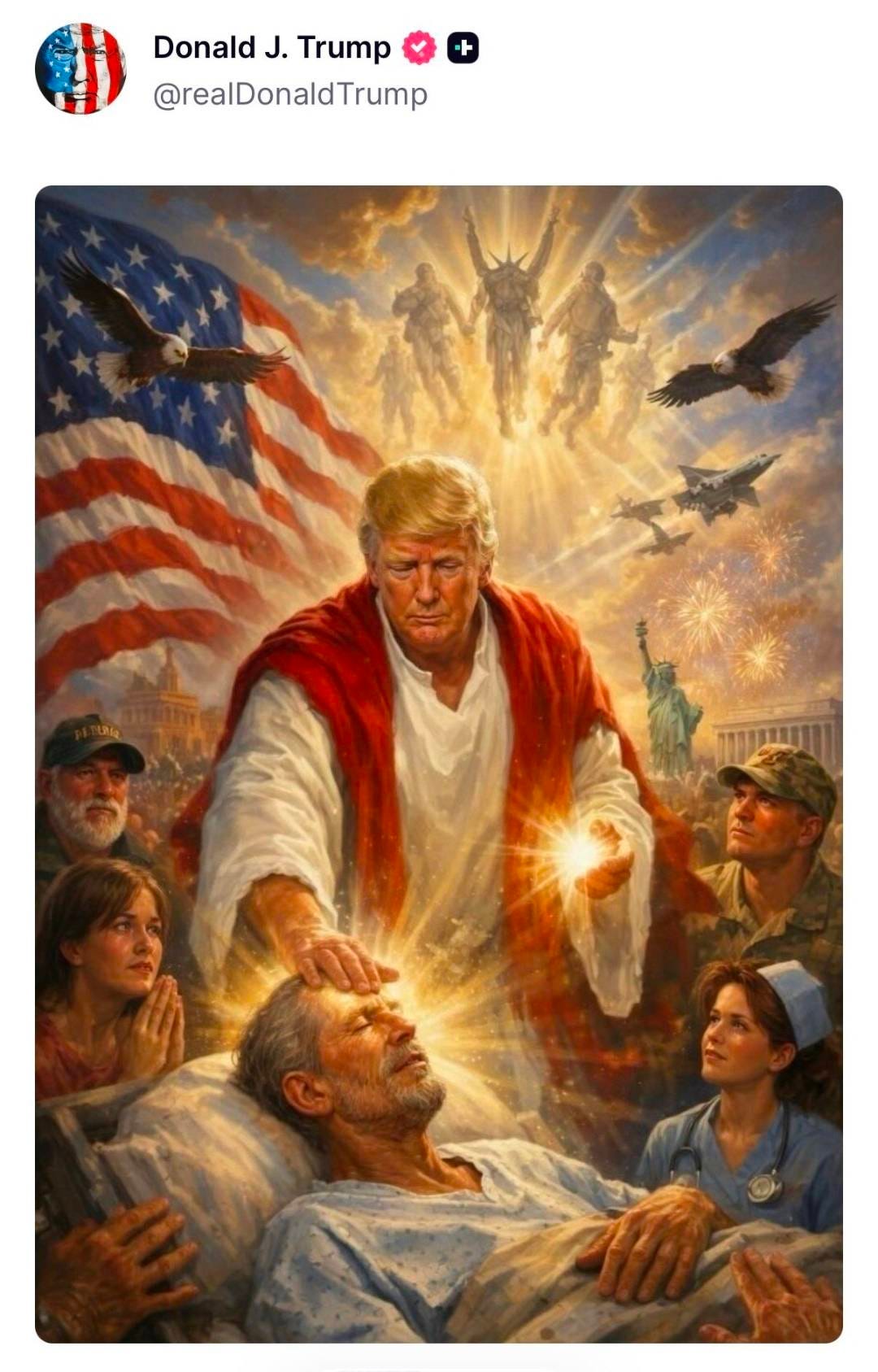
When Donald Trump posted an AI-generated image that appeared to cast himself in a Jesus-like role, it would have been easy to dismiss it as another social-media stunt built for outrage and attention. But that reading is too small. The post landed in the middle of Trump’s public feud with Pope Leo XIV, after the pope criticized the U.S.-Israeli war on Iran and defended a Gospel message of peace against the language of domination and force. In that context, the image was not just tasteless. It was revealing. It showed a political leader so consumed by his own myth that he is willing to borrow even the imagery of divinity, then dare religious institutions and believers to decide whether they still have a line he cannot cross. The backlash matters not simply because critics objected, but because some of it came from Catholics and evangelicals who have often defended him. That is what turns this from another bizarre Trump moment into something larger: a test of how far personal glorification can go before even loyal religious allies recoil.
This Community Is Powered by You
What started as a small circle has grown into something much bigger, and it’s all because of readers like you.
Every time you forward this email, post it on socials, or bring someone new into the fold, you’re helping build one of the most passionate, independent political communities out there.
Want to keep the momentum going?
Share this newsletter with someone who should be part of this conversation.
Thank you for being here. It means everything.
The post was the spectacle. The timing was the story.
The post drew backlash, was later removed, and Trump claimed he saw it as a doctor image, not Jesus. On its own, that would already have been enough to dominate a day of headlines. Trump posts something inflammatory, critics react, allies explain it away, and the cycle rolls on.
However, this one did not arrive in a vacuum. It came in the middle of Trump’s escalating fight with Pope Leo XIV, who had criticized the U.S.-Israeli war on Iran and defended a Christian message centered on peace rather than domination. Trump answered by calling the pope “weak” and “terrible for foreign policy.” That timing changed the meaning of the image. What might otherwise have looked like random provocation instead landed as part of a broader clash over moral authority, war, and who gets to claim the high ground.
That is why the post should not be filed away as just another weird Trump internet moment. The image was the spectacle people saw first. The timing is what made it matter. A president who was already attacking the pope then circulated imagery that seemed to elevate him into sacred space, and some of the people most inclined to defend him hesitated. That is where the stunt stops being disposable and starts revealing a deeper pattern.
This was not ordinary trolling. It was borrowed sacred authority.
Trump’s defenders will say it was a joke, a meme, bait for the media, or another example of critics taking him too seriously. However, that explanation collapses once you look at what the image was actually doing. A glowing, healing figure with a hand extended over the suffering is not neutral political imagery. It borrows the language of sanctity, salvation, and chosenness. People did not react as though they were looking at a generic doctor image. They reacted as though they were being asked to accept a president stepping into sacred space and daring everyone else to pretend not to notice.
That is the deeper point. The modern authoritarian style is not always to declare yourself divine outright. It is to wrap yourself in symbols that place you above ordinary politics. You become the chosen one, the singular protector, the only man who can heal the nation, the only voice that matters when institutions fail. In that light, the image was not just a provocation. It was an attempt to borrow sacred authority and fold it into political power.
That is also why the backlash from inside the religious right mattered so much. When even some friendly evangelical and conservative Catholic voices say the image crossed a line, they are reacting to more than bad taste. They are reacting to the way Trump’s political brand keeps expanding into territory that used to be treated as off-limits. The issue is not simply offense. The issue is whether the country is being trained to accept a politics in which the leader is elevated above criticism, above institutions, and eventually above moral limits.
The backlash from inside the coalition.
Trump has spent years benefiting from a religious-political bargain. Many supporters were willing to see him as personally crude but politically useful, spiritually immature but instrumentally necessary. That bargain helped explain why so many believers kept defending him through scandal, vulgarity, and open contempt for democratic norms. This moment strained that arrangement in a different way.
Critics are expected to be offended. Opponents are expected to call the post blasphemous or grotesque. Yet when people inside the broader Christian right start saying out loud that something crosses the line, the story changes. That does not mean the coalition is breaking apart, but it does mean a pressure point has become visible.
A Jesus-like image posted amid a public feud with the pope makes compartmentalization harder to maintain. It forces a more direct question: at what point does the instrument begin demanding reverence for himself? That is what sharpened the tension here. This was not just a random image floating free of any larger conflict. It came as Trump was openly attacking a religious authority who represented a framework in which power is not the same thing as righteousness. The clash, therefore, started to feel less like a passing controversy and more like a choice between two rival forms of authority: one rooted in spectacle, grievance, and personal dominance, and the other rooted, at least in its own claim, in moral teaching that stands above any one political leader.
That is why the inside-the-coalition backlash is the hinge point of the whole story. It shows that this was not received merely as tasteless content. It was received, even by some people predisposed to defend Trump, as an attempt to occupy space that did not belong to him. And once that appetite for symbolic power reaches sacred ground, even loyal audiences start to wonder whether any limit is left at all.
Every institution must either validate him or be attacked.
This moment feels familiar because it fits a pattern Trump has shown again and again. Institutions are acceptable only as long as they serve his legitimacy. Courts are praised when they protect him and denounced when they constrain him. The press is useful when it amplifies him and fake when it scrutinizes him. Agencies are expected to carry out his will, not act as independent checks. The same logic now appears in his approach to religious authority.
That is the larger significance of the Jesus-like post. It suggested that even religious symbolism can be pulled into the same orbit as every other institution in Trump’s political world. If an institution offers validation, it can be celebrated. If it resists, it can be bypassed. If bypassing it is not enough, its imagery, language, and moral force can be repurposed and turned toward the leader himself.
This is how personalist politics works. The point is not simply to win a policy argument. The point is to make every rival source of meaning look smaller than the leader. Law becomes secondary to personality. Institutions become props. Public loyalty stops being about agreement on principle and starts becoming a test of emotional submission. That is why these moments matter even when they arrive as memes or online provocations. The medium looks unserious, but the underlying claim is not.
The conflict with Pope Leo made that especially visible because religion is one of the few institutions that can still speak in a language of moral restraint rather than partisan strategy. A pope can tell presidents, parties, and nations that power is not the same thing as righteousness. That is precisely why such authority would irritate a leader built on dominance and grievance. Once you understand that, the attack on the pope and the Jesus-like imagery no longer appear to be separate controversies. They start to look like two expressions of the same impulse: the need to subordinate every external standard to the self.
The real danger is not offense. It is normalization.
The easiest way to misunderstand this story is to reduce it to taste. Was the image offensive? Was it disrespectful? Was it blasphemous? Those questions matter, but they are too small for what is really happening. The greater danger is not that Trump posted one more inflammatory image. The deeper danger is that the country is being trained, again and again, to absorb behavior that should feel disqualifying as just another strange day in the feed.
That is how normalization works. It does not arrive by persuading everyone that something is good. It arrives by exhausting people until they stop expecting better. A president attacks the pope, posts himself in Jesus-like imagery, refuses to back down, and the public is invited to treat it as just one more example of Trump being Trump. That phrase has always done more than describe his behavior. It has helped lower the standard around it. It has taught the country to mistake repetition for harmlessness, spectacle for unseriousness, and open contempt for institutions as something too familiar to resist.
This story is bigger than religion. Once the public gets used to a leader borrowing sacred imagery, attacking moral authorities, and demanding that every institution either validate him or absorb the insult, the damage does not remain confined to a single controversy. It spreads into the civic bloodstream. It teaches supporters to defend anything as long as it comes from the right man. It teaches institutions to flinch, calculate, or accommodate. It teaches opponents to burn out, and it teaches the broader public to stop recognizing escalation when it is right in front of them.
The question is not whether Trump literally thinks he is Jesus. The question is what kind of politics is being built when a president can move this easily into quasi-sacred self-imagery and still expect the system, the media, and much of the political class to treat it as a passing distraction instead of a warning. The post was crude. The symbolism was obvious. The backlash was real, but the true test is what happens next. If the country shrugs, then the line does not just move. It disappears.
Support Independent Media
The Coffman Chronicle exists to follow power, strip away the spectacle, and show what happens when dangerous behavior gets treated as normal. If that kind of independent journalism matters to you, and you can afford to support it, please consider becoming a paid subscriber.
Sources:
“Many US Catholics Dismayed by Trump’s Verbal Attack on Pope Leo.” Associated Press, April 13, 2026.
“Trump Says He Won’t Apologize to Pope Leo.” Associated Press, April 13, 2026.
“Pope Leo Says He Is Not Afraid of Trump after President’s Broadside.” Reuters, April 13, 2026.
“Trump’s AI Image of Himself as Jesus-like Figure Follows Feud with Pope Leo.” Reuters, April 13, 2026.
The image is also white Jesus for only white people. Trump making it clear again, that he is the savior for only the white Christian population of the U.S. This is why Trump, MAGA and the GOP are viewed as bigots. They embrace and display their disregard of other religions and ethnicities. And then are offended when they are called out for their lack of morality, character weakness and cruelty.
He took some heat for this. But IMHO it looks like a complete self-own. Because the guy he's trying to resurrect/heal or whatever sure looks like Jeff Epstein.